
The popular advice is to launch an internal job board and tell employees to apply. That approach leaves the hardest work undone. Internal mobility programs move people into roles, projects, rotations, mentorships, and career pathways through reliable skills data, fair manager practices, clear communication, and usable technology. In 2026, the practical question isn’t whether opportunities are posted. It’s whether employees can discover, qualify for, and complete an internal move.
Key Takeaways
- Internal mobility is broader than internal hiring. It includes promotions, lateral transfers, cross-functional projects, rotations, mentorships, and temporary assignments.
- Skills data is the operating foundation. AI matching can’t repair incomplete taxonomies, inconsistent job architecture, or unvalidated employee profiles.
- Manager behavior determines adoption. A policy won’t overcome talent hoarding, unclear release rules, or backfill anxiety.
- Frontline employees need different access points. Mobile alerts, kiosks, supervisor conversations, and paid development time may matter more than a desktop portal.
- Measure the employee experience as well as placements. Track visibility, feedback, decision transparency, participation, movement, and business outcomes.
What Internal Mobility Programs Actually Are in 2026
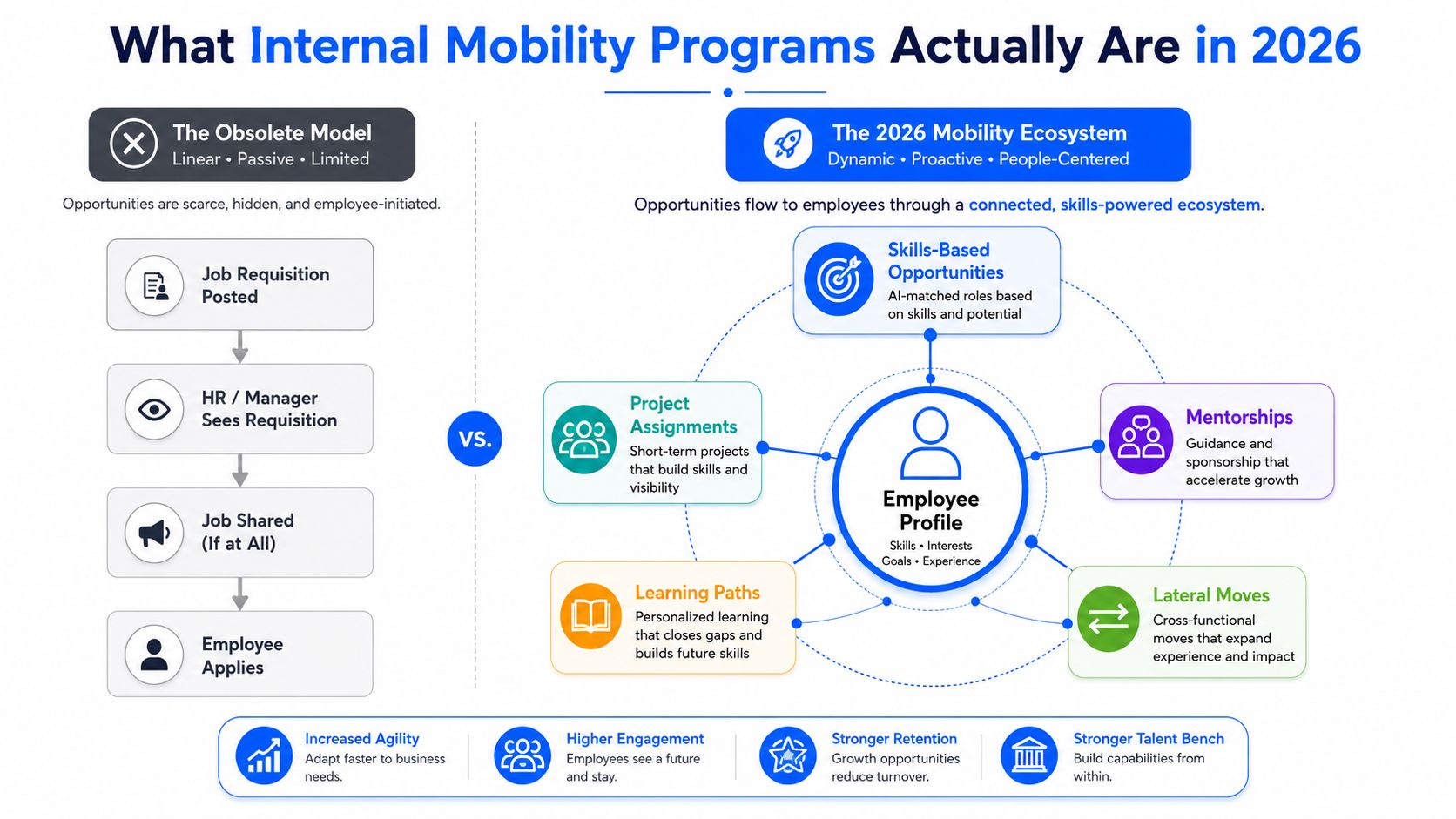
An internal mobility program isn’t a glorified job board. A job board waits for an employee to search, interpret a title, assess their fit, and take the risk of applying. A functioning program helps employees understand possible destinations, identifies adjacent skills, surfaces realistic development steps, and gives managers a governed way to release talent.
The working definition is broad: internal mobility is the structured movement of employees into new roles, levels, functions, projects, rotations, mentorships, or temporary assignments within the same organization. That includes internal career mobility and internal job mobility, but it also includes movement that doesn’t result in an immediate permanent transfer.
The distinction matters because an employee may need a project assignment before a lateral move, a mentor before a promotion, or targeted learning before internal hiring becomes realistic. A program built only around vacancies misses these intermediate steps.
Internal mobility, talent mobility, and talent agility
These terms overlap, but they aren’t interchangeable.
- Internal mobility describes the movement itself, such as a promotion, transfer, rotation, or project assignment.
- Talent mobility describes the broader system for moving skills and people across organizational demand.
- Talent agility is the organizational capability to redeploy, reskill, and reassign people as priorities change.
A useful operating model treats internal mobility as the mechanism, talent mobility as the infrastructure and culture around that mechanism, and talent agility as the outcome leadership wants to improve.
The 2026 shift is from passive discovery to active matching. AI can infer skills from work history, learning records, certifications, completed projects, and role requirements. Human judgment still matters for readiness, context, performance, employee preference, and equitable decision-making. The system should recommend possibilities, not make irreversible career decisions without accountable people.
Why the definition must include frontline work
Corporate employees often hear about internal job opportunities through email, intranets, manager networks, or career conversations. A retail associate, hospital aide, warehouse worker, technician, or shift-based employee may have limited access to those channels and no detailed digital profile.
For frontline workforces, employee mobility programs need practical pathways: cross-training rotations, visible eligibility rules, supervisor sponsorship, shift-compatible learning, mobile access, and opportunity notices that reach people where work happens. An opportunity employees can’t see or access isn’t a mobility pathway.
The Retention and Agility Case for Internal Mobility
Internal mobility is a retention and workforce allocation strategy that reduces replacement costs and gives employees a credible way to build careers inside the organization. LinkedIn’s 2024 Workplace Learning Report found that only 33% of organizations offered formal internal mobility programs, while only one in five employees felt confident they could make an internal move. The same report found that employees at companies with high internal mobility had 53% longer average tenures than employees at companies with low internal mobility.
The direction of travel is clear. LinkedIn reported that average internal mobility rates rose from 18.7% in 2021 to 24.4% in 2023, an increase of 5.7 percentage points, or roughly 30% relative growth from the 2021 level. In that reporting, internal mobility meant employees changing job titles while staying with the company. The measure points to a practical workforce lever for redeployment, retention, and internal hiring, though it does not show whether every move improved performance or employee experience.
A retailer-based academic study examined 109,063 commissioned salespeople and 12,931 managers and reported lower quitting among internal hires than among external hires. The linked study supports treating internal movement as a retention consideration, but it does not justify assuming that every internal hire, or a particular performance tier, will stay longer. retailer-sample internal mobility research provides the study details.
Internal versus external hiring
| Metric | Internal mobility | External hiring | Delta |
|---|---|---|---|
| Existing organizational knowledge | The employee already understands internal systems, relationships, and operating norms | The organization must transfer context during onboarding | Internal movement starts with more context |
| Retention signal | The retailer study reported lower quitting among internal hires | External hires do not carry the same demonstrated internal retention signal | Internal movement can reduce replacement risk |
| Career experience | Employees see a credible route to growth inside the organization | Employees may conclude that advancement requires leaving | Internal pathways support career ownership |
| Workforce agility | People can be redeployed across roles, projects, and functions | The organization waits for sourcing, selection, and onboarding | Internal movement supports faster reallocation |
The comparison is a planning tool, not a case for ending external recruitment. External hiring adds capabilities, experiences, and perspectives the organization may lack. CFO discussions should compare the fully loaded cost of both choices, including vacancy disruption, onboarding effort, lost institutional knowledge, and effects on employee experience.
Mobility metrics also belong in the wider employee engagement and retention strategies. The operating question is specific: can employees see suitable paths, meet clear eligibility requirements, and move without a manager blocking release? Policy documents create little retention value when skills data is incomplete, opportunities are invisible, or frontline employees cannot access the process.
Building the Skills Data Foundation Before You Launch
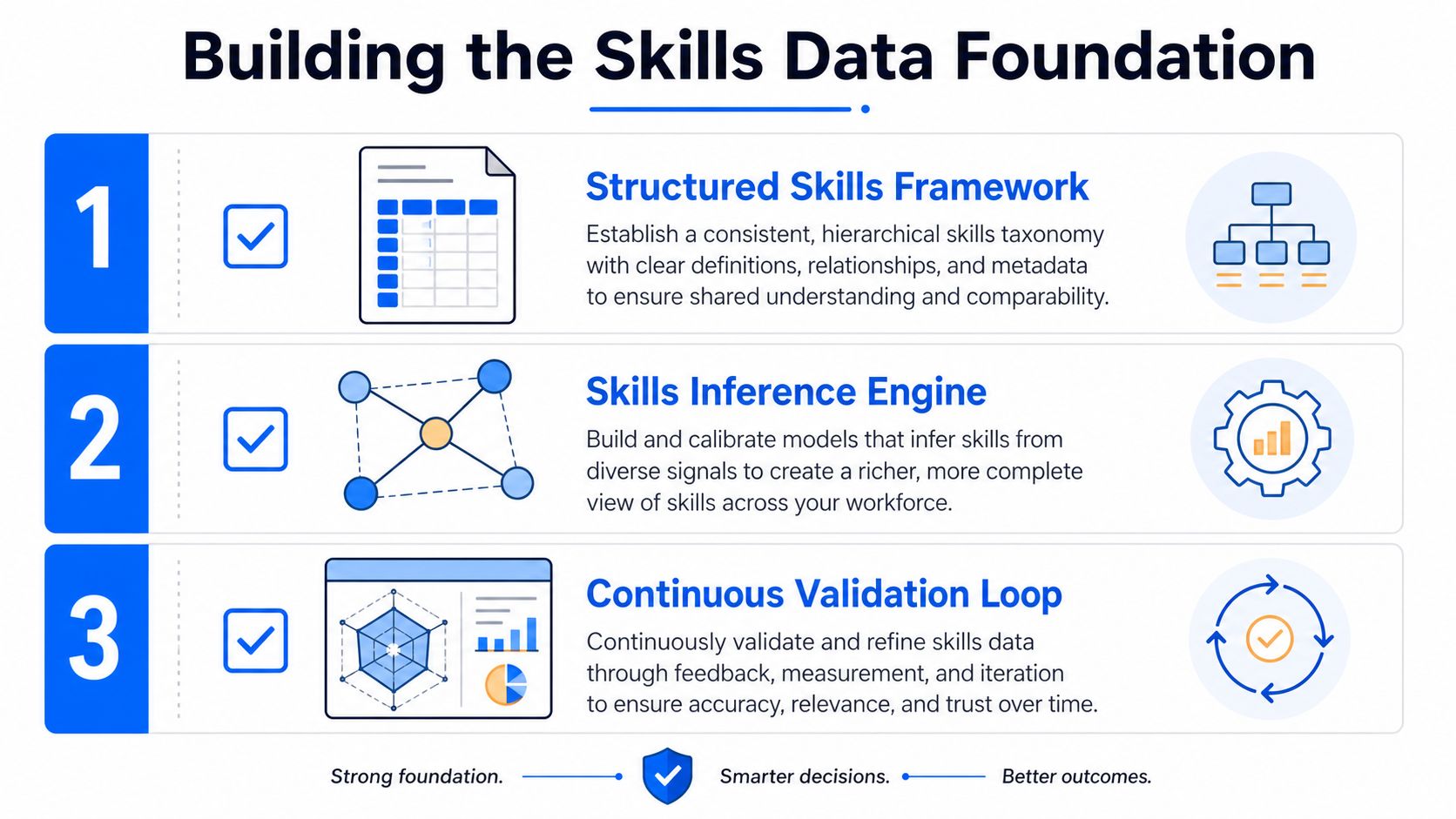
A marketplace with poor skills data is a search interface over unreliable inventory. Before launching an internal talent marketplace or expanding an internal job board, establish three foundations: a structured skills framework, accountable data governance, and a job architecture that describes work more accurately than legacy titles.
SHL’s 2025 EMEA State of Talent Mobility report found that 95% of talent professionals considered internal mobility critical, but only 15% described their strategy as mature and advanced. More than 80% had limited or no confidence in the accuracy and reliability of their skills data, and 44% cited resource constraints as a major barrier. The lesson is direct: organizational enthusiasm doesn’t equal operational readiness.
The three prerequisites
Start with a skills taxonomy. Group skills into meaningful families, distinguish foundational from role-specific capabilities, and connect them to the work your organization performs. Avoid copying a generic taxonomy without adapting terminology to manufacturing, healthcare, hospitality, government, technology, or another operating context.
Add governance. Assign owners for skills definitions, role requirements, employee profile updates, validation rules, and dispute resolution. Decide how often role profiles are reviewed and what happens when an employee disagrees with an inferred skill or fit recommendation.
Repair job architecture. Map roles to levels, families, adjacent roles, and skill clusters. A title such as “associate,” “specialist,” or “coordinator” means different things across departments. Career pathing becomes credible when employees can see the capabilities that connect roles, not just a sequence of titles.
Inferred skills and self-declared skills
Self-declared skills capture aspiration and tacit capability, but employees may overestimate, underestimate, or use inconsistent language. Inferred skills from project history, certifications, learning records, work samples, and manager validation offer evidence, but automated inference can miss context.
Use a blended model. Let employees declare interests and goals, infer likely capabilities from work data, and validate critical skills through assessments, manager review, or demonstrated assignments. For frontline workers, collect evidence from training completion, equipment authorization, task proficiency, supervisor observations, and cross-training records rather than assuming a professional networking profile exists.
Use the skills inventory assessment guide to structure the audit. Before launch, confirm that role requirements are populated, employee records can be updated, frontline workers have an accessible profile route, disputed data has an owner, and recommendations can explain why an opportunity appeared.
Designing and Implementing Your Internal Mobility Program
Implementation fails when leaders treat technology selection as the launch. Technology is only one layer. The program also needs manager behavior, employee communication, operational capacity, and a decision process for handling exceptions.
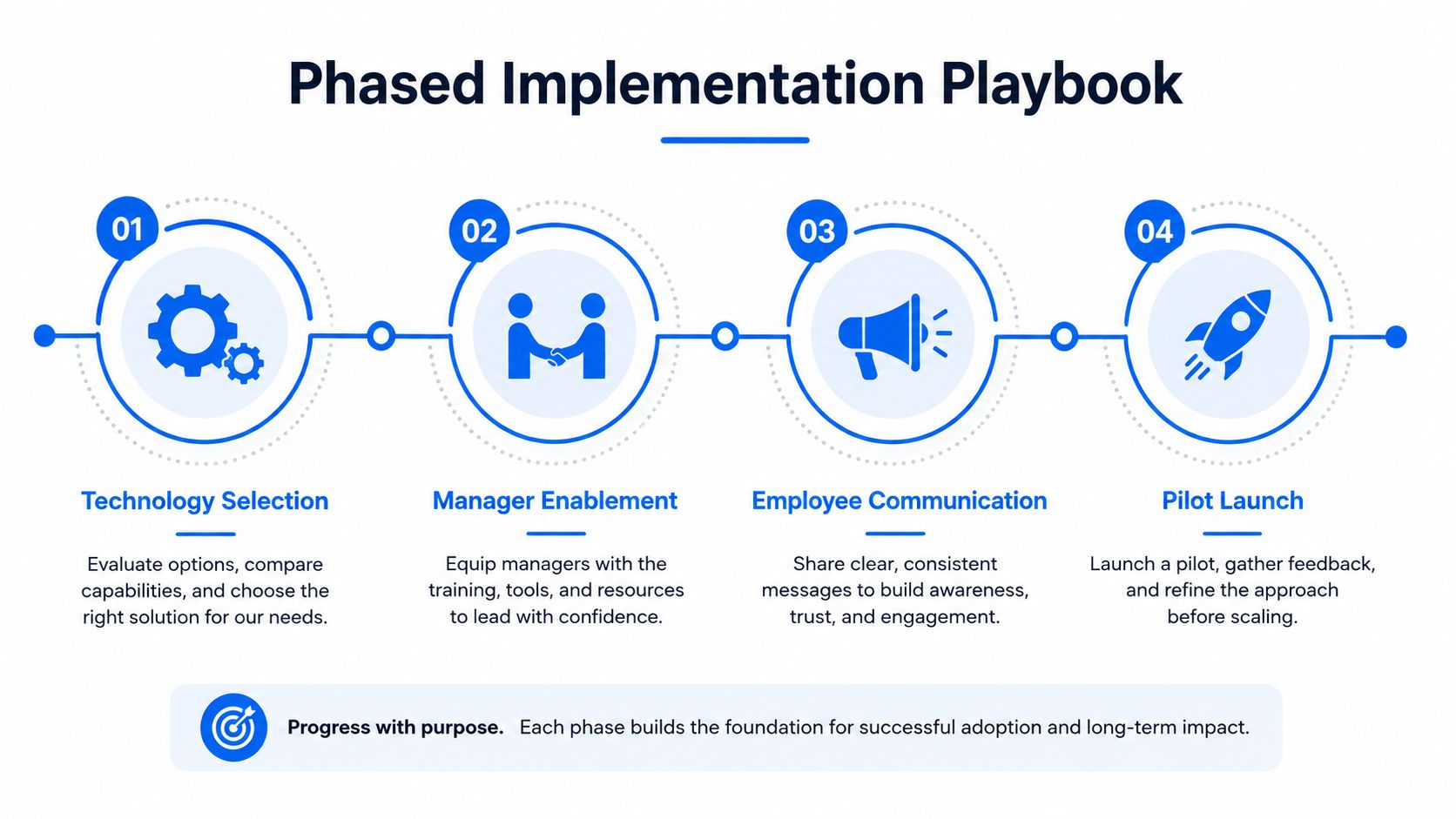
Phase one, choose the smallest viable system
Begin by deciding whether an existing HRIS or ATS can support the use case or whether an internal talent marketplace is justified. Evaluate integrations with the HRIS, applicant tracking, learning, performance, scheduling, identity, and workforce planning systems. Ask vendors to demonstrate how they handle incomplete profiles, role changes, frontline access, permissions, explainable matching, and data corrections.
A traditional internal job board may be the right starting point when roles are well defined, opportunity volume is manageable, and skills data is immature. A marketplace becomes more useful when employees need recommendations across permanent roles, projects, mentors, gigs, and learning paths.
Use a work graph approach to think about relationships among people, skills, roles, teams, projects, and business demand. The decision gate is simple: can the proposed system show trustworthy opportunities to the workers you need to reach, without creating another disconnected data store?
Phase two, change manager incentives
Managers often resist internal movement because they fear losing productive employees before they can backfill them. In a survey of more than 300 talent acquisition, HR, and IT leaders, 29% said managers made it difficult for internal candidates to apply, 57% said managers weren’t encouraging employee movement, and 63% cited too few available roles as a barrier, according to HR Executive’s reporting on internal mobility failures.
Set release rules before employees start applying. Define eligibility, response expectations, transition planning, and escalation routes. Require managers to maintain a backfill plan, but don’t let “backfill” become an indefinite veto. Include talent development and responsible talent export in manager reviews so the organization rewards building people, not just retaining them.
Phase three: communicate by workforce type
Effective internal mobility also depends on consistent employee communication. Organizations often combine mobility programs with employee communication platforms that help distribute career opportunities, learning resources, feedback requests, and workforce updates across desk-based and frontline teams.
Communication should answer four questions plainly:
- What opportunities are available?
- Who is eligible?
- What skills or experience are required?
- What happens after an employee applies?
Phase four, pilot with operational safeguards
Pilot in a business area with real movement demand and leaders willing to test the process. Include HR business partners, IT, internal communications, frontline supervisors, recruiters, learning teams, and employee representatives where relevant. For unionized environments, review posting, seniority, bidding, classification, training, and transfer provisions before promising a pathway.
Include project-based mobility, cross-training, and short-term assignments in the pilot. A permanent transfer is not the only valid outcome. The decision gate for expansion is evidence that employees can discover opportunities, managers can release talent, and HR can explain outcomes fairly.
Why Internal Mobility Programs Fail and How to Prevent It
The most common failure isn’t a missing policy. It’s a mismatch between the employee promise and the operating system behind it. Organizations announce career development programs while leaving managers, data owners, frontline supervisors, and recruiters to interpret the rules locally.
HR.com’s 2025–26 research on career development and mobility found that only 18% of organizations had a formal internal mobility process and only 13% regularly measured internal mobility metrics. The leading obstacles included a lack of career paths for non-managerial roles, cited by 45%, and insufficient available positions, cited by 41%.
| Failure mode | Root cause | Countermeasure | Early warning signal |
|---|---|---|---|
| Manager hoarding | Managers carry delivery risk when employees leave | Release rules, transition plans, manager mobility measures, and escalation | Employees ask privately about opportunities but don’t apply |
| Inaccurate skills data | Profiles are stale, inconsistent, or treated as fact without validation | Blend employee input, inference, assessments, and manager verification | Employees reject recommendations as irrelevant |
| Frontline exclusion | Access depends on desktop tools, informal networks, or office hours | Mobile, kiosk, supervisor, and shift-compatible access | Participation clusters in corporate teams |
| Opaque selection | Applicants receive little feedback or can’t see process status | Publish eligibility, timelines, status updates, and decision reasons | Repeat applications decline |
| Thin career architecture | Non-managerial roles have no visible next step | Define lateral, technical, specialist, and cross-functional pathways | Employees believe promotion means becoming a manager |
Operational test: If a manager can block an eligible employee indefinitely, the organization doesn’t have internal mobility. It has manager-controlled vacancy access.
Audit approval rates, time in stage, opportunity visibility, profile completeness, and participation by workforce group. Don’t assume equal access because a role appears on an intranet. Check whether shift workers, hourly employees, workers without corporate email, and non-managerial employees can discover and pursue it.
This is also a workforce experience debt issue. Fragmented channels, stale data, and unclear ownership create friction that employees experience as indifference. Turn On Work’s analysis of workforce experience debt provides a useful lens for treating that friction as an operational problem rather than an isolated HR complaint.
Internal Talent Marketplaces Versus Traditional Job Boards
An internal job board is a publication channel. An internal talent marketplace is a matching and movement system. The right choice depends on data maturity, opportunity variety, workforce composition, manager readiness, and the organization’s ability to govern recommendations.
| Decision dimension | Internal talent marketplace | Traditional internal job board |
|---|---|---|
| Core mechanism | Matches people to roles, projects, gigs, mentors, and learning opportunities | Lists open requisitions for employees to search |
| Skills visibility | Depends on skills inference, taxonomy, integrations, and profile governance | Usually depends on job descriptions and employee self-navigation |
| Employee experience | Proactively surfaces possible next steps | Places discovery and interpretation burden on the employee |
| Manager involvement | Requires release behavior, validation, and opportunity ownership | Often concentrates activity around requisition approval |
| Frontline suitability | Can support targeted mobile or kiosk experiences if designed for them | Can work when access and posting communication are strong |
| HR data | Supports analysis of skills, demand, movement, and funnel friction | Primarily records views, applications, and requisition activity |
The marketplace isn’t automatically better. It can amplify bad data, create opaque recommendations, and add integration and governance work. A job board with accurate descriptions, transparent eligibility, strong communications, and responsive recruiters may outperform an expensive marketplace that employees don’t trust.
A practical maturity decision
Choose a job board first when role definitions are inconsistent, skills ownership is unclear, and the immediate problem is visibility. Invest in a marketplace when the organization can maintain skills data, connect multiple opportunity types, give managers accountable workflows, and explain matching decisions.
The internal talent marketplace category is also receiving more market attention. One market research forecast projects spending will grow from USD 3.99 billion in 2025 to USD 4.66 billion in 2026, reaching USD 10.13 billion by 2031 at a 16.81% CAGR. That projection supports technology investment context, not a reason to buy before the operating foundations exist.
Measuring Success and Driving Employee Adoption
A credible measurement system follows the employee journey from discovery to movement. Start with adoption metrics, then add outcome and business measures.
Adoption metrics include profile completion, opportunity views, application starts, completed applications, project participation, and participation by workforce type. Outcome metrics include internal move rate, promotion movement, lateral movement, time in process, manager release behavior, and the composition of internal candidate slates. Business metrics connect mobility to retention, internal hiring, time-to-fill, critical skill coverage, and redeployment of people into priority work.
Don’t count a placement as success if the employee had no feedback, waited without updates, or moved into a role with unclear expectations. A lateral move can be successful when it builds capability, improves fit, expands contacts, or creates a credible future pathway. Measure those experiences through brief post-process surveys and manager follow-up, not just transactions.
Use the employee engagement measurement guide to connect mobility experience with broader workforce listening.
A 90-day adoption checklist
- Days 1 to 30: Publish the program promise, eligibility rules, manager responsibilities, and employee support channels.
- Days 31 to 60: Identify early opportunities, coach managers through release decisions, and correct broken profiles or role descriptions.
- Days 61 to 90: Review participation by workforce group, analyze application friction, share employee feedback, and adjust communication or governance.
If you use AI, track recommendation relevance and employee correction behavior. Human review should remain part of decisions involving readiness, performance context, accommodations, protected information, or significant career consequences.
Internal Mobility Programs FAQs
What are internal mobility programs?
Internal mobility programs are structured systems that help employees move within the same organization. They can include promotions, lateral transfers, cross-functional moves, rotations, projects, gigs, mentorships, temporary assignments, learning paths, and internal hiring.
What does internal mobility mean in HR?
In HR, internal mobility means enabling and governing employee movement across roles, levels, functions, teams, or projects without requiring the employee to leave the organization. It combines career pathways, skills data, manager practices, communication, technology, and measurement.
What is the difference between internal mobility and talent mobility?
Internal mobility describes the movement of an employee. Talent mobility describes the wider operating system that makes movement possible across the organization, including skills intelligence, career architecture, opportunity discovery, governance, and workforce planning.
What is the difference between internal mobility and internal hiring?
Internal hiring fills a role with an existing employee. Internal mobility is broader. It includes internal hiring, but also covers projects, rotations, mentorships, cross-training, lateral development, and temporary assignments that may not involve a new permanent job.
What is the difference between internal mobility and succession planning?
Succession planning prepares potential successors for selected critical roles. Internal mobility manages broader movement across the workforce. Succession planning can be one pathway within an internal mobility strategy, but it doesn’t replace employee-wide access to career opportunities.
What is the difference between an internal talent marketplace and an internal job board?
An internal job board lists open roles and expects employees to search and apply. An internal talent marketplace can match employees with roles, projects, gigs, mentors, and learning opportunities using skills, interests, and business demand. A marketplace requires stronger data and governance.
Why are internal mobility programs important in 2026?
They help organizations retain knowledge, create visible career pathways, redeploy skills, and reduce dependence on external recruitment. The 2026 case is especially operational: employers need systems that connect changing work requirements with capabilities already present in the workforce.
How does internal mobility support employee retention?
Employees are more likely to see a future inside the organization when advancement and development aren’t limited to leaving. LinkedIn found longer average tenure in organizations with high internal mobility, while academic research has linked internal hires, particularly high-performing internal hires, with lower quitting likelihood.
How can internal mobility reduce dependence on external hiring?
Organizations can identify employees with adjacent skills, give them targeted learning or project experience, and move them into roles that would otherwise require external recruitment. This works only when role requirements, employee capabilities, manager release practices, and internal selection processes are trustworthy.
How does internal mobility improve workforce agility?
It gives leaders a structured way to redeploy people across roles, projects, and functions as demand changes. A skills-based system makes workforce capability more visible, while clear governance helps managers complete moves without relying entirely on informal networks.
How should frontline organizations design career mobility programs?
Start with pathways that reflect frontline work, including cross-training, specialist certifications, supervisor routes, technical progression, location transfers, and short-term assignments. Provide access through mobile devices, kiosks, shift briefings, and supervisors, and account for scheduling, pay, transportation, language, union, and eligibility realities.
What should organizations measure first?
Begin with visibility and trust: who can access opportunities, whether profiles and role requirements are accurate, whether managers release eligible employees, whether applicants receive feedback, and whether participation reaches frontline and non-managerial workers. Then connect movement to retention, internal hiring, skills coverage, and workforce demand.
Internal mobility programs become credible when employees can see a path, managers can support movement without operational chaos, and HR can explain how decisions are made. Start with a focused audit of skills data, career pathways, manager release behavior, and frontline access. Then choose the simplest technology that can support the process, publish the rules, and pilot with a real business need. Turn those findings into a 90-day action plan, and assign an accountable owner for every broken step.