
If you’re comparing employee engagement software in 2026, the 12 platforms I’d shortlist are HubEngage, Culture Amp, Qualtrics EmployeeXM, Workday Peakon Employee Voice, Lattice, 15Five, Leapsome, Workvivo, Staffbase, WorkTango, Workleap and Bonusly. HubEngage leads this comparison because it combines listening, communication, recognition and desk-to-frontline reach, not because it is the automatic choice for every company. Culture Amp, Qualtrics and Peakon are stronger when deeper listening is the priority, while Lattice, 15Five and Leapsome make more sense when engagement needs to connect closely with performance.
What Counts as Employee Engagement Software in 2026?
Employee engagement software used to be easier to define.
A company ran an annual survey, received an engagement score, and perhaps gave managers a dashboard showing where their teams scored above or below the company average.
That is only one part of the market now.
Some platforms still put employee listening and survey analytics at the center. Others treat engagement as something influenced by manager behavior, recognition, communication, performance conversations or the employee’s ability to participate in company life.
That distinction matters before comparing feature lists.
A 500-person technology company trying to improve quarterly pulse surveys has a different requirement from a healthcare organization trying to reach thousands of frontline workers across shifts. Neither has the same requirement as a multinational employer with a dedicated People Analytics team running several listening programs at once.
I find it more useful to think about the market in four broad groups.
Listening-led platforms such as Culture Amp, Qualtrics EmployeeXM and Workday Peakon Employee Voice focus heavily on surveys, benchmarking, qualitative feedback and understanding what is changing in the workforce.
Performance-connected platforms such as Lattice, 15Five and Leapsome place engagement alongside reviews, goals, development and manager routines.
Communication-led platforms such as HubEngage, Workvivo and Staffbase treat employee engagement partly as a question of whether people receive information, participate in company communication and have an accessible way to provide feedback.
Then there are platforms such as WorkTango, Workleap and Bonusly, where manager action, recognition or more continuous team-level engagement plays a larger role.
The useful question is therefore not simply:
“Which employee engagement platform has the most features?”
It is:
“Which part of our current engagement program is not working?”
If the organization has not yet established a reliable listening process, our guide to analyzing employee survey answers explains how to move from survey scores and open-text responses to priorities and measurable action before adding more technology.
How We Compared These Employee Engagement Platforms
The shortlist is based on how well each platform supports a meaningful part of the employee engagement cycle rather than on the number of items on a vendor feature page.
I looked at five practical questions.
First, can the platform collect useful employee feedback rather than simply send generic surveys?
Second, can HR and managers understand what the results mean without needing a data analyst for every report?
Third, does the product help the organization do something after the results arrive?
Fourth, does the employee experience make sense for the workforce using it? This matters particularly for organizations with frontline or deskless employees.
And finally, does the pricing model make sense for the type of company the product appears to target?
Where current vendors publish pricing, I have used their public figures. Where pricing is not publicly available, the table says custom quote rather than filling the gap with third-party estimates that may no longer be accurate.
AI features are included where they materially affect employee listening, analysis or manager action. I have not treated “has AI” as a reason to rank a platform higher by itself.
12 Best Employee Engagement Software Platforms Compared
| Platform | Best-fit companies | Main engagement strength | Pricing in 2026 |
| HubEngage | Distributed, frontline and mixed workforces wanting one broader engagement environment | Communication, surveys, recognition and multi-channel workforce reach | Custom quote based on employee count and configuration |
| Culture Amp | Mid-size and enterprise organizations with structured engagement programs | Survey science, benchmarking, feedback analysis and manager action | Custom annual pricing |
| Qualtrics EmployeeXM | Large enterprises running complex employee experience programs | Enterprise listening, employee research and advanced analytics | Employee-based custom pricing |
| Workday Peakon Employee Voice | Large organizations, particularly existing Workday customers | Continuous listening, benchmarking, AI themes and manager insights | Custom quote |
| Lattice | Growing companies wanting engagement and performance together | Surveys, pulse listening, eNPS and connection with performance management | Engagement from $4/seat/month, annual billing; $4,000 annual minimum |
| 15Five | Small and mid-market organizations focused on manager effectiveness | Engagement measurement, assessments and manager action | Engage from $4/user/month, billed annually |
| Leapsome | Growing companies combining engagement, performance and development | Surveys, sentiment analysis, summaries and action recommendations | Custom quote |
| Workvivo | Mid-size and enterprise workforces wanting communication plus listening | Employee communications, social engagement and Seer listening | Custom quote |
| Staffbase | Large distributed organizations with mature Internal Comms teams | Employee app, intranet, email, surveys and frontline communication | Custom quote |
| WorkTango | Mid-market and enterprise organizations connecting listening with manager action and recognition | Surveys, AI-assisted insights, action planning and recognition | Custom quote; 12-month minimum |
| Workleap | Small and mid-size businesses wanting simpler engagement and performance tools | Pulse surveys, anonymous feedback, manager insights and recognition | Standard from $4,999/year; Pro from $11,999/year |
| Bonusly | Organizations where recognition is the main engagement gap | Peer recognition, rewards, pulse insights and manager habits | Free up to 8 users; Team from $3/user/month without Bizy AI |
Pricing was checked against current vendor information in August 2026. Enterprise quotes, minimums and module costs can change, so final pricing should always be confirmed directly with the vendor.
1. HubEngage: Best for Distributed and Frontline Employee Engagement
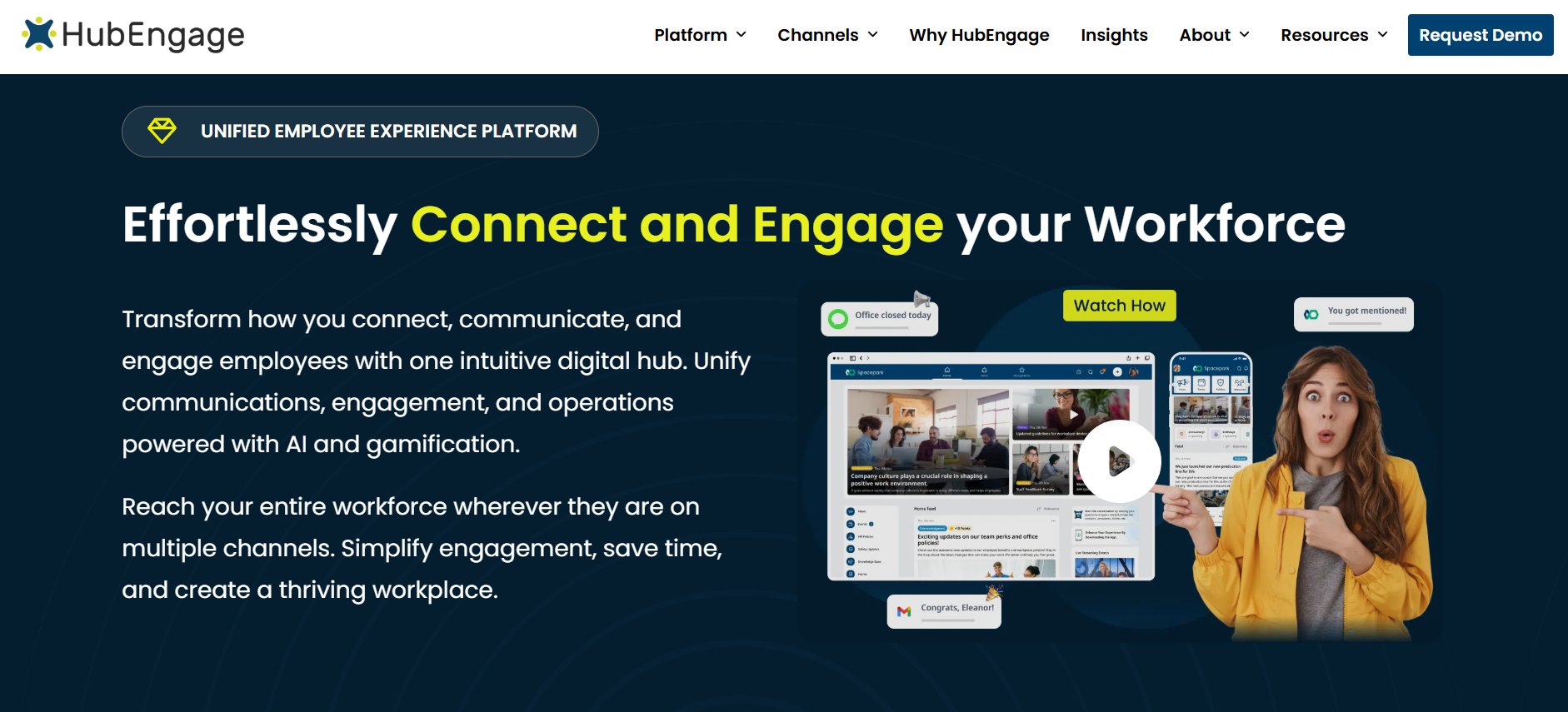
HubEngage makes the strongest case when employee engagement is not being treated as a survey-only problem.
Its platform combines employee communications, surveys, recognition and wider engagement tools, while giving organizations several ways to reach employees across mobile, web, email, SMS and digital displays depending on the configuration.
That matters in environments such as healthcare, manufacturing, hospitality and retail, where a meaningful part of the workforce may not spend the day inside a corporate inbox.
For employee listening, HubEngage supports pulse and engagement surveys, open-text feedback and AI-assisted sentiment and thematic analysis. The broader platform can then be used to communicate with employees or run engagement activity after an issue has been identified.
The trade-off is depth in specialist people analytics. A large organization whose main requirement is sophisticated qualitative research, advanced survey science or deep benchmarking should also examine Culture Amp, Qualtrics or Workday Peakon.
HubEngage is more compelling when employee listening, communication, recognition and workforce reach need to operate within the same broader engagement environment.
Best fit: Distributed or mixed desk-and-frontline organizations that want to consolidate several engagement workflows rather than operate separate survey, communication and recognition tools.
Pricing: Custom. HubEngage bases proposals on employee count, selected capabilities and contract configuration.
2. Culture Amp: Best for Structured Employee Engagement Programs
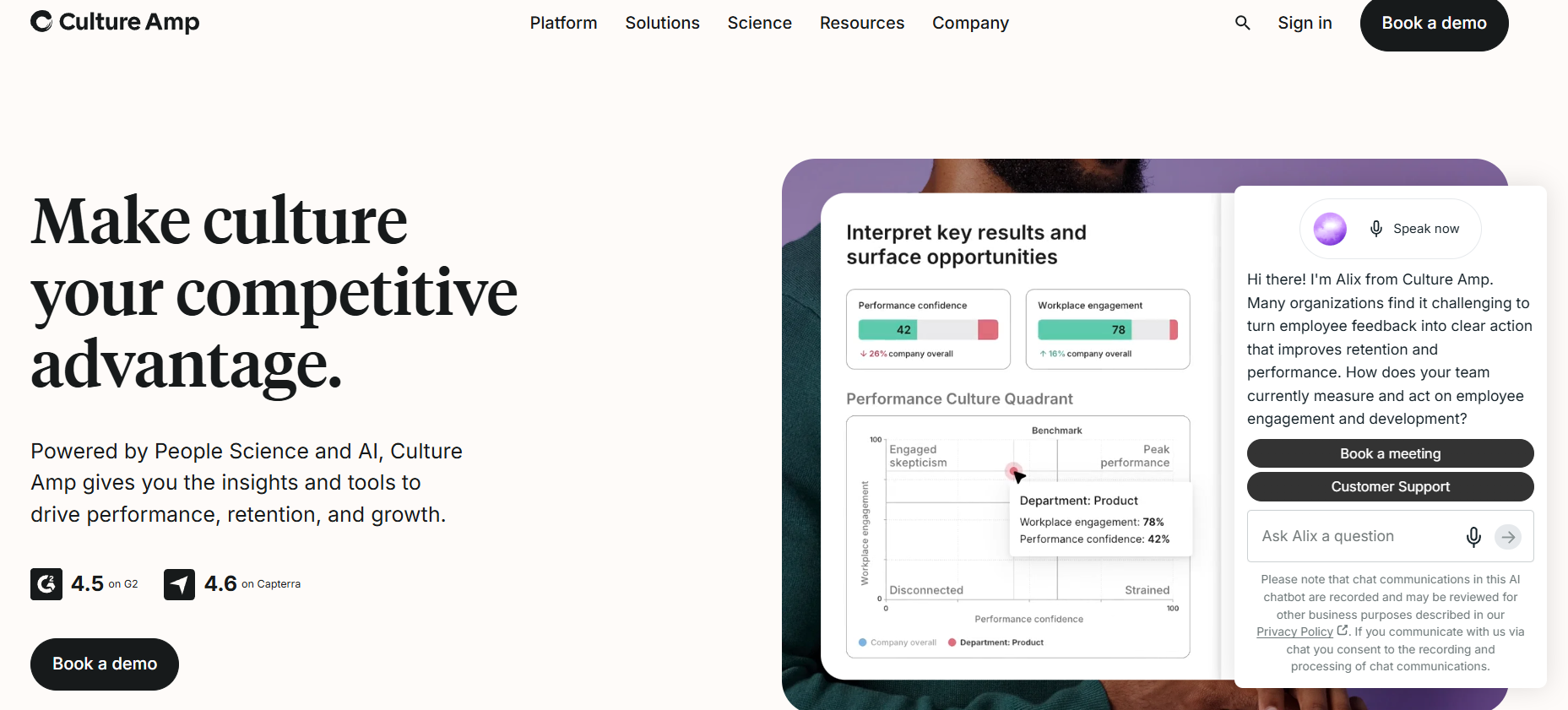
Culture Amp belongs on the shortlist when employee listening itself is the priority.
Its Engage product combines engagement and pulse surveys with onboarding and offboarding feedback, benchmarking, comment analysis, retention insights and manager action planning.
One of Culture Amp’s main strengths is that the platform is built around a more formal approach to survey methodology and People Science. That matters for companies that want more than a generic questionnaire builder and would rather work with established survey frameworks and benchmarks.
The AI layer now helps summarize employee comments, classify topics and sentiment, and support manager action through tools such as AI Coach. Those capabilities sit on top of an established survey product rather than acting as a replacement for the engagement methodology.
Culture Amp is less focused than HubEngage, Workvivo or Staffbase on day-to-day workforce communication. Its value is much clearer when the main question is:
“How do we measure engagement properly and help managers respond to the findings?”
Best fit: Mid-size and enterprise organizations running structured engagement, lifecycle and manager-action programs, particularly where benchmarking and People Science support are important.
Pricing: Custom annual pricing based on employee count, selected products and service level.
3. Qualtrics EmployeeXM: Best for Complex Enterprise Listening
Qualtrics EmployeeXM is better suited to organizations where engagement surveys are one component of a much larger employee experience program.
Its current Employee Experience capabilities cover engagement and pulse programs as well as broader employee research. Qualtrics Text iQ can analyze written responses, apply topic tags, and work with sentiment at both the overall response and topic level.
That becomes useful when the organization is trying to understand several parts of the employee journey rather than simply run an annual engagement survey.
A global employer may want to connect engagement feedback with onboarding, exit, lifecycle research and other workforce listening programs. Qualtrics gives a dedicated Employee Experience or People Analytics team considerably more room to configure that environment.
The trade-off is complexity.
A smaller HR team running a quarterly pulse and reviewing a few hundred written responses may not need the same level of analytical infrastructure.
Qualtrics becomes more compelling as the listening program becomes more sophisticated.
Best fit: Large enterprises with established HR, Employee Experience or People Analytics teams that need configurable surveys, open-text analysis and multiple listening programs rather than a lightweight engagement tool.
Pricing: Employee-based custom pricing. Qualtrics does not publish a simple EmployeeXM list price.
4. Workday Peakon Employee Voice: Best for Continuous Enterprise Listening
Workday Peakon Employee Voice is one of the more focused listening platforms in this comparison.
Its purpose is not simply to run occasional surveys. Peakon is built around recurring employee listening, benchmarking, analysis and helping managers understand what is happening inside their teams.
Current capabilities include personalized dashboards, benchmarking, AI-generated themes and summaries, and recommended areas for action.
Workday has also been updating Peakon’s survey model in 2026, including a more flexible question model for newer deployments. That may sound like a product-detail change, but it matters for larger organizations that want a consistent listening framework while still adapting questions to changing workforce priorities.
Its biggest advantage becomes obvious if Workday already sits at the center of the HR technology stack. Workforce data and employee listening can sit much closer together without introducing another entirely separate people-data environment.
Best fit: Large organizations with continuous employee-listening programs, particularly companies already using Workday HCM or wanting engagement data closely connected with workforce information.
Pricing: Custom quote. Workday does not publish numeric Peakon Employee Voice pricing on its current public pages.
5. Lattice: Best for Connecting Engagement With Performance
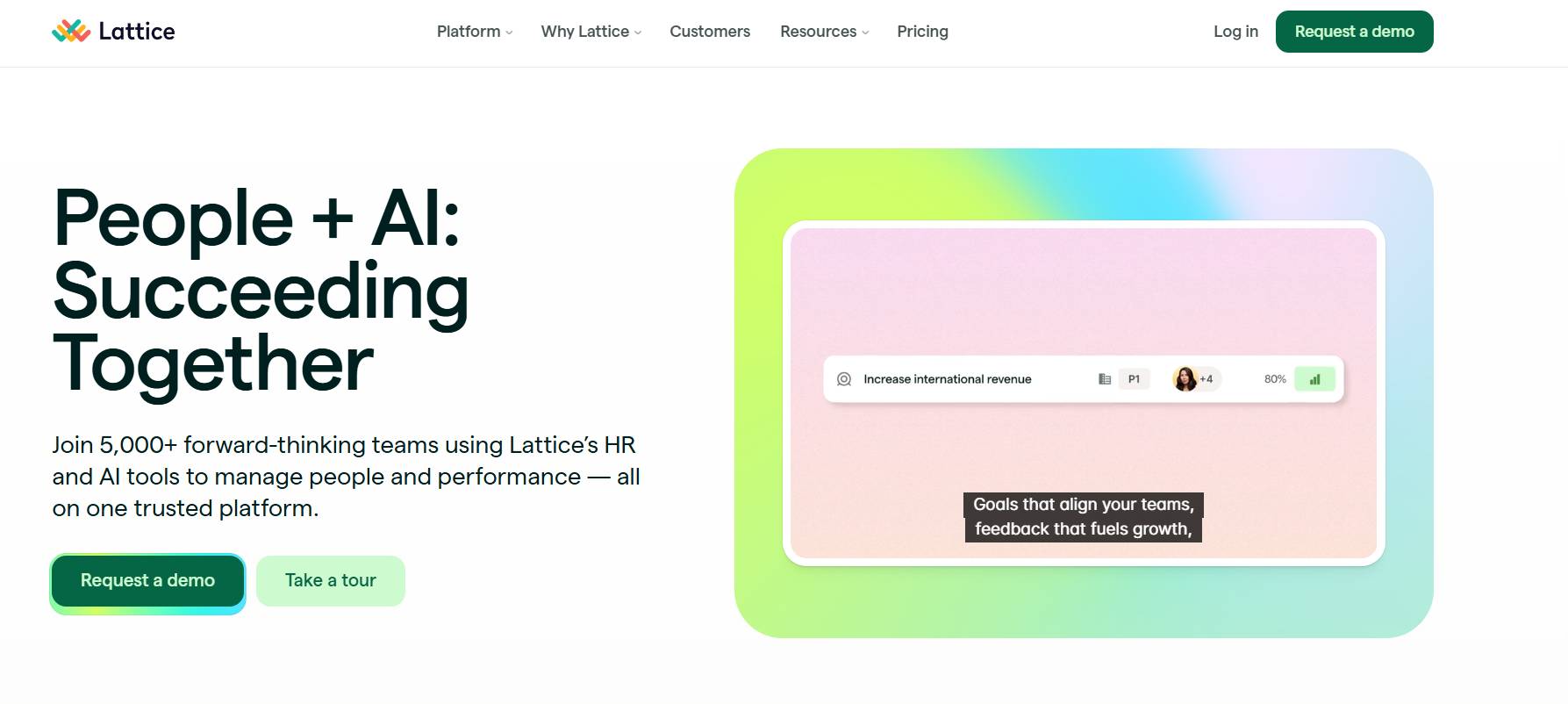
Lattice approaches employee engagement as one part of a broader performance and talent-management environment.
Its Engagement product includes surveys, pulse listening, eNPS, onboarding and exit surveys, action planning and AI-assisted analysis. Those engagement workflows can sit next to Lattice’s performance reviews, goals, 1:1s, feedback and employee-development tools.
That connection is the reason to consider it.
A growing organization may not want a dedicated survey platform sitting separately from the system managers already use for performance conversations.
If the employee engagement result says career development is a problem, having goals, feedback and development processes nearby can make the manager workflow more coherent.
The compromise is analytical specialization. Organizations that need particularly deep enterprise listening or benchmarking should compare Lattice with products such as Culture Amp, Qualtrics and Peakon rather than assuming the platforms solve the same problem.
Best fit: Growing small, mid-market and larger organizations that want employee engagement surveys connected closely with performance management, goals and manager routines.
Pricing: Lattice currently lists Engagement at $4 per seat per month, billed annually, with a $4,000 minimum annual agreement.
6. 15Five: Best for Manager-Led Engagement
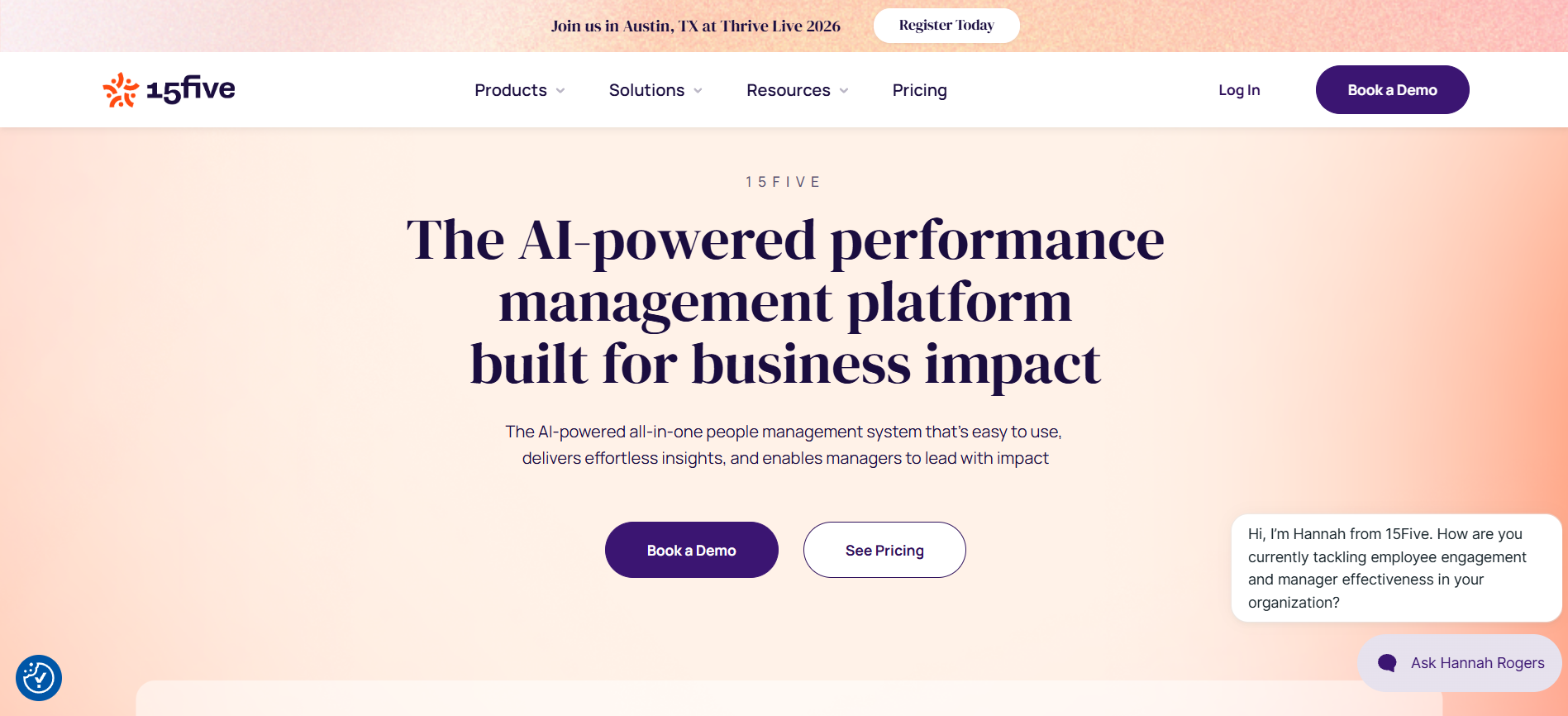
15Five also connects employee engagement with the day-to-day work of managers, but its emphasis is slightly different.
The Engage product includes employee engagement surveys, targeted assessments, benchmarking, heat maps, action planning and data breakdowns that help HR understand where engagement differs across the organization.
The wider 15Five platform includes performance reviews, 1:1s, goals, feedback, career development and manager-focused tools.
That makes the product particularly relevant to organizations that believe manager effectiveness is one of the main mechanisms through which employee engagement improves.
A small or mid-market organization may not have a dedicated People Analytics team interpreting complex survey data. It may need a simpler system that identifies the areas requiring attention and gives managers somewhere to continue the conversation.
Best fit: Small and mid-market organizations that want engagement measurement connected closely with manager effectiveness, feedback and performance conversations.
Pricing: 15Five currently lists Engage at $4 per user per month, billed annually. Perform is $11 per user per month, while the Total Platform is $16 per user per month.
7. Leapsome: Best for Engagement, Performance and Development in One System
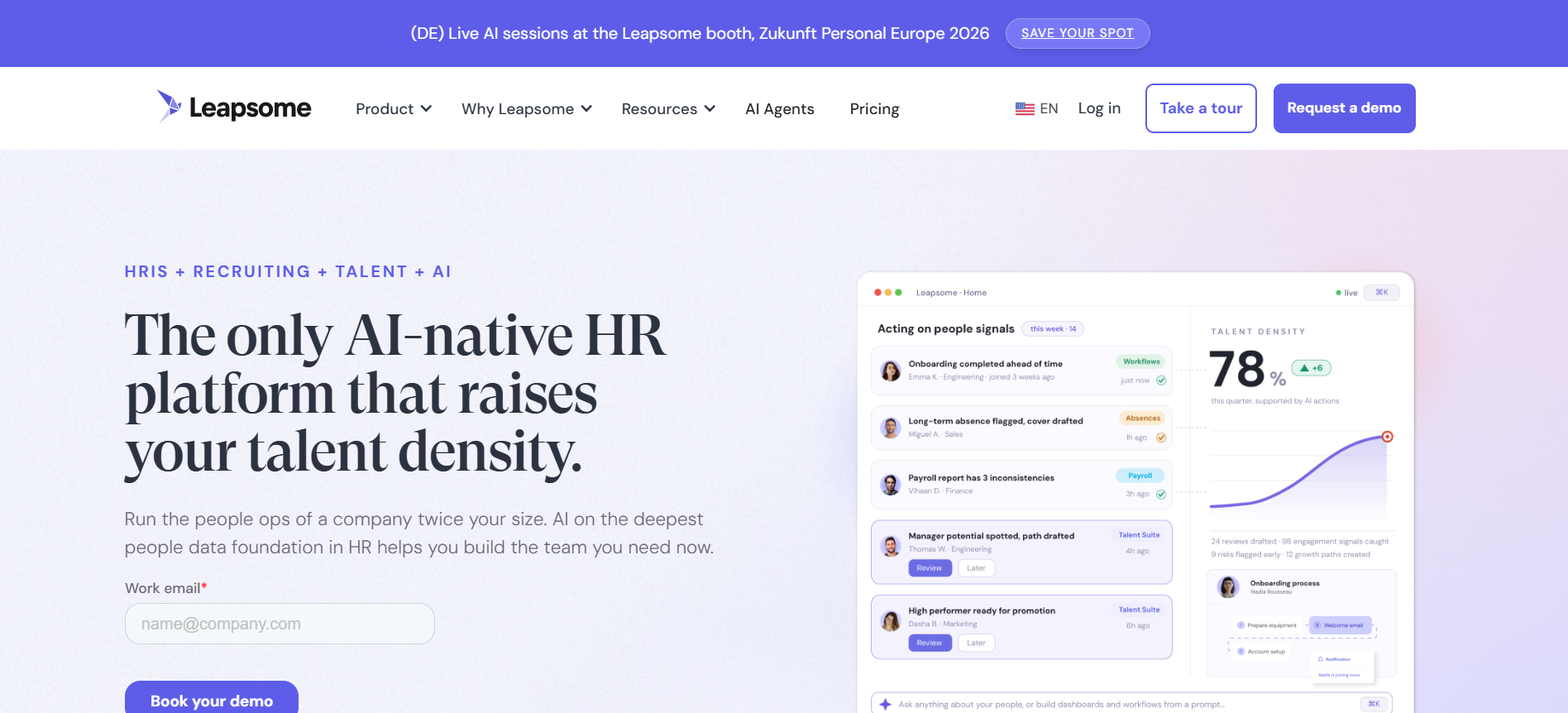
Leapsome is another platform where employee engagement is designed to sit alongside the rest of the talent-management cycle.
Its survey capabilities cover engagement, pulse, onboarding and custom surveys, including recurring listening and configurable anonymity. AI can help summarize written responses, identify themes, analyze sentiment and suggest actions from survey findings.
The appeal is breadth.
The same environment can also support performance reviews, goals, feedback and employee development.
That can make Leapsome attractive to growing organizations whose HR processes are becoming more structured but where the People team would still prefer one manageable platform rather than separate specialist systems for surveys, performance and development.
The trade-off is similar to Lattice and 15Five. If the primary requirement is highly sophisticated employee listening, a dedicated listening platform may offer more analytical depth.
Best fit: Growing and mid-market organizations that want engagement surveys, performance management, employee development and feedback to work together.
Pricing: Custom pricing based on employee count, selected modules and contract configuration. Leapsome currently sells annual contracts and offers a limited free trial.
8. Workvivo: Best for Communication-Led Engagement With Listening
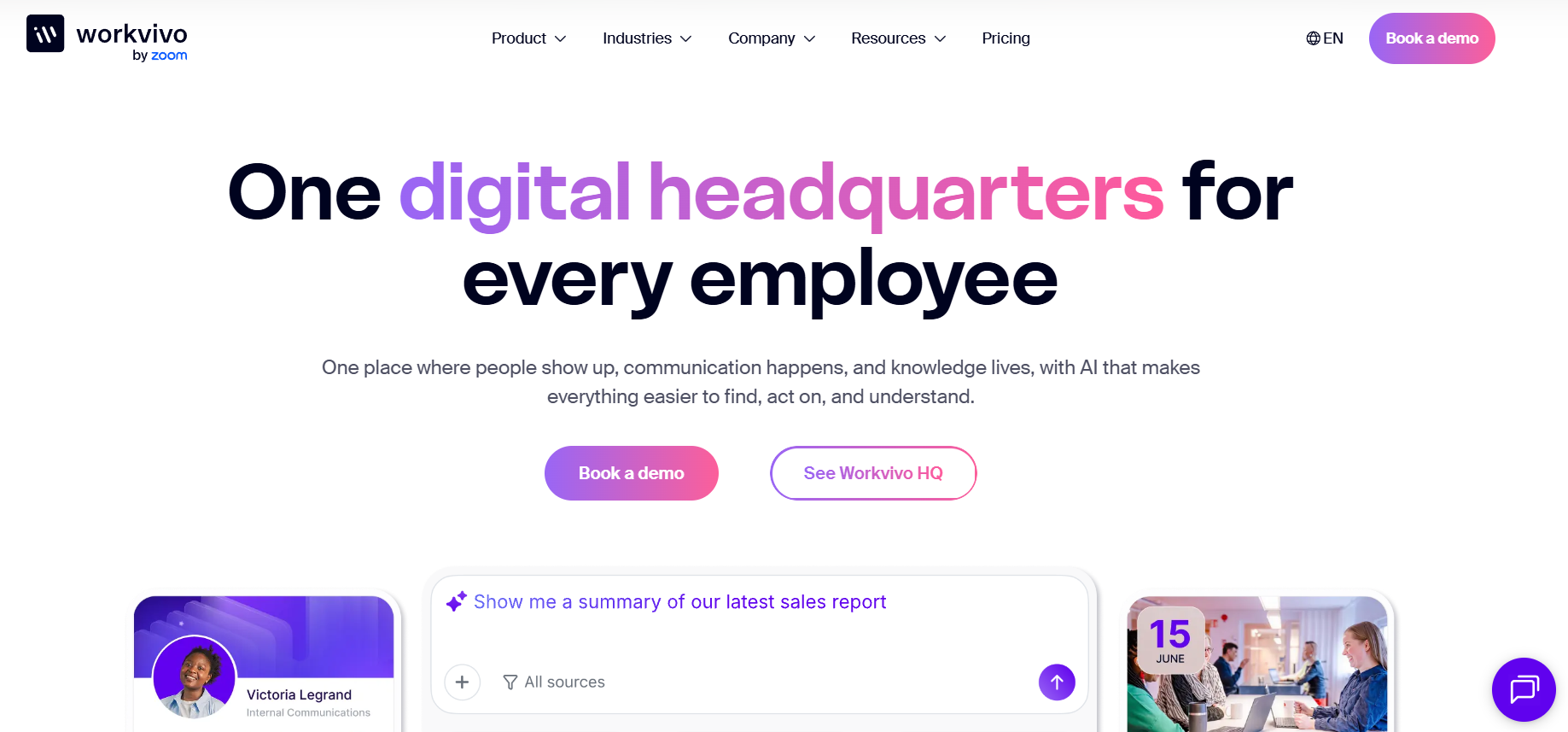
Workvivo started from a very different place than Culture Amp or Qualtrics.
Its strength has traditionally been employee communication, social participation and giving employees a more engaging way to interact with company information.
Workvivo HQ combines communication, employee interaction, recognition, knowledge, surveys, polls and engagement analytics.
Its newer Seer product brings deeper employee listening into that environment. Seer supports engagement and pulse surveys, AI-assisted topic grouping and comment analysis, benchmarking, executive reporting and recommended actions.
That gives Workvivo an interesting position in the market.
The same wider ecosystem can be used to listen to employees and then communicate what is changing after the survey closes. That feedback loop is often harder to manage when survey software and Internal Comms technology live in completely separate systems.
Best fit: Mid-size and enterprise organizations that want employee communication, social participation and employee listening to reinforce one another, particularly where mobile workforce engagement matters.
Pricing: Custom. Workvivo pricing depends on licenses, selected products and add-ons.
9. Staffbase: Best for Enterprise Internal Communication and Frontline Reach
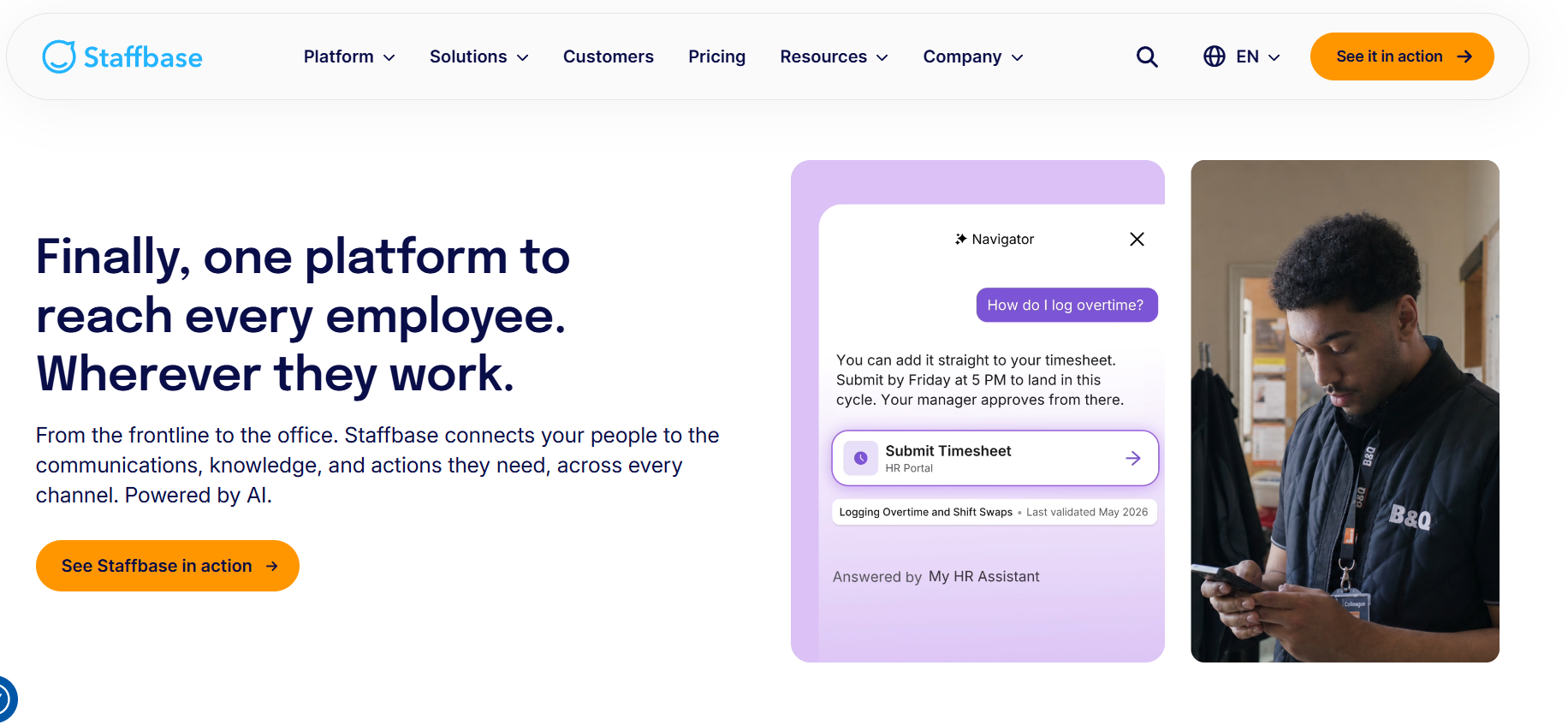
Staffbase belongs in this comparison because employee engagement is not always primarily a survey problem.
Its core strength is Internal Comms.
The platform combines employee apps, intranet experiences, email, digital signage and other communication workflows. Surveys can also be delivered through its Employee App, Intranet and Email products, including recurring surveys where organizations want regular feedback.
If employees are missing company information, cannot easily find resources or feel disconnected from leadership, improving the communication environment may have more impact than adding another layer of survey analytics.
Staffbase is particularly oriented toward large and complex organizations with distributed workforces and mature Internal Comms functions.
The limitation is straightforward.
A company whose primary requirement is advanced employee research, detailed benchmarking or sophisticated sentiment analysis should compare Staffbase with more listening-focused platforms rather than assuming a communication platform replaces them.
Best fit: Large, distributed or global organizations needing a branded employee app, intranet and enterprise communication environment with employee feedback capabilities built in.
Pricing: Custom pricing based on workforce type, channels and enterprise configuration.
10. WorkTango: Best for Connecting Listening With Manager Action and Recognition
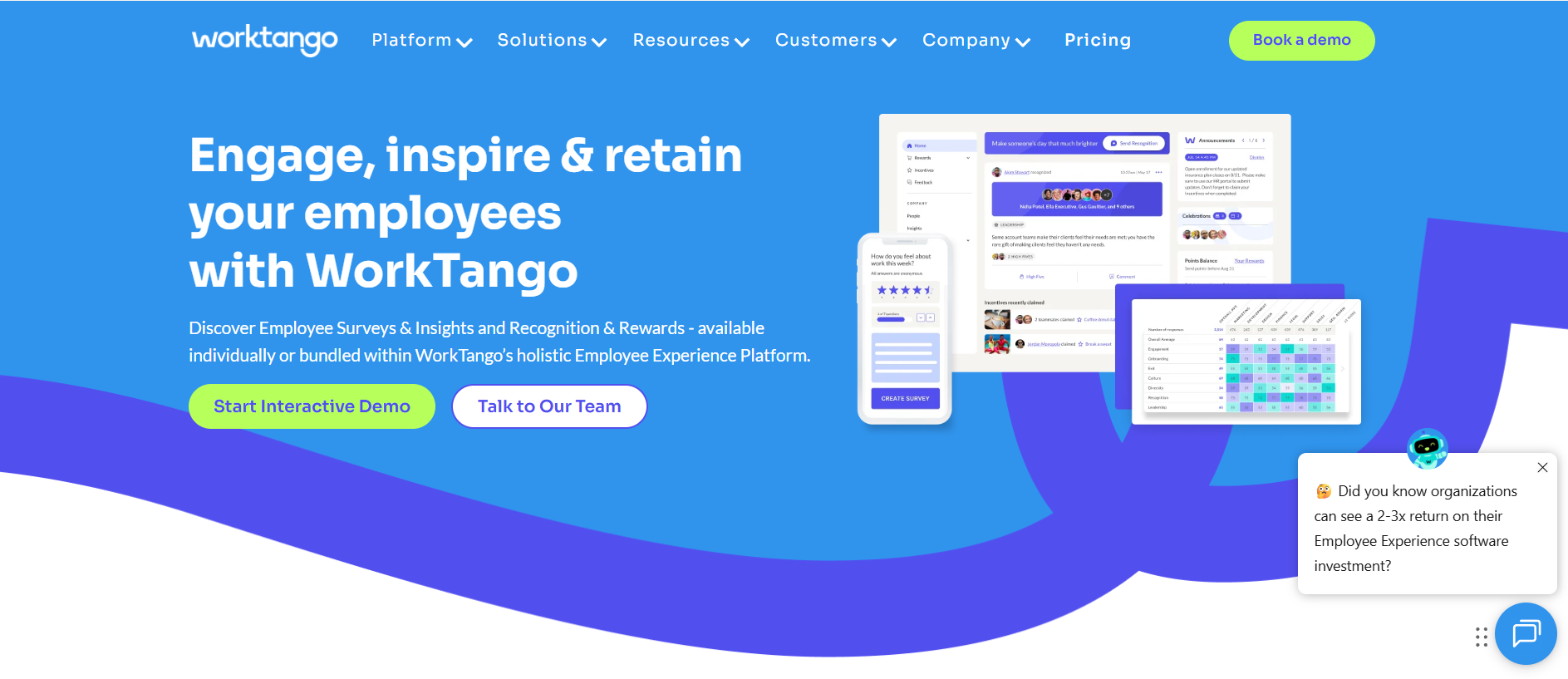
WorkTango combines employee listening with some of the mechanisms organizations can use after the survey closes.
Its Surveys & Insights product supports engagement, onboarding, change and other lifecycle surveys. Results can be reviewed through dashboards, benchmarks, open-text analysis and AI-generated themes and summaries.
Managers can then move from the result into recommended actions and action-planning workflows.
The wider WorkTango platform also includes Recognition & Rewards, which gives organizations another way to connect employee feedback with the everyday employee experience.
That combination makes sense for organizations that want a more complete engagement workflow but do not necessarily need the complexity of a large enterprise research platform.
It also supports participation methods designed for distributed workforces, including mobile and kiosk scenarios where employees may not have a traditional corporate email account.
Best fit: Mid-market and enterprise organizations that want employee listening, manager action planning and recognition to work as connected parts of an engagement program.
Pricing: Custom quote, with a minimum 12-month contract.
11. Workleap: Best for Smaller Teams Wanting Straightforward
Engagement Management
Workleap, including the Officevibe capabilities many HR teams already know, is one of the more approachable choices for smaller and mid-sized organizations.
Its engagement workflows include recurring pulse surveys, anonymous employee feedback, team-health reporting, recognition through Good Vibes and manager-facing insights.
Officevibe’s employee listening model looks across several engagement areas, including recognition, manager relationships, growth, wellness, satisfaction and alignment.
The wider Workleap product now connects those engagement capabilities with performance management, goals, people analytics and AI-assisted workflows.
The biggest advantage is simplicity.
A 150-person organization may not need the same listening infrastructure as a multinational enterprise. It may need a reliable pulse, a safe way for employees to raise concerns and a clearer way for managers to understand what needs attention.
Best fit: Small and mid-sized organizations that want practical employee surveys, anonymous feedback, recognition and performance tools without implementing a complex enterprise EX platform.
Pricing: Workleap currently lists Standard from $4,999 per year and Pro from $11,999 per year. Organizations above the published employee threshold move to Enterprise pricing.
12. Bonusly: Best When Recognition Is the Main Engagement Gap
Bonusly is more specialized than most platforms in this comparison.
That is exactly why it belongs here.
Some organizations do not have a listening problem. They already run surveys and understand what employees are saying.
Their problem is that good work goes unnoticed, recognition depends too heavily on individual managers or appreciation happens only during formal review cycles.
Bonusly focuses on peer-to-peer recognition, rewards, celebrations and integrations with tools employees already use, including Slack and Microsoft Teams.
Its newer product capabilities also extend into manager habits, pulse insights and Bizy AI, giving managers more help in identifying recognition opportunities and maintaining everyday engagement routines.
I would not buy Bonusly as a replacement for Culture Amp, Qualtrics or Peakon if the company needs sophisticated employee listening.
It solves a different problem.
If recognition is the primary buying requirement rather than broader listening, our employee recognition software comparison looks at that category in more depth.
Best fit: Organizations that already have their core HR and survey infrastructure in place but want recognition to become a more visible and consistent part of the employee experience.
Pricing: Bonusly currently offers a free plan for up to eight users. Team without Bizy AI starts at $3 per user per month, while Team + Bizy AI starts at $5 per user per month. Enterprise-style Organization pricing is custom.
Which Employee Engagement Platform Fits Your Company?
The shortlist becomes much easier once the buying decision starts with the engagement problem rather than with the vendor category.
If your organization needs deeper employee listening and analysis, Culture Amp, Qualtrics EmployeeXM and Workday Peakon deserve more weight. Their product depth is concentrated around surveys, employee feedback, benchmarking and understanding what is changing across the workforce.
If the larger problem is reaching employees and keeping communication connected with engagement, HubEngage, Workvivo and Staffbase are more natural comparisons. This becomes particularly relevant in distributed and frontline-heavy organizations where access to the employee experience cannot depend entirely on desktop or email.
Lattice, 15Five and Leapsome make more sense when engagement needs to sit alongside performance reviews, goals, feedback and employee development.
WorkTango is worth considering when the organization wants surveys to lead more directly into manager action and recognition.
Workleap is easier to justify for smaller or mid-market organizations that want a simpler engagement layer without implementing a large enterprise listening environment.
Bonusly becomes more interesting when the company already understands its engagement issues and the missing piece is everyday recognition.
That is a much more useful way to build a shortlist than comparing which vendor has the most AI features.
What Features Matter Most in Employee Engagement Software?
The feature list should follow the engagement strategy rather than define it.
The first thing I would evaluate is the employee listening model.
Can the platform support the surveys the organization actually intends to run? That may include an annual engagement survey, shorter pulses, onboarding feedback, exit surveys and open-text questions.
Then look at what happens after employees respond.
A good platform should help HR and managers move from an overall result to something they can investigate. That might mean understanding which groups are affected, reading representative comments, identifying themes or creating a manager action plan.
Workforce access matters just as much.
A platform can have excellent survey analytics and still be a poor fit if thousands of employees cannot easily open the survey.
For deskless or frontline workforces, mobile access, SMS, kiosk options, shared devices and non-email authentication can matter more than another analytics dashboard.
If workforce reach is one of your main buying problems, our employee communication tools guide goes deeper into choosing channels and platforms for desk, frontline and hybrid employees.
Recognition should also be treated as its own buying question.
A basic badge feature does not necessarily replace a dedicated recognition system. If appreciation and reinforcement are important engagement goals, look closely at how employees recognize one another, what managers can see and whether rewards are actually part of the intended program.
Finally, analytics should make decisions clearer.
If HR receives another 20 charts but still cannot explain what employees are struggling with or what managers should do next, the platform is producing information rather than insight.
How Much Does Employee Engagement Software Cost in 2026?
Employee engagement software pricing varies too widely for one average to be particularly useful.
At the transparent end of the market, 15Five Engage currently starts at $4 per user per month, while Lattice Engagement is listed at $4 per seat per month with a $4,000 annual minimum.
Workleap uses annual starting prices rather than a straightforward per-user figure, while Bonusly begins at a lower per-user price because recognition is a narrower use case than a full engagement suite.
Many enterprise products remain custom priced.
HubEngage, Culture Amp, Qualtrics, Workday Peakon, Workvivo, Staffbase and WorkTango all require buyers to request commercial pricing.
That does not necessarily mean those platforms will always cost more.
Enterprise pricing can depend on employee count, selected modules, implementation requirements, support, workforce composition and negotiated contract terms.
The more useful budgeting exercise is to calculate the complete system you actually need.
Ask whether the quote includes implementation, survey consulting, required integrations, support tiers, reward budgets, additional communication channels and future employee growth.
A cheap starting price can become expensive once the missing modules are added. A higher enterprise quote can sometimes replace several existing systems.
What I Would Ask in Every Employee Engagement Software Demo
The least useful demo question is:
“Can you show me the engagement dashboard?”
Every vendor can.
Give the vendor a real scenario instead.
For example:
“Our latest survey says frontline employees are struggling with communication, managers are weak on career development and office employees are broadly satisfied. Show me what HR sees, what each manager sees, how we investigate the written feedback, what happens next and how employees hear about the action.”
That forces the vendor to demonstrate the engagement workflow rather than one attractive screen.
I would also ask them to show how confidentiality behaves when employee groups become small, how open-text comments are analyzed, what managers can and cannot access, how employee attributes are synchronized, which AI features process employee comments, whether a manager can move directly from a result into an action plan, how frontline employees actually log in and participate, and what happens when the company adds another 1,000 employees.
The answers to those questions usually reveal more than the feature checklist.
Frequently Asked Questions
What is the best employee engagement software in 2026?
There is no single platform that is best for every company.
HubEngage is a strong option when communication, surveys, recognition and frontline reach need to sit together. Culture Amp, Qualtrics EmployeeXM and Workday Peakon are stronger candidates when sophisticated employee listening is the main requirement. Lattice, 15Five and Leapsome become more attractive when engagement needs to connect with performance management.
The better choice depends on what is currently missing from the organization’s engagement program.
What features should employee engagement software include?
At minimum, the platform should help the organization collect meaningful employee feedback, understand the results and give managers a practical way to respond.
Depending on the workforce, that may mean pulse surveys, lifecycle surveys, open-text analysis, benchmarking, manager dashboards, action planning, recognition, mobile participation or integration with performance-management processes.
A longer feature list is not automatically better. The important question is whether those features support the engagement process the company actually intends to run.
How much does employee engagement software cost?
Published prices in this comparison range from a few dollars per employee per month for narrower products to annual contracts costing several thousand dollars.
Lattice Engagement and 15Five Engage currently start at $4 per user or seat per month, while Workleap starts at $4,999 annually.
Several enterprise platforms do not publish list prices and require buyers to request a quote.
The real cost should also include implementation, modules, support, integrations and any recognition reward budget.
Which employee engagement software is best for small businesses?
15Five, Workleap and Bonusly are relatively straightforward products for smaller organizations to evaluate because their use cases and pricing are more transparent.
Lattice can also suit growing organizations, although its $4,000 annual minimum matters for very small teams.
A small business should be cautious about paying for enterprise survey sophistication that no one on the HR team will realistically use.
Which employee engagement platforms are best for frontline employees?
HubEngage, Workvivo, Staffbase and WorkTango deserve particular attention for frontline or distributed workforces.
The important factor is not simply that they have mobile apps.
Frontline engagement depends on whether employees without a traditional desk or company email address can realistically receive communication, participate in surveys, access information and take part in recognition.
That entire employee journey should be tested during the product demo.
What is the difference between employee engagement software and employee experience software?
Employee engagement software generally focuses on how connected, motivated and involved employees are at work and supports that through surveys, feedback, recognition, communication or manager action.
Employee experience software is usually broader.
It may cover several stages of the employee journey, including onboarding, communication, workplace knowledge, development, services and offboarding.
In practice, the categories now overlap considerably, which is why products that started in different parts of HR technology increasingly appear on the same shortlist.
Is Culture Amp better than Lattice for employee engagement?
Culture Amp is generally the stronger fit when the organization’s main requirement is structured employee listening, benchmarking, survey methodology and interpretation.
Lattice becomes more compelling when engagement needs to sit closely beside performance reviews, goals, feedback and development.
Neither is automatically better. They address different versions of the engagement problem.
Do companies still need engagement surveys if they use communication or recognition software?
Usually, yes.
Communication and recognition can improve parts of the employee experience, but they do not tell HR everything employees think about workload, management, development, fairness or organizational change.
Surveys provide a structured way to measure those experiences and track whether they are improving.
The better approach is usually not choosing surveys instead of communication or recognition. It is deciding which combination the organization’s engagement strategy actually requires.
Final Take
The employee engagement software market looks crowded because products that started in very different categories now appear on the same comparison pages.
Survey platforms have added AI and manager action planning. Performance products have added engagement. Internal communication platforms have added employee listening. Recognition products are becoming more analytical.
That makes simple feature-count comparisons much less useful.
Start with the engagement problem.
If the problem is fragmented communication and workforce reach, HubEngage, Workvivo or Staffbase deserve more attention. If deeper listening and analysis are the priority, Culture Amp, Qualtrics and Workday Peakon become more compelling. If engagement needs to connect directly with performance, Lattice, 15Five and Leapsome make more sense. If the missing layer is manager follow-through, simpler team feedback or recognition, WorkTango, Workleap and Bonusly become more relevant.
The best employee engagement platform is not the one with the longest feature list.
It is the one that fits the engagement system your company can actually run.