Once you have chosen metrics, run them in an employee surveys hub so managers see site-level results instead of a company-wide PDF.
You can have a clean annual engagement scorecard and still know very little about how employees actually experience work. The number looks tidy in the executive deck, managers acknowledge the results, and then the same problems continue appearing on the floor, in employee comments, in manager conversations, and eventually in the turnover report.
The problem is usually not a lack of data. It is the absence of a measurement system that connects employee feedback with manager behavior, internal communication, recognition, workplace tools, operational friction, and retention outcomes.
Measuring employee engagement should therefore involve more than asking employees how they feel once a year. The goal is to understand where the experience is helping people perform, where it is wearing them down, and what leaders should change next.
Key Takeaways
- Measure engagement as a system rather than relying on one survey score.
- Separate engagement drivers, employee sentiment, and business outcomes so leaders understand what each metric can reveal.
- Combine direct feedback with manager insights, communication data, recognition activity, workplace signals, and retention outcomes.
- Segment results by team, location, role, tenure, shift, and workforce type before acting.
- Use aggregated data to improve systems and working conditions, not to create hidden employee productivity scores.
- Limit each measurement cycle to a small number of visible actions with named owners and follow-up dates.
Why Most Engagement Measurement Programs Fall Short
A distribution-center manager cannot do much with a once-a-year engagement score that reaches her after the shift patterns, supervisor changes, and scheduling problems behind it have already moved on. She needs to know whether the issue is communication, workload, manager support, recognition, or something in the operation that is making the job harder than it should be.
A score without context is just a report, and reports do not fix a broken shift handoff.
That is the core weakness in many engagement programs. They collect sentiment, package it into a dashboard, compare it with a benchmark, and stop before the measurement reaches the people who can change the experience.
Frontline engagement is especially difficult to understand through surveys alone because the experience is shaped by schedules, staffing, devices, manager consistency, task clarity, information access, and the reliability of everyday workflows. Office and hybrid employees may face different problems, but the same principle applies: what looks like disengagement may actually be confusion, excessive workload, poor tools, limited career visibility, or a breakdown in trust.
The useful question is not simply, “What is our engagement score?” It is, “What changed in the employee experience, where did it change, who owns the issue, and what will leaders do next?”
Practical rule: If the data cannot help a manager or business leader decide what to do differently this month, it is probably not being measured at the right level.
A modern engagement program needs a baseline, an ongoing listening cadence, contextual evidence, clear ownership, and a visible response path. The objective is not to produce a more impressive dashboard. It is to make the employee experience easier to understand and improve.
Building the Engagement Model Behind Your Metrics
A useful engagement model starts before the first survey question is written. Leaders should decide what they are trying to understand, which workplace conditions may be influencing engagement, and which outcomes should improve if the employee experience becomes stronger.
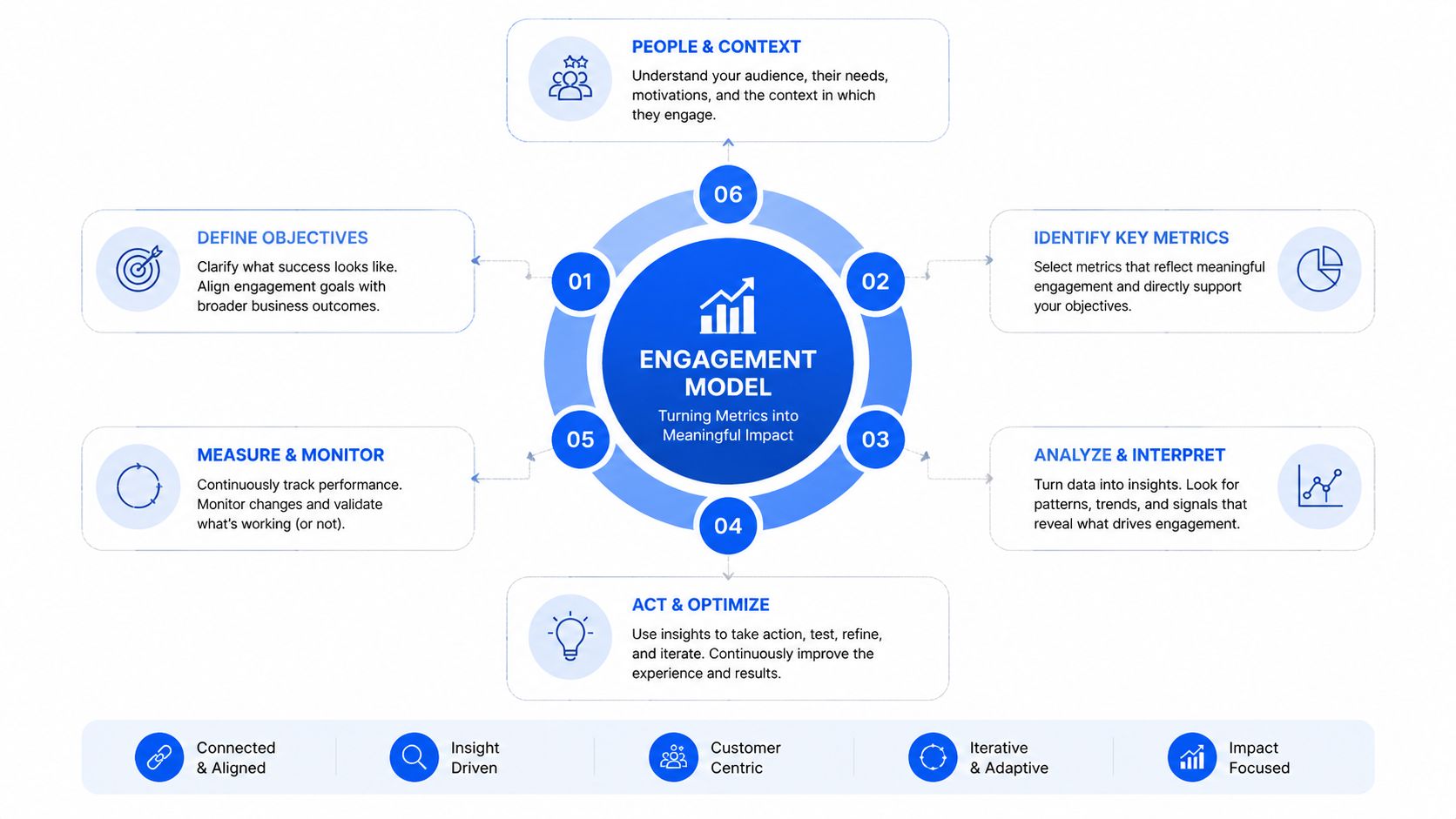
The most important distinction is between drivers, engagement signals, and outcomes.
Engagement drivers
Drivers are the workplace conditions that shape how employees experience work. Common examples include manager support, recognition, growth, workload, belonging, communication, flexibility, enablement, fairness, and access to the tools or information needed to perform well.
Engagement signals
Engagement signals reflect how employees currently relate to the organization and their work. They may include motivation, pride, advocacy, trust, willingness to contribute, sense of purpose, and intent to stay.
Workforce outcomes
Outcomes show what may happen when the experience strengthens or deteriorates over time. These can include voluntary turnover, absenteeism, internal mobility, customer outcomes, safety, productivity, quality, and new-hire retention.
These categories should not be treated as interchangeable. Turnover is not an engagement score, recognition activity does not prove employees feel valued, and a high communication open rate does not show that employees understood the message.
A hybrid retail organization, for example, might select manager support, schedule predictability, recognition, career growth, and tools and training as its primary drivers. It may use pride, motivation, and intent to stay as engagement signals, while monitoring voluntary turnover, internal movement, absenteeism, and service quality as outcomes.
That structure gives HR, internal communications, operations, and business leaders a shared language. HR can examine retention and development, communications can evaluate whether information reached and helped employees, and operations can identify whether schedules, tools, and processes are creating unnecessary friction.
A Five-Layer Employee Engagement Measurement Framework
The strongest measurement systems combine five layers of evidence rather than expecting one method to explain the entire employee experience.
| Layer | What It Captures | Example Measures |
|---|---|---|
| Employee voice | What employees intentionally say about work | Engagement surveys, pulse surveys, comments, stay interviews, focus groups |
| Manager context | What managers observe in daily work | Repeated concerns, workload pressure, role confusion, withdrawal, team conflict |
| Communication and recognition | Whether employees receive information and feel seen | Reach, understanding, acknowledgements, questions, recognition distribution |
| Work and behavior signals | Where systems, processes, or conditions create friction | Absence, task delays, schedule changes, knowledge searches, support requests |
| Workforce outcomes | Whether the experience is affecting stability and performance | Turnover, internal mobility, new-hire retention, safety, service, productivity |
No layer should stand alone. Survey results need context, operational data needs employee voice, and manager observations need evidence before they are treated as conclusions.
The purpose of the framework is triangulation: when several different signals point toward the same problem, leaders can act with greater confidence.
The Core Metrics and Formulas You Will Actually Use
The best engagement dashboards mix sentiment measures with communication, recognition, operational, and retention indicators. The goal is not to track everything available, but to choose metrics that reveal where leaders should investigate or intervene.
| Metric | How It Is Calculated or Tracked | What It Can Tell You |
|---|---|---|
| Engagement index | Composite of consistent engagement questions | Overall engagement level and trend |
| eNPS | Percentage of promoters minus percentage of detractors | Employee advocacy and willingness to recommend |
| Participation rate | Participants divided by invited employees, multiplied by 100 | Whether the listening method is reaching the workforce |
| Recognition reach | Percentage of employees recognized during a period | Whether appreciation is distributed across the workforce |
| Communication reach | Percentage of the intended audience receiving or viewing a message | Whether employees were exposed to important information |
| Internal mobility | Number or percentage of employees moving into internal roles | Whether employees see opportunities to grow |
| Absenteeism | Absence days compared with available workdays | A possible signal of strain, health issues, or disengagement |
| Voluntary turnover | Voluntary departures compared with average headcount | Workforce stability and retention pressure |
| New-hire retention | Percentage of new hires remaining after a defined period | Early employee experience and onboarding effectiveness |
| Intent to stay | Survey response to a consistent retention question | Near-term employee attachment and possible exit risk |
Each metric has limits. eNPS measures advocacy rather than the full employee experience, participation reflects access and trust in the listening process rather than engagement itself, and turnover is a lagging outcome that may be influenced by pay, labor-market conditions, personal circumstances, and role availability.
Recognition activity should also be interpreted carefully. A high number of recognition messages may look positive while the same small group receives most of them. Leaders should examine recognition by manager, location, role, shift, and workforce type so that office-based or highly visible employees do not receive disproportionate attention.
How to Read Leading and Lagging Signals
Some engagement signals move before serious workforce outcomes appear. Others confirm that a problem has already become expensive.
Leading signals may include declining survey sentiment, lower recognition reach, weak communication understanding, reduced participation, recurring employee questions, lower internal applications, or repeated manager concerns. These indicators can give leaders time to investigate before employees withdraw or leave.
Lagging outcomes include voluntary turnover, extended absence, safety incidents, reduced service quality, or declining productivity. They are important, but they often describe a problem after the organization has already absorbed the cost.
The strongest measurement system connects both. A team with stable turnover may still have falling recognition, rising absence, weak manager trust, and limited mobility, which suggests that the employee experience may be deteriorating before resignations begin.
Choosing the Right Listening Methods for Your Workforce
No single listening method provides a complete picture. A broad survey establishes the baseline, shorter pulses reveal movement, lifecycle surveys capture important moments, and conversations add context that structured questions may miss.
Baseline engagement surveys
A baseline survey should provide a broad view of engagement drivers and workforce segments. It may be conducted annually or less frequently, depending on how quickly the organization changes, but it should not become the only listening event.
A practical baseline often includes approximately 30 to 50 carefully selected questions, although the final length should depend on workforce access, survey purpose, and the time employees can reasonably give.
Pulse surveys
Pulse surveys are shorter and more focused, generally using 3 to 10 questions tied to a particular issue, change, or engagement driver. They may be conducted quarterly, monthly, or after a significant event such as a reorganization, leadership change, technology rollout, or scheduling update.
Their value comes from speed and consistency rather than depth.
Lifecycle surveys
Lifecycle surveys capture feedback during moments such as onboarding, role changes, promotions, return from leave, major training, or exit. These surveys help leaders see whether a particular journey is working rather than relying on a general engagement score.
Stay interviews and employee conversations
Stay interviews help leaders understand why employees remain, what may cause them to leave, and what could improve the experience while there is still time to act. Focus groups, skip-level conversations, and manager check-ins can provide deeper context when a survey identifies a concern but does not explain it fully.
The strongest programs use several methods because scale and context solve different problems.
Sentiment Analysis: Useful Pattern Detection, Not Mind Reading
Sentiment analysis can help organizations review large volumes of survey comments, open-text feedback, HR questions, support requests, or employee messages and identify recurring themes more quickly than manual review alone.
It can reveal whether comments increasingly reference workload, manager inconsistency, scheduling, recognition, communication, or career growth. It may also help leaders compare themes across roles, locations, shifts, or stages of the employee journey.
However, sentiment analysis should not be treated as a perfect measure of emotion. Sarcasm, cultural differences, language, context, and industry terminology can affect how comments are interpreted, while a brief negative comment may reflect a specific process issue rather than broad disengagement.
The safest approach is to use sentiment analysis at an aggregated level, combine it with other evidence, and require human review before drawing conclusions or taking sensitive action.
It should help leaders identify questions worth investigating, not label individual employees as positive, negative, engaged, or disengaged.
Manager Insights: Context, Not Proof
Managers often see changes before they appear in a formal report. They may notice repeated questions, declining participation, growing workload pressure, team conflict, schedule frustration, reduced initiative, or employees becoming less willing to speak openly.
These observations can add valuable context, but they should not replace direct employee feedback or become the sole basis for conclusions.
A manager may interpret quiet behavior as disengagement when the employee is dealing with unclear priorities, health concerns, inaccessible tools, or a work style that differs from the manager’s expectations.
Manager insight is context, not proof.
Organizations should collect manager observations through structured check-ins, action reviews, and escalation processes, then compare them with employee feedback, communication patterns, operational data, and workforce outcomes.
Communication and Recognition Data Beyond the Survey
Internal communication data can show whether employees had a realistic opportunity to receive, understand, and act on important information.
The measurement sequence should be:
- Reach: Did the message reach the intended workforce?
- Attention: Did employees view or open it?
- Understanding: Did they interpret it correctly?
- Action: Did they complete the expected next step?
- Trust: Did they believe the message and know where to ask questions?
A message can have a high open rate and still fail. Employees may view an announcement without understanding how it affects their role, or they may understand the change but lack the tools or permissions needed to act.
Questions, acknowledgement rates, manager reinforcement, task completion, and follow-up feedback can provide a fuller picture than opens alone.
Recognition data deserves similar care. Leaders should look at who receives recognition, how frequently it occurs, whether it is specific, whether peers and managers both participate, and whether frontline, remote, hybrid, and less-visible employees are represented.
The goal is not to maximize the number of recognition posts. It is to understand whether valuable work is being noticed fairly and meaningfully.
Behavioral and Operational Signals Beyond the Survey
Employees often change how they work before they explain why in a survey. That is why engagement measurement should include selected operational and behavioral signals, provided they are used transparently and responsibly.
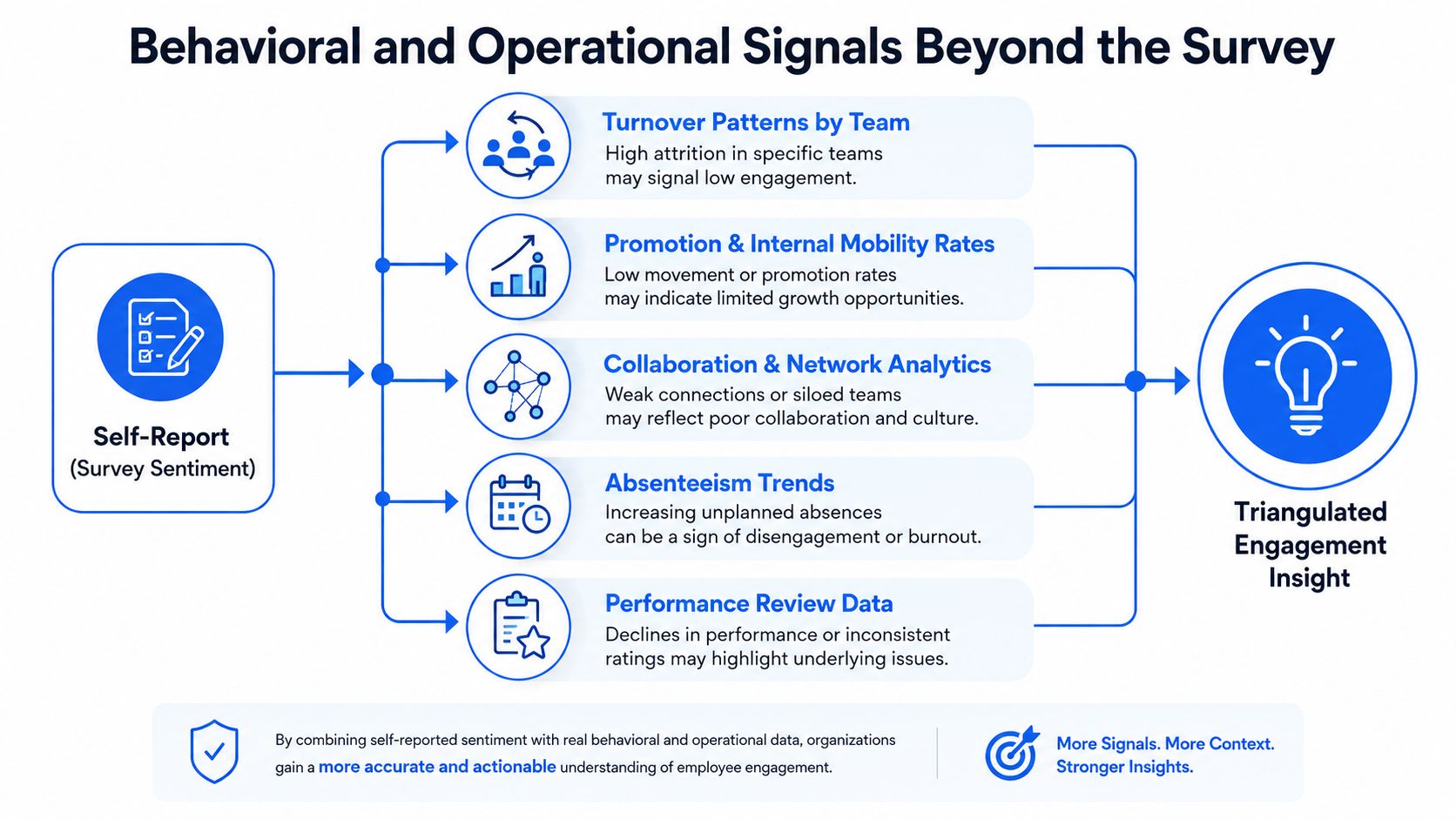
Useful signals may include:
- Voluntary turnover and new-hire exits
- Absence and schedule instability
- Internal applications and promotions
- Training or onboarding completion
- Repeated support requests
- Task delays and escalation volume
- Unsuccessful knowledge searches
- Missed handoffs
- Communication response
- Recognition distribution
These signals become more valuable when they are read together. A team with low recognition, rising absence, weak internal mobility, and repeated manager escalations may be experiencing a serious decline even when its annual survey score has not yet changed.
A frontline retail team provides a simple example. If recognition falls, schedule changes increase, and unplanned absence rises within the same location, leaders have a reason to investigate manager practices and workload before waiting for another survey.
The goal is not to monitor every employee action. It is to identify where the work environment may be creating friction.
Designing Surveys That Distributed and Frontline Teams Will Actually Complete
A survey nobody finishes creates noise and gives leaders false confidence in incomplete data. For frontline and distributed teams, the design challenge is often less about analytics sophistication and more about access, time, language, and trust.
The listening method should match the workforce. Office employees may complete a deeper baseline survey through email, while employees working in hospitals, warehouses, stores, hotels, or field locations may need short mobile surveys, kiosks, SMS invitations, translated questions, or in-app prompts.
A practical structure is:
- Baseline survey: approximately 30 to 50 questions
- Pulse survey: approximately 3 to 10 questions
- Lifecycle survey: approximately 5 to 15 questions
- Transactional or in-app check-in: approximately 1 to 3 questions
These are useful ranges rather than rigid rules. Every question should have a clear purpose, and leaders should be able to explain how the answer may influence a decision.
Survey wording should be direct, accessible, and relevant to the employee’s work. Anonymity protections should also be clear, especially in small teams where employees may fear that critical feedback can be traced back to them.
Response rates should be reviewed by segment before conclusions are drawn. A low or uneven response rate requires caution, particularly when one shift, location, role, or workforce group is underrepresented.
The issue may not be employee indifference. It may be that the survey was delivered through the wrong channel, at the wrong time, or in a format employees could not easily access.
Measuring Without Creating Surveillance
Combining surveys with communication, recognition, operational, and technology signals requires clear ethical boundaries.
Engagement measurement should reveal where work is failing employees, not create a hidden score for each employee.
Organizations should:
- Use aggregated data whenever possible.
- Explain what is collected and why.
- Set minimum group sizes for reporting.
- Restrict manager access to appropriate team-level information.
- Avoid using engagement data for discipline or individual performance scoring.
- Measure systems and workflows rather than private employee behavior.
- Require human review for sensitive interpretations.
- Give employees a way to question or correct inaccurate information.
Trust is part of measurement quality. Employees who believe the listening process is secretly evaluating them may provide less honest feedback or avoid participating altogether.
Turning Engagement Data Into Decisions Leaders Will Fund
Data matters only when someone changes something because of it.
The strongest analysis follows a simple cycle:
Measure – Collect a balanced set of direct feedback, workplace evidence, and workforce outcomes.
Interpret – Separate engagement drivers from signals and outcomes, then compare several sources before deciding what the pattern means.
Localize – Segment by team, manager, role, location, tenure, shift, workforce type, or other relevant factors so company-wide averages do not hide local problems.
Prioritize – Select one to three issues that leaders can realistically improve during the next cycle.
Act – Assign a named owner, timeline, intervention, and expected result.
Recheck– Use the next pulse, operational review, manager conversation, or outcome report to determine whether the experience improved.
A useful executive view should answer four questions quickly: What changed, where did it change, what is probably driving it, and who owns the response? It should also show the actions underway. A dashboard containing scores without ownership is a reporting tool, not an improvement system.
Common Employee Engagement Measurement Mistakes
Organizations commonly weaken their own measurement programs by relying on one annual survey, treating eNPS as a complete engagement score, tracking too many metrics, or changing survey questions so frequently that trends become impossible to compare.
Other common mistakes include looking only at company-wide averages, confusing communication reach with understanding, assigning every issue to managers, collecting behavioral data without transparency, and treating correlation as proof that one factor caused another.
The most damaging mistake is surveying employees without closing the loop. When employees repeatedly provide feedback and see no visible response, participation falls and future answers become less candid.
Leaders should communicate what they heard, what they will change, what they cannot change yet, who owns the action, and when employees should expect an update.
Final Thoughts
Measuring employee engagement is not about finding one perfect score. It is about combining enough evidence to understand where the employee experience is strengthening, where it is weakening, and what leaders should do before disengagement becomes absence, poor performance, or turnover.
Annual surveys still have a role, but they work best as one layer in a broader system that includes employee voice, manager context, communication, recognition, workplace conditions, and workforce outcomes.
The best engagement programs do not simply produce more data. They create a faster, clearer path from what employees experience to what the organization improves.
FAQs on How to Measure Employee Engagement
What is the best way to measure employee engagement?
The strongest approach combines a baseline engagement survey with ongoing pulse surveys, manager insights, employee conversations, communication data, recognition activity, operational signals, and retention outcomes. No single metric can explain the full employee experience.
How often should employee engagement be measured?
Many organizations use an annual or periodic baseline survey supported by quarterly or monthly pulses. The right cadence depends on how quickly the workplace changes and how rapidly leaders can respond to the results.
What metrics should be included in an engagement dashboard?
A practical dashboard may include an engagement index, eNPS, participation, recognition reach, communication understanding, internal mobility, absenteeism, intent to stay, voluntary turnover, and new-hire retention. The final selection should reflect the organization’s workforce and priorities.
Can employee engagement be measured without surveys?
Operational and behavioral data can reveal important patterns, but it cannot fully explain how employees interpret their experience. Surveys, conversations, and comments remain necessary because employees should have a direct voice in engagement measurement.
How can internal communications measure its effect on engagement?
Internal communications should measure reach, attention, understanding, action, and trust. Opens and views show exposure, but acknowledgements, questions, manager reinforcement, task completion, and employee feedback provide stronger evidence of impact.
How should sentiment analysis be used?
Sentiment analysis should identify aggregated themes and patterns across employee comments. It should be combined with human review and other evidence rather than used to label or evaluate individual employees.
How do you measure frontline employee engagement?
Frontline measurement should combine short mobile or kiosk-based surveys with manager conversations, schedule stability, absence, task clarity, communication access, recognition, training progress, and turnover by location or shift.
How do you know whether survey data is reliable?
Review participation and representation by team, role, location, shift, and workforce type. Low or uneven participation does not automatically invalidate the survey, but it should limit how confidently leaders interpret the results.
What is the biggest employee engagement measurement mistake?
The biggest mistake is collecting feedback without acting on it. When employees do not see what changed because of their input, trust and future participation decline.