You’ve launched a culture survey, received a polished dashboard, and still can’t tell a store manager, plant supervisor, or department head what to do differently next week. That’s the failure this guide is designed to prevent. The best culture assessment tools connect employee perceptions with workplace behavior, manager action, communication, and operational context. In 2026, I’d prioritize continuous signals and closed-loop actioning over question volume.
Key takeaways
- Culture Amp is the strongest all-around choice for mature people teams that need survey design, benchmarks, and people analytics.
- Peakon fits organizations that prioritize continuous listening, especially those already invested in Workday.
- Viva Glint, formerly associated with Glint’s Microsoft and LinkedIn ecosystem, makes the most sense for Microsoft-centered enterprises.
- Denison is the better choice when psychometric defensibility and structured benchmarking matter more than self-service simplicity.
- No platform earns its subscription fee unless managers can understand the signal, act on it, and report what changed.
What Culture Assessment Tools Are and Why They Matter in 2026
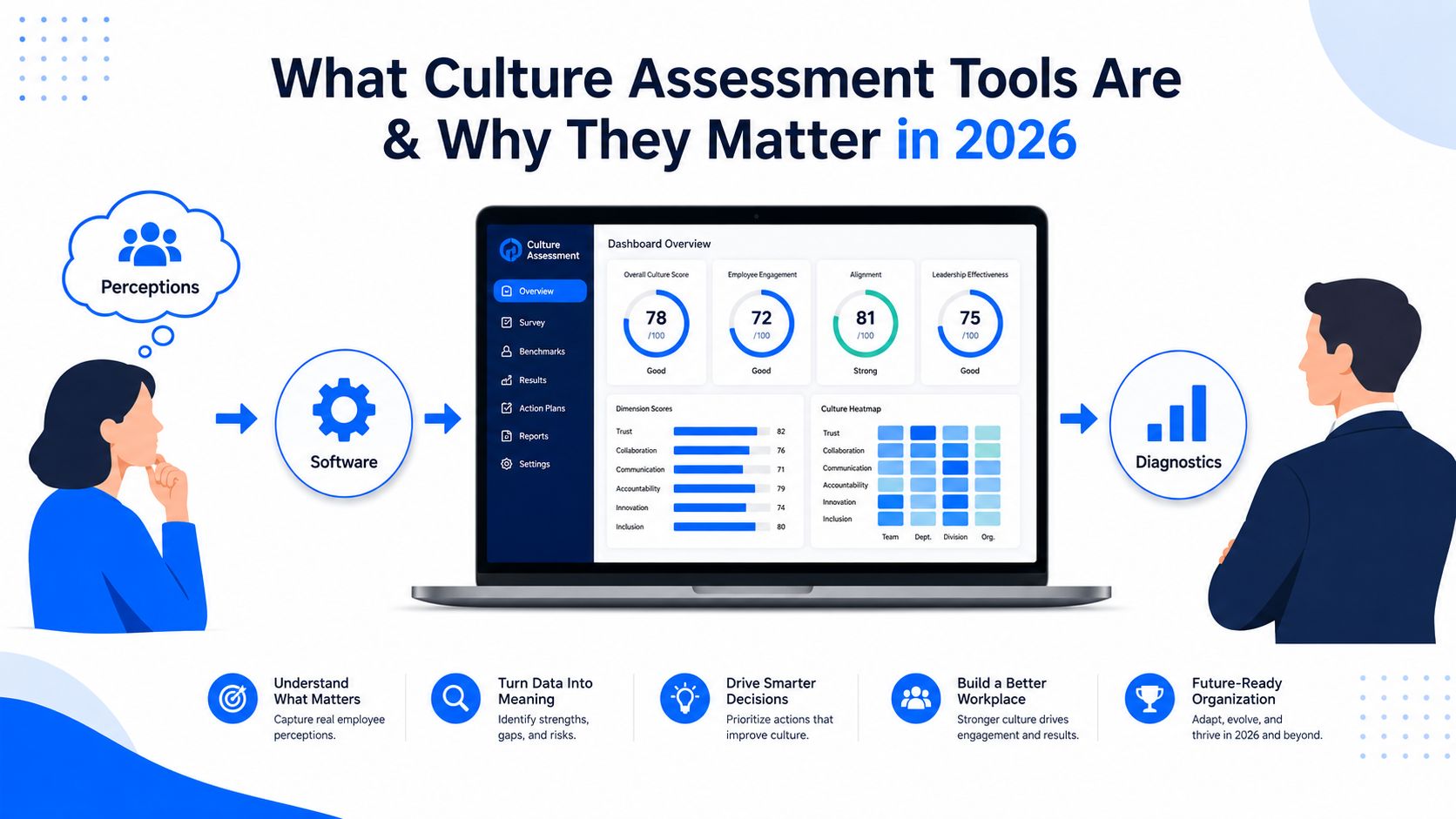
Culture assessment tools are software platforms or structured instruments that measure how employees experience workplace norms, values, behaviors, and decision-making, then translate those signals into diagnostics leaders can use. They’re different from a generic engagement survey because the central question isn’t only whether people feel satisfied. It’s whether the organization’s stated culture matches the way work gets done.
That distinction matters for workforce experience. A deskless employee may rarely open an HR portal, a hybrid employee may experience communication differently from an office-based colleague, and a global team may interpret the same leadership behavior through different cultural expectations. A useful assessment reaches those groups through suitable channels and lets leaders examine patterns below the company average.
The category became more formal in the late twentieth century. The term “organizational culture” entered American management scholarship in 1979, academic interest expanded rapidly in the 1980s, and instrument development accelerated through the 1990s, described by researchers as the peak period for culture-measurement tools, according to this history of organizational culture assessment instruments. Kim Cameron and Robert Quinn developed the Organizational Culture Assessment Instrument, or OCAI, in the 1990s and formalized it in 1999 as a validated method based on the Competing Values Framework. OCAI compares an organization’s current and preferred states, making it useful for change management and leadership alignment.
Culture measurement is now an operating decision
SHRM’s global culture report found that 61% of employees worldwide rated their organization’s culture as “good” or “excellent,” while fewer than 10% rated it “poor” or “terrible,” as reported in the SHRM Global Culture Report. The more revealing finding is the large middle group. Nearly one-third described their culture as only “slightly good,” which means a respectable aggregate score can conceal weak connection and inconsistent team experiences.
Gallup reported in 2026 that only 20% of U.S. employees strongly agree they feel connected to their organization’s culture, showing why broad approval and deep connection shouldn’t be treated as the same metric. Culture tools can help leadership distinguish sentiment from lived experience, but only if the platform captures team-level and behavioral context.
The seven commercial tools compared here are Culture Amp, Glint or Viva Glint, Peakon, Workleap Officevibe, Quantum Workplace, Perceptyx, and Culture15. My evaluation lens is straightforward:
- Instrument quality: Does the method measure a defined cultural construct?
- Signal reach: Can it include frontline, hybrid, multilingual, and distributed employees?
- Decision usefulness: Can leaders identify drivers and meaningful differences?
- Action closure: Can managers assign, complete, and review follow-up work?
- Operational fit: Does it work with the communication, HR, and workforce systems people already use?
For a broader foundation, pair a culture platform with a practical employee listening strategy. A survey without communication before launch, context after results, and visible follow-through creates skepticism rather than trust.
How to Evaluate Culture Assessment Tools Before You Buy
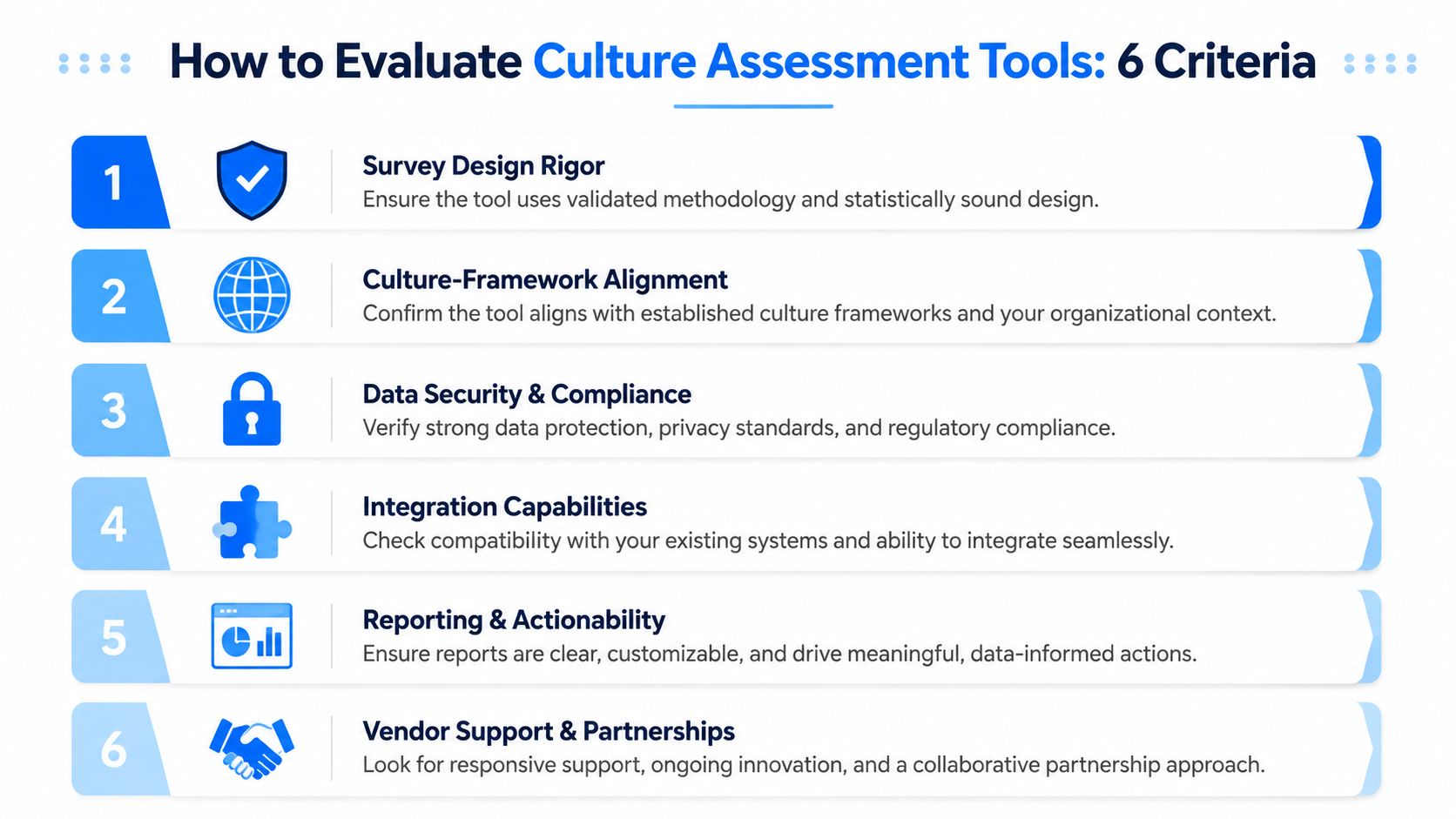
Evaluate culture assessment tools as risk and operating systems, not feature lists. A platform with more questions, dashboards, or AI labels isn’t automatically better. The right choice depends on whether the tool can produce reliable signals for your workforce and move those signals into accountable action.
Six buyer tests that expose weak platforms
1. Survey design rigor. Ask the vendor which constructs its questions measure, how the instrument was validated, and how much customization is safe before comparability disappears. A red flag is a library of attractive questions with no explanation of reliability, scoring, or framework alignment.
2. Analytics depth. Your people team needs more than an overall score. Ask whether the platform supports subgroup analysis, driver analysis, manager-level views, qualitative coding, and safeguards against overinterpreting small groups. A red flag is an AI-generated summary that doesn’t show the underlying responses or methodology.
The Denison Organizational Culture Survey offers a useful benchmark for psychometric seriousness. It contains 60 items, organized across 12 dimensions and 4 traits, and published reliability evidence reports internal consistency above .70, reaching .88 to .97 in the cited validation evidence, as documented in the Denison survey validation manuscript.
3. Reach and sampling logic. Ask how the tool reaches employees who don’t sit at a desk, share an inbox, or work in the dominant language. Test mobile access, kiosk or SMS options where available, translation workflows, accessibility, and manager visibility. A red flag is a platform that treats an office employee with daily laptop access as the default respondent.
4. Integration capability. Ask whether the platform connects with your HRIS, communication tools, performance system, service desk, and BI environment. Clarify whether integrations support data exchange or merely link to another application. A red flag is a read-only API or a connector that requires manual exports for every reporting cycle.
5. Security and privacy. Request current documentation for access controls, encryption, audit logging, retention, consent, regional hosting, and relevant compliance obligations. Don’t accept a generic security whitepaper as proof that the configuration fits your workforce and jurisdictions. A red flag is shared administration, unclear role permissions, or no documented deletion process.
6. Closed-loop actioning. Ask what happens after a manager sees a low score. Can they create an action, assign an owner, set a review point, communicate the response, and track completion? A red flag is a report that ends with “consider improving communication.”
The TurnOnWork signal-to-action lens
This is a TurnOnWork editorial model, not an industry standard. Score each shortlisted platform from 0 to 3 across four dimensions:
- Signal continuity: occasional snapshot, recurring pulse, or ongoing behavioral signal.
- Workforce reach: office-only convenience, mixed-workforce access, or strong frontline and global coverage.
- Manager usability: HR analytics only, manager-readable reporting, or embedded action guidance.
- Loop closure: findings only, recommended actions, or assigned and trackable follow-through.
Give the last two dimensions greater weight than survey volume. A smaller instrument that reaches shift workers and prompts manager action is often more valuable than a large questionnaire that produces a presentation nobody revisits.
Use the same discipline when reviewing open-text comments. This guide to analyzing employee survey answers is useful because qualitative feedback becomes valuable only when teams code themes, protect confidentiality, and connect comments to a decision.
The 7 Best Culture Assessment Tools Compared Side by Side
Culture Amp is the safest general recommendation for a mature people team, while Peakon and Viva Glint are stronger ecosystem choices. Denison is the most defensible specialist option in this shortlist. The other tools can be good fits, but buyers should test action workflows and workforce reach rather than assume a familiar brand solves those problems.
The table uses indicative positioning rather than invented price quotes. Vendors commonly tailor pricing by employee population, modules, implementation scope, benchmarks, integrations, and contract terms, so request a written proposal for your exact configuration.
Culture Amp
Culture Amp is strongest for organizations that want engagement, culture, performance, and people analytics in one established survey environment. It generally suits hybrid knowledge workforces and people teams with the capacity to manage survey design, benchmark interpretation, and manager enablement.
Its weakness is operational distance. A platform can provide excellent analytics while still leaving managers with a quarterly report and no practical workflow. Employee experience platforms such as HubEngage combine employee communication, surveys, recognition, and engagement workflows to help organizations move from collecting feedback to improving day-to-day workforce connection. Ask for a live demonstration of comment analysis, action assignment, and manager follow-up before signing.
Glint or Viva Glint
Glint’s value is highest inside the Microsoft and LinkedIn talent ecosystem. It can be attractive to enterprises already standardizing on Microsoft tools and seeking an integrated employee listening experience.
The trade-off is dependency. Buyers should clarify product packaging, roadmap, licensing, data boundaries, and how much capability depends on the broader Microsoft environment. Don’t buy it solely because it appears inside an existing technology portfolio.
Peakon
Peakon, now associated with Workday’s employee voice offering, is the clearest choice for continuous listening in a Workday-centered enterprise. Its appeal is the ability to run recurring feedback and connect employee signals with a wider people-data environment.
The implementation burden can be substantial. Teams outside the Workday ecosystem should test integration depth and reporting administration carefully rather than assume the same value transfers unchanged.
Workleap Officevibe
Officevibe is a practical option for teams that want a more approachable pulse and engagement experience. It can suit mid-sized organizations and managers who need readable feedback without building a specialist people analytics function.
Its limitation is diagnostic depth. If your leadership team needs a formal culture model, cross-cultural equivalence testing, or complex enterprise governance, you may outgrow the platform or need a companion instrument.
Quantum Workplace
Quantum Workplace is a credible fit for organizations that want employee engagement, lifecycle listening, and manager-oriented reporting in one environment. It’s most compelling when people leaders need a structured program rather than an academic culture study.
Test frontline delivery, multilingual workflows, and action closure. A platform can be easy for HR and still be inconvenient for a supervisor managing a distributed or shift-based team.
Perceptyx
Perceptyx is built for large organizations with advanced employee listening and people analytics requirements. Its appeal is configurability, enterprise research support, and the ability to connect multiple listening programs.
That flexibility comes with governance and administration overhead. It’s a poor choice for a lean HR team that needs a self-service launch and has no dedicated analytics owner.
Culture15
Culture15 is best understood as a focused culture diagnostic that compares current culture with the culture an organization believes it needs. The vendor describes a model measuring culture across 12 validated dimensions, with a comparison between current and required culture on its Compono Engage product page, which is relevant to buyers considering culture-gap analysis.
Its strength is clarity. Its risk is treating a diagnostic as a complete operating system. If you need recurring listening, manager workflow, and integration with operational execution, verify those capabilities rather than inferring them from the assessment model.
| Tool | Methodology | Analytics depth | Integrations | Frontline support | Security | Price band |
|---|---|---|---|---|---|---|
| Culture Amp | Survey-led employee experience and culture measurement | Strong survey analytics and benchmarks | Broad HR ecosystem, verify exact connectors | Requires validation for deskless populations | Request current controls and certifications | Quote-based |
| Glint or Viva Glint | Survey-led listening within Microsoft and LinkedIn environments | Strong enterprise reporting and text analysis potential | Strongest in Microsoft-centered estates | Validate mobile, language, and access model | Enterprise controls require configuration review | Quote-based or ecosystem-dependent |
| Peakon | Continuous employee voice and recurring listening | Strong trends, drivers, and manager insights | Strongest with Workday | Validate delivery for shift-based workers | Request current regional and role controls | Enterprise quote |
| Workleap Officevibe | Pulse and engagement surveys | Accessible, manager-friendly reporting | Common workplace integrations, verify scope | Suitable for pilots, test frontline reach | Review plan-specific controls | Quote-based |
| Quantum Workplace | Engagement, lifecycle, and employee listening | Strong program reporting and action orientation | Verify HRIS, collaboration, and BI depth | Test mobile and multilingual operation | Request current documentation | Quote-based |
| Perceptyx | Enterprise listening and research platform | Deep, configurable analytics | Broad enterprise integration potential | Strong potential, validate deployment model | Formal enterprise review required | Enterprise quote |
| Culture15 | Culture-gap diagnostic across validated dimensions | Focused diagnostic comparison | Verify operational integrations | Validate access and cadence | Request vendor documentation | Quote-based |
Which Culture Tool Fits Which Workforce Reality
The best tool depends more on workforce shape than on brand recognition. A platform that works beautifully for hybrid product teams can fail in retail, manufacturing, healthcare, or field operations because employees have different access, language, scheduling, and manager-support needs.
Frontline-heavy retail or manufacturing
Start with Peakon, Quantum Workplace, or Workleap Officevibe, but require a live test with employees who don’t use corporate email throughout the day. Mobile-first delivery, simple authentication, multilingual access, and manager-level summaries matter more than elaborate executive dashboards.
Perceptyx may fit a large manufacturer with a dedicated listening function, but it can create too much administration for a regional operator. Culture Amp can work well when the organization already has strong HR technology and communication processes, but it shouldn’t be assumed to solve frontline reach by itself.
Hybrid knowledge workers
Culture Amp is the strongest starting point for a hybrid knowledge workforce that wants engagement, culture, performance, and benchmark context. Officevibe fits a smaller or less complex program, while Quantum Workplace is useful when lifecycle listening and manager reporting are central.
A survey-led platform can work here because employees usually have regular digital access and can provide narrative feedback. Still, don’t confuse easy participation with cultural accuracy. Hybrid workers may experience communication overload, weak manager connection, or uneven decision visibility that requires comment analysis and follow-up, not just a favorable score.
Large multinational enterprises
Shortlist Perceptyx, Peakon, and Viva Glint. These tools can support larger governance models, but buyers must test language coverage, regional hosting, data separation, role-based reporting, and local consent practices during procurement.
Cross-cultural portability deserves special attention. Research comparing three quantitative instruments found that the Denison Organizational Culture Survey and Organizational Culture Profile showed satisfactory psychometric properties and cultural equivalence, while GLOBE’s reliability indices fell below recommended thresholds and its construct validity was unsatisfactory, according to the cross-cultural validation research. Don’t benchmark countries or business units with an instrument that hasn’t demonstrated conceptual equivalence.
Mid-sized growing companies
Officevibe, Culture Amp, or Quantum Workplace are sensible starting points, depending on analytics maturity and budget. Culture15 can add a focused current-versus-needed culture diagnostic when leadership needs alignment before a transformation.
The weakest fit is usually an enterprise platform that requires a dedicated administrator, consultant-led interpretation, and extensive governance for a team that needs a usable answer quickly. Use this guide to measure employee engagement to avoid buying a culture product when the actual need is a simpler engagement or communication feedback loop.
| Tool | Frontline or deskless | Hybrid knowledge workers | Global enterprise | Mid-sized growth |
|---|---|---|---|---|
| Culture Amp | Test access and delivery first | Strong fit | Good with governance | Good if analytics capacity exists |
| Viva Glint | Strong ecosystem potential, validate access | Strong fit for Microsoft estates | Strong fit | Often excessive |
| Peakon | Good continuous-listening candidate | Strong fit | Strongest with Workday | Often excessive |
| Officevibe | Practical pilot candidate | Strong accessible fit | Limited for complex governance | Strong fit |
| Quantum Workplace | Good if frontline workflows test well | Strong fit | Good with validation | Strong fit |
| Perceptyx | Strong with enterprise resources | Strong fit | Strong fit | Usually too complex |
| Culture15 | Diagnostic only unless paired with action tooling | Useful for alignment | Useful with localization | Strong diagnostic fit |
How to Choose and Roll Out a Culture Assessment Tool
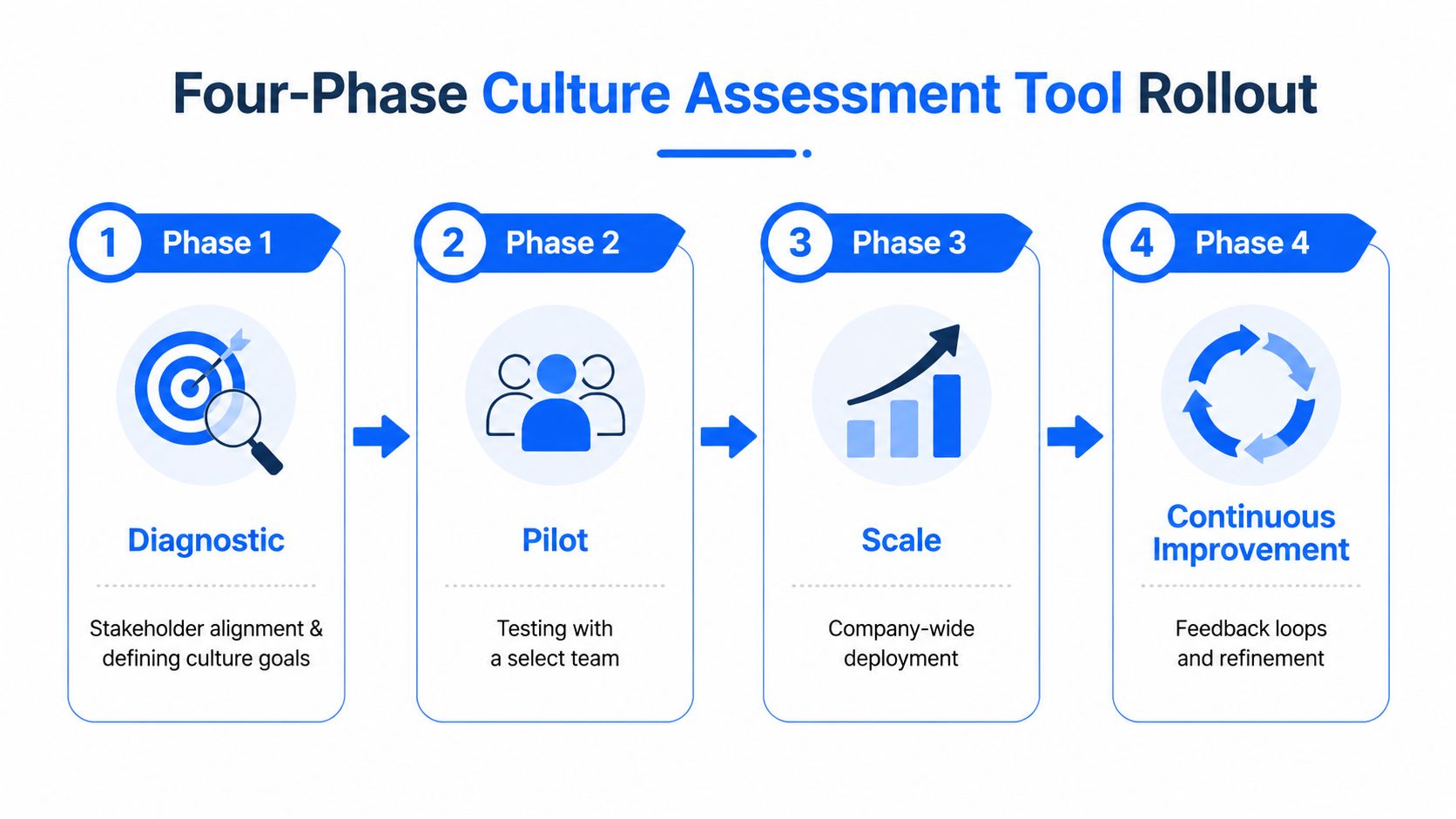
Roll out the tool in four phases, and don’t scale a program that managers haven’t used successfully in a smaller setting. The objective isn’t to collect a baseline. It’s to build a repeatable connection between signal, communication, manager behavior, and operational change.
Phase one, diagnostic
Bring HR, internal communications, operations, IT, privacy, and representative managers into the decision. Define the culture question in operational language, such as inconsistent escalation, weak shift communication, poor cross-functional handoffs, or low confidence in local leadership.
Shortlist two or three vendors from the comparison. Ask each to map its product to your workforce segments, data flows, manager workflow, and existing systems. If the vendor can’t explain what a store manager or shift supervisor will do after seeing the result, the shortlist is wrong.
Phase two, pilot
Run a 90-day pilot in one business unit or workforce segment. Choose a group with a clear sponsor, visible managers, and a problem leaders are prepared to address. Measure participation, signal quality, manager access, action completion, employee communication, and whether the tool captures the intended population.
Set an exit criterion before launch. For example, stop or redesign the pilot if managers can’t interpret the results, frontline employees can’t access the survey, or actions remain unassigned. Don’t rescue a weak product with heroic HR effort.
Phase three, scale
Launch organization-wide only after the pilot produces a usable operating rhythm. Train managers on confidentiality, interpretation, team conversations, and action planning. Publish what leadership heard, what it will do, what it won’t do, and when employees will receive an update.
Connect findings to onboarding, performance conversations, internal communication planning, workforce operations, and leadership development. Culture data should change decisions, not sit in a people analytics folder.
Phase four, continuous improvement
Review the cadence quarterly and assign a named governance owner. The owner should monitor participation, subgroup coverage, manager action quality, recurring themes, and whether communication closes the loop.
A practical selection checklist should include:
- Survey flexibility: Can you adapt questions without destroying comparability?
- Analytics depth: Can leaders see drivers, segments, trends, and coded comments?
- Integration coverage: Does data flow into HR, communication, performance, and BI systems?
- Sampling logic: Can the platform reach deskless, hybrid, multilingual, and remote groups?
- Security posture: Are access, retention, consent, audit, and regional requirements documented?
- Action workflow: Can managers assign, review, and report actions?
Use an employee engagement calendar to coordinate survey windows, manager conversations, communication, and follow-up. A listening program fails when employees are asked for feedback during operational chaos and never hear what changed.
Pricing, Security, and Integration Realities Buyers Miss
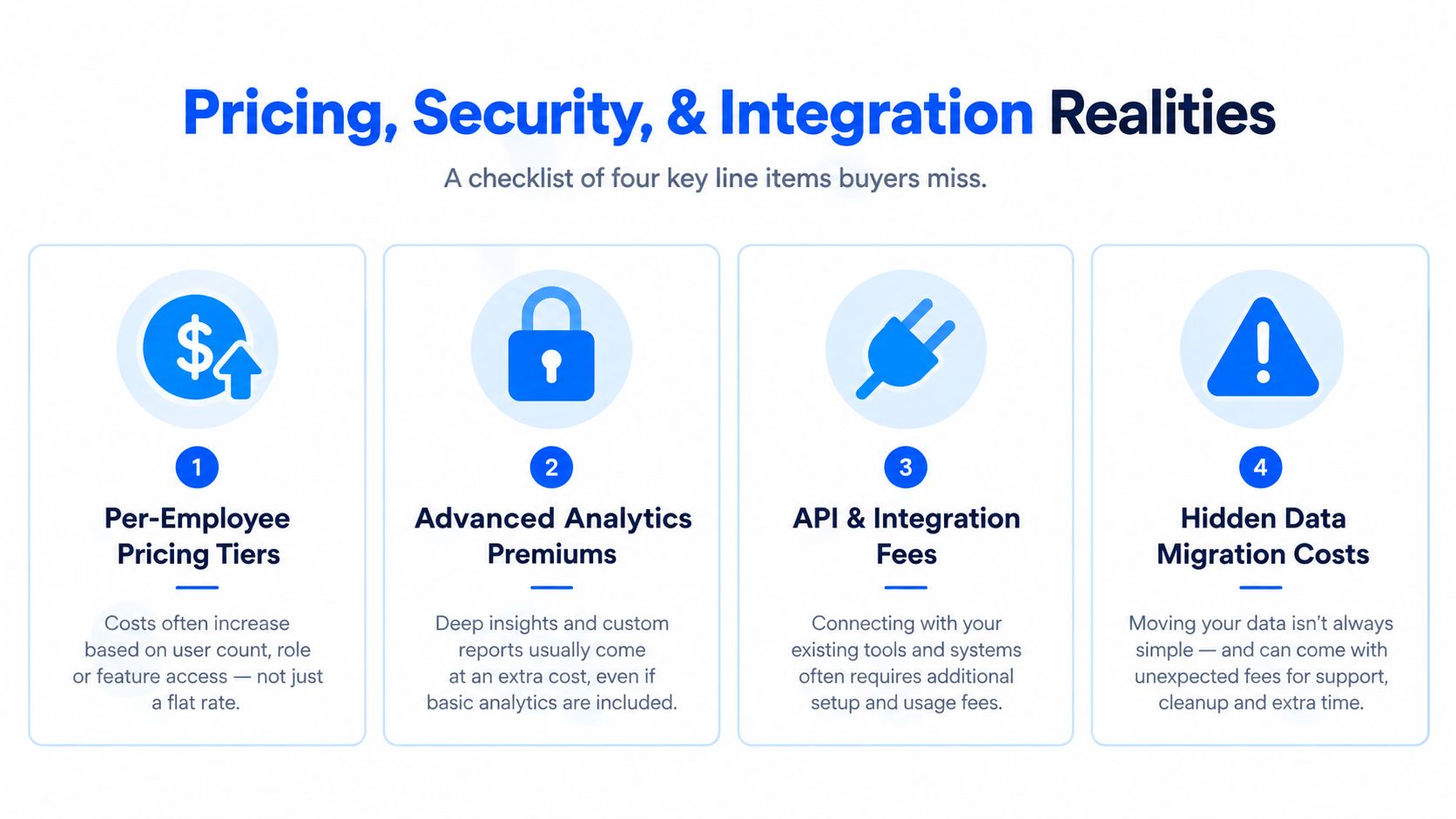
The proposal price is only one part of the cost. Evaluate culture assessment tools using total cost of ownership across the contract period, including implementation, administration, analytics access, integration work, manager enablement, data migration, and renewal terms.
Vendors may separate core surveying from advanced analytics, benchmark access, action planning, translation, SSO, SCIM provisioning, or API access. Ask for every capability in writing. A low initial quote can become expensive once the features required for a real workforce program appear as add-ons.
Security questions that deserve evidence
Ask whether the vendor supports SOC 2 Type II, ISO 27001, GDPR, CCPA alignment, regional data residency, single sign-on, role-based access, and audit logging. These are procurement questions, not assumptions. Requirements vary by organization and jurisdiction, so your privacy and security teams should validate the vendor’s current documentation.
Check how anonymous responses are protected. A platform that promises anonymity but allows overly narrow manager filters can undermine trust, especially in small teams. Review retention, deletion, export, subprocessors, breach notification, and administrator privileges before employee data enters the system.
Integration questions that affect daily use
Rank integrations by operational value:
- HRIS: employee identity, hierarchy, lifecycle events, and population changes.
- Performance management: goals, development, and manager follow-through.
- Collaboration and communication: reaching employees and closing the feedback loop.
- BI platforms: joining culture signals with approved workforce and operational data.
Find out whether the API is read-only, whether exports are automated, and whether the vendor charges for SSO or provisioning. Manual spreadsheets are a hidden operating cost and a governance risk.
Your strongest negotiation levers are often overlooked:
- Benchmark data rights: clarify what comparisons you can retain and use after the contract ends.
- Price protection: seek a multi-year price lock or clear renewal ceiling.
- Exit portability: require a usable export of questions, responses, metadata, comments, action records, and reporting definitions.
For a broader view of how employee data becomes an operating capability, see this perspective on employee experience intelligence.
FAQs on Culture Assessment Tools
What do culture assessment tools actually measure?
They measure perceptions, norms, values, behaviors, and gaps between the culture employees experience and the culture leaders intend to create. Some rely primarily on validated surveys, while others add recurring pulses, open-text analysis, manager signals, or behavioral data.
How are culture assessments different from engagement surveys?
Engagement surveys mainly measure how employees feel about work, leadership, or the organization. Culture assessments examine the patterns and expectations that shape those feelings, such as decision-making, accountability, collaboration, communication, adaptability, and consistency.
Use both when necessary, but don’t rename an engagement survey as a culture diagnostic without changing the instrument and interpretation.
Do these tools work for frontline and deskless employees?
They can, but only when the delivery model matches the work. Test mobile access, authentication, shared-device safeguards, language coverage, timing around shifts, accessibility, and whether supervisors can act without exposing confidential responses.
A laptop-first survey that excludes field, warehouse, clinical, retail, or production employees measures the culture of the connected minority.
How long until a culture assessment produces value?
You should expect the first value when leaders can identify a credible issue and communicate a specific response. Business impact takes longer and depends on the quality of the action, manager adoption, operational conditions, and whether the organization repeats the measurement.
Don’t define success as a dashboard launch. Define it as a signal that changes a decision or behavior.
Why do culture tools fail after purchase?
The common failures are predictable: unclear purpose, weak employee communication, poor subgroup reach, excessive survey frequency, no manager training, and no owner for follow-through. A platform can’t compensate for leaders who collect feedback but refuse to make visible changes.
Should we choose annual surveys or continuous culture sensing?
Use an annual or periodic diagnostic when you need a deep baseline or a structured transformation assessment. Use recurring pulses or continuous signals when managers need to detect changes and act during normal operations.
The strongest approach is usually a deliberate combination, but continuous sensing should win when the goal is operational improvement. Culture isn’t a once-a-year report. It’s reflected in how teams communicate, prioritize, escalate, recognize, and execute work every week.
Before you request demos, write down your workforce segments, culture question, required integrations, security conditions, and manager action you expect after each signal. Then score two or three vendors using the TurnOnWork lens and run a real pilot with frontline and hybrid employees included. For more practical workforce-experience analysis and HR technology comparisons, visit Turn On Work.