Generic perks do not keep people. Clear communication, fair treatment, manager follow-through, useful tools, and work that does not create daily friction do. If a retention strategy still leans on gift cards, swag, and a once-a-year survey, it is treating a structural problem like a morale problem.
Retention programs that mention recognition need a place to do it in public and on mobile; that is the job of an employee recognition hub, not a quarterly awards email.
The better model is workforce experience, where engagement, internal communications, HR, technology, manager behavior, flexibility, and operations work together. That is how organizations create an experience employees can realistically see themselves staying in, whether they work in an office, remotely, across locations, or on the front line.
Key Takeaways
- Engagement and retention are connected, but they are not the same.
- Engagement shows how employees feel about work now; retention reflects whether the experience gives them enough reason to stay.
- Pay and fairness create the foundation, while managers, recognition, growth, flexibility, communication, and daily work shape the decision to remain.
- Frontline turnover often requires operational fixes, not another culture campaign.
- Listening only matters when leaders act, explain what changed, and measure whether the issue improved.
- The most effective retention strategy is a repeatable process for identifying and fixing the reasons good employees consider leaving.
Why Engagement and Retention Are Not the Same Thing
Engagement is a signal of how connected, motivated, and energized an employee feels. Retention is the outcome of whether the overall work experience remains worth staying for over time.
That distinction matters because engagement can change quickly. A poor manager conversation, confusing announcement, broken workflow, or unfair schedule can lower it almost immediately.
Retention moves more slowly. It reflects the accumulated effect of compensation, manager quality, workload, flexibility, growth, recognition, communication, and whether employees believe the organization will improve what is not working.
An employee can be engaged and still leave because pay is uncompetitive or advancement feels impossible. Another employee may feel only moderately engaged but stay because the schedule works, the manager is reliable, and the role fits their life.
Practical rule: Engagement tells you where the experience is weakening. Retention tells you whether employees are still willing to live with it.
Leaders should therefore separate the signal from the intervention. A weak recognition score may require better manager habits. A high exit rate may point to pay, workload, scheduling, or limited mobility. A culture campaign will not solve an operational problem.
The Engagement Crisis Leaders Are Not Talking About
Recent workplace research continues to show low engagement and elevated retention risk. Gallup reported that only 21% of employees globally were engaged in 2024, while U.S. engagement fell to 31%, its lowest level in a decade.
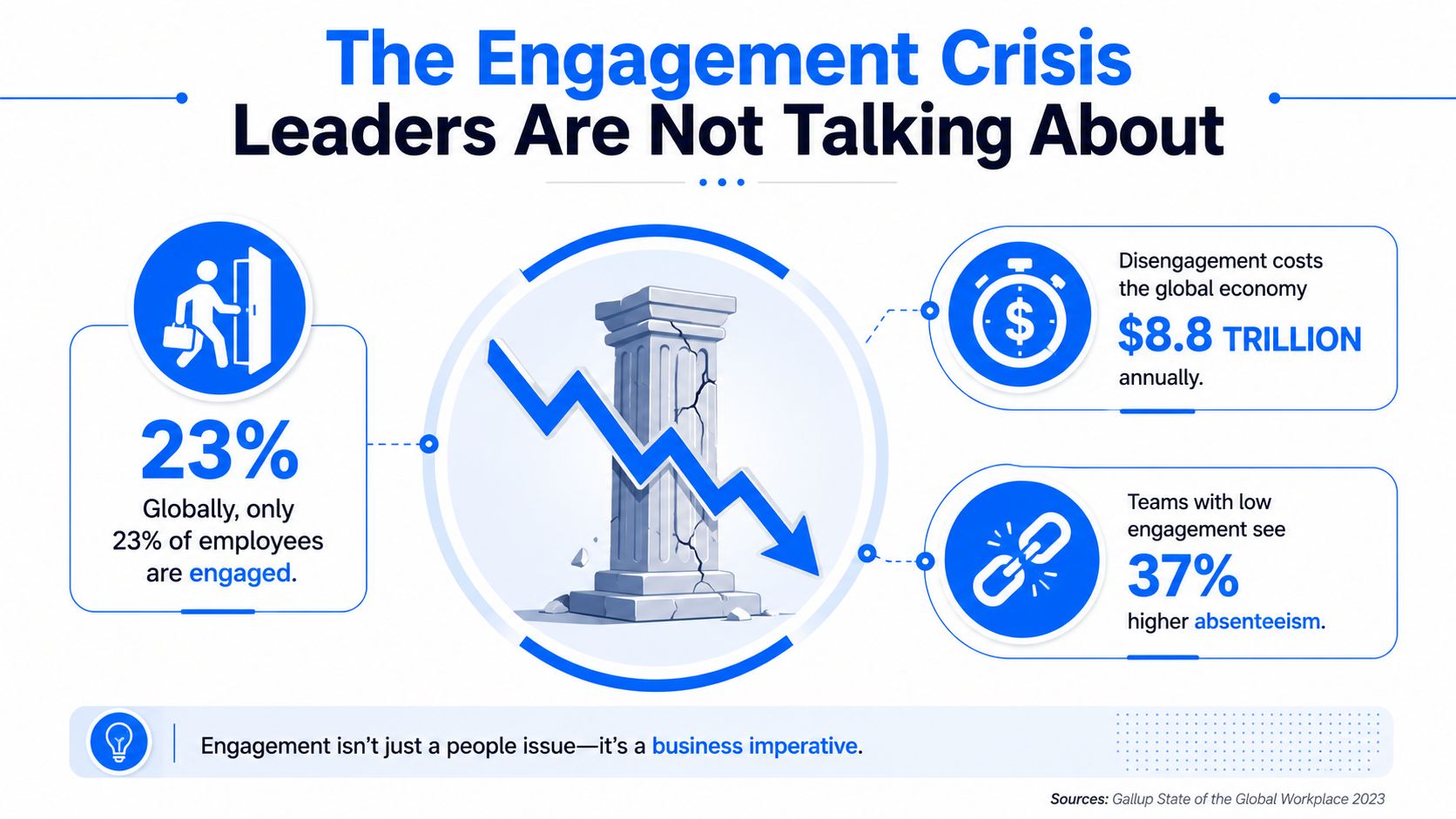
The wrong response is to blame employees for lacking loyalty. Low engagement often reflects a workplace that makes sustained commitment difficult. Employees may receive conflicting priorities, weak manager support, little recognition, limited career visibility, or tools that turn routine work into unnecessary effort.
Disengagement is not always loud. It often appears first as:
- Lower initiative
- Less feedback
- More verification and workarounds
- Reduced participation
- Quiet job searching
- A growing belief that nothing will change
High turnover frequently begins as low clarity, then becomes low trust.
The strongest organizations do not run engagement as a campaign. They treat it as an operating discipline that identifies where the work experience is becoming difficult to sustain.
Five Evidence-Based Drivers of Engagement
Gallup’s engagement framework highlights five practical drivers: purpose, development, caring managers, ongoing conversations, and strengths-based work.
The value of these drivers is not in naming them. It is in building routines that make them visible in everyday work.
Purpose and Development
Purpose becomes meaningful when employees can see how their role connects to an outcome.
Leaders should translate company strategy into clear team and role priorities, then reinforce that connection through manager conversations, shift huddles, and regular updates.
Development also needs to be concrete. Employees are more likely to stay when they can see what comes next, which skills they need, and whether opportunities are realistically available to them.
A vague promise of growth is not enough. Employees need visible pathways.
Caring Managers and Ongoing Conversations
Managers shape the daily experience more directly than most programs or campaigns.
A good manager:
- Clarifies expectations
- Discusses workload before burnout appears
- Recognizes useful contributions promptly
- Explains changes
- Follows up on concerns
- Talks about career interests
- Applies flexibility and scheduling rules consistently
Ongoing conversations should happen before an employee begins withdrawing, not after they announce an exit.
A predictable rhythm of check-ins is more valuable than an occasional high-quality conversation delivered too late.
Strengths-Based Work
People are more engaged when they can use their capabilities in meaningful ways. That does not mean employees should avoid every difficult or unfamiliar task. It means roles, assignments, and team responsibilities should make reasonable use of what people do well. When employees repeatedly perform work that drains them while their strongest skills remain unused, the organization loses both performance and retention value.
| Driver | Operational Practice | Owner | Technology Need |
|---|---|---|---|
| Purpose | Translate company goals into role-level priorities | Business leader and manager | Team communication platform |
| Development | Tie learning to real role moves | HR and manager | LMS or internal talent tools |
| Caring managers | Coach on feedback, recognition, and follow-up | People leader | Manager toolkit and dashboards |
| Ongoing conversations | Weekly or monthly check-ins with action tracking | Manager | Pulse survey and 1:1 workflow tools |
| Strengths-based work | Assign work to fit skill and interest | Manager and operations | Skills data and scheduling support |
If your managers don’t have a rhythm, your engagement strategy doesn’t have one either.
The point isn’t to admire the framework. The point is to build the routines behind it.
Retention Strategies That Actually Move the Needle
If leaders want people to stay, they should focus on the conditions that reduce regret and increase the future value of remaining.
Pay and Fairness Establish the Foundation
Compensation is not the only reason employees stay, but it cannot be dismissed. Employees may leave a supportive team when pay is materially uncompetitive or when compensation decisions appear inconsistent and unfair.
The better principle is:
Pay and fairness establish the foundation. Manager quality, growth, recognition, flexibility, communication, and daily work determine whether employees continue to see a future with the organization.
Leaders should review more than market ranges. They should also examine pay compression, inconsistent adjustments, promotion fairness, schedule premiums, and whether employees understand how compensation decisions are made.
Recognition Must Be Frequent and Specific
Recognition works best when it is timely, credible, and connected to something meaningful. A quarterly award cannot compensate for months of invisible effort.
Effective recognition may include:
- A manager acknowledging a specific contribution
- Peer recognition for teamwork or support
- Visible appreciation for safety, service, or quality
- Recognition tied to company values
- Follow-up showing how the contribution helped the team
The goal is not to manufacture praise. It is to ensure valuable work is noticed.
Career Growth and Internal Mobility
Employees often leave because finding a new opportunity outside the organization feels easier than finding one inside it.
A useful mobility strategy should:
- Publish internal roles clearly
- Show adjacent career paths, not only promotions
- Make required skills visible
- Allow employees to express career interests
- Give frontline employees access to internal opportunities
- Hold managers accountable for developing talent rather than hoarding it
- Track how many roles are filled internally
A warehouse associate who trains new hires and consistently performs well on safety may be a strong candidate for a team-lead or training role. That potential may remain invisible when internal mobility depends only on job titles and informal manager nominations. Employees are more likely to stay when growth feels possible without leaving.
Flexibility Must Match the Work
Flexibility does not mean the same thing for every workforce. For an office employee, it may involve location, hours, or meeting expectations. For a frontline employee, it may mean predictable schedules, easier shift swaps, advance notice, or more control over availability.
The important question is not whether every role offers the same flexibility. It is whether the organization has removed avoidable rigidity where the work allows it. Unequal flexibility may be unavoidable. Unexplained and inconsistently applied flexibility creates distrust.
Communication Should Reduce Uncertainty
Communication becomes a retention lever when it helps employees understand:
- What is changing
- Why it is changing
- How it affects them
- What action is required
- Where to ask questions
- What leaders heard
- What the organization will change
- What cannot be changed and why
Silence creates room for speculation. Excessive communication creates noise. The goal is not more messages, but greater clarity. Employees are more likely to stay when they do not have to guess what the organization expects or whether leaders are paying attention.
Segment the Strategy by Workforce Type
One universal retention playbook sounds efficient, but it often misses the employees most at risk.
Office Teams
Office employees may leave because promotion criteria are unclear, workloads are uneven, or development opportunities depend too heavily on manager visibility. Useful interventions may include clearer career paths, workload reviews, manager coaching, and greater transparency around internal opportunities.
Hybrid Teams
Hybrid employees may experience unequal access to recognition, stretch assignments, informal information, and leadership visibility. Leaders should examine whether office presence is influencing opportunity in ways that are unrelated to performance.
Distributed Teams
Distributed employees may receive company information late, without local context, or through channels that do not support questions. Retention improves when communication is consistent across locations while still accounting for regional differences.
Frontline Teams
Frontline employees are often less affected by abstract culture messaging than by the conditions they encounter every shift.
Key retention levers may include:
- Schedule predictability
- Mobile access to information
- Clear task handoffs
- Fast answers to HR questions
- Consistent supervisor behavior
- Safer and more manageable workloads
- Practical growth opportunities
- Easier shift changes
A recognition post will not fix a broken schedule. A culture campaign will not solve a manager who responds only when something goes wrong.
Building a Closed-Loop Listening System
Feedback programs fail when organizations collect more information than they are prepared to use. A real listening system should collect focused input, identify patterns, assign ownership, act on the findings, explain what changed, and measure again.
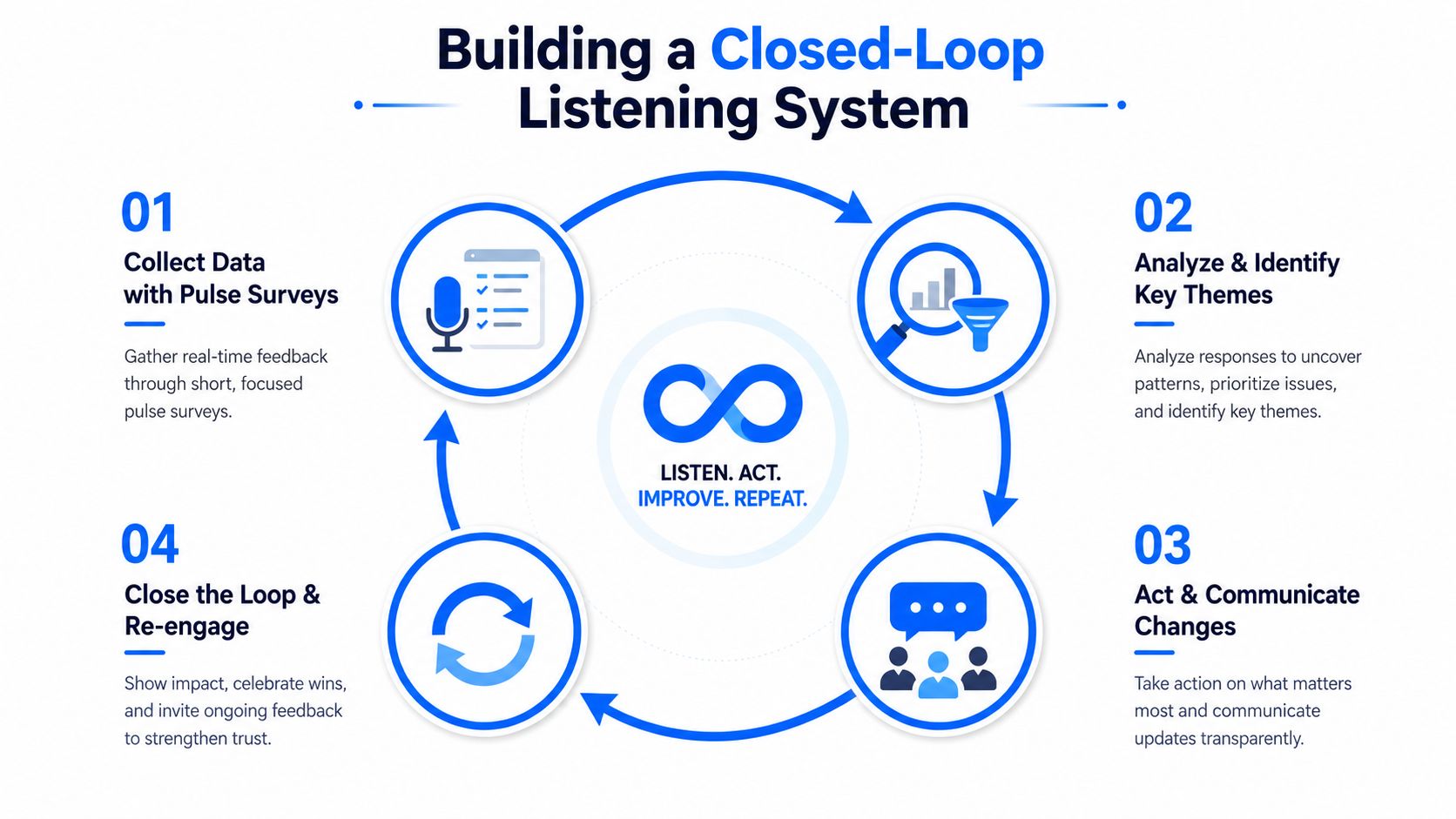
The process can remain simple:
Listen
Use pulse surveys, stay interviews, manager conversations, and employee comments to understand what makes work harder than it should be.
Ask questions such as:
- What makes you consider leaving?
- What prevents you from doing your best work?
- Do you see a realistic future here?
- What should your manager do differently?
- Which process creates the most unnecessary effort?
Diagnose
Break the results down by role, location, manager, tenure, shift, and workforce type. Organization-wide averages often hide the problem. A strong overall score may conceal a location with severe scheduling issues or a hybrid team where remote employees feel excluded from opportunity.
Act
Choose one or two issues that leaders can realistically improve.
Assign:
- A clear owner
- A deadline
- A specific action
- The outcome expected
- The metric that will show whether it worked
Trying to solve everything at once usually produces little visible change.
Communicate
Tell employees what leaders heard and what will happen next. Also explain what cannot be changed immediately. Employees do not expect every request to be granted. They do expect evidence that their input entered a real decision process.
Measure
Revisit the same question and connect it to workforce outcomes.
Look for changes in:
- Engagement
- Manager behavior
- Internal movement
- Absence
- Schedule stability
- Voluntary turnover
- Regrettable attrition
The point of listening is not to create more data. It is to change what employees experience next.
Common Retention Mistakes
Treating engagement and retention as the same KPI – A stronger survey score does not automatically mean employees intend to stay.
Responding to structural problems with perks – Swag and events cannot fix poor pay, workload, weak management, or unpredictable schedules.
Waiting for annual surveys – By the time an annual result reveals the issue, many employees may already have decided to leave.
Holding managers accountable without equipping them – Managers need clear expectations, training, useful data, and time to lead well.
Ignoring compensation fairness – Employees compare their treatment with coworkers and the external market.
Building career paths only for corporate roles – Frontline and hourly employees also need visible movement and development.
Measuring participation instead of change – A high survey-response rate is not success if the underlying issue remains unresolved.
Waiting for exit interviews – Exit interviews explain what already happened. Stay conversations help leaders intervene while employees are still present.
Measuring Whether Engagement Strategies Improve Retention
The question is not whether survey scores improved in isolation. It is whether employees are staying longer, moving internally, experiencing better management, and encountering less daily friction. A practical dashboard should answer four questions.
What changed in engagement? Review pulse data, comments, and themes.
What changed in behavior? Track recognition, check-in cadence, manager follow-through, training, and employee participation.
What changed in mobility? Measure internal applications, lateral moves, promotions, and roles filled internally.
What changed in retention? Track Voluntary turnover, Regrettable attrition, Turnover by manager, Turnover by location or shift, New-hire turnover, Frontline turnover, Retention after internal moves
Leaders should connect each intervention to an expected result.
For example:
- Manager coaching should improve manager trust and reduce turnover in affected teams.
- Scheduling changes should improve predictability and reduce frontline exits.
- Mobility programs should increase internal applications and internal fills.
- Recognition improvements should strengthen employees’ sense of appreciation and future commitment.
If engagement improves but turnover does not, the problem may be pay, workload, role fit, or opportunity. If turnover improves without a large survey shift, the effective change may have been operational rather than cultural.
Do not let a better survey score substitute for a better employee experience.
Final Thoughts
Engagement tells leaders how employees are experiencing work now. Retention reveals whether that experience remains sustainable over time.
The connection between them is action.
Employees are more likely to stay when leaders respond to what they hear, managers follow through, growth feels possible, communication reduces uncertainty, and daily work does not force people to fight broken systems.
The best retention strategy is not a campaign, a perk, or a slogan.
It is a repeatable operating discipline for finding and fixing the reasons good employees consider leaving.
Employee Engagement and Retention FAQs
What is the difference between employee engagement and employee retention?
Employee engagement reflects how connected, motivated, and supported employees feel in their work. Employee retention measures whether employees remain with the organization over time. Engagement can influence retention, but an engaged employee may still leave because of compensation, workload, limited growth, or personal circumstances.
How does employee engagement affect retention?
Engagement can reveal whether employees feel recognized, supported, informed, and connected to their work. When these conditions remain weak, employees may become more likely to leave. However, retention also depends on factors such as fair pay, manager quality, career opportunities, flexibility, scheduling, workload, and the overall work experience.
What employee retention strategies are most effective?
The most effective employee retention strategies address the reasons employees consider leaving. These commonly include competitive and fair compensation, capable managers, regular recognition, career growth, internal mobility, flexible work options, predictable scheduling, clear communication, and visible action on employee feedback.
Why do employee perks often fail to improve retention?
Perks may improve morale temporarily, but they rarely fix structural problems such as poor management, unfair pay, excessive workload, limited career growth, unpredictable schedules, or broken work processes. Employees are more likely to stay when the underlying experience improves.
What role do managers play in employee retention?
Managers shape employees’ daily experience through communication, workload decisions, feedback, recognition, flexibility, and development support. Strong managers identify problems early and follow through on concerns. Poor manager behavior can become a major retention risk even when company-wide programs are strong.
How can recognition improve employee retention?
Recognition helps employees see that their work is noticed and valued. It is most effective when it is timely, specific, credible, and connected to a meaningful contribution. Frequent recognition from managers and peers can strengthen employees’ sense of belonging and their belief that they have a future with the organization.
How does internal mobility support retention?
Internal mobility gives employees opportunities to grow without leaving the organization. Clear career paths, visible job openings, skills-based development, lateral moves, and fair access to opportunities can reduce the belief that changing employers is the only way to advance.
How can organizations improve frontline employee retention?
Frontline retention often improves through practical operational changes, including predictable schedules, easier shift swaps, mobile access to information, clear task instructions, responsive supervisors, manageable workloads, recognition, and visible career opportunities. Frontline employees usually need fewer daily obstacles rather than more culture messaging.
How should employee feedback be turned into retention action?
Organizations should follow a closed-loop process: listen to employees, diagnose patterns, select one or two priorities, assign clear owners, communicate what will change, and measure the results. Feedback loses credibility when employees repeatedly share concerns but see no visible response.
How can leaders measure whether retention strategies are working?
Leaders should track voluntary turnover, regrettable attrition, new-hire turnover, internal mobility, retention by manager or location, schedule stability, employee feedback, and manager follow-through. These measures should be connected to specific interventions so leaders can determine what actually changed the employee experience.
Are retention strategies different for office, hybrid, and frontline employees?
Yes. Office employees may prioritize career visibility, workload, and development. Hybrid employees may be affected by unequal access to recognition and opportunities. Distributed employees need consistent communication and local context. Frontline employees often place greater importance on scheduling, mobile access, supervisor support, task clarity, and reliable operations.
How often should organizations measure employee engagement and retention?
Engagement should be monitored regularly through pulse surveys, manager conversations, stay interviews, and employee feedback. Retention outcomes should be reviewed alongside those insights on a consistent monthly or quarterly cadence. Annual surveys alone are usually too slow to identify emerging risks.