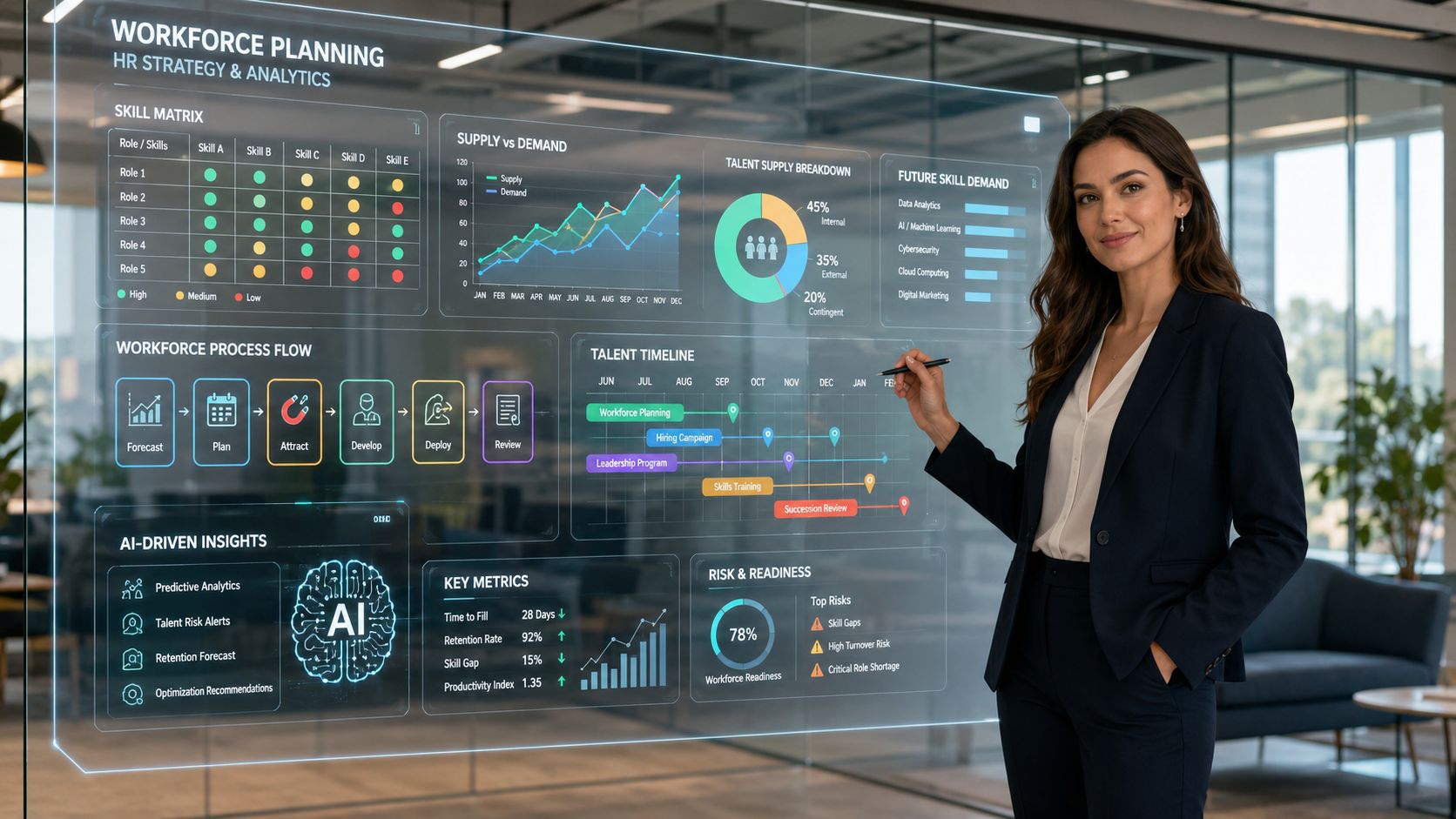
Strategic Planning in HRM is the process of turning business strategy into role, capability, and skills decisions over a 3 to 5 year horizon, not an annual headcount exercise. It works when HR, finance, operations, and line managers treat workforce planning as an execution discipline, because 73% of organizations still do operational planning, while only 12% of HR leaders in the U.S. report strategic workforce planning with a three-year horizon (McKinsey HR Monitor 2025).
Key takeaways
- Strategic HR planning is about capability, not just capacity. You’re planning for skills, roles, and location decisions that support business goals.
- Most organizations are still too short term. The planning gap is real, and it leaves reskilling, succession, and AI adaptation too late.
- Frontline reality matters. If managers can’t execute the plan, the plan doesn’t exist outside HR.
- AI changes the planning unit. Skills taxonomies, job families, and role redesign matter more in 2026 than simple requisition planning.
- Measurement has to be decision-ready. Track capability coverage, time to competence, internal mobility, and critical role risk, not just activity.
What Strategic Planning in HRM Means in 2026
Strategic planning in HRM means building a structured workforce plan that connects business direction to critical roles, skills, and operating capacity. It’s not a document you file away after budget season. It’s a living planning cycle that helps HR decide what to hire, what to build, what to redeploy, what to automate, and what to stop doing. Historical reviews of strategic HRM trace its roots to the 1920s in the United States, while the subfield became distinct in the 1980s as strategic management shaped HR thinking (historical review).
What it means in practice
- It starts with business strategy. Growth plans, cost pressure, service shifts, and technology changes all feed workforce decisions.
- It goes beyond annual headcount. A staffing plan fills vacancies. A strategic plan builds future capability.
- It has to account for AI exposure. Roles are changing fast, so job families and skills taxonomies need regular review.
- It must include frontline redesign. Deskless and hourly workforces need tools, schedules, and communication that match how work happens.
- It lives or dies with managers. If line leaders don’t understand the plan, they won’t execute it, and the workforce experience will drift.
Practical rule: if your plan can’t be translated into manager actions by next quarter, it’s not strategic yet.
The reason this matters now is simple. Organizations still plan in the short term. McKinsey’s HR Monitor 2025 found that 73% of surveyed organizations conduct full operational workforce planning, but only a small share connect those plans to future skill needs, and in the U.S. just 12% of HR leaders reported strategic workforce planning with at least a three-year horizon (McKinsey HR Monitor 2025). That gap is exactly why strategic planning in HRM still matters.
Strategic HR Planning vs Operational Workforce Planning
Strategic HR planning starts with the business model, future skills, and where AI will change the work. Operational workforce planning starts with open roles, budget pressure, and immediate staffing gaps. Too many organizations call the second one strategy and stop there.
Strategic vs Operational Workforce Planning
| Dimension | Strategic HR Planning | Operational Workforce Planning |
|---|---|---|
| Time horizon | 3 to 5 years | Current year or quarter |
| Primary input | Business strategy, scenarios, future skills | Vacancy requests, budget cycle, staffing gaps |
| Main question | What capabilities will the business need next? | Who do we need to fill open roles now? |
| Decision focus | Hire, build, buy, redeploy, automate | Replace, backfill, approve, delay |
| Skill view | Role families, capability clusters, AI exposure | Individual openings and spans of control |
| Output | Workforce strategy, succession logic, capability roadmap | Hiring plan, headcount plan, approval list |
Operational planning still matters. It keeps the lights on. But if HR only tracks vacancies, it will miss the reskilling windows, succession risks, and frontline redesign choices that shape delivery next quarter.
A short-term planning habit is common. As noted in CIPD 2024 resourcing and talent planning, many organizations still plan within six months, while far fewer look beyond two years. That same reporting also points to weak skills-gap data and limited future-skill identification. The result is predictable, companies hire into old job shapes, miss internal mobility, and leave managers to cope with capability gaps on their own.
Use workforce management forecasting as the operational input, not the whole plan. Forecasting tells you what staffing you need now. Strategic planning tells you which roles, skills, and manager actions will matter after the current quarter is over.
The Strategic HR Planning Process Step by Step
Strategic HR planning works when HR runs a repeatable cycle, not an ad hoc debate. The cycle is demand analysis, supply analysis, gap analysis, and solution analysis. That structure converts business strategy into specific decisions on roles, skills, and locations.
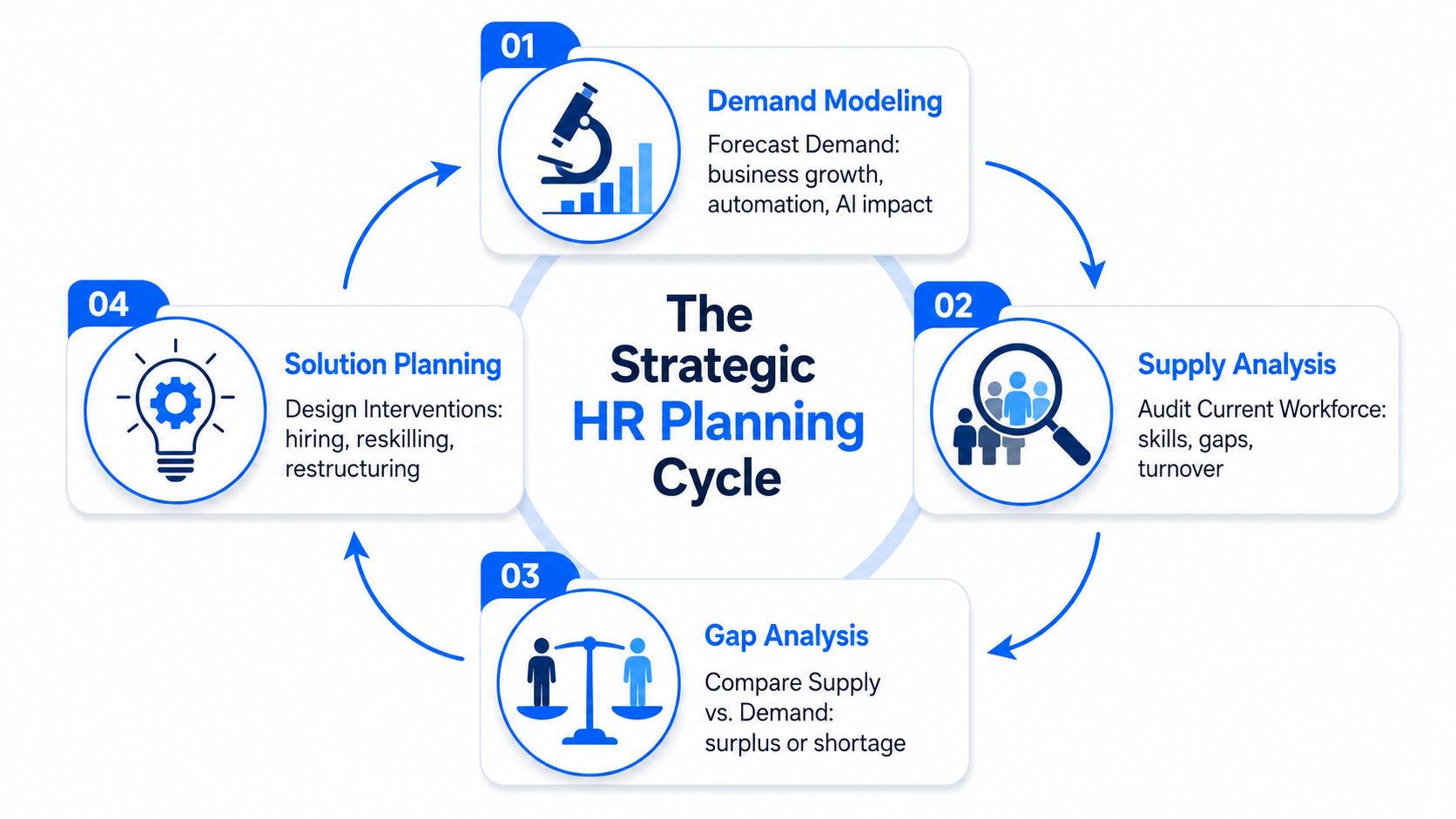
Step 1 Demand modeling
Start with the business plan, then model what work will change. Look at growth, automation, AI exposure, customer demand, and operating model shifts by role family. The output should be a forecast of roles, skills, and locations, not just an FTE total.
Step 2 Supply analysis
Map internal talent, turnover risk, mobility potential, and external labor pools. A real skills inventory matters here. HR should know what it already has, what it can move, and where it will have to recruit.
Step 3 Gap analysis
Compare demand and supply under base, optimistic, and downside scenarios. The best gap analyses separate role gaps, skill gaps, and capability gaps, because those require different interventions. A shortage of future digital supervisors is not the same thing as a shortage of forklift operators.
Step 4 Solution analysis
Choose the mix of hire, build, buy, redeploy, and automate. Each lever needs an owner, a timing estimate, and a cost conversation with finance. If a capability can be built in six months, do not default to external hiring.
Decision rule: if your solution set doesn’t include at least two levers, you’re probably overrelying on hiring.
SHRM’s guidance on strategic workforce planning stresses standardizing the process, centralizing planning expertise, and securing leadership buy-in so scenarios connect to strategy and financial goals (SHRM strategic workforce planning guidance). That matters because planning only works when someone owns the decisions, not just the spreadsheet.
Strategic HR Planning Frameworks You Can Use
The right framework depends on maturity, volatility, and HR capacity. Frameworks are lenses, not scripts. If you pick the wrong one, you’ll create a prettier deck, not better decisions.
How to choose the right framework
The 7S model works when you need a broad alignment lens across strategy, structure, systems, staff, style, skills, and shared values. Galbraith’s Star Model is stronger when organizational design is the primary issue, because it forces trade-offs across strategy, structure, processes, rewards, and people. A Balanced Scorecard translated to HR works for larger organizations that want clear measures across financial, customer, process, and capability outcomes. AI-aware capability frameworks are the better fit when skills volatility is high and roles are changing fast.
Avoid combining three frameworks at once. That usually produces a slide deck no manager can act on.
| Framework | Best For | Core Elements | Weakness in 2026 |
|---|---|---|---|
| 7S model | Broad alignment | Strategy, structure, systems, staff, style, skills, shared values | Can stay abstract without hard workforce decisions |
| Galbraith Star | Org design changes | Strategy, structure, processes, rewards, people | Needs strong leadership discipline |
| Balanced Scorecard for HR | Large organizations with mature metrics | Financial, customer, internal process, learning and growth | Can become KPI overload |
| AI-aware capability framework | Rapid role change | Skills taxonomy, job families, automation exposure, redeployment logic | Fails if skills data is stale |
The right question is not, “Which framework is most complex?” It’s, “Which framework will help us decide what to do next quarter?” For many organizations, that starts with a skills inventory and a narrower planning scope. Our skills inventory assessment 2026 resource is useful if you’re trying to move from assumptions to actual capability data.
Examples of Strategic Planning in HRM Across the Employee Lifecycle
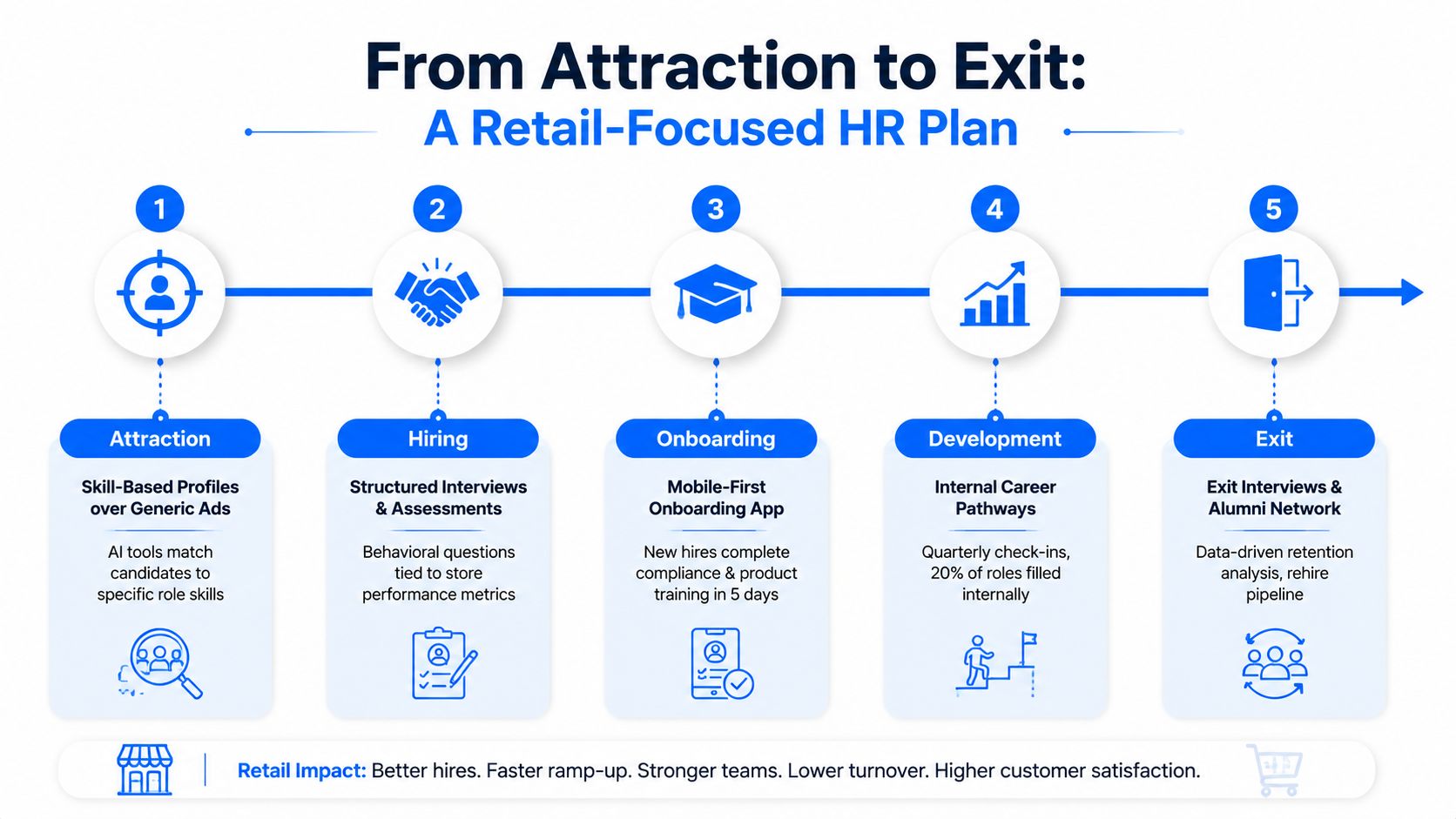
Strategic planning in HRM shows up in the employee lifecycle, or it doesn’t show up at all. In frontline-heavy businesses, the plan has to shape attraction, onboarding, development, mobility, retention, and exit as one system.
From attraction to internal mobility
A retail or healthcare organization shouldn’t write generic job ads and hope for the best. It should build skill-based profiles that reflect what work requires, especially as AI tools reshape frontline roles faster than requisition cycles can keep up. In onboarding, skills tagging helps new hires reach competence faster because managers can assign training to the gaps, not a standard checklist.
Development should follow capability, not tenure. That means career paths built around demonstrated skills, not just years in seat. Internal mobility then becomes a workforce strategy, not a retention slogan.
Retention and exit belong in the same plan
Retention problems often show up first in scheduling, manager consistency, or unclear growth paths. Exit interviews should feed the same workforce plan that guided hiring, because turnover in a critical role is a supply signal, not just an HR event. That’s where succession logic matters most.
For a stronger succession lens, see our succession planning framework. It connects directly to strategic planning because vacancies in critical roles are always more expensive than they look on paper.
In healthcare, the visible proof of strategic HRM is not a polished strategy deck. It’s whether nurse scheduling, credential tracking, and pipeline planning are working together so operations can cover demand.
HR Metrics That Show Whether the Plan Is Working
The right strategic HR dashboard is small, sharp, and decision-linked. Don’t build a 40-KPI dashboard nobody reads. Group your metrics by the decision they support, and force every metric to answer a specific planning question.
Four metric blocks to use
- Workforce shape: track FTE mix, critical role coverage, and skills inventory completeness. These tell you whether the organization has the right structure and visibility.
- Capability: measure time to competence, internal mobility rate, and learning tied to strategic skills. These show whether people can step into future work.
- Engagement and retention: watch regrettable attrition in critical roles, engagement for high performers, and manager health. These tell you where execution is breaking down.
- Financial impact: monitor revenue per FTE, HR cost ratio, and cost of vacancy. These tie workforce choices back to business pressure.
Match each metric to a decision
If critical role coverage drops, the plan should trigger succession action. If time to competence is slow, onboarding or manager coaching needs redesign. If internal mobility is flat, your employee development strategy probably isn’t creating real movement. If cost of vacancy rises, you need faster redeployment or more aggressive talent pipelining.
AI-enabled people analytics now makes near-real-time cohort cuts more practical, which means HR doesn’t have to wait for quarter-end to spot the problem. If you want a measurement lens focused on engagement specifically, our how to measure employee engagement guide is a useful companion.
Common Mistakes to Avoid in HR Strategic Planning
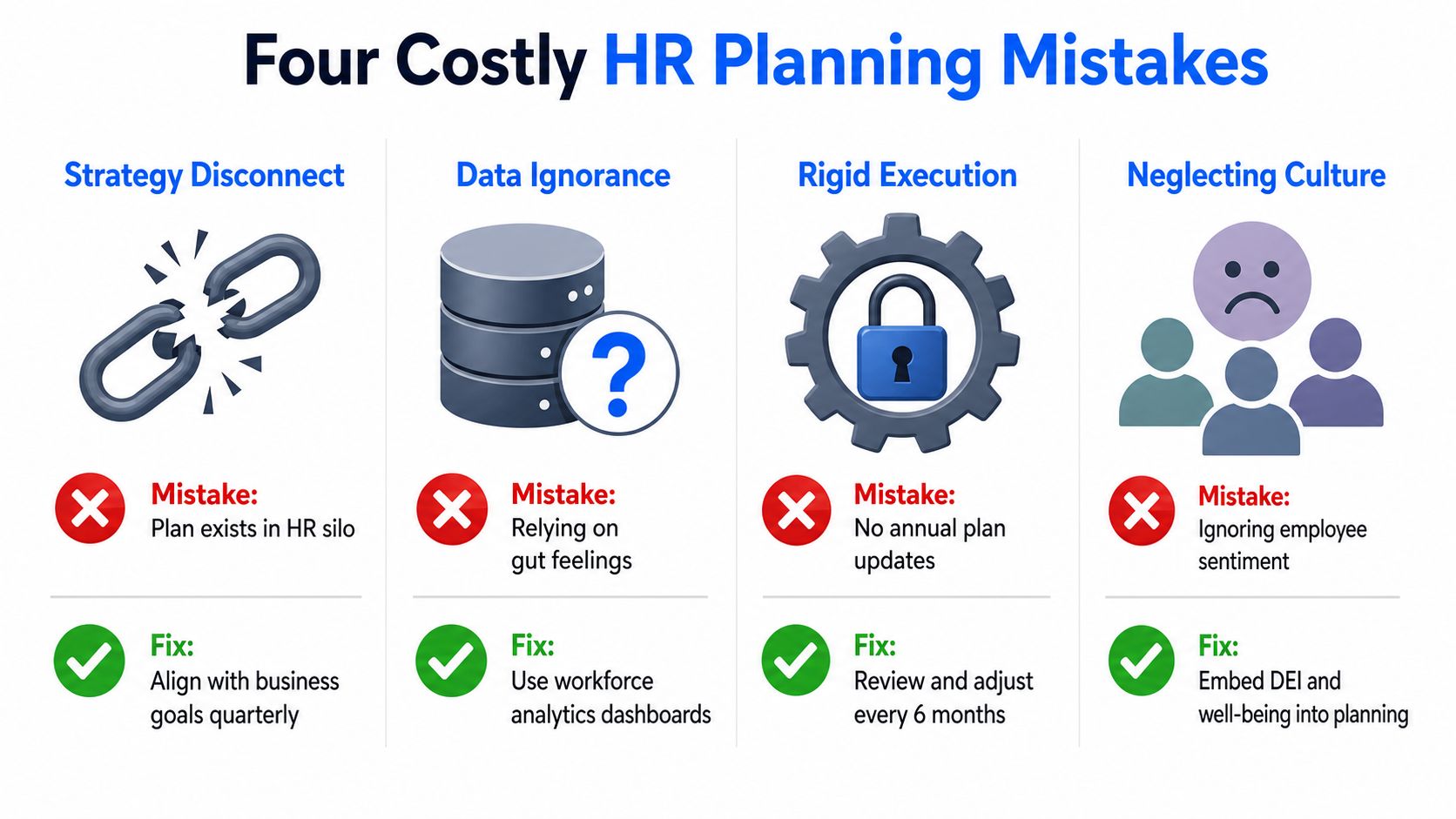
Most plans fail because HR treats planning like paperwork instead of workforce execution. That’s the mistake. A strategic plan that doesn’t change manager behavior, role design, or communication habits is just an internal presentation.
The four failure buckets
- Strategy misalignment: HR copies the corporate deck but never translates it into frontline role shifts. The signal is a plan that sounds right and changes nothing. Fix it by reviewing the business plan with operations and finance every quarter.
- Process gaps: HR runs supply and demand once, then never refreshes the baseline after AI or market shifts. The signal is stale skills data and surprise vacancies. Fix it with a formal six-month scenario refresh.
- Manager enablement failure: HR publishes the plan, but managers can’t operationalize it. The signal is low usage of dashboards, weak follow-through, and repeated escalation. Fix it by giving managers a simple weekly view of roles, risks, and actions.
- Measurement blind spots: Teams track training hours instead of capability coverage and time to proficiency. The signal is activity without improvement. Fix it by tying every metric to a decision.
Budget cycles push HR into reactive mode, and that destroys strategic credibility fast. When the plan changes only after the budget is approved, leaders stop believing it’s strategic at all.
A Practical Checklist and FAQs for HR Leaders
Use this as a 90-day execution checklist, not a theory exercise. The point is to build a plan that managers, finance, and operations can use.
The 90-day checklist
-
Confirm the business strategy input.
Owner: CHRO and CFO.
Deliverable: one-page summary of the next 3 to 5 years of growth, cost, and operating priorities. -
Map critical roles to capability clusters.
Owner: HR business partners with operations leaders.
Deliverable: a role map that identifies which jobs matter most to execution. -
Baseline the skills inventory.
Owner: Talent and analytics lead.
Deliverable: a current-state skills view by role family, not just by job title. -
Pressure-test AI exposure.
Owner: HR, operations, and technology leaders together.
Deliverable: a list of roles likely to change through automation, AI augmentation, or redesign. -
Align with finance on headcount and labor cost scenarios.
Owner: CHRO and finance partner.
Deliverable: base, upside, and downside workforce scenarios. -
Enable frontline managers.
Owner: HR operations and internal communications.
Deliverable: a simple dashboard and a manager guide written in plain language. Effective manager communication also requires clear talking points, regular check-ins, and communication channels that give employees a way to ask questions as workforce priorities change. If you need support on communication habits and listening loops, our employee listening strategy resource is worth using alongside the plan. -
Lock the quarterly refresh cadence.
Owner: executive team.
Deliverable: a recurring review agenda with decisions, not just updates.
Short version: if the plan doesn’t change what managers do on Monday, it’s decorative.
FAQs on Strategic Planning in HRM
What is strategic planning in HRM?
It’s the process of turning business strategy into workforce decisions about roles, skills, location, and timing over a multi-year horizon.
Why is strategic planning important in human resource management?
Because it helps organizations avoid skill shortages, weak succession pipelines, and last-minute hiring that can’t support future work.
What are the steps in strategic HR planning?
Use demand analysis, supply analysis, gap analysis, and solution analysis.
How does AI impact strategic workforce planning in 2026?
AI changes role design, skill requirements, and planning horizons, so HR has to refresh skills data and scenario assumptions more often.
How should companies plan for frontline employees?
Start with scheduling reality, communication channels, manager enablement, and role-specific skills, not generic office-based HR models.
How can HR leaders measure success?
Track critical role coverage, time to competence, internal mobility, regrettable attrition, and cost of vacancy.
What mistakes should organizations avoid?
Don’t confuse headcount planning with strategy, don’t let skills data go stale, and don’t expect managers to execute a plan they never helped shape.
Treat the plan as a living operating asset, or it won’t survive the next budget cycle.