A supervisor finishes a shift handover, a remote teammate misreads a message, and a customer escalation reaches someone who hasn’t practiced de-escalation. Soft skills development solves these gaps by turning communication, collaboration, judgement, adaptability, and emotional intelligence into observable workplace behaviors. For frontline and distributed teams, effective development isn’t a course catalog. It’s a workforce operating practice built into huddles, handoffs, manager coaching, tools, and performance measurement.
Key Takeaways
- Soft skills improve through practice and feedback, not completion certificates alone.
- Frontline programs must fit the shift, with mobile access, short activities, and manager reinforcement.
- Distributed teams need explicit communication behaviors for asynchronous work, escalation, and knowledge sharing.
- AI increases the value of human judgement, empathy, validation, and trust-building.
- Measurement should prioritize behavior change and operational outcomes, not attendance.
What Soft Skills Development Means in 2026
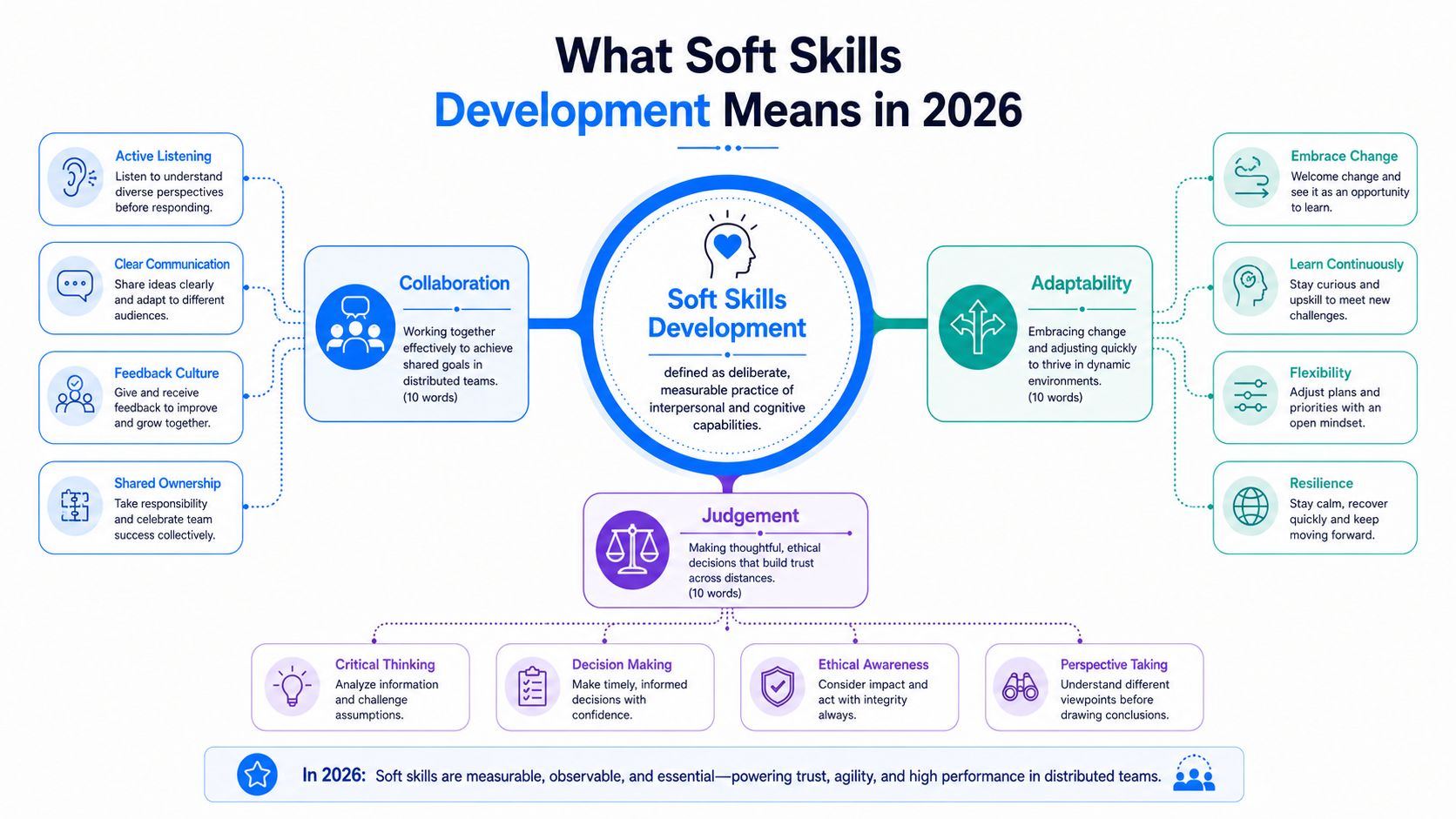
Soft skills development is the deliberate, measurable practice of building the interpersonal and cognitive capabilities employees use to work with people, handle uncertainty, and make sound decisions. It includes communication skills, active listening, collaboration, emotional regulation, customer interaction, problem-solving, adaptability, and judgement.
The distinction matters because a one-off webinar creates exposure, not necessarily capability. A real program maps skills to roles, gives employees realistic practice, provides fast feedback, and checks whether the behavior appears during actual work. That approach aligns with the broader idea of human agency at work, where people remain responsible for context, decisions, and relationships even as technology handles more routine tasks.
What belongs in the discipline
Soft skills development should include:
- Role-specific behaviors: A contact-center agent clarifies the customer’s issue before proposing a solution. A shift lead confirms priorities before assigning work.
- Practice channels: Huddles, simulations, peer shadowing, mobile learning, manager coaching, and after-action reviews.
- Reinforcement systems: Scheduling, learning platforms, performance conversations, internal communications, and team rituals should support the same behaviors.
- Evidence of transfer: Observation rubrics, quality reviews, customer feedback, peer input, and operational indicators show whether learning reached the job.
It shouldn’t include technical certifications, safety procedures, or compliance acknowledgments because those activities happen in the same learning platform. Those are important, but they test different capabilities.
AI changes the context. Employees increasingly need to brief AI tools clearly, validate outputs, spot missing context, escalate unusual situations, and explain decisions to other people. The differentiator isn’t only knowing how to use a tool. It’s knowing when to trust it, when to challenge it, and how to preserve human accountability.
A practical soft skills development system therefore has five parts: a skill taxonomy, accessible delivery channels, manager coaching, a measurement framework, and integration with workforce systems. Treating those parts as infrastructure keeps employee capability building connected to workforce experience rather than isolated inside L&D.
Why Soft Skills Matter More Than Ever for Employees
A technically capable employee can still slow a shift or remote workflow with an unclear update, incomplete handoff, avoidable conflict, or late escalation. Soft skills determine how reliably people coordinate when demand changes, information is incomplete, or a customer interaction becomes difficult.
Employer evidence supports treating these capabilities as workforce requirements. The OECD report on skill gaps in firms identifies gaps across several European countries in teamworking and problem-solving, alongside technical skill gaps. The report cites a UK employer study in which teamwork was valued by 55% of employers and communication by 52%, compared with 26% for computer skills. It also reports that 43% of respondents weren’t taught soft skills during childhood, while more than 27% of UK workers received no support developing them. The attribution matters: these figures come from the UK study as summarized by the OECD report.
The training expectation is becoming more formal. In SHRM’s 2022 Workplace Learning and Development Trends report, 84% of employees said soft-skills training was important, and leadership training was the most desired area at 54%. Organizations therefore need to schedule, fund, and reinforce capability building rather than leave it to informal experience.
Operational outcomes linked to proficiency
| Outcome | Soft skill lever | Typical directional impact |
|---|---|---|
| Customer recovery | Active listening and de-escalation | Faster resolution and more consistent service |
| Shift continuity | Clear handoffs and accountability | Fewer missed tasks and avoidable rework |
| Team productivity | Collaboration and problem-solving | Better coordination across roles and locations |
| Retention conversations | Empathy and manager coaching | Clearer expectations and stronger employee support |
| AI adoption | Judgement and critical thinking | Better validation, escalation, and responsible use |
These skills influence what happens after an employee is qualified, including throughput, error recovery, customer trust, and team retention. They belong in any employee engagement and retention strategy, especially where managers handle regular check-ins across shifts or time zones.
Frontline communication failures make the operational cost visible. A 2025 Unily analysis estimates annual enterprise losses of $80.6 billion from communication breakdowns and digital underinvestment in frontline workers. It also reports 376 hours per year per worker spent searching for, waiting on, or redoing tasks because information is inaccessible. Sending more announcements does not resolve unclear ownership or outdated guidance. The 2025 State of Internal Communications report found that 60% of respondents struggled to engage frontline workers, while 53% reported low intranet engagement and 47% cited outdated information.
Hard skills establish whether someone can perform a task safely and correctly. Soft skills affect whether the wider team performs consistently under pressure. HR and operations leaders should protect time for both through scheduling, manager expectations, coaching, and performance systems, treating interpersonal development as part of daily operations rather than optional professional development.
The Soft Skills That Actually Move Workplace Performance
The most useful workplace soft skills are the ones managers can observe during real work. A long list of desirable traits creates weak priorities. For frontline and distributed teams, six capabilities deserve early attention because they affect handoffs, customer interactions, decisions, and self-directed execution.
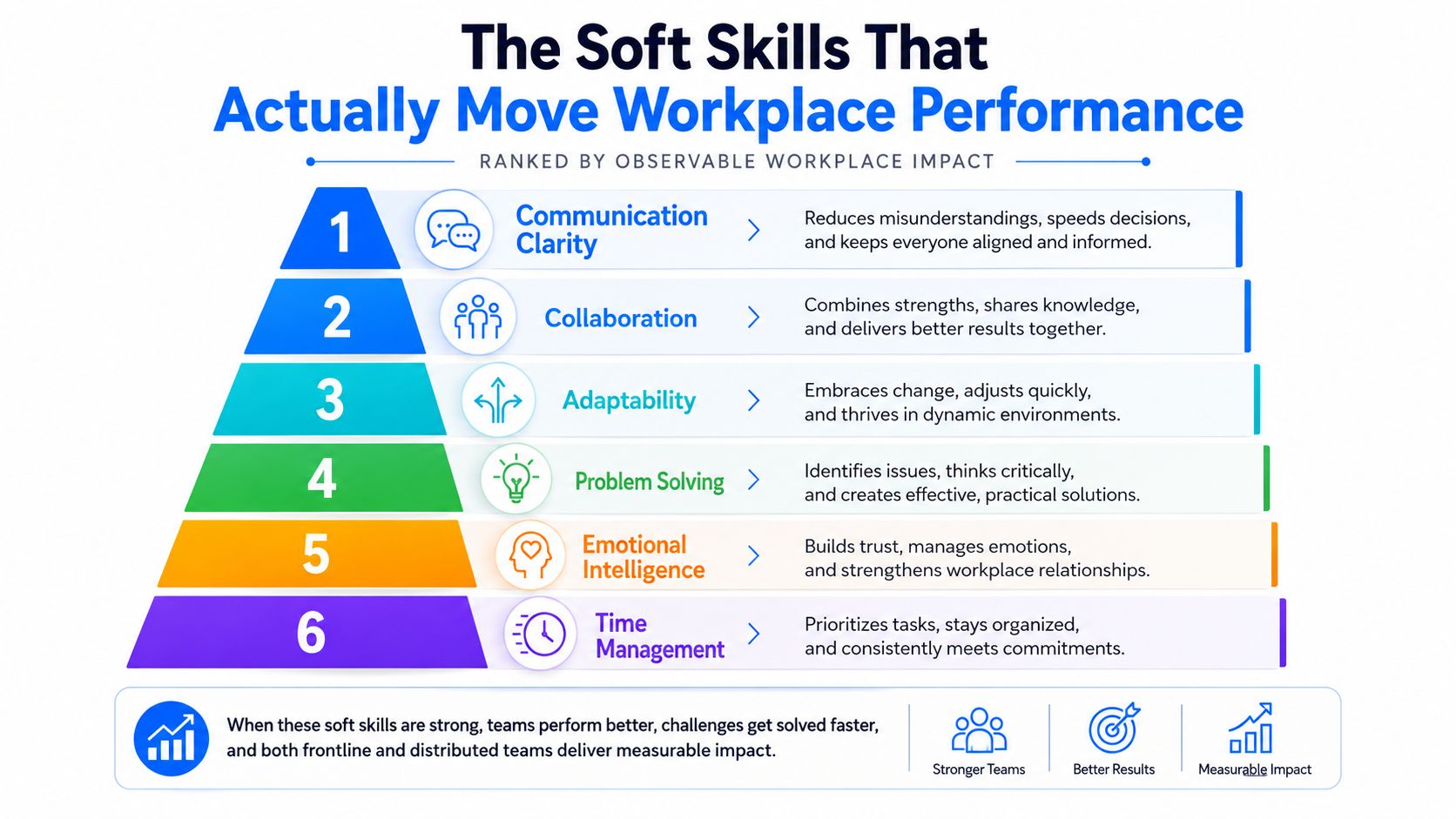
Six capabilities with visible workplace behaviors
-
Communication clarity
Employees state the issue, action, owner, and deadline without making colleagues reconstruct the context. In a distributed team, a useful update explains what changed, what is blocked, and what decision is needed. On a retail floor, it may mean telling the next shift which customer order requires follow-up and why. -
Collaboration across boundaries
Collaboration isn’t just being agreeable. It means sharing relevant information, coordinating dependencies, and making the next person’s work easier. A hospital unit improves coordination when staff confirm critical details during handoff instead of assuming the incoming team will find them. -
Adaptability under changing demand
Adaptability shows up when an employee reprioritizes calmly, learns a new process, or asks a focused question instead of resisting a change blindly. A contact-center agent may need to adjust a conversation when a policy changes during a busy period. -
Problem-solving and critical thinking
Employees identify the actual problem, separate facts from assumptions, test an option, and escalate when the risk exceeds their authority. This is more useful than asking people to “be creative” without giving them a decision process. -
Emotional intelligence at work
Emotional intelligence includes self-awareness, emotional regulation, empathy, and social judgement. A service employee who notices rising frustration can slow the interaction, acknowledge the concern, and offer a clear next step before the situation becomes a formal complaint. -
Self-management and accountability
Distributed work requires employees to manage priorities without constant observation. The behavior is visible when someone flags a delay early, records the decision, completes the agreed action, and asks for help before a deadline becomes a failure.
Creativity and leadership presence still matter, but they shouldn’t automatically outrank these foundations for every individual contributor. A warehouse associate may need reliable escalation and teamwork before a creativity workshop. A remote analyst may need concise written updates before advanced presentation training.
AI-augmented work adds another layer. Employees must provide clear instructions, question weak outputs, protect confidential information, and explain why a recommendation was accepted or rejected. Organizations can use a structured skills inventory assessment to identify which behaviors matter most by role instead of assigning the same soft skills training to everyone.
Soft Skills vs Hard Skills and Where Each Belongs
Hard skills are role-specific abilities that can usually be tested, demonstrated, or verified through output. Soft skills describe how employees communicate, coordinate, regulate responses, and apply judgement while doing that work. The categories overlap in practice, but they serve different operational purposes.
| Dimension | Hard skills | Soft skills |
|---|---|---|
| Definition | Technical knowledge and task execution | Behavioral, relational, and cognitive workplace capability |
| Learnability | Often taught through instruction, practice, and testing | Built through practice, feedback, reflection, and reinforcement |
| Measurement | Tests, certifications, accuracy, output, or completion of a procedure | Observations, interaction quality, decisions, feedback, and team outcomes |
| Frontline example | Operating equipment or using a point-of-sale system | Explaining a delay and resolving customer frustration |
| Typical failure when overused | Technical proficiency without coordination | Strong rapport without sufficient technical accuracy |
Hard skills commonly gate entry into a role. Certifications, safety procedures, clinical protocols, tool proficiency, and product knowledge protect quality and reduce risk. Soft skills influence what happens after the employee is qualified, including throughput, error recovery, customer trust, team retention, and cross-shift coordination.
Consider a 4 a.m. shift handoff. The employee needs hard knowledge of the process, systems, and current workload. They also need the soft skills to summarize the situation, identify unresolved risks, listen to questions, and confirm ownership. A gap in either category can interrupt the next shift.
The same blend appears in healthcare, retail, manufacturing, and field service. A nurse needs clinical competence and empathetic communication. A retail associate needs product knowledge and consultative selling. A field technician needs diagnostic skill and the ability to explain the repair in language the customer understands.
Operational rule: Don’t choose between hard and soft skills. Design the workflow so employees practice both at the moment each is required.
For distributed organizations, a work graph can help leaders think about the relationships among people, tasks, systems, knowledge, and decisions. That view prevents soft skills from becoming an abstract personality category. It places communication and judgement where they belong, inside the flow of work.
How to Build a Soft Skills Development Program Step by Step
A strong soft skills training program starts with an operational problem, not a catalog of courses. The sequence below turns a broad ambition such as “improve communication” into a program managers can deliver and leaders can evaluate.
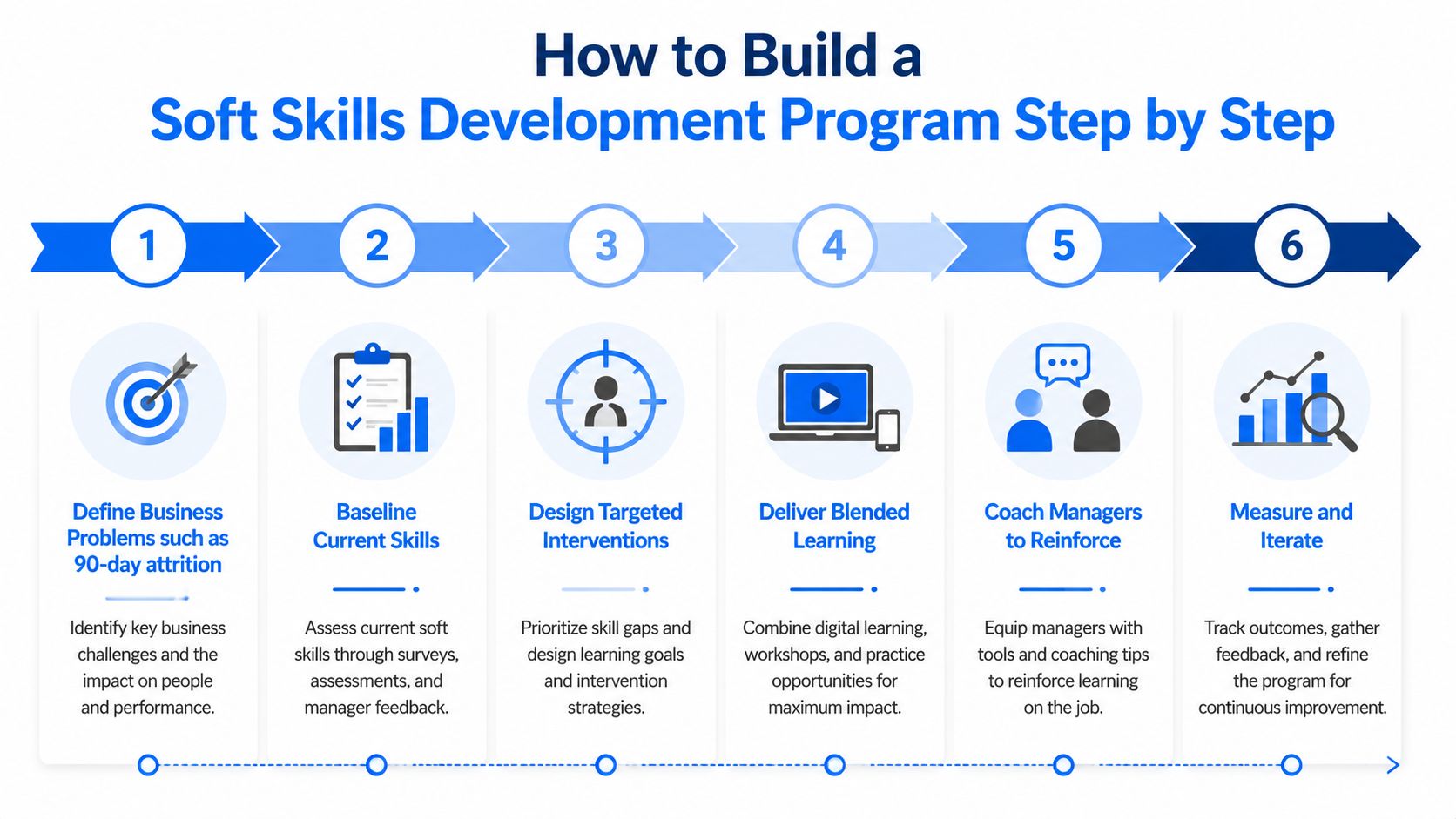
Six implementation steps
-
Define the business problem.
Start with a visible issue such as early attrition, customer dissatisfaction, safety events, low first-contact resolution, missed handoffs, or slow escalation. Then write a skill hypothesis. For example, “new agents need better active listening and issue summarization” is more useful than “agents need stronger people skills.” -
Map behaviors to roles.
Define what competent behavior looks like in context. A competency matrix might use columns for role, critical situation, target behavior, unacceptable behavior, practice method, observer, and outcome signal. Keep the matrix narrow enough that supervisors can use it during a real shift. -
Choose delivery methods that match the work.
Combine short mobile lessons, peer shadowing, scenario drills, manager coaching, and AI role-play. A simulated difficult conversation gives employees a low-risk place to rehearse, but it shouldn’t replace a live conversation followed by feedback. -
Embed practice in existing routines.
Use the start-of-shift huddle to rehearse one behavior, the handoff to observe it, and the after-action review to discuss what happened. Off-shift e-learning should supplement these moments, not carry the entire program. -
Instrument leading and lagging indicators.
Leading indicators can include observation rubrics, peer feedback cycles, pulse responses, scenario performance, and conversation-quality signals. Lagging indicators can include retention, quality scores, customer feedback, rework, escalation patterns, or resolution outcomes. Avoid claiming causation unless the evaluation design supports it. -
Govern and iterate.
An HR, operations, and L&D triad should review adoption, behavior evidence, and business signals together. A quarterly review can retire content that employees don’t use, revise scenarios that don’t reflect current work, and adjust manager expectations.
Three templates worth building
Competency matrix: Map each role to three or four priority behaviors, two realistic situations, one observation method, and one operational signal.
30-60-90 rollout plan: Use the first phase to baseline and pilot, the second to coach and refine, and the third to compare evidence across shifts or sites before scaling.
Manager coaching rubric: Score whether the manager observed the behavior, described the evidence, asked the employee to self-assess, agreed on a next action, and followed up.
Integration matters as much as content. Connect the LMS to HRIS role data, use scheduling systems to protect coaching windows, and surface prompts in the tools managers already open. A practical employee listening strategy can add context, but listening should inform the program rather than substitute for behavior observation.
Training Frontline and Distributed Teams Where Time Is Scarce
The assumption that employees need a full classroom session before they can develop soft skills is wrong for shift-based work. Frontline workers often have limited uninterrupted time, inconsistent device access, varying language and literacy needs, and managers responsible for several locations. Distributed employees face a different constraint, fragmented communication and fewer chances to observe behavior naturally.
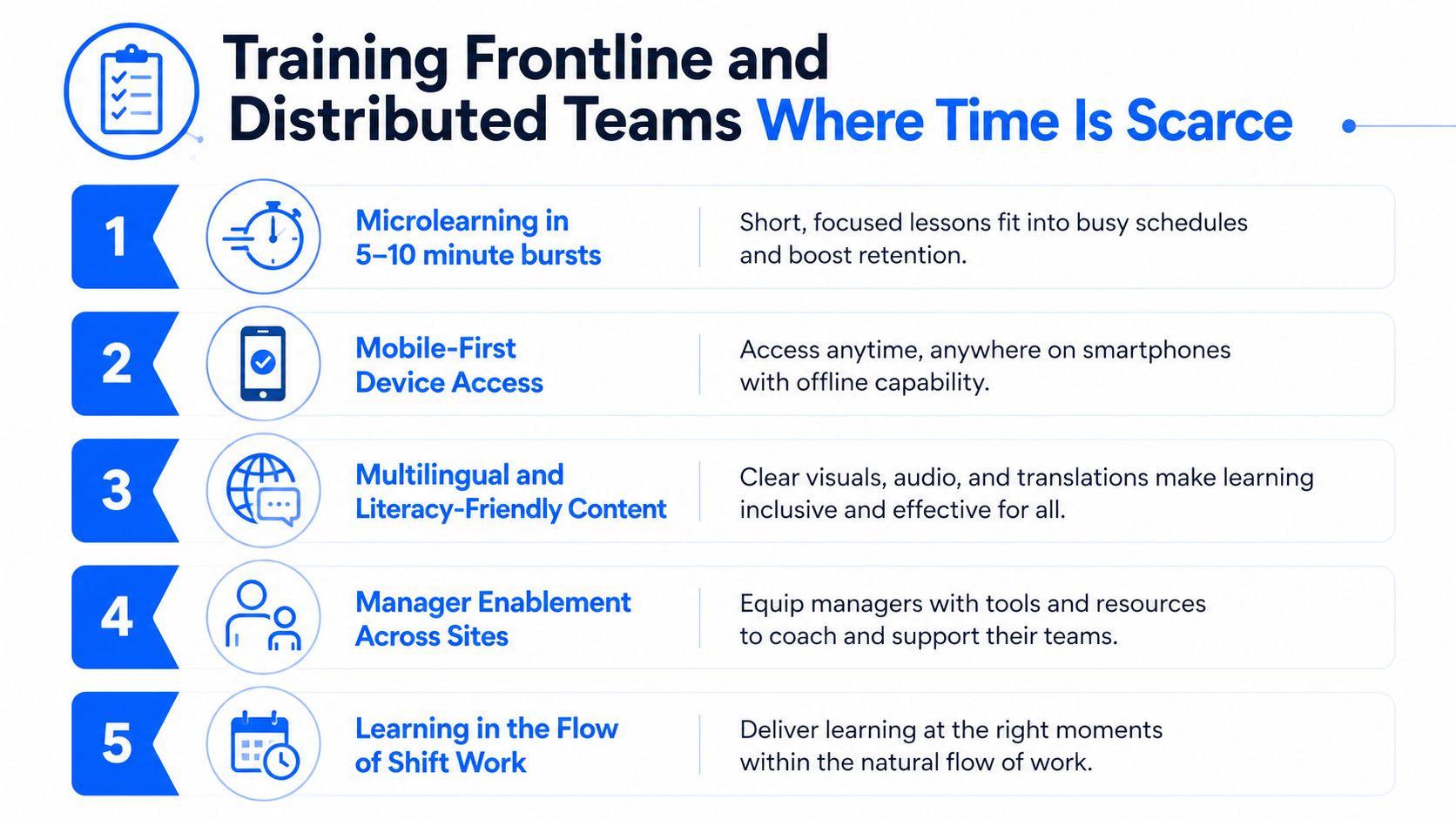
Design for the actual shift
Use three-to-seven-minute mobile activities for one behavior at a time. Push them during predictable shift gaps, before a team huddle, or during a commute where local policy allows learning. Avoid making employees complete training while they’re serving customers, operating equipment, or handling clinical responsibilities.
A practical frontline design can include:
- Scenario libraries: Create retail, healthcare, hospitality, manufacturing, transportation, and field-service examples. Translate the dialogue and adapt it for local language, literacy, and cultural context.
- Peer learning circles: Anchor each quarter around one skill, such as de-escalation or clear handoffs. Ask employees to bring one real example and one question.
- Micro-coaching windows: Have a manager observe one interaction per shift and provide same-day feedback. The observation can be brief, but it must identify a specific behavior.
- Offline access: Provide downloadable packs for connectivity gaps, SMS nudges for reminders, and QR codes on break-room boards that open the correct resource.
- Consistent reinforcement: Use a short script, an observation scorecard, and a follow-up prompt so managers don’t have to invent the coaching process.
For teams spread across shifts and locations, these coaching routines also depend on reliable frontline employee communication, especially when employees need mobile access, multilingual messages, and clear manager-led follow-through.. Give them examples of useful feedback, escalation language, and questions that help employees reflect. Protect coaching time in schedules instead of adding it to an already full list of responsibilities.
Pilot readiness checklist
- Device access: Confirm which employees can use mobile, shared, or offline learning.
- Manager certification: Verify that supervisors can run the observation and feedback routine.
- Content localization: Test language, reading level, scenarios, and imagery with the target workforce.
- Measurement wiring: Connect learning activity, observation data, quality signals, and employee feedback before launch.
- Operational fit: Confirm that huddles, handoffs, and coaching windows exist on every pilot shift.
The same principle applies to remote team communication. Replace physical observation with recorded role-play, structured peer feedback, manager one-to-ones, and explicit written norms for response times, escalation, decision logs, and meeting participation.
Common Mistakes in Soft Skills Development Programs
The most common failure is treating soft skills development like compliance training. A company assigns a generic course, watches completion rise, and assumes employees can now handle conflict, coach peers, or communicate clearly under pressure. The certificate exists, but the behavior doesn’t appear during the shift.
The catalog dump
A broad library can look generous while creating decision fatigue. Assigning dozens of generic modules to cashiers, nurses, technicians, and remote analysts ignores the situations in which each group needs to perform. A tighter program selects a few behaviors, gives employees realistic scenarios, and removes content that doesn’t change the work.
Measurement theater
Completion rates and badges are easy to report, but they don’t answer whether handoffs improved or customer conflicts resolved more effectively. Use leading evidence such as observed behaviors, peer feedback, coaching notes, and scenario performance before waiting for retention or quality outcomes.
The J-PAL field study of soft-skills training for Indian garment workers illustrates why operational evaluation matters. The study found a 13.5% productivity gain, treated workers were 20% more productive than controls after the program, and the firm’s net return reached 256% eight months after completion. It also found gains were larger for joint operations, which supports measuring teamwork in the workflow rather than relying on attendance.
Manager neglect
Frontline supervisors are the delivery channel. If they don’t reinforce communication, de-escalation, or teamwork during huddles, learning fades. A separate retail leadership and communication intervention study found positive effects on store-level and individual productivity, along with spillovers from trained managers to untrained sales representatives. That finding supports training managers as multipliers, not treating them as administrative recipients.
Context blindness and AI overreach
A single program won’t fit a retail cashier, ICU nurse, and field technician. Segment by environment, language, device, risk, and customer interaction. AI can personalize practice and flag possible coaching opportunities, but generic feedback can erode trust if managers and employees can’t see how the system reached its conclusion.
Soft Skills Development FAQs for 2026
What is the fastest soft skill to improve on a frontline team?
Active listening and de-escalation are practical starting points because they appear in customer interactions, peer coordination, and shift handoffs. Employees can practice them quickly when scenarios are specific and managers give feedback on observable behaviors.
How do you measure soft skills development without surveys?
Use behavior-based evidence, including peer observation scores, manager coaching notes, customer feedback connected to the interaction, and time from conflict to resolution. Combine multiple signals because no single measure captures interpersonal capability reliably.
Are soft skills trainable, or should companies hire for them?
Both approaches matter. Hiring affects the starting mix of capability, while structured practice and feedback can raise performance among current employees. Training is especially valuable when the organization needs shared behaviors across shifts and locations.
Should soft skills training be e-learning or live coaching?
Use a blend. Short, role-specific digital practice can prepare employees, while manager-led rehearsal and feedback connect the skill to actual work. Fully self-directed learning often struggles to transfer without reinforcement.
What role does AI play in 2026?
AI can personalize content, simulate difficult conversations, and identify possible coaching moments from work interactions. People must validate scenarios, protect privacy, review feedback, and retain responsibility for decisions.
Which metric matters most?
Shift-level behavior change matters more than completion. Choose the behavior first, then connect it to relevant quality, customer, productivity, safety, or retention signals.
The scale of AI adoption makes this integration practical rather than theoretical. McKinsey’s 2025 workplace survey found that 94% of employees and 99% of C-suite leaders reported some familiarity with generative AI tools. A 2026 analysis of BCG’s AI at Work findings reported that positive sentiment rose from 15% to 55% when leaders showed strong support, reinforcing the value of instruction, in-person practice, and coaching.
Soft skills development works when leaders connect communication, technology, manager behavior, and operational execution. Start with one workforce problem, define the behaviors that affect it, give employees realistic practice, and measure what changes on the job. If your team is ready to move beyond course completion, audit one frontline or distributed workflow this month, identify its highest-cost communication gap, and build a small coached pilot around it.