Only 19% of organizations had formal succession plans in a 2025 benchmark, while 72% kept succession planning mostly at the executive and senior-management level (Scott Madden, 2025). A strong succession planning framework fixes that gap by identifying business-critical roles, building successor pools, testing readiness with evidence, closing skill gaps, and reviewing the plan continuously so operations don’t wobble when people move, leave, or get promoted.
- Start with risk, not titles. A role is critical when its loss creates real operational disruption.
- Use evidence, not vibes. Readiness should come from skills proof, behavioral assessment, and structured feedback.
- Plan for more than executives. Frontline, shift-based, and specialist roles often carry the biggest continuity risk.
- Make development specific. Stretch work, cross-training, shadowing, and mentoring beat generic leadership training.
- Review it like an operating system. Succession plans need regular updates, not annual dusting.
What a Succession Planning Framework Includes
A succession planning framework is the operating system for leadership continuity. It is not a spreadsheet of backup names. It connects critical roles, successor pools, readiness assessment, development actions, and governance so the organization can keep serving customers, patients, residents, and internal stakeholders when people move, leave, or get promoted.
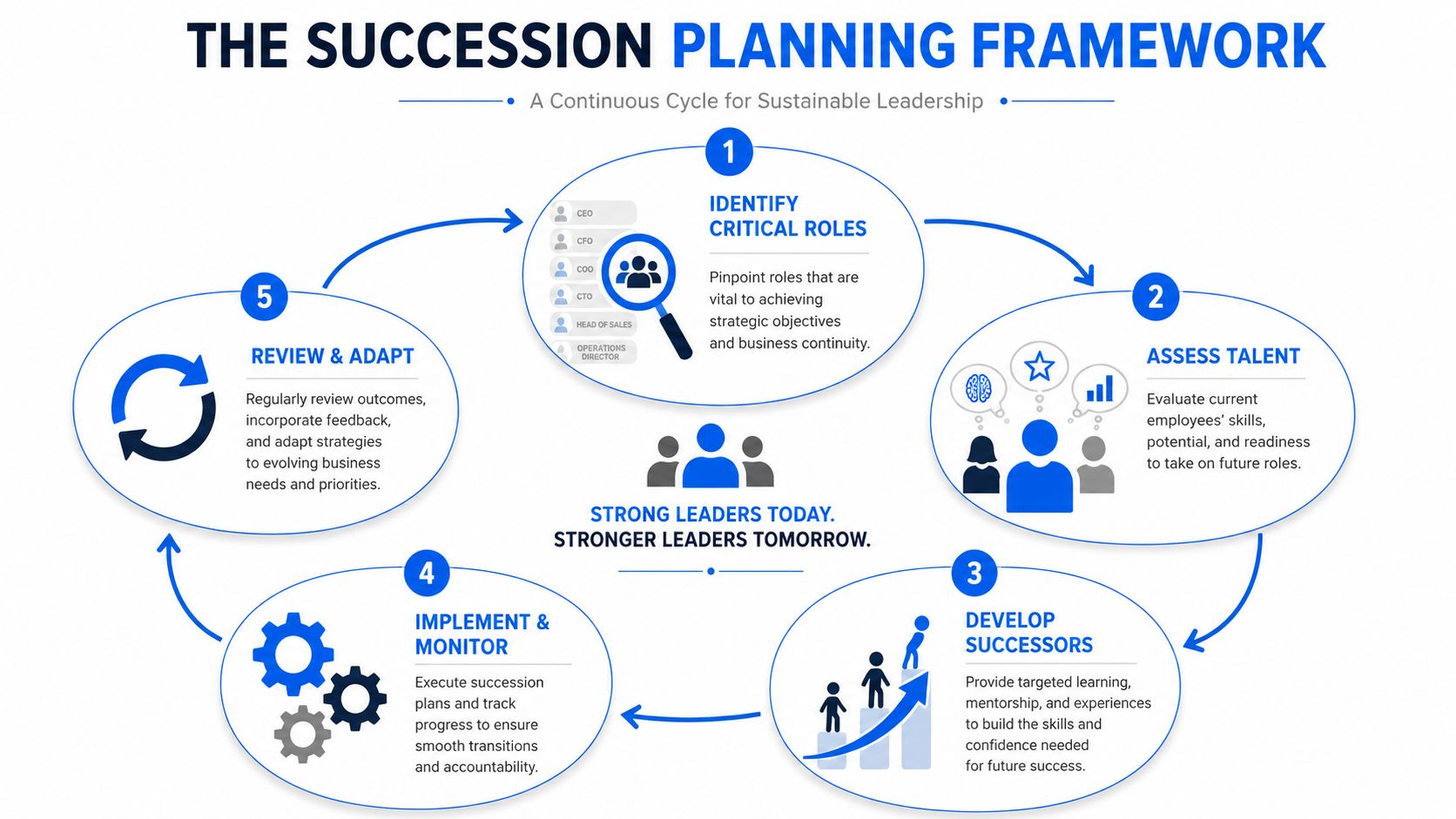
The gap usually shows up in the work, not in the org chart. The framework has to cover more than executive names, because continuity risk often sits in operational roles, shift-based supervision, and specialist positions that keep day-to-day work moving. It needs role prioritization, competency expectations, development tracking, and a review cadence that can keep up with labor movement and business change. For a broader operating view of talent and work, the Turn On Work work graph is a useful lens.
The core pieces that have to fit together
A usable framework starts with talent segmentation. That means separating roles that carry real continuity risk from roles that can be filled more easily. It then adds a skills profile for each role, a successor pool with more than one person where practical, and a readiness model that shows who is ready now, who needs targeted development, and who is a longer-term prospect.
Practical rule: if the framework cannot survive a manager leaving, a shift changing, or a site opening in a different time zone, it is not a framework yet. It is a document.
It also needs governance. Someone owns the plan, someone reviews it, and someone updates it when roles change, people transfer, or skill requirements shift. That is the difference between succession planning and replacement planning. Replacement planning names a single backup for one person. Succession planning builds a broader bench for a role and the capabilities around it.
The distinction from workforce planning matters too. Workforce planning looks at headcount, labor demand, and skill supply at a macro level. Succession planning is narrower and deeper. It asks who can step into a specific critical role and what it would take to get them there.
It is also not the same as career development. Career development supports an individual’s growth goals. Succession planning aligns development to organizational continuity needs. Those can overlap, but they are not interchangeable.
Identify Critical Roles and Succession Risks
Critical roles are not the most visible jobs on the org chart. They are the roles whose loss would create unacceptable risk to mission, operations, safety, compliance, revenue, or customer experience. The U.S. Geological Survey’s desk guide defines criticality in those terms, and that framing is more useful than job title prestige because it forces leaders to focus on business impact rather than hierarchy (USGS desk guide).
A practical way to sort roles is to look at three lenses, revenue impact, knowledge concentration, and replaceability timeline. Pin’s 2026 guide offers a useful screen, if a role would take more than 60 days to replace externally, it should be treated as critical (Pin, 2026). That test is especially helpful when managers say every role matters, but cannot explain which ones create real continuity risk.
Build the critical-role inventory
Start with the roles that would hurt the most if they disappeared tomorrow. Include executives, but also plant managers, branch supervisors, technical specialists, schedulers, and frontline team leads. In deskless environments, a single experienced night-shift supervisor can matter more to daily continuity than a senior manager who mostly shapes strategy.
Use a simple filter:
- Business impact. Does the role affect revenue, service levels, compliance, or safety?
- Knowledge concentration. Is the know-how concentrated in one person or a very small group?
- Replaceability. Could someone from outside the organization realistically fill it quickly?
- Operational exposure. Would the loss create a visible disruption on a shift, in a location, or in a customer journey?
- Dependency risk. Is this role a single point of failure for systems, approvals, or specialized work?
A role can be “important” without being critical. Succession planning should reserve the highest level of attention for roles where the loss would cause measurable operational strain.
The problem with many programs is scope. A recent benchmark found that succession planning still centers on executive and senior-management roles, which leaves out the managers and specialists who keep the operation stable (Scott Madden, 2025). That gap shows up fast in distributed operations, where coverage depends on supervisors, dispatchers, site leads, and subject-matter experts who are far from headquarters and hard to replace at short notice.
Risk review should also include movement risk, not just vacancy risk. A valued employee may not be leaving today, but they may be mobile, overloaded, or carrying knowledge that no one else has. A stay interview template for managers with questions, risk signals, and action tracking helps managers surface that kind of risk early, before a resignation turns into a coverage gap.
Assess Potential Successors and Evaluate Readiness
Once you know which roles matter most, the next step is to assess who can realistically step into them. The biggest mistake here is relying on “high potential” labels that mean different things in different teams. A strong succession planning framework uses evidence, not reputation.
TalentGuard’s model is useful because it treats each role as a skills-and-proficiency profile, not a title match, and it evaluates readiness with three separate evidence layers, verified skills proficiency, behavioral talent assessment, and 360-degree feedback (TalentGuard framework). That approach matters because it reduces manager bias and self-report inflation. A person may be well liked, visibly ambitious, or highly productive in their current job, but none of that automatically proves readiness for a different role.
Use a three-layer readiness check
Start with verified skills proficiency. Look for completed assignments, project outcomes, certifications, and evidence that the person has already done part of the target role. Then assess behavioral talent, especially how they handle ambiguity, conflict, decision-making, and pressure. Finish with 360-degree feedback from peers, direct reports, and cross-functional partners so the picture isn’t limited to one manager’s view.
A simple readiness model works best in practice:
- Ready Now. Could step into the role with minimal transition support.
- Ready in 1–2 Years. Has the capability foundation, but needs targeted development.
- Longer-Term Potential. Shows promise, but needs deeper experience before the role is realistic.
That model keeps the discussion grounded. It also helps leaders avoid the common mistake of confusing current performance with future readiness. A great individual contributor isn’t automatically a great supervisor, and a strong supervisor isn’t automatically ready for enterprise leadership.
For broader talent signals and growth-related input, the career growth and development survey template for better employee retention can help capture aspiration, mobility interest, and development appetite without turning the process into guesswork.
AI can support this step in 2026 by mapping skills, analyzing workforce data, and surfacing hidden talent pools. Used well, it helps you see patterns a spreadsheet misses. Used badly, it becomes another opaque score. AI should inform the conversation, not make the final promotion or succession decision automatically.
Best practice: if you can’t point to evidence for why someone is on a succession slate, they’re not really on a succession slate. They’re on a manager’s hunch list.
A simple assessment sequence
- Match the role profile. Define the skills and behaviors the role requires.
- Check proof. Review real work, not just resumes or aspiration.
- Calibrate across managers. Compare notes so one manager’s standards don’t skew the pool.
- Assign readiness. Place each candidate into the ready-now, 1–2-year, or longer-term bucket.
- Document the gap. If they’re not ready, say exactly why.
Build Development and Transition Plans
A successor is only useful if the organization closes the gap between where that person is today and where the role demands them to be. That means development has to be specific, practical, and tied to the exact readiness gap. Generic leadership training rarely fixes role-specific problems.
The U.S. Office of Personnel Management’s six-step process is a good backbone here because it treats succession planning as an ongoing management system, linking succession to strategy, analyzing gaps, identifying talent pools, developing strategies, implementing them, and reviewing results (OPM succession planning PDF).
Turn gaps into development actions
Start by naming the gap in plain language. If the candidate can lead peers but struggles with cross-functional influence, give them a project that forces that skill. If they know the operation but not the numbers, have them own a budget or forecasting task. If they need broader perspective, add a rotation or shadow assignment.
Useful development actions include:
- Stretch assignments. Give them a real problem with visible stakes.
- Mentoring. Pair them with someone who has already done the role.
- Cross-functional projects. Build enterprise perspective and stakeholder range.
- Job shadowing. Let them observe the role before they own it.
- Targeted training. Fill specific skill gaps, not generic learning catalogs.
Frontline and deskless environments need a different delivery model. Classroom-heavy leadership programs don’t work well when managers are on rotating shifts, travel between sites, or have fragmented learning time. In those settings, microlearning, cross-training, shift-overlap shadowing, and mobile-delivered knowledge resources are more realistic. Knowledge transfer has to happen in the workflow, not in a training room that nobody can attend.
For operational knowledge capture, the internal knowledge base matters because succession fails quickly when tribal knowledge lives only in one person’s head. If the successor can’t find procedures, contacts, escalation paths, and local nuances in a usable format, the plan is incomplete.
Don’t skip transition planning
Transition planning is separate from development. It covers how handoff happens when the move comes. That means documenting critical contacts, scheduling stakeholder introductions, sequencing responsibilities, and deciding how long the overlap will last.
A clean handoff usually includes:
- Knowledge transfer. Document key decisions, routines, and risk points.
- Stakeholder mapping. Identify who the successor needs to know.
- Phased ownership. Move responsibility in stages, not all at once.
- Support window. Keep the outgoing leader available for questions.
Succession Planning Examples by Role and Company Size
The same framework looks different depending on the role and the operating model. A mid-size company, a growing tech firm, a plant with shifts, and a small business don’t have the same talent depth or development options, so the plan has to reflect reality instead of aspiration.
The table below compares role types and what tends to matter most.
| Role Type | Critical Risk | Successor Pool Size | Key Development Method | Review Cadence |
|---|---|---|---|---|
| Executive leadership | Strategic continuity, investor confidence, decision velocity | 2 to 3 where possible | Cross-functional exposure, board-level preparation, mentoring | Quarterly |
| Department manager | Team execution, coordination, people leadership | 1 to 2 | Stretch assignments, coaching, shadowing | Quarterly |
| Specialist or technical role | Deep knowledge, compliance, system stability | 1 to 2 | Knowledge transfer, documentation, paired work | Monthly to quarterly |
| Frontline supervisor | Shift coverage, service quality, safety | 1 to 3 | Cross-training, shift overlap, mobile learning | Monthly |
| Small business owner or operator | Client continuity, vendor relationships, operational memory | Often one named successor plus an external contingency | Cross-training, documentation, external readiness planning | Monthly |
For frontline engagement and retention context, the frontline employee engagement resource helps frame why visibility, communication, and practical support matter as much as title progression.
Hypothetical examples
A hypothetical mid-size company identifies its COO as a critical role, but the primary risk is the plant operations manager who understands the production rhythm, vendor dependencies, and shift issues. The successor pool includes one deputy manager ready in 1 to 2 years and one senior supervisor with longer-term potential.
A hypothetical growing technology firm treats department managers as critical because they coordinate product, engineering, and customer delivery. The successor is a team lead with strong project outcomes, but the readiness gap is cross-functional influence. The development plan is a cross-team launch project and quarterly coaching.
A hypothetical healthcare operation identifies a night-shift frontline supervisor as critical because staffing, handoffs, and escalation decisions happen after hours. The best successor isn’t the most senior nurse, it’s the person who can preserve coverage, compliance, and communication under shift constraints.
A hypothetical small business may not have an internal successor for every role. In that case, succession planning includes external recruitment triggers, knowledge documentation, and an ownership transfer path for the roles that can’t be filled from inside.
How to Measure and Review Succession Plans
A succession plan that isn’t measured becomes stale fast. The right metrics show whether the organization has real coverage, not just paperwork. They should support continuity and development decisions, not become a standalone HR scorecard.
Phenom’s modern framework points to KPIs like bench strength, readiness scores, coverage, and representation as leading indicators of succession health (Phenom, 2025). Those are useful because they tell you whether the pipeline is getting stronger before a vacancy appears.”
Metrics that matter
Track the following indicators:
- Succession coverage. How many critical roles have at least one identified successor?
- Ready-now successor coverage. How many critical roles can be filled immediately from inside?
- Internal promotion rate. Are critical roles being filled from the pipeline?
- Development-plan completion. Are successors finishing the actions assigned to them?
- Time to fill critical roles. How long does it take when a vacancy opens?
- Successor retention. Are the people in the pipeline staying?
- Leadership pipeline strength. Is the bench deep enough for the roles you care about?
Review cadence should match business risk. Critical roles in volatile operations may need monthly or quarterly review. Slower-moving organizations can review less often, but the plan still needs refreshes when people leave, roles change, reorganizations happen, or a successor gets promoted out of the pool.
A high coverage number means little if every listed successor is stuck in the same development gap. Measure depth, not just names.
Good review meetings include HR, business leaders, and the manager who owns the role. They should end with decisions, not just discussion. If the review doesn’t change a development action, a readiness rating, or a coverage gap, it didn’t really function as governance.
Succession Plan Template and Common Mistakes to Avoid
A usable succession plan template needs to work for executives and frontline roles alike. Keep it simple enough to maintain, but detailed enough to drive action.
Succession planning template
| Field | What to capture |
|---|---|
| Critical role | The role being planned for |
| Current role holder | Who is in the role now |
| Business impact or risk | Why the role matters |
| Potential successors | One or more internal candidates |
| Readiness level | Ready now, ready in 1 to 2 years, longer-term potential |
| Key strengths | Evidence-based strengths relevant to the role |
| Development gaps | Specific gaps blocking readiness |
| Development actions | Stretch work, mentoring, shadowing, training, cross-training |
| Expected readiness timeline | When the candidate could be ready |
| Plan owner | Who is accountable |
| Review date | When the plan will be revisited |
Common mistakes that derail the process
- Treating succession as a one-time event. Plans go stale when they’re not revisited.
- Limiting it to the C-suite. Operational and frontline roles carry real continuity risk.
- Relying on manager opinion alone. Evidence beats familiarity.
- Ignoring role change. A role can become critical long before the incumbent leaves.
- Assigning vague development. “Take a leadership course” isn’t a plan.
- Skipping transition detail. A successor can still fail if handoff is chaotic.
Use the template as a working document, not a compliance artifact. If the development actions aren’t tied to actual business needs, the plan won’t build readiness where it matters.
FAQs on Succession Planning Framework
What is a succession planning framework?
It’s a structured system for identifying critical roles, assessing internal talent, closing readiness gaps, and reviewing the plan continuously so the business can keep operating when people change roles or leave.
What are the steps in succession planning?
A practical sequence is critical role identification, successor assessment, readiness rating, development planning, transition planning, and regular review.
How do you create a succession plan?
Start with the roles that create the most operational risk, assign potential successors, document readiness and gaps, then build specific development actions tied to those gaps.
What is the difference between succession planning and replacement planning?
Replacement planning names a backup for one role. Succession planning builds a broader, evidence-based pipeline for critical roles and the capabilities around them.
How often should succession plans be reviewed?
Review them on a regular cadence, often quarterly or monthly for high-risk roles, and update them whenever roles, people, or business priorities change.
How can AI support succession planning?
AI can help with skills mapping, workforce data analysis, development recommendations, and identifying hidden talent pools, but people should still make the final succession decision.
If you’re building or refreshing a succession planning framework, start with your most critical roles, document the successor pool, and pressure-test readiness with evidence instead of opinion. For teams that need help connecting communication, talent data, and frontline operations into one practical system, explore Turn On Work for more workforce experience resources built for distributed organizations.