
A manager spends part of every shift explaining a process that should already be clear. Employees enter the same information into multiple systems. Important updates are sent through channels that frontline workers rarely check. The work still gets done, but only because people keep compensating for tools and processes that do not work as they should.
That accumulated friction is workforce experience debt. It builds when outdated tools, disconnected systems, manual processes, poor communication, and unresolved employee feedback create extra work across the organization.
Like technical debt, workforce experience debt may remain hidden while operations continue. But the organization keeps paying interest through repeated questions, duplicate work, errors, slower execution, support requests, and manager intervention.
For HR and operations leaders, the issue is not simply whether employees like their workplace technology. It is whether people can find information, understand expectations, and complete routine work without unnecessary obstacles. When those experiences break down, employee engagement, internal communication, workforce technology, and operational performance all absorb the cost.
Practical rule: if a process keeps “working” only because employees, managers, and support teams keep compensating for it, the organization is already paying interest.
Key Takeaways
- Workforce experience debt is the recurring cost created by poorly designed tools, processes, communication, and workflows.
- It often remains hidden because employees and managers compensate for broken experiences.
- Common signs include duplicate entry, repeated questions, manual handoffs, missed messages, and frequent exceptions.
- Frontline, hybrid, and enterprise teams experience the debt differently, but the underlying problem is the same.
- Leaders can begin reducing it by identifying one recurring source of friction, measuring its cost, and redesigning the workflow.
What Is Workforce Experience Debt?
Workforce experience debt is the extra effort employees, managers, and support teams must provide because routine work is harder than it needs to be.
It may begin with a small compromise. A scheduling tool does not connect with the HR system, so a manager maintains a separate spreadsheet. An important policy cannot be targeted by role or location, so managers forward it manually. An onboarding platform records that training was assigned but does not show whether the employee found the right procedure.
Each workaround may appear manageable on its own. Over time, however, the organization builds a growing layer of manual work around its official systems.
The distinction between a one-time problem and workforce experience debt is repetition.
A temporary outage is a disruption. A process that regularly requires duplicate entry, repeated clarification, manual reconciliation, or manager intervention is debt.
Employees often stop reporting these issues because they become part of the normal way work gets done. They save screenshots because a system is unreliable. They keep personal checklists because official instructions are difficult to find. Managers copy information between systems because integrations were never completed.
The organization may see these actions as flexibility or resourcefulness. In reality, they are signs that people are carrying work the process should have eliminated.
Why Workforce Experience Debt Matters
Workforce experience debt is not simply an employee satisfaction issue. It affects how quickly, accurately, and consistently work gets completed.
When routine tasks contain unnecessary friction, employees spend more time navigating the process and less time performing the work. Managers become the connection point between systems, departments, and communication channels. Support teams repeatedly answer questions that better design could prevent.
The costs may appear in several places:
- Longer onboarding and training periods
- Slower task completion
- More payroll, scheduling, and administrative errors
- Higher support-ticket volume
- Inconsistent execution across teams or locations
- Increased manager workload
- Lower trust in internal tools and communications
- Frustration that contributes to disengagement or turnover
These costs rarely appear in one report. A scheduling problem may show up as overtime. A communication failure may appear as inconsistent compliance. A poor knowledge system may look like a training problem. A disconnected workflow may surface as manager burnout.
That is why workforce experience debt requires a broader view. HR, internal communication, technology, and operations may own different parts of the employee experience, but employees encounter them as one connected system.
When one part breaks, another team or the employee usually absorbs the cost.
Five Types of Workforce Experience Debt
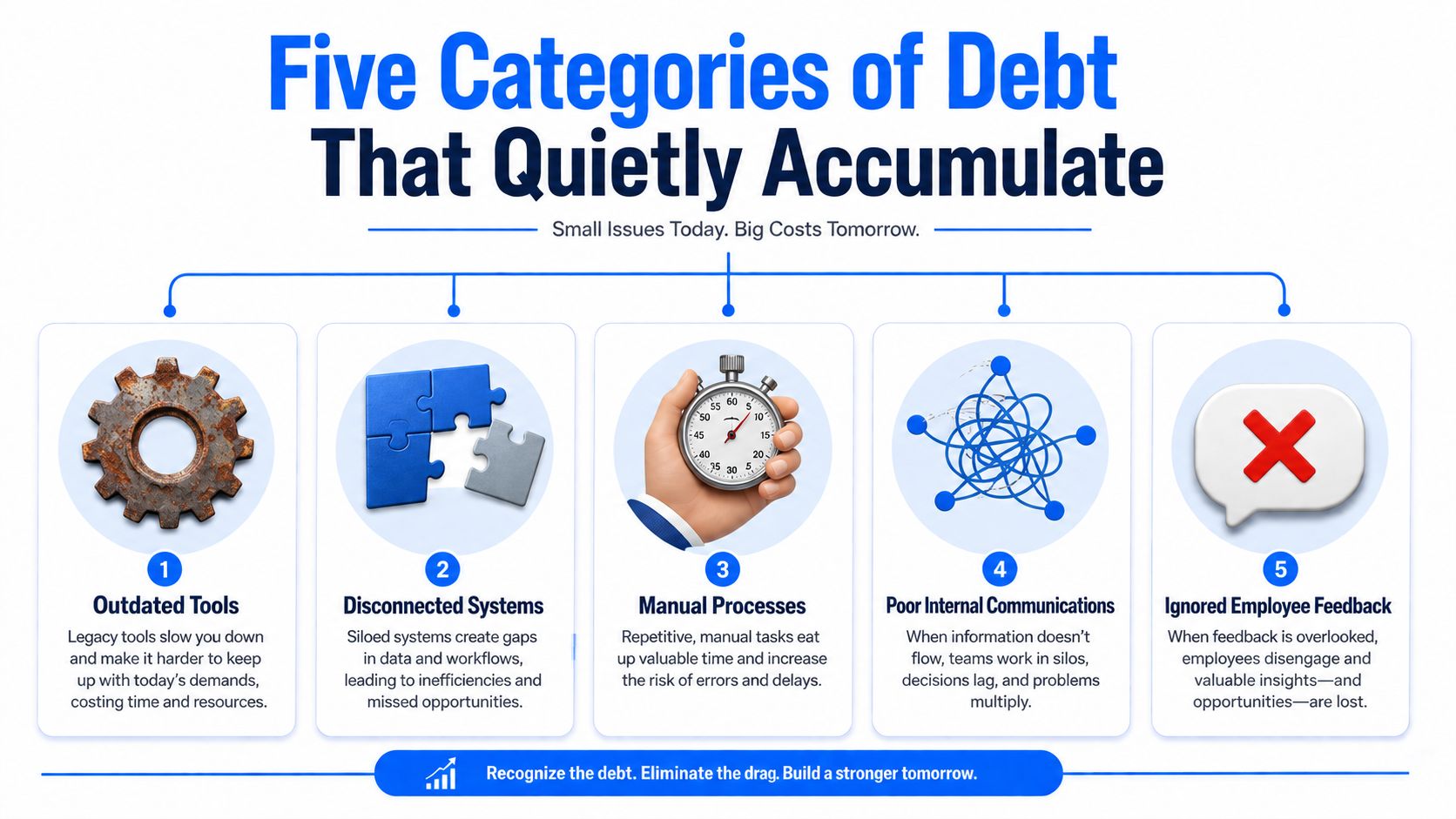
1. Outdated tools
Older tools may still perform their original function while no longer supporting how employees work today.
A system designed primarily for desktop users may create barriers for frontline employees who rely on mobile devices. A scheduling platform may publish shifts but make swaps or availability changes difficult. An intranet may contain valuable information but require employees to know the exact page or phrase to search.
When the official tool cannot complete the job easily, employees create shadow processes using spreadsheets, text messages, personal notes, or informal conversations.
The tool still appears operational, but the real workflow has moved elsewhere.
2. Disconnected systems
Organizations often use separate platforms for HR, payroll, scheduling, communication, learning, knowledge, and task management.
The problem is not necessarily the number of tools. It is the lack of connection between them.
Employees may have to update the same information in several places. Managers may reconcile conflicting records manually. A change made in one system may not reach the teams responsible for acting on it.
In these situations, people become the integration layer. They copy, translate, compare, and confirm information that systems should be sharing automatically.
3. Manual processes
Some manual steps are necessary. Debt develops when routine work depends on unnecessary emails, spreadsheets, approvals, or follow-ups.
Examples include:
Managers approving common exceptions one email at a time
Employees calling support to complete a standard request
HR manually reminding every new hire about the same missing task
Operations teams recreating reports from multiple systems
Supervisors confirming task completion through separate messages
Manual processes are especially costly when they occur frequently. A five-minute workaround repeated hundreds of times becomes a significant operational expense.
4. Poor internal communication
Communication debt develops when employees receive too many messages, receive them through the wrong channels, or cannot identify which version is current.
An update may be posted on the intranet, discussed in a meeting, attached to an email, and summarized in a chat thread. Despite the amount of communication, the employee may still be unsure what changed or what action to take.
Frontline workers may miss information that is delivered primarily through desktop channels. Hybrid employees may encounter the same decision across several fragmented conversations. Managers may repeatedly interpret company messages for their teams.
Communication is not effective simply because a message was sent. Employees need to receive, understand, and act on it.
5. Unresolved employee feedback
The final category develops when employees repeatedly identify friction but nothing changes.
Organizations may collect feedback through surveys, listening sessions, support tickets, manager conversations, or suggestion channels. But when the response ends with a report rather than a workflow improvement, the underlying problem remains.
Employees eventually stop reporting the issue. Leaders may interpret the decline in feedback as improvement, even though people have simply learned to work around the problem.
Feedback creates value only when it leads to visible action.
Why the categories reinforce one another
A bad tool produces manual work. Manual work creates more communication. More communication spawns more exceptions. Once employees believe the issue will not get fixed, they stop surfacing it. That is why debt is a systems problem, not a single-team problem.
Operational clue: if a manager’s day is full of repeat explanations and exception handling, the workflow itself is under-designed.
How the Debt Appears Across Different Work Environments
Frontline teams
Frontline teams often experience workforce experience debt through missed communication, limited access, and poorly timed information.
A policy update may be posted in a portal that employees do not open during a shift. A task may be assigned without the procedure needed to complete it. A schedule may change without reaching the right employee in time.
The manager then becomes responsible for repeating the message, explaining the task, and correcting inconsistent execution.
The problem may not appear in a dashboard. It appears through missed steps, repeat questions, slower shifts, and manager fatigue.
Hybrid and remote teams
Hybrid teams often experience debt through fragmented context.
A decision may be discussed in a meeting, revised in a chat thread, recorded in a document, and assigned through a project tool. Employees can access all the information but may not know which source is authoritative.
The result is duplicated work, delayed decisions, and repeated discussion of issues the team believed it had already resolved.
Hybrid work does not necessarily create the debt. It makes weak information and communication practices easier to see.
Large enterprises
In large organizations, the debt often comes from scale and complexity.
The organization may have mature technology, detailed processes, and extensive documentation. Yet every platform may use different permissions, terminology, ownership rules, and approval paths.
Employees spend less time looking for a tool and more time identifying which system, document, or process applies to their situation.
Across all three environments, the symptoms are similar: extra steps, repeated clarification, frequent exceptions, and managers manually connecting the parts of the organization.
Signs Your Organization Is Carrying Workforce Experience Debt
Leaders can often find the debt by listening for common phrases:
- “That is not the system we actually use.”
- “Ask your manager to send you the latest version.”
- “You need to enter it in both places.”
- “That process is different for our location.”
- “The portal says it is complete, but it is not.”
- “We keep a separate spreadsheet for that.”
- “Support has to fix it every time.”
- “Only one person knows how this works.”
Another strong signal is repeated labor.
When employees, managers, or support teams repeatedly explain the same instruction, correct the same mistake, transfer the same information, or resolve the same exception, the organization should examine the workflow rather than treating each case as an isolated problem.
Managers are especially useful indicators. When much of a manager’s day is spent forwarding information, interpreting policies, chasing approvals, and reconciling systems, the process has shifted administrative work onto the manager.
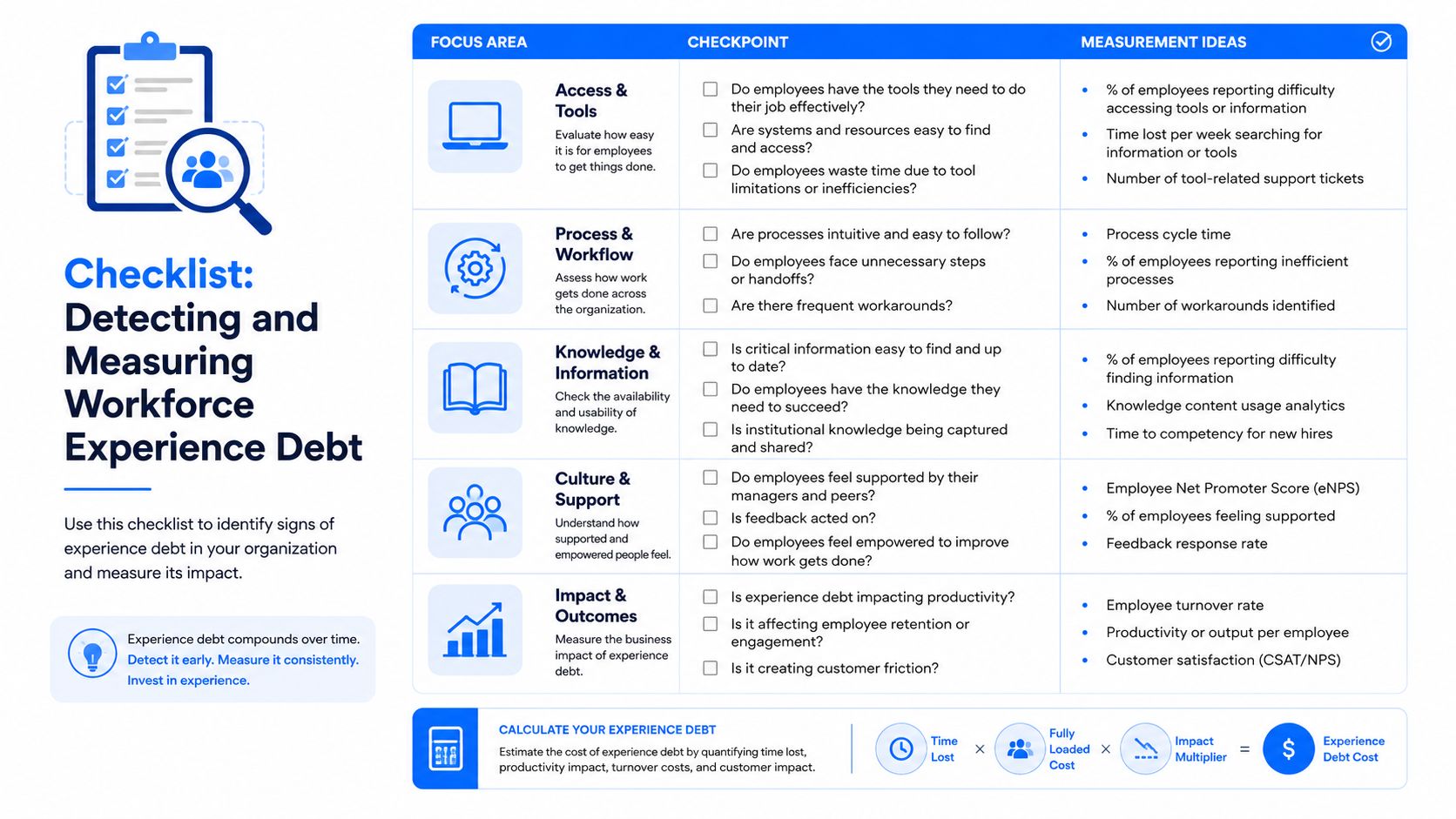
The best measurement systems do one thing well. They tie a human outcome to a workflow metric. If a change reduces friction but does not improve productivity, reach, or sentiment, it may be cosmetically better without being operationally better.
How to Measure Workforce Experience Debt
Annual engagement surveys can identify broad sentiment, but they may not reveal the operational friction causing it.
A better approach is to combine focused employee feedback with workflow data. The goal is not to monitor employees more closely. It is to identify where the design of work creates unnecessary effort.
Useful measures include:
Exception frequency
Track how often an ordinary process requires special handling. Frequent exceptions are among the clearest signs that a workflow does not match operational reality.
Rework and duplicate entry
Measure how often employees or managers repeat a task, correct information, or enter the same data in multiple systems.
Support requests
Look for repeated tickets or questions related to the same process. High support volume may indicate that instructions, navigation, or system design are unclear.
Search failures
Track searches that produce no useful answer, repeated searches for the same topic, or cases where employees leave the knowledge system and ask someone directly.
Completion delays
Identify where tasks, approvals, onboarding steps, or requests consistently take longer than expected.
Communication reach and action
Measure whether important messages reached the intended audience and whether employees completed the required action. Sending a message is not the same as achieving understanding.
Manager intervention
Estimate how often managers must step into routine processes to clarify information, correct errors, or move work between systems.
The strongest measurements connect a workflow signal with a business or employee outcome.
For example:
- Did simplifying an onboarding process reduce time to first productive task?
- Did improving message targeting reduce repeat manager questions?
- Did connecting two systems lower duplicate entry and payroll corrections?
- Did restructuring knowledge content reduce support requests?
- Did redesigning an approval process shorten completion time?
A lower-friction process is valuable, but the strongest case comes from showing that it also improved speed, accuracy, communication, employee confidence, or manager capacity.
Practical rule: the more a program depends on employee self-navigation, the more it will exclude the people under the most pressure.
The Role of AI in Reducing or Adding to the Debt
AI may help organizations reduce workforce experience debt, but only when it is applied to a clear operational problem.
For example, AI could help employees find the right procedure, summarize relevant information, identify repeated support questions, or route requests to the correct team. It could also help leaders detect patterns across employee feedback and workflow data.
However, adding AI to a fragmented process does not automatically improve it.
An AI assistant that draws from outdated documents may distribute incorrect information faster. An automated recommendation that lacks context about roles, locations, schedules, or skills may create additional correction work. Another chatbot or interface may simply become one more tool employees have to navigate.
Before introducing AI, leaders should ask:
- Is the underlying process clear?
- Is the source information accurate and current?
- Does the tool understand the relevant role, location, or workflow?
- Will it remove a step or add another one?
- Can employees understand how a recommendation was produced?
- Is a person still available when judgment or an exception is required?
AI should reduce repeated effort, not automate confusion.
Common Mistakes to Avoid
Treating the issue as an employee-adoption problem
When people avoid a tool, the immediate response is often more training. But employees may be avoiding it because the tool is slow, incomplete, difficult to access, or disconnected from the real workflow.
Training cannot fix poor design.
Adding another tool too quickly
A new platform may solve one problem while creating additional logins, notifications, integrations, and ownership questions.
Before purchasing another tool, leaders should determine whether the problem comes from missing functionality, weak integration, unclear governance, or poor use of existing systems.
Trying to fix everything at once
Workforce experience debt can exist across hundreds of processes. Attempting to map and redesign the entire employee experience at once usually creates an oversized project with unclear results.
A more effective approach is to begin with one recurring source of friction that employees and managers already recognize.
Measuring activity instead of outcomes
Logins, messages sent, and tasks assigned do not necessarily show whether employees completed the work successfully.
Measure what happened after the activity. Did employees find the answer, understand the update, complete the task, and avoid a follow-up?
Collecting feedback without closing the loop
Asking employees about friction creates an expectation that the organization will respond.
Leaders should communicate what they heard, what they plan to change, and what cannot be changed yet. Visible action builds trust and encourages employees to continue identifying problems.
A Practical 90-Day Plan
Days 1–30: Identify and map the debt
Choose one team, workforce segment, or high-friction process.
Interview employees, managers, and support teams. Review repeated tickets, manual handoffs, common errors, duplicate work, and frequently asked questions.
Map the process as it actually happens—not only as it appears in official documentation.
Record:
- The steps employees take
- The systems and channels involved
- Where information is repeated or transferred
- Where employees wait, leave the process, or ask for help
- Which workarounds keep the process moving
- How often the friction occurs
- Who currently absorbs the extra work
The goal is to identify one recurring cost clearly enough to address it.
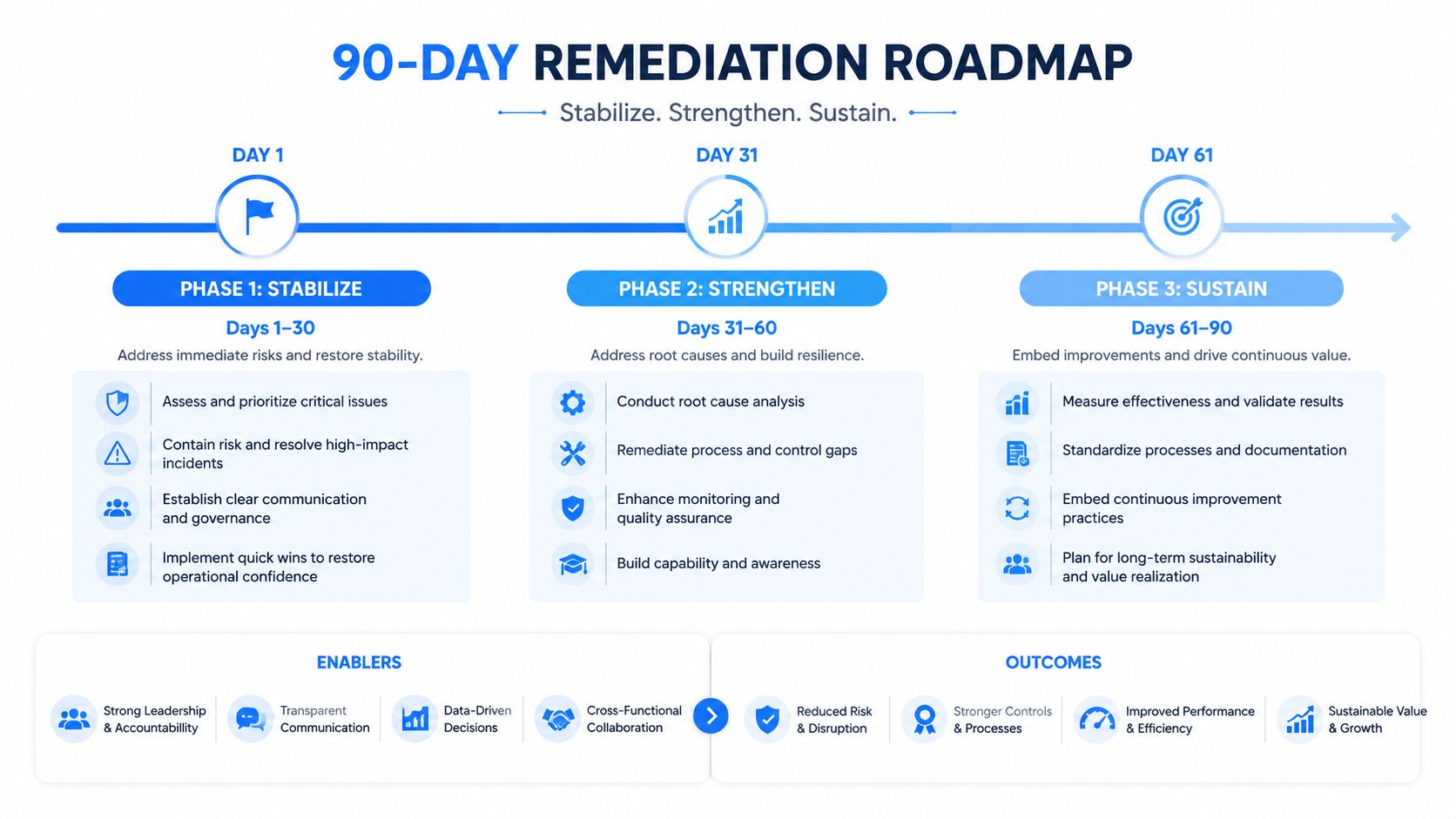
Days 31–60: Prioritize and redesign
Create a small backlog of the most important friction points. Rank them by business impact, employee impact, frequency, and effort to fix.
Assign an owner to each selected issue.
Then redesign one visible workflow. The solution may involve:
- Removing an unnecessary approval
- Connecting two systems
- Consolidating duplicate forms
- Updating and restructuring instructions
- Sending messages through the right channels
- Automating a repeated reminder
- Clarifying ownership
- Giving managers a better view of completion or exceptions
Test the revised workflow with the employees who use it.
Days 61–90: Implement and measure
Launch the redesigned process with a defined team.
Measure the same indicators identified during discovery. Compare exception frequency, completion time, support demand, rework, employee feedback, and manager intervention before and after the change.
Document what improved and what still creates friction.
The goal of the first 90 days is not to eliminate all workforce experience debt. It is to prove that the organization can identify, prioritize, reduce, and measure one meaningful source of recurring friction.
Preventing the Debt From Returning
Paying down existing debt is only part of the work. Organizations also need to prevent new tools and processes from creating more of it.
Before introducing a new system, policy, or workflow, ask:
- Does this replace an existing step or add another one?
- Which employees will use it, and how will they access it?
- Does it connect with the systems they already use?
- Who owns the information and keeps it current?
- What happens when the process does not follow the standard path?
- Will managers have to translate or reconcile the output?
- How will employees report friction?
- What measure will show whether the change improved the experience?
Quarterly reviews can help leaders revisit the highest-cost workarounds and evaluate whether new initiatives are reducing or increasing complexity.
The most meaningful improvements may appear uneventful: fewer repeated questions, fewer exceptions, cleaner handoffs, faster access to information, and less manager intervention.
That is what reducing workforce experience debt looks like in everyday operations.
Final Thoughts
Organizations rarely design workforce experience debt intentionally. It accumulates through temporary fixes, disconnected technology decisions, outdated processes, and problems that remain unresolved because people continue finding ways around them.
That adaptability can hide the true condition of the employee experience.
Leaders should not ask only whether a process technically works. They should ask how much extra effort people must provide to make it work.
The most useful signal is often not a single survey score. It is the pattern of repeated exceptions, duplicate work, support demand, missed messages, delayed tasks, and managers continually stepping in to connect the organization.
Turn On Work examines workforce experience through this broader operational lens. Employee engagement, communication, HR technology, AI, frontline enablement, and workforce operations are closely connected. Improving the experience means understanding those relationships and removing the recurring friction that prevents people from doing their best work.
Workforce Experience Debt FAQs
How is workforce experience debt different from employee engagement?
Employee engagement describes how connected, motivated, and committed people feel at work. Workforce experience debt describes the recurring friction underneath the daily experience, such as broken workflows, communication gaps, duplicate work, and disconnected systems.
The two can influence each other, but they are not the same.
Is workforce experience debt the same as technical debt?
No. Technical debt usually refers to technology shortcuts that create future maintenance or development costs.
Workforce experience debt is a broader organizational concept. It includes technology problems but also covers processes, communication, knowledge access, approvals, handoffs, and unresolved employee feedback.
What should an organization measure first?
Start with exception frequency and repeated manager intervention.
These measures often reveal where routine work depends on manual corrections, explanations, or workarounds.
Does workforce experience debt affect retention?
It can. Repeated workplace friction may contribute to frustration, loss of trust, manager burnout, and the feeling that basic work is unnecessarily difficult.
Retention is influenced by many factors, so leaders should avoid attributing it to one workflow. However, persistent friction can become part of an employee’s decision to leave.
Do we need a new platform to address it?
Not necessarily.
Many organizations can make meaningful progress by simplifying a process, improving communication targeting, connecting existing systems, updating knowledge, removing unnecessary steps, or clarifying ownership.
The goal is not to add more technology. It is to make work easier to complete.
How can we estimate the cost of inaction?
Calculate the recurring labor created by the problem.
Estimate how often it occurs, how many people are involved, and how much time they spend correcting, explaining, re-entering, reconciling, or following up.
Then consider related costs such as errors, delays, support requests, missed communication, and lost manager capacity.