Experience intelligence still starts with clean pulse data, which is why the collection layer is often an employee surveys hub rather than another analytics warehouse.
A company can have a clean engagement dashboard and still miss what is actually making work harder. A hospital unit may report stable quarterly sentiment while nurses lose time to repeated logins, schedule changes, delayed handoffs, and outdated procedures. A retail region may show acceptable survey results even as store managers absorb daily frustration caused by broken devices, confusing communications, incomplete training, and difficult shift swaps.
The survey is not necessarily wrong. It is simply incomplete.
That gap is where employee experience intelligence becomes useful. Employee experience intelligence combines what employees say with aggregated signals about how work is actually functioning, helping leaders understand where the experience supports people, where it creates friction, and what should change next.
It is the next step beyond annual surveys and dashboard reporting because it connects employee voice with communication reach, recognition, onboarding, schedules, tasks, knowledge, technology, and operational workflows. The goal is not to collect more data about people. It is to make better decisions about the systems, processes, and conditions surrounding their work.
Key Takeaways
- Engagement surveys show how employees feel, while employee experience intelligence helps explain what may be shaping those feelings.
- A fuller view can combine surveys, sentiment, recognition, communication reach, onboarding progress, schedule friction, task completion, knowledge searches, support requests, and employee feedback.
- More data does not automatically create intelligence; intelligence begins when a pattern is connected to a cause, an owner, and an action.
- Employee experience intelligence should diagnose work, not profile workers.
- Aggregation, transparency, data minimization, human review, and clear access rules are essential to employee trust.
- Managers need focused guidance and practical actions, not another complicated dashboard.
Why Engagement Scores Alone Are No Longer Enough
Engagement measurement remains valuable because employees need a direct way to express how work feels. Surveys can reveal whether people feel recognized, supported, informed, motivated, or connected to the organization.
The limitation is that a score rarely explains the full cause.
A regional hospital manager may see that engagement has barely changed while hearing more complaints about missed handoffs and slow approvals. A hybrid team may report lower confidence in leadership when the actual trigger is a confusing return-to-office process. A frontline team may score poorly on communication even though messages are being delivered, because employees receive them after the shift or cannot act on them from a mobile device.
Survey results show the effect. They often do not show the mechanism.
This is why organizations frequently respond to the wrong problem. They see a recognition score decline and launch a company-wide appreciation campaign, even though one location’s issue is inconsistent supervision. They see poor onboarding sentiment and add more content, even though new hires are struggling with system access and unclear task ownership.
Employee experience intelligence adds the missing context by connecting what employees report with aggregated evidence from the work environment.
Practical rule: If a dashboard cannot help someone decide what to change, it is reporting rather than intelligence.
What Employee Experience Intelligence Is Trying to Fix
Employee experience is shaped by more than opinions or HR programs. It is affected by the entire environment around the employee, including communication, managers, schedules, technology, knowledge, workloads, workflows, recognition, and the ease of completing routine tasks.
Those signals often sit in different systems and are reviewed by different teams.
HR sees survey results and turnover. Internal communications sees message reach and acknowledgements. IT sees failed logins, application problems, and help-desk demand. Operations sees task delays, schedule gaps, and incomplete handoffs. Learning teams see onboarding and training progress.
Each function sees part of the experience. Few see how the parts connect.
Employee experience intelligence creates a shared view so that leaders can ask better questions:
- Did employees receive the information?
- Did they understand it?
- Could they act on it?
- Did the process work as intended?
- Did managers reinforce the change?
- Did the problem appear in one location or across the organization?
- Did the action improve the employee experience?
The purpose is not to build a larger dashboard. It is to reduce the distance between employee feedback and organizational action.
How Employee Experience Intelligence Differs From Engagement Measurement
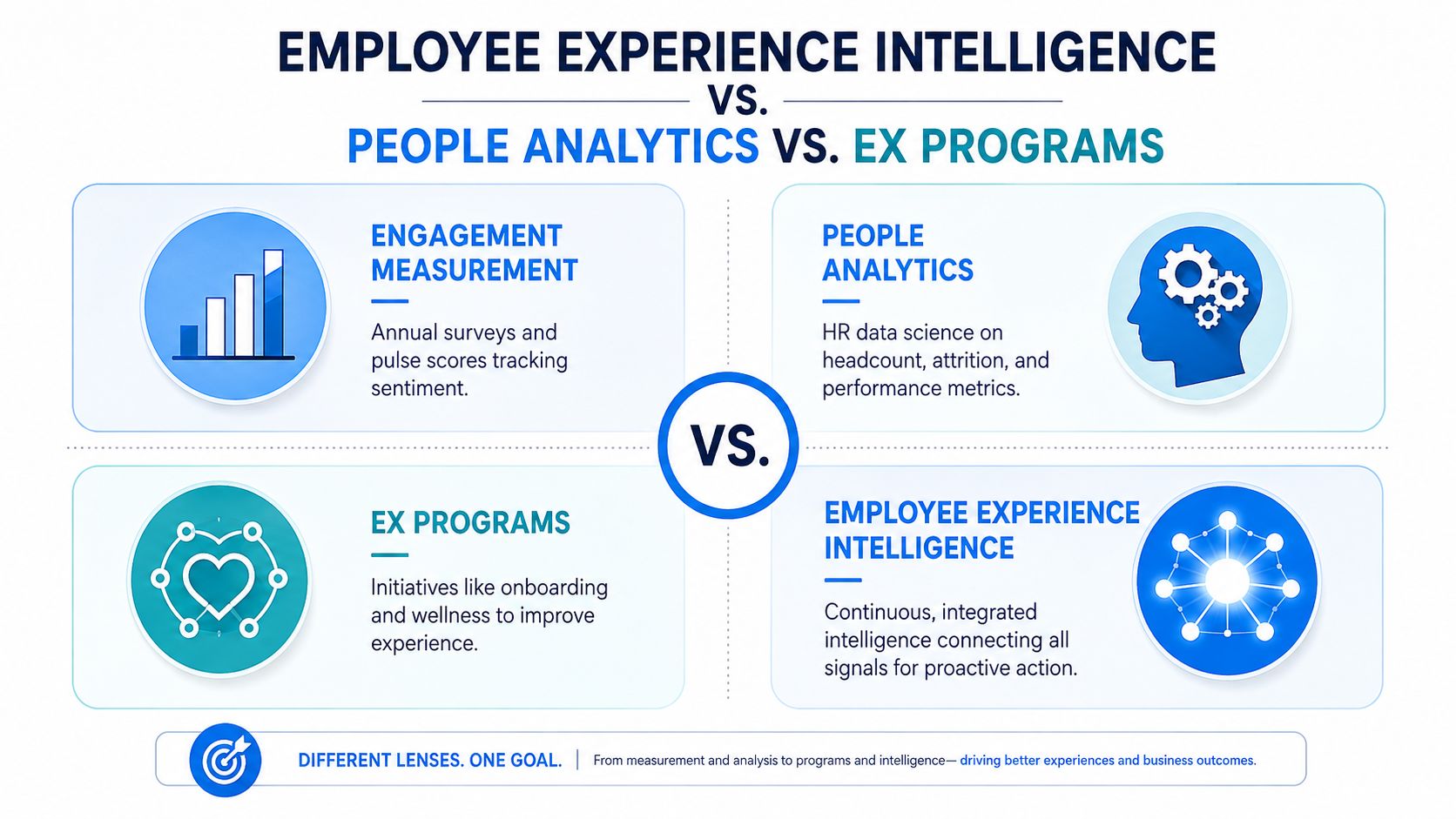
Engagement measurement and experience intelligence are connected, but they are not the same discipline.
| Engagement Measurement | Employee Experience Intelligence |
|---|---|
| Asks how employees feel | Connects feelings to workplace conditions |
| Relies mainly on surveys and pulse scores | Combines employee voice with aggregated operational signals |
| Produces scores, trends, and benchmarks | Identifies likely causes, owners, and actions |
| Often reviewed periodically | Supports more continuous improvement |
| Usually led by HR or people teams | Requires HR, communications, IT, operations, and managers |
| Measures perception | Connects perception with communication, behavior, and workflow conditions |
| Highlights where sentiment is weak | Helps explain why the weakness may exist |
Employee experience intelligence does not replace surveys, people analytics, or employee experience programs.
People analytics may show that turnover is rising among new hires. An employee experience program may redesign the onboarding journey. Experience intelligence helps determine whether system access, manager follow-up, training overload, communication gaps, or task confusion is causing the experience to break down.
The useful question is no longer only:
“Did the engagement score improve?”
It becomes:
“What changed in the work environment, how did employees experience it, and who needs to act?”
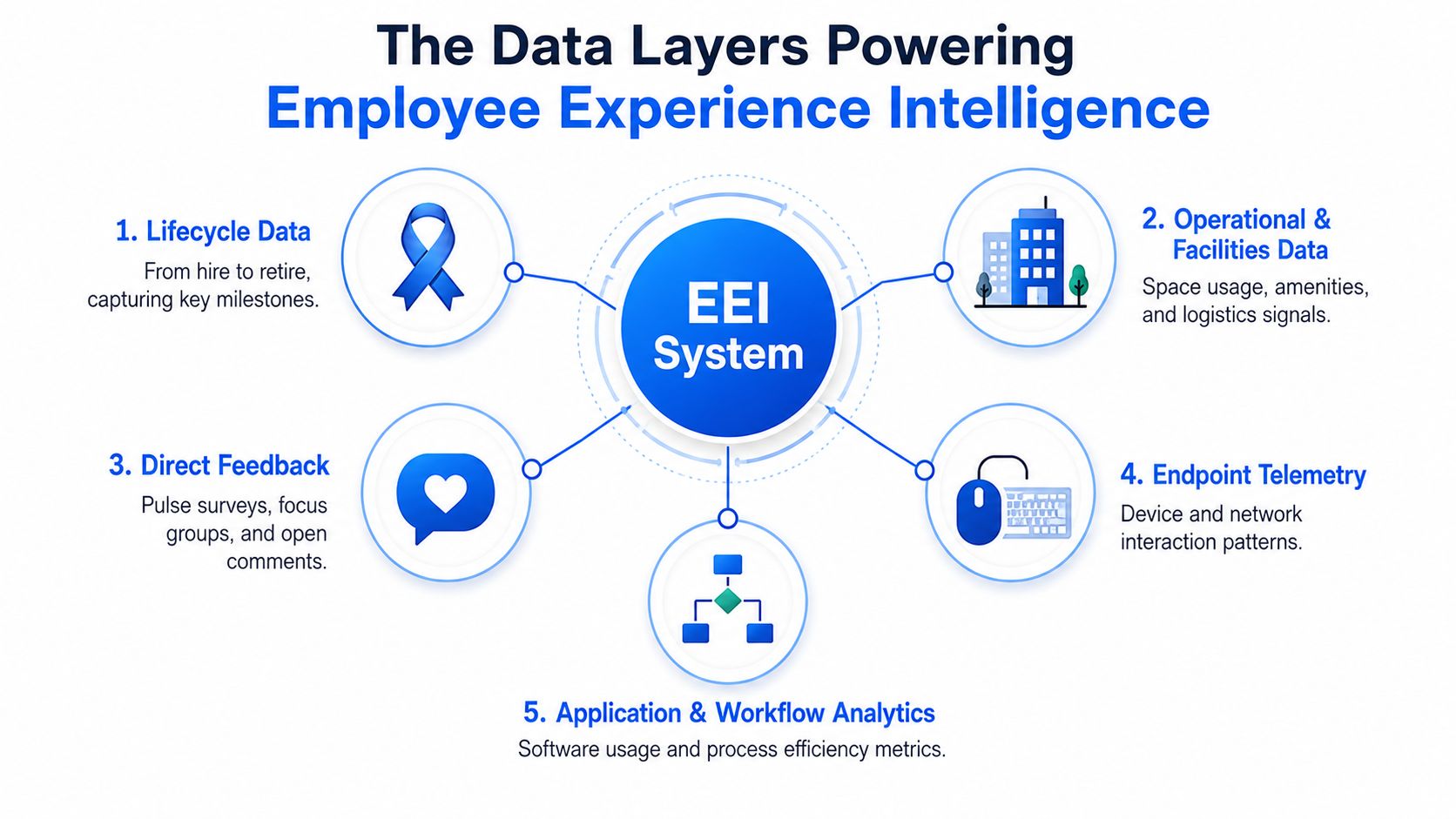
The Data Layers That Power Employee Experience Intelligence
A useful employee experience intelligence model combines several kinds of signals, but it should collect only what is necessary to answer a defined workforce question.
Employee Voice
Employee voice includes information people intentionally provide through:
- Engagement surveys
- Pulse surveys
- Open comments
- Stay interviews
- Focus groups
- Manager conversations
- HR questions
- Employee feedback channels
These signals explain how employees interpret their experience, which is important because operational data alone cannot tell leaders whether a process feels confusing, unfair, exhausting, or unsupported. Employee voice should remain central. Experience intelligence should add context to feedback rather than replace employees’ own accounts of work.
Communication and Connection
Communication signals help leaders understand whether information reached the right people and whether it supported action.
Useful signals may include:
- Message reach
- Acknowledgements
- Questions generated after an announcement
- Channel performance
- Manager follow-up
- Recognition activity
- Survey participation
- Communication by role, shift, or location
Recognition activity can reveal important patterns. One team may receive frequent appreciation while another remains largely invisible. Remote or frontline employees may receive less recognition than office-based colleagues. Recognition may depend heavily on individual managers rather than being distributed consistently. Recognition volume alone does not prove that employees feel valued, but it can help leaders identify where appreciation may be uneven or disconnected from daily work.
Journey and Development
Journey data helps leaders understand how employees experience important transitions.
This can include:
- Onboarding progress
- Time to complete required steps
- Training completion
- Certification status
- Internal applications
- Role changes
- Manager transitions
- Return from leave
- New-hire support requests
A new employee may complete every assigned onboarding course and still struggle to become productive because they lack access to a system, cannot find the right procedure, or do not know who owns the first assignment. Experience intelligence connects formal completion with the real conditions surrounding the journey.
Work and Operations
Operational signals show where the work itself may be creating friction.
Examples include:
- Schedule changes
- Shift-swap delays
- Overtime patterns
- Task completion
- Missed handoffs
- Escalation volume
- Approval delays
- Workload imbalances
- Repeated manager intervention
- Safety or process exceptions
These signals are especially important for frontline and shift-based employees, whose experience is often shaped less by corporate programs than by whether schedules, staffing, tools, and handoffs work reliably.
Knowledge and Technology
Knowledge and technology signals can reveal friction that employees may not always report through surveys.
Useful examples include:
- Failed or repeated logins
- Slow applications
- Unsuccessful knowledge searches
- Repeated searches for the same policy
- Workflow abandonment
- Duplicate help requests
- Repeated support tickets
- Employees opening a ticket immediately after searching
- Content that is frequently accessed but poorly rated
Repeated searches for the same information may indicate that knowledge is missing, difficult to find, unclear, or outdated. A failed login is not an employee behavior problem. It is a system-friction signal. The focus should remain on whether the tools and processes are working, not on monitoring individual productivity.
From Signals to Action: The SIGNAL Framework
The value of employee experience intelligence depends on what happens after a pattern appears. The SIGNAL framework provides a practical way to move from disconnected data to visible improvement.
S – See the Pattern
Combine employee voice with only the aggregated signals relevant to the problem. For example, a company may see that new-hire sentiment is declining while onboarding completion remains high. Adding system-access delays, repeated support tickets, and manager follow-up data may reveal that employees are completing content but cannot begin real work smoothly. The goal is not to combine every available data source. It is to see enough of the pattern to avoid a false conclusion.
I – Identify the Friction
Determine where the experience is actually breaking.
Is the issue caused by:
- Manager behavior?
- Communication timing?
- An unclear process?
- A broken tool?
- Schedule instability?
- Missing knowledge?
- Excessive workload?
- Lack of ownership?
A broad sentiment problem should be translated into a specific work condition before leaders take action.
G – Give It an Owner
Every insight needs a responsible owner.
Depending on the issue, that may be:
- A manager
- HR
- Internal communications
- IT
- Workforce operations
- Learning and development
- A process owner
- A cross-functional team
An insight that belongs to everyone usually belongs to no one.
N – Narrow the Action
Choose one practical intervention rather than launching a large transformation program.
For example:
- Simplify a shift-swap process
- Rewrite a confusing message
- Give managers a new check-in routine
- Repair a broken onboarding handoff
- Update an outdated policy
- Improve mobile access
- Reduce duplicate approvals
Small, visible improvements often create more trust than broad commitments with unclear timelines.
A – Act and Explain
Make the change and tell employees what happened.
Leaders should explain:
- What they heard
- What the data showed
- What will change
- Who owns the action
- What cannot be changed immediately
- When the issue will be reviewed again
Employees do not need every request to be accepted. They do need evidence that their input entered a real decision process.
L – Learn From the Result
Measure whether the intervention improved both the employee experience and the operational condition.
A scheduling change may reduce complaints but increase manager workload. A new communication channel may improve reach but not understanding. An onboarding redesign may improve sentiment without reducing time to productivity.
Experience intelligence should reveal these trade-offs rather than declaring success based on one metric.
Use Cases That Connect Signals to Action
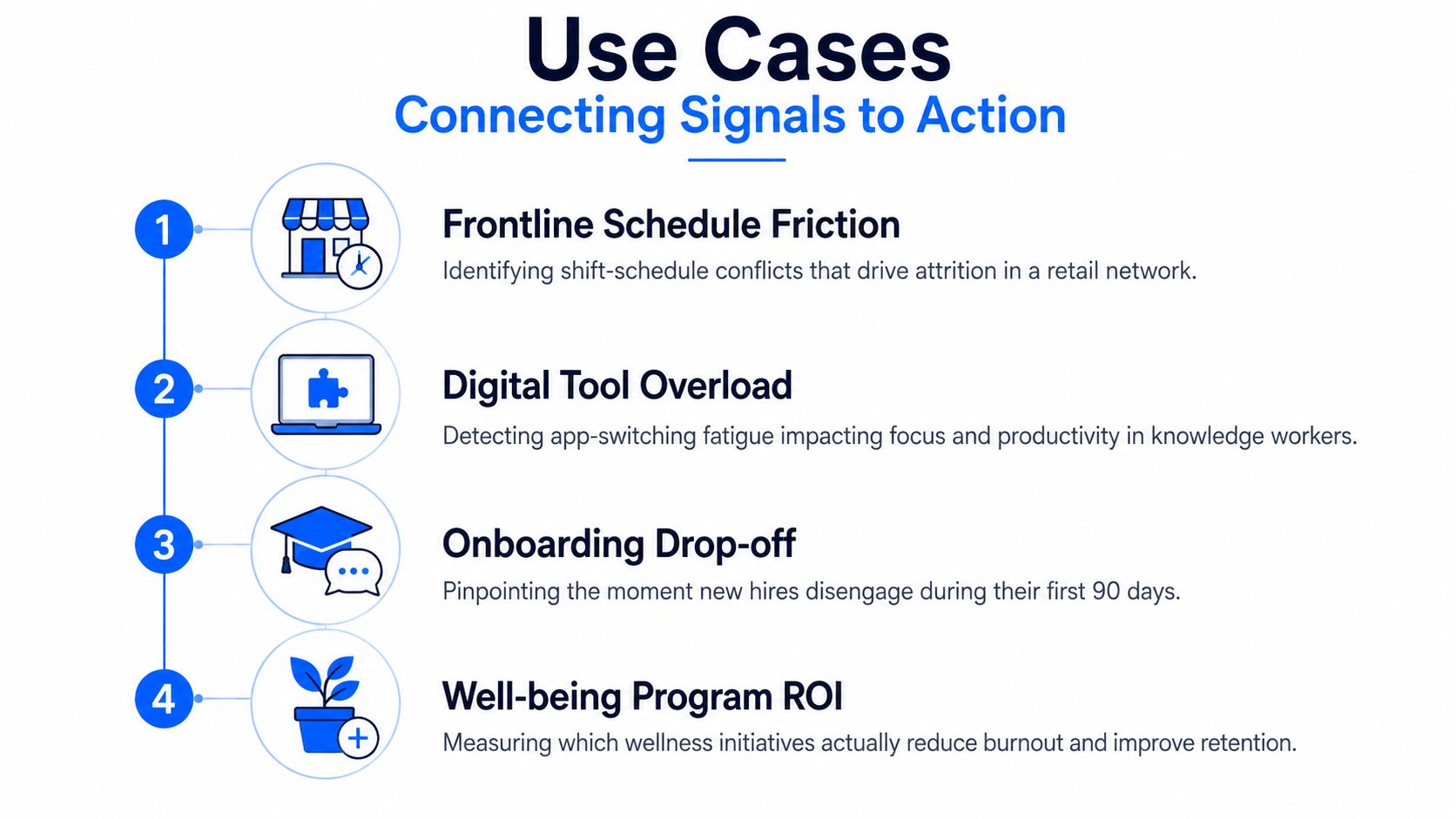
Frontline Schedule Friction
A retail region sees stable engagement scores, but shift-swap requests are taking longer, managers are manually resolving more schedule issues, and comments increasingly mention unpredictability.
The combined signals suggest that the issue is not general disengagement. It is schedule friction. The owner may be workforce operations, working with store leadership. The action could involve simplifying swap approvals, improving advance notice, or changing staffing rules. The follow-up measures should include swap completion time, manager intervention, schedule-related comments, and frontline turnover.
Hybrid Onboarding
New hires report confusion even though training completion is high. Workflow data shows repeated system switching, delayed account access, and unfinished first-week tasks. The insight is that onboarding contains too many handoffs rather than too little content. HR and IT may jointly own the solution by creating a simpler first-30-days process, clarifying responsibilities, and reducing the number of systems employees must navigate.
Communication Reach Without Understanding
An internal communications team sees high message reach but low completion of the required action. Employee questions suggest that the announcement was seen but not understood. Manager follow-up varies considerably across teams. The answer is not necessarily another reminder. It may require clearer language, more local context, a stronger call to action, or a manager briefing.
Knowledge Search Failures
Employees repeatedly search for a leave policy, open several pages, and then submit an HR ticket. That pattern may show that the policy is difficult to understand, several versions exist, or employees cannot determine which rule applies to them. The knowledge owner can simplify the explanation, remove outdated versions, add context, and connect the answer directly to the required form or workflow.
Recognition Gaps
Recognition activity is high overall, but distributed and frontline employees receive significantly less visible appreciation than corporate teams. The organization should not assume that recognition is healthy because total participation is high. Managers may need better routines, mobile recognition tools, or clearer expectations about recognizing employees across roles and locations.
Manager Enablement: Intelligence Must Lead to a Better Conversation
Managers are often given more dashboards than they can reasonably use.
Employee experience intelligence should make managers more capable, not more watched.
A useful manager view should provide:
- A small number of relevant patterns
- Context about what may be causing them
- Actions within the manager’s control
- Guidance for discussing the issue
- A way to escalate structural problems
- A date for follow-up
For example, a manager does not need a complex sentiment model showing that team confidence declined by several points.
They need to know that employees are reporting unclear priorities, that task rework has increased, and that the next action is to clarify weekly priorities and review workload during one-to-one conversations. Not every experience problem belongs to the manager. Broken systems, unfair policies, and staffing shortages should not be turned into coaching issues. The manager’s role is to act on what they can influence and escalate what they cannot.
Governance, Ethics, and AI in Employee Experience Intelligence
Employee experience intelligence can become surveillance if organizations collect too much information, analyze it at the individual level, or use it to assign blame.
The ethical principle should be clear:
Employee experience intelligence should diagnose work, not profile workers.
Transparency
Employees should understand:
- What information is being used
- Why it is being collected
- How it will improve work
- Who can access the results
- Whether AI is involved
- How long information is retained
Data Minimization
Organizations should collect only the information needed to answer the defined question. A company trying to understand onboarding friction does not need broad access to every employee activity.
Aggregation
Signals should be aggregated wherever possible. Team, location, role, or journey-level patterns are often sufficient to identify a problem without exposing individual behavior. Minimum group thresholds should prevent managers from identifying individual survey respondents or employees from small data sets.
Appropriate Access
Access should reflect responsibility. Managers may need team-level patterns and recommended actions. HR may need broader workforce trends. IT may need technology-friction signals. Few people need access to every layer.
Human Review
AI can help summarize feedback, identify themes, and detect patterns. It should not make high-impact decisions about performance, discipline, promotion, or termination based on experience signals. Human review is essential when the data is incomplete, the context is unclear, or the recommendation may affect an employee materially.
Employee Challenge and Correction
Employees should have a way to question how information is used and correct inaccurate data where appropriate. Trust declines when employees believe systems are forming conclusions about them without visibility or recourse.
How to Start Without Building a Surveillance System
The strongest starting point is one clear workforce problem.
Examples include:
- Why are frontline shift-swap complaints increasing?
- Why are new hires taking longer to become productive?
- Why are employees missing an important communication?
- Why are support tickets rising after a new tool launch?
- Why does recognition vary so widely across teams?
Then follow a limited process:
- Define the question.
- Select only the relevant signals.
- Establish aggregation and access rules.
- Identify the owner.
- Choose one practical action.
- Communicate the change.
- Measure whether the experience improved.
This approach keeps the program focused on improvement rather than observation.
Final Thoughts
Surveys remain valuable because employees must have a direct voice in how work feels. But surveys alone cannot show whether communication reached the right people, onboarding stalled, schedules became unstable, tasks repeatedly failed, or employees could not find the knowledge they needed.
Employee experience intelligence connects those signals without turning employees into surveillance targets.
Its purpose is not to know everything people do. It is to help leaders see where the work experience is failing, assign ownership, and act before frustration becomes disengagement or turnover. The future of employee experience will not be built on larger dashboards. It will be built on better decisions.
Employee Experience Intelligence FAQs
What is employee experience intelligence?
Employee experience intelligence is the practice of combining employee voice with aggregated signals from communication, tools, workflows, and workforce operations to understand where work supports or hinders employees and what leaders should change.
How is employee experience intelligence different from engagement surveys?
Engagement surveys show how employees feel at a particular point in time. Employee experience intelligence combines those perceptions with aggregated signals about communication, onboarding, schedules, tasks, knowledge, technology, and operations to help explain what may be causing the experience.
Does employee experience intelligence replace surveys?
No. Surveys and direct employee feedback remain essential because operational data cannot fully explain how work feels. Experience intelligence adds context to employee voice rather than replacing it.
What data can be used in employee experience intelligence?
Relevant signals may include surveys, open comments, recognition activity, communication reach, onboarding progress, training, schedule changes, task completion, knowledge searches, support requests, workflow delays, and aggregated technology-friction data.
How can organizations avoid employee surveillance?
Organizations should use transparent purpose statements, collect only necessary data, aggregate signals wherever possible, restrict access, avoid individual productivity scoring, and require human review for high-impact decisions.
What should managers see?
Managers should receive a small number of relevant patterns, possible causes, actions within their control, conversation guidance, and a way to escalate larger structural problems.
How can employee experience intelligence help frontline workers?
It can reveal operational issues that surveys alone may miss, including schedule instability, poor mobile access, missed communications, task confusion, repeated handoff failures, and difficulty finding current procedures.
How should organizations measure success?
Success should be measured by whether the intervention improves both the employee experience and the underlying work condition. Relevant measures may include employee feedback, communication understanding, onboarding progress, schedule stability, task completion, knowledge-search success, support demand, and time to resolve issues.