
A frontline communication calendar template for 2026 is a dated operating plan that assigns every message an audience, owner, channel, action window, deadline, and feedback route, so it reaches workers who can’t read email during a shift. It turns your internal communications calendar from a list of announcements into a shift-aware system for safety, rotas, training, and recognition.
What a Frontline Communication Calendar Is
You’ve sent a rota change at 9 a.m. on Monday. Day staff saw it, night staff didn’t, and by Friday you’re answering the same question on three sites. That’s the gap a frontline employee communication calendar closes.
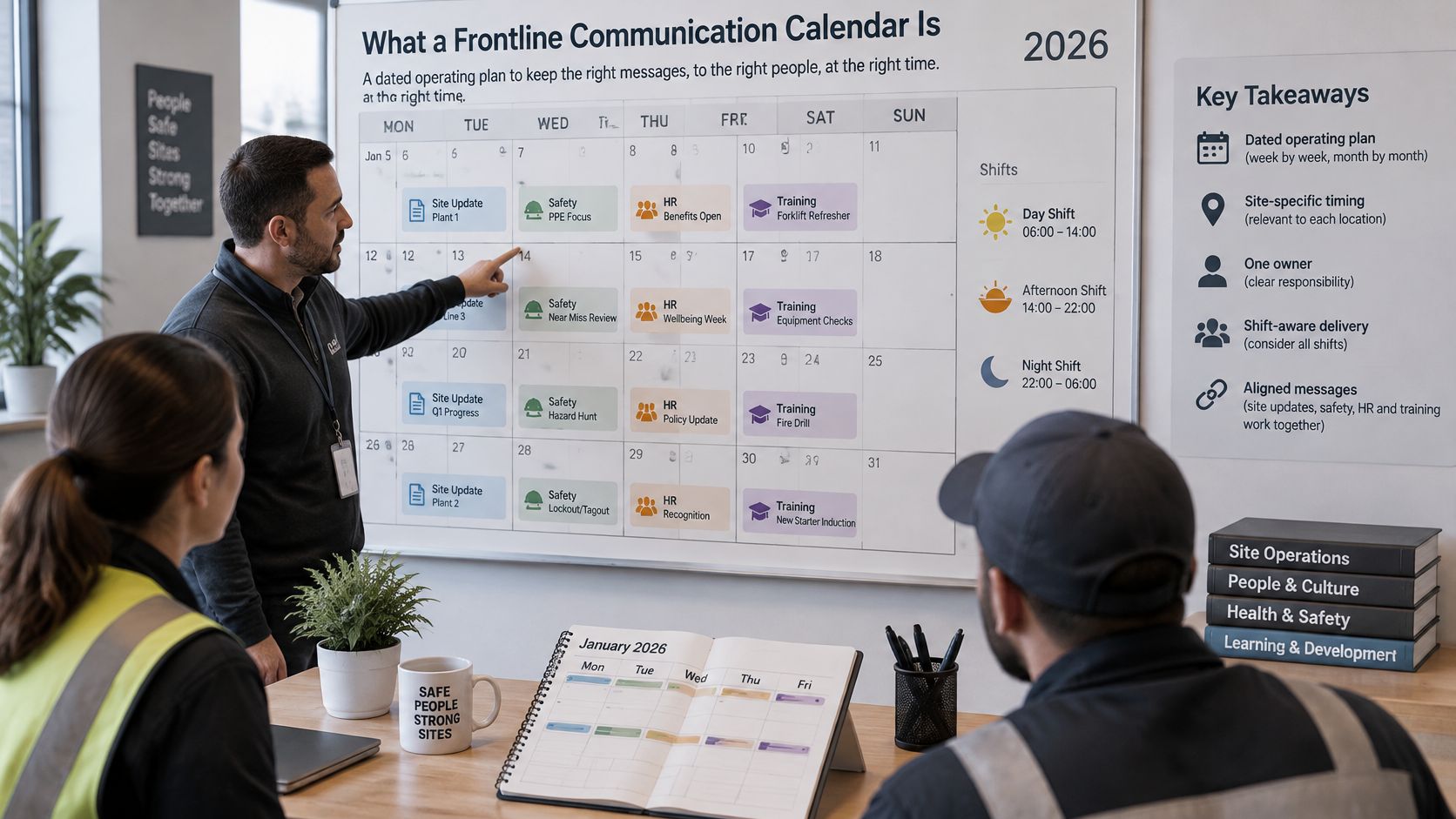
Key Takeaways
- Plan by shift, not office hours: Name the site, shift, and language for every entry.
- Give every message an action: State what workers must do and by when.
- Brief managers first: Supervisors need talking points before staff hear the message.
- Build in a reply route: Record who collects feedback and when they’ll answer.
- Measure completion, not opens: Track action by shift, location, and language.
Internal communications sets message strategy and channels. Employee experience covers the wider working life, including tools, policies, and manager behaviour. HR communications covers policy, benefits, leave, and people processes. A frontline calendar is the scheduling layer that decides when and how those messages reach people on fixed or rotating shift communication patterns, often without a company device.
Say a safety reminder goes to head office at 9 a.m. Monday. It becomes a frontline calendar item once it’s assigned to nights at each site, placed in a pre-shift huddle, and paired with a manager question. In care settings, practical guidance to overcome communication barriers in social care shows why format, timing, and plain language matter as much as wording.
Treat this employee communication calendar template as a planning tool, not a strategy document. Strategy decides priorities. The calendar makes them land.
Build the Calendar Structure with ISO Weeks and Time Zones
Monthly planning misaligns payroll, safety, training, and campaign cycles at year boundaries, so build the calendar on ISO weeks as well as months. Under the ISO 8601 standard, which defines week dates by calendar year, week number, and weekday, 2026 has 53 weeks: Week 1 begins Monday, December 29, 2025, and Week 53 runs Monday, December 28, 2026, through Sunday, January 3, 2027.
Assign Week 53 a job: year-end closeout, inventory, holiday staffing, compliance refreshers, or contingency messages. Left blank, it surfaces in December as unplanned noise.
Fields Every Row Needs
- ISO week and local date: Use YYYY-MM-DD, for example 2026-W14 and 2026-03-30.
- Site or region: Site B, not all locations.
- Shift audience: Nights at Site B, in the required languages.
- Message owner: One named person, such as the site HR lead.
- Channel: Start-of-shift huddle with a text backup.
- Translation status: Complete, in progress, or not started.
- Required action: Sign the updated rota.
- Deadline: 2026-04-01 at 18:00 local time.
- Completion metric: Signed acknowledgements divided by shift headcount.
- Time zone: Europe/London, stored with the event.
A row built this way is sortable by week, site, or shift, which is what lets you spot a site or shift pattern that keeps missing deadlines. Copy the structure for every entry in your internal communications calendar 2026 rather than letting each department invent its own columns. The completion metric is what turns a schedule into an operating loop: every entry produces a result you can check by shift, and missed targets feed the next planning cycle instead of disappearing.
Practical rule: A message scheduled for 23:30 in one time zone may land on a different calendar day elsewhere, so never store a time without its time zone.
Without a named owner and a completion metric, an entry produces no feedback, and the loop stays open.
Frontline Communication Calendar Template for 2026 by Month
Start with shared global anchors, then layer on local dates. Fixed markers worth building around include International Women’s Day on 8 March, World Day for Safety and Health at Work on 28 April, Labour Day on 7 September, International Day of Peace on 21 September, World Teachers’ Day on 5 October, and International Migrants Day on 18 December. Religious and civic dates need the same treatment because they move leave and demand patterns: Eid al-Fitr on 20 March, Eid al-Adha on 27 May, and Diwali on 8 November, plus any movable observances your specific workforce follows.
Every site then adds its own statutory holidays, collective agreement dates, school terms, and peak trading periods. Pair this monthly view with our employee engagement calendar when you’re planning recognition alongside operational messages.
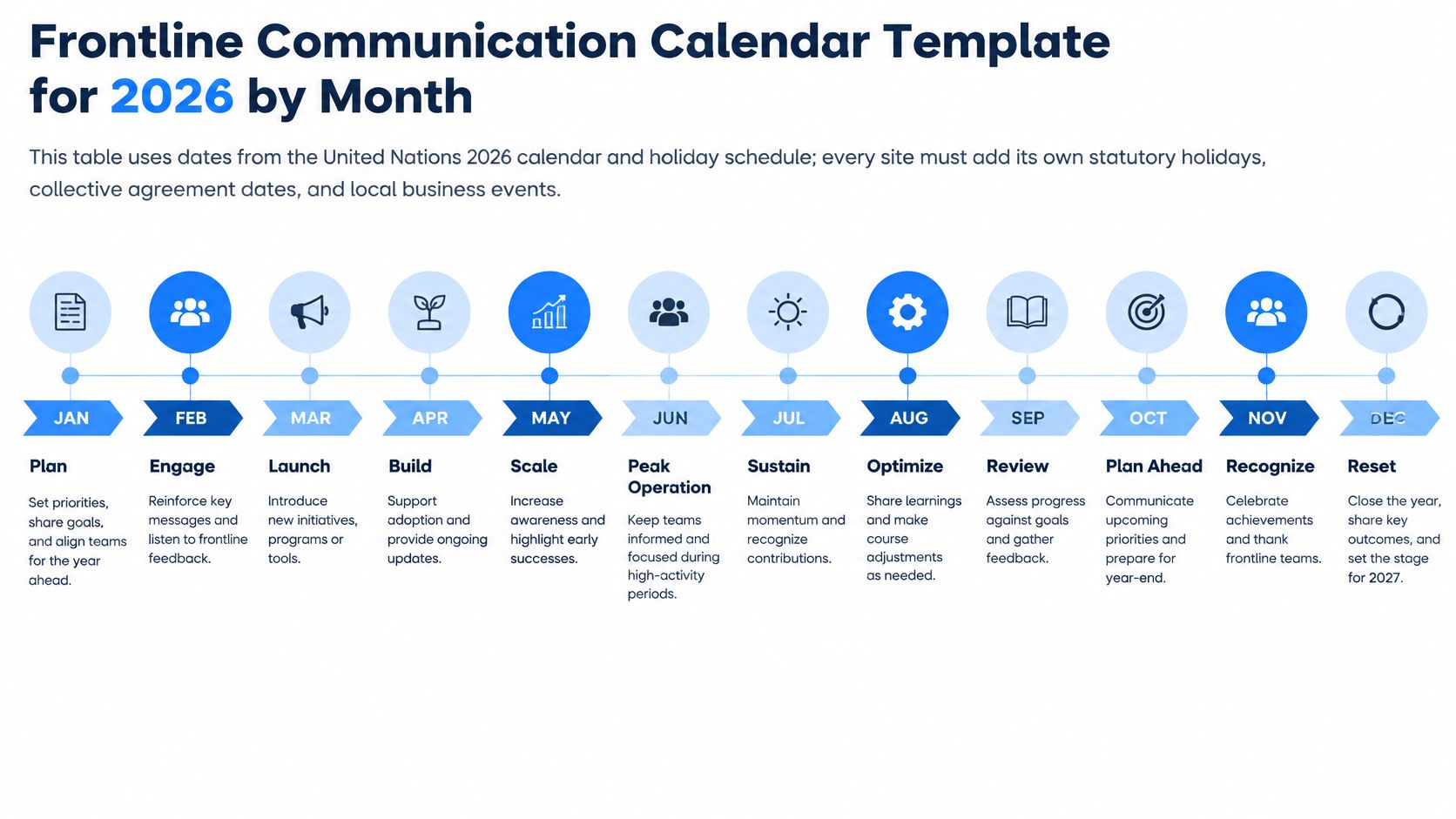
| Month | Dates to check | Planning focus | Owner and channel |
|---|---|---|---|
| January | 1 January, New Year’s Day | Policy and safety reset, shift pattern changes | HR, manager huddle plus printed notice |
| February | 17 February, Lunar New Year (floating) | Leave and shift-swap requests | Site manager, huddle and text |
| March | 8 March, International Women’s Day; 20 March, Eid al-Fitr and Nowruz | Recognition, staffing cover | Internal comms and site managers, multilingual notice |
| April | 3 April, Good Friday; 28 April, World Day for Safety and Health at Work | Safety briefing, incident-reporting reminder | Safety lead, pre-shift briefing and mobile |
| May | 27 May, Eid al-Adha | Leave, cover, delivery changes | HR and operations, manager briefing |
| June | 19 June, Juneteenth | Leave planning, local recognition | HR, locally adapted notice |
| July | Site peak trading dates, summer leave windows | Mid-year review, pre-peak planning, training refresh | Site leads, scheduled huddles |
| August | Site audit and inventory dates, school term restarts | Peak staffing, handover rehearsal | Operations, shift handover notes |
| September | 7 September, Labour Day; 21 September, International Day of Peace and Yom Kippur (floating) | Labour agreements, wellbeing messages | HR and union liaison, formal notice |
| October | 5 October, World Teachers’ Day; mental health and wellbeing observances | Skills, peer recognition, wellbeing resources | Learning team, microlearning and posters |
| November | 8 November, Diwali (floating); 24 November, Gurpurab (floating); 26 November, Thanksgiving Day | Holiday cover, shift swaps | Operations and HR, manager briefing |
| December | 18 December, International Migrants Day; 20 December, International Human Solidarity Day; 25 December, Christmas Day; ISO Week 53 | Year-end closeout, recognition, holiday cover | Internal comms and HR, multilingual notice and huddles |
Use 28 April for a multilingual safety briefing and manager discussion guide. Use 5 October for peer recognition and skills development. I’d treat religious and civic dates as staffing signals first and recognition moments second, because they drive leave requests, shift swaps and demand swings, so schedule the related messages weeks ahead, not days.
Copy the table into a shared sheet, add one column per region, and review it quarterly. July and August stay site-specific by design: pull those anchors from your own peak dates, audit cycles and leave patterns rather than waiting for a global observance. Close the loop each quarter by checking which messages reached all three shifts and which dates produced swap spikes, then adjust the next quarter’s rows. That feedback loop is how fewer, better-timed messages reach more of the frontline.
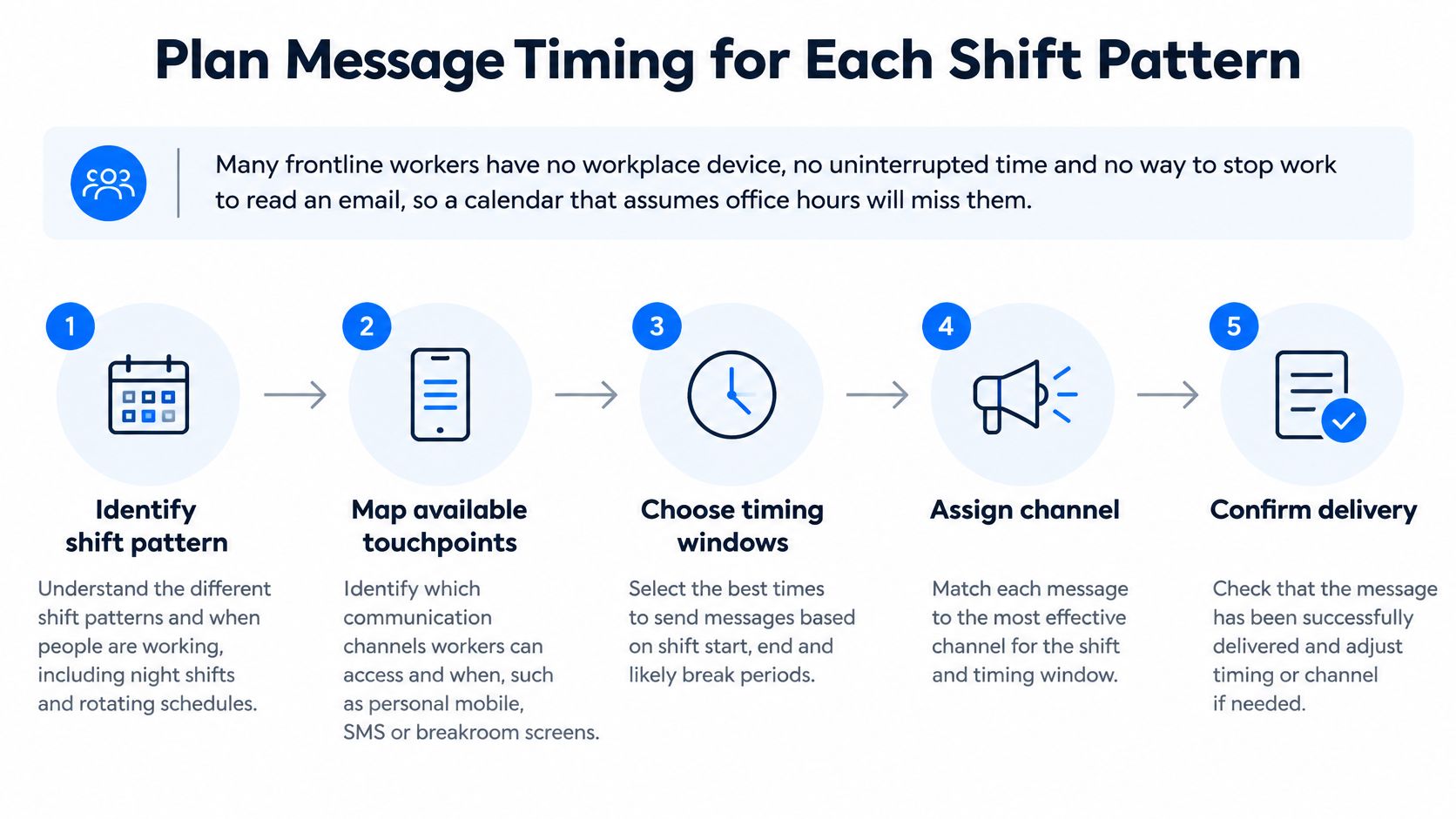
Plan Message Timing for Each Shift Pattern
A safety notice sent at noon reaches the day shift in the pre-shift huddle and lands on the night shift nine hours stale. Many frontline workers have no workplace device, no uninterrupted time, and no way to stop work to read an email, so a calendar that assumes office hours will miss them. Deloitte’s frontline productivity article reports that 82% say improved technology would enhance productivity, that 62% of communication professionals identify heavy workloads and insufficient time to check messages as major barriers, and that 60% struggle specifically to engage frontline employees.
For teams managing communication across multiple shifts and locations, choosing the right channels is just as important as scheduling messages. HubEngage’s frontline employee communication guide explains how mobile-first communication, two-way feedback, and centralized information can help organizations reach deskless employees more effectively.
This is the point where the calendar works as an operating loop rather than a publishing schedule. Pick the slot where each shift can act, record what landed, and feed that back into next month’s plan. One well-placed message replaces three reminders.
| Shift pattern | Best message slot | Backup channel | Manager briefing |
|---|---|---|---|
| Morning shift | Pre-shift huddle, first 15 minutes | Printed notice at workstation | Brief supervisor 30 minutes before |
| Evening shift | Start-of-shift huddle or mid-shift break | Text or push to shift group | Brief evening supervisor at handover |
| Night shift | Start-of-shift briefing, written summary in break room | Asynchronous message next day | Brief night lead before shift |
| Rotating shifts | Repeat across two shift cycles | Dated shared noticeboard | Brief each rotation supervisor |
| Overlapping shifts | Handover window with both shifts present | Handover note in shift log | Brief both leads together |
| 24/7 operations | Rotate live, repeated, and asynchronous formats | Recorded briefing with check-in question | Brief each shift group separately |
Six Timing Steps
- List patterns: Record every shift pattern on each site.
- Mark action windows: Note when each group can act.
- Assign channels: Pick a primary channel and a backup, using sensible push notification best practices rather than repeated alerts.
- Book manager briefings: Brief supervisors before release.
- Set the action window: Give a realistic completion period.
- Check translation: Build lead time into the date, not after it.
Our guide on planning a frontline town hall across day, evening, and night shifts explains how to choose live, repeated, hybrid, and asynchronous formats. The same principle applies when you share feedback with your commercial cleaners, where timing around visits matters more than sending another reminder.
Before any message is released, check each timing choice against one test: can this audience realistically act within the window you have given them? If acting requires a device they do not carry, a break that disappears when the line runs late, or a supervisor who was never briefed, change the slot or shrink the ask.
That check is the core of a workable shift worker communication strategy. Extra reminders pile onto already overloaded channels in a 24/7 workforce communication strategy, while a message timed to a real action window reaches more of the frontline with less noise.
Plan Peak Seasons Without Losing Shift Coverage
Peak season changes the message mix, not just the volume. A good peak season communication plan starts earlier, briefs supervisors before demand rises, and closes with a review while problems are still fresh.
Say a grocery distribution centre expects its busiest weeks in November. In September, operations confirm rota rules, leave limits, and training gaps. In late October, supervisors receive the handover standard and rehearse it. During peak weeks, the site runs short night-shift huddles and records handover notes for each pick wave, then publishes what’ll change next time.
Four-Phase Peak Sequence
- 8 to 12 weeks before: Confirm rota rules, leave freezes, cover needs, and training. Use your own demand data and workforce management forecasting to set dates.
- 2 to 4 weeks before: Brief supervisors, publish the handover standard, and close shift-swap deadlines.
- During the peak: Run short daily huddles from one source of updates. Don’t let each shift maintain its own version.
- After the peak: Collect feedback and publish a you said, we did update naming what changed.
Local calendars can move cover needs during a peak. If a holiday affects swaps, leave, deliveries, or customer demand at a site, add a calendar row for that site early. A central date that looks minor at headquarters can be the hardest staffing week locally.
Handovers connect the calendar to daily work. Our shift handover communication guide provides practical formats for transferring unfinished work, safety concerns, and responsibility between teams. Use one format for task status, risk, owner, and next check, and keep it in the shift log where the incoming lead already looks.
For seasonal workforce communication planning in retail and hospitality, I’d protect supervisor briefing time first. Seasonal hires copy what their lead does in the first busy shift, not what a poster said three weeks earlier.
Coordinate HR, Operations, Safety and Training Messages
Give every site one calendar owner, with a central owner holding the master file. Without that rule, HR, operations, safety, and training will schedule competing messages into the same huddle.
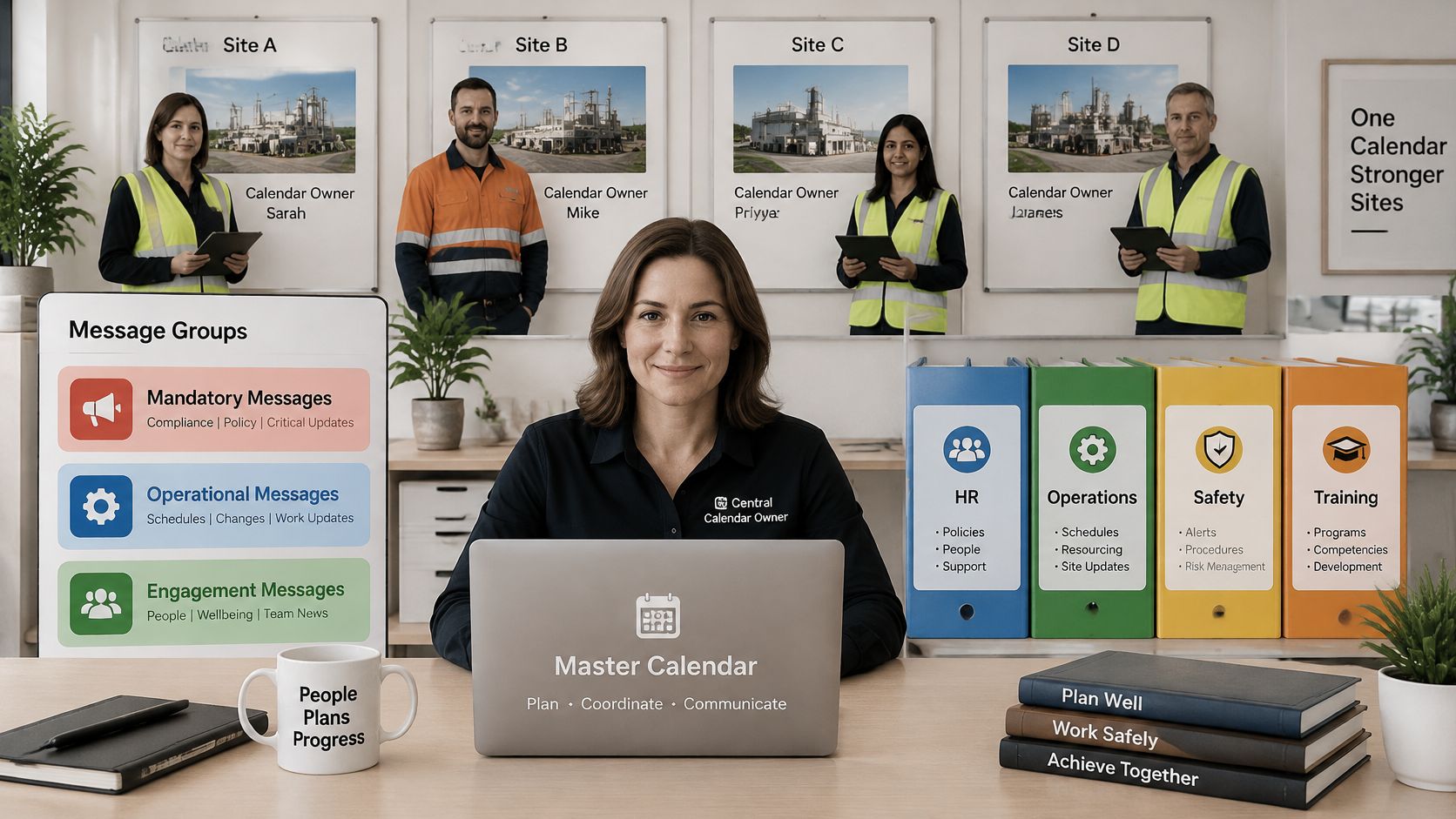
Three Message Categories
- Mandatory: Safety, legal, and compliance messages that must reach every worker with proof of receipt.
- Operational: Rota changes, handover updates, system changes, and cover rules.
- Culture: Recognition, learning, wellbeing, and community content.
Never place mandatory and culture content in the same slot. Workers remember the lighter item and miss the action, or they treat both as optional.
Name the approved source of truth for each topic. A 2025 Unily report based on 800 frontline employees in North America estimated workers spent 376 hours per year searching for, waiting on, or redoing tasks because information was inaccessible, and found 71% used personal devices or unsanctioned apps to complete work. If staff find three rota versions, they’ll use the group chat version.
Set channel ownership clearly: who posts, who approves, and who answers questions. Our internal communications strategy for distributed workforces covers audience mapping, channel ownership, and how information moves between central and local teams. For safety content, specific material such as inspection topics for trucking safety meetings is more useful in a briefing than a generic reminder to stay safe.
Keep medical and leave details out of group messages. Sensitive information belongs in restricted HR or leave-management systems.
For AI announcements, state when a tool may be used, how outputs are checked, and where to report errors. Don’t announce a tool without role-specific practice and manager support in the frontline workforce communication schedule.
Before an entry joins the calendar, ask five questions. Who must act, what’s the deadline, who’s the owner, where’s the source of truth, and how will feedback return? If one answer is missing, it isn’t ready.
Measure Results and Run a Two-Week Pilot
Measure whether workers completed the required action, not whether an email was opened. Workvivo’s frontline communication gap article reports 38% of global frontline workers have feedback for leadership but no good way to share it, 42% say their company is bad at communicating with them, and 48% consider most company communications irrelevant. Relevance beats frequency.
| KPI | How to measure | Starting target |
|---|---|---|
| Action completion by shift | Completed actions divided by assigned actions, per shift | Set from the first two-week pilot |
| Reach by location and language | Recipients who completed the action, by site and language | Set from the first two-week pilot |
| Manager briefing completion | Briefings delivered before message date divided by briefings planned | All mandatory briefings before release, then set a pilot baseline |
| Feedback response time | Hours from worker question to logged reply | Set from the first two-week pilot |
| Feedback closure rate | Feedback items receiving a you said, we did update divided by items received | Every safety item closed, wider baseline from pilot |
| Repeat-question volume | Questions about same message per week, by shift | Falling trend after second pilot week |
| Source-of-truth usage | Teams using approved source instead of unofficial channels | Set from the first two-week pilot |
Use our internal communications KPIs and metrics guide to define calculations consistently. We also publish a frontline employee communication guide and a guide on measuring employee engagement for frontline and deskless teams.
Two-Week Pilot
- Load four weeks: Use the ISO week fields for one site and two shift patterns.
- Assign owners: Add action windows and feedback owners to every entry.
- Brief supervisors: Do this before each message, not on release day.
- Record daily: Log completion and questions by shift.
- Review on day 14: Remove or redesign entries that didn’t reach their audience.
- Close the loop: Publish a you said, we did update naming what changed.
Choose one site and one shift pattern first if two feels too much. Name the person who’ll read feedback each day.
Frontline Communication Calendar Template for 2026 FAQs
Do I Need a Separate Calendar for Each Shift Pattern
No. Keep one master frontline communication calendar template for 2026 with a shift audience field, then filter it into supervisor views. Separate files create conflicting versions.
How Far Ahead Should Peak Season Messages Be Scheduled
Start 8 to 12 weeks before the peak, brief supervisors 2 to 4 weeks before, and use your site’s demand data for exact dates. That’s the core of deskless employee communication during busy periods, planning early enough for cover decisions.
Can One Calendar Serve Several Countries
Yes, if every row stores an ISO week, local date, time zone, language, and translation status. Add statutory holidays and agreement dates per site rather than forcing one national list onto everyone.
How Should a Holiday on an Uncoverable Shift Be Handled
Add the row early enough for swap requests to close. Assign a named cover owner, publish the cover rule in the manager briefing, and confirm cover before the date rather than asking for volunteers during the shift.
How Many Messages Should the Calendar Hold Each Week
There’s no universal number. Use the Action Window Score and pilot feedback to decide whether to add, repeat, merge, or remove an entry. If workers can’t act within the window, the calendar’s too crowded for that shift.
What Is the First Step With No Calendar Today
Pick one site and two shift patterns, load four weeks with owners and action windows, and run the two-week pilot. Expand only after you’ve removed entries that didn’t work.
Start this week by copying the monthly template into a shared sheet, choosing one pilot site, and naming the owner who’ll review feedback daily. Then subscribe to Turn On Engagement, our newsletter on employee engagement, workforce experience, internal communications, and workplace technology, for practical frameworks you can apply to your next internal communications calendar review.