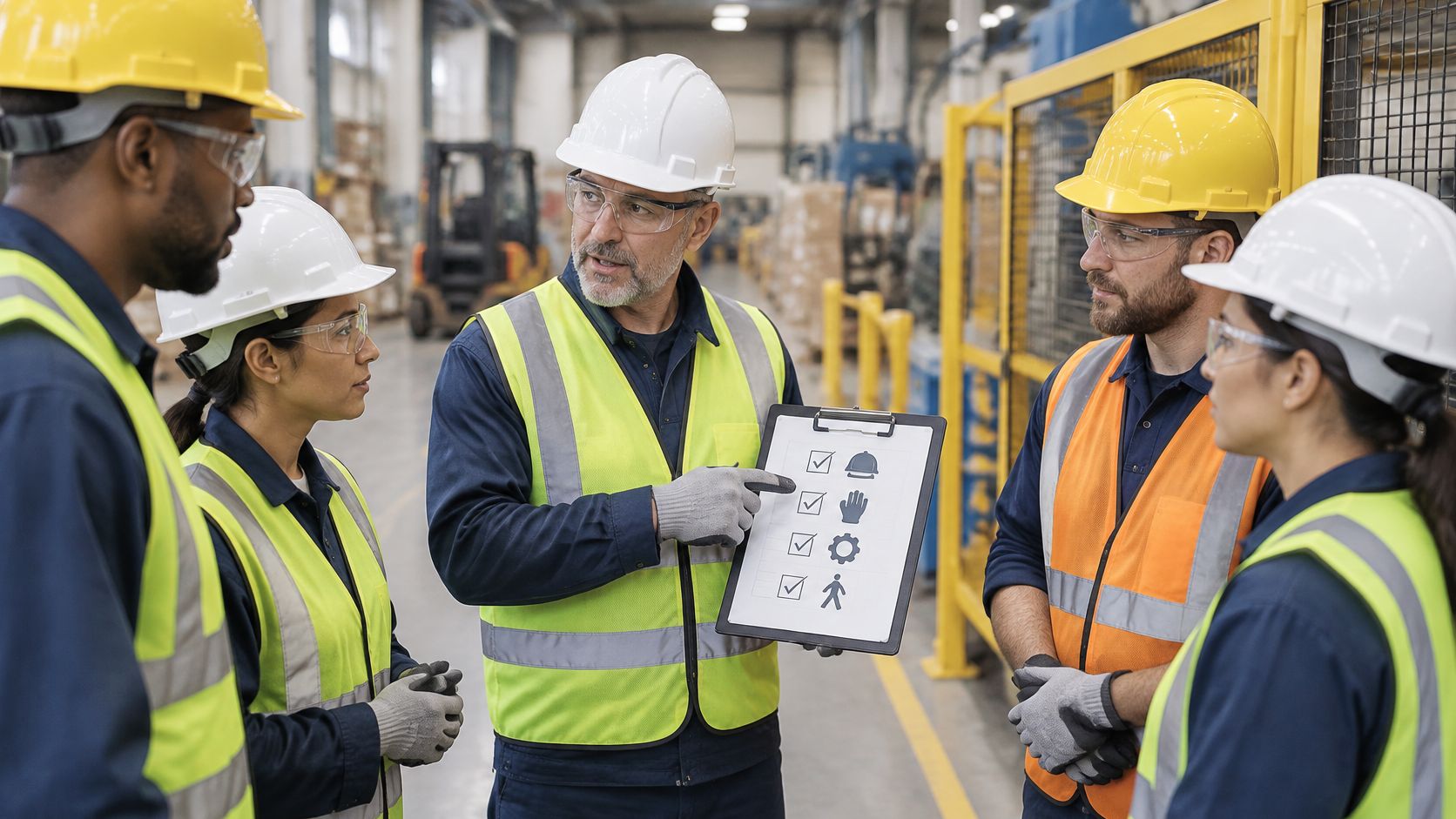
Your crew is waiting, the shift is starting, and you need a safety discussion that fits today’s work. The best toolbox talk topics address a specific hazard, let workers test the control, and finish with an accountable owner. These 50 toolbox talk topics for frontline safety meetings, with talking points, cover everyday exposures, high-risk tasks, emergencies, and worker health through a practical workforce operations lens.
- Choose locally: Use recent near misses, upcoming tasks, and worker exposure to select safety meeting topics.
- Show the control: A demonstration tells you more than a signed attendance sheet.
- Make participation safe: Include contractors, mixed-language crews, and workers who prefer raising concerns privately.
- Assign the fix: Record a named owner, deadline, and evidence of completion.
- Protect worker privacy: Discuss workplace controls together, but handle personal health information privately.
Choose Topics by Crew, Site and Season
A toolbox talk is a short discussion of a task or hazard the crew faces now. Plan for five to ten minutes, with one local check rather than a compressed training course. The topics below form five sets of ten.
Five topic sets, the crews they fit and a suggested cadence
These frequencies are Turn On Work recommendations, not regulatory requirements.
| Topic set | Topic numbers | Best-fit crews | Suggested cadence |
|---|---|---|---|
| Hazard, PPE and housekeeping | 1–10 | All crews, new starters | Weekly, plus before new tasks |
| Falls, heights and slips | 11–20 | Construction, maintenance, warehouse | Before any elevated or access-heavy task |
| Machinery, lifting and vehicles | 21–30 | Manufacturing, warehouse, transport | Weekly or pre-shift on equipment changes |
| Fire, emergency and seasonal weather | 31–40 | All sites | Monthly, plus seasonal stand-downs |
| Health, fatigue and new starters | 41–50 | Supervisors and all crews | Monthly, plus on onboarding |
Use the Turn On Work selection model
This editorial model isn’t an industry standard. Score candidate topics as low, medium, or high against these inputs:
- Recent warning signs: Review incidents and near misses from the last 90 days.
- Upcoming work: Check tasks scheduled over the next two weeks.
- Exposure: Consider how many workers will encounter the hazard.
Choose the strongest combined signal, but let an uncontrolled serious hazard override the score.
For industry context, BLS recorded 163,600 nonfatal injury and illness cases in construction at 2.1 per 100 full-time workers, 306,500 in manufacturing at 2.5, and 51,300 in food manufacturing at 3.0 in 2024. Those figures support different agendas: falls and struck-by hazards in construction, isolation and handling in manufacturing, sanitation chemicals and cutting equipment in food plants.
Use current site logs, including available 2025 and 2026 records, rather than treating national figures as your risk ranking. Include incoming seasonal workers in the selection process through seasonal employee onboarding.
The five-minute format is straightforward: one topic, one local check, one named owner.
Run Each Talk as a Closed Loop
A toolbox talk works when it ends in a named control change and a check at the next shift, not when the sign-in sheet is full. A talk with no follow-up is compliance theater.
The UK Health and Safety Executive’s worker-involvement guidance emphasizes active participation in identifying hazards, suggesting controls, and providing feedback. Attendance alone doesn’t show that anyone understood the procedure or corrected the problem.
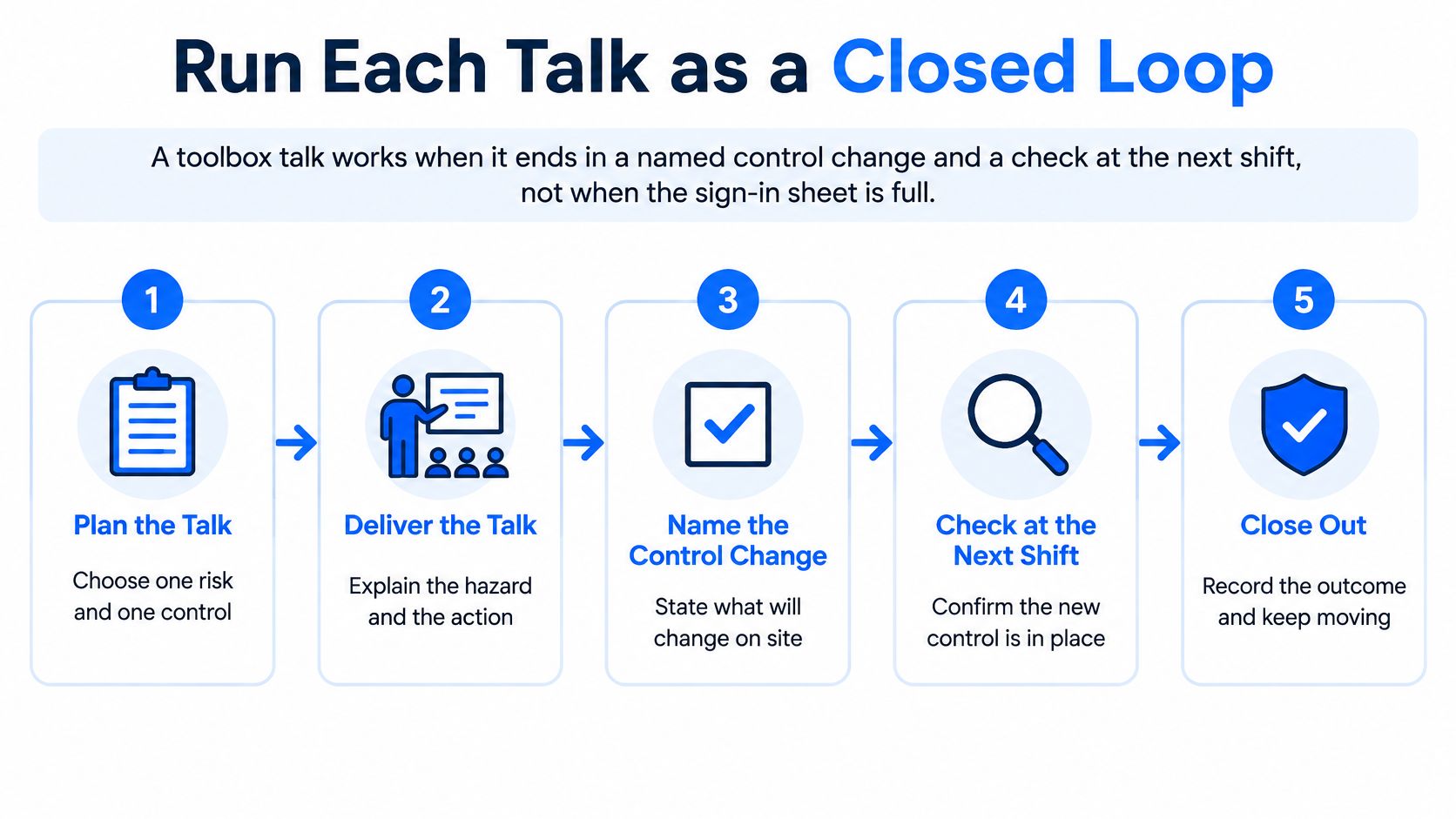
Follow the Talk-to-Close-Out Loop
The Turn On Work Talk-to-Close-Out Loop is an editorial workflow, not an established industry standard. Use these delivery steps:
- Open with a local event. Spend roughly two minutes describing a changed condition, exposure, or near miss without identifying someone to blame.
- Ask open questions. Ask where the task becomes awkward, what workers improvise, and which control is difficult to use.
- Compare procedure with practice. Bring the actual instruction to the work location and identify the mismatch.
- Agree on control changes. Prioritize elimination, substitution, engineering controls, administrative controls, then PPE.
- Assign responsibility. Give each action a named owner and due date, including temporary protection while the permanent fix is pending.
- Verify and report back. Check implementation at the next shift. Don’t mark an action complete because someone ordered a replacement.
Check understanding without putting people on the spot
Ask a worker to demonstrate the safe setup or explain the response to a changed condition. Make teach-back a check on your explanation, not a public test of the employee.
Use translated visuals, suitable interpreters, and a private reporting route to address language barriers in the workplace. Include temporary and contract workers.
Practical rule: A worker who challenges the plan should receive an answer, not a reputation for being difficult.
Record worker-raised hazards separately from inspection findings. Track participation rate, hazards raised per meeting, and days to close-out, then investigate recurring unresolved items.
For teams working across different shifts or locations, digital tools can make safety communication easier to manage. A safety meeting app can help distribute toolbox talks, share safety updates, collect hazard reports, and track employee acknowledgments without relying entirely on paper records. Our shift handover communication guide provides practical formats for transferring unfinished work, safety concerns, and responsibility between teams; our frontline engagement measurement guide supports the listening side of that process.
Hazard, PPE and Housekeeping Topics
A PPE talk starts with a task-specific hazard assessment, not a reminder to wear gloves. OSHA’s PPE assessment guidance explains the workplace assessment, control selection, equipment selection, and training responsibilities associated with 29 CFR 1910.132.
Everyday hazard and reporting checks
-
Hazard identification on today’s task. Walk the work area and ask what changed since the previous checklist, including deliveries, contractors, or temporary cables. Close-out: The area lead records the missed hazard and checks its control before shift end.
-
Job hazard analysis in plain terms. Explain the task, break it into steps, identify hazards, and choose controls; name who completes the analysis and where workers can retrieve it. Close-out: The task supervisor checks the document against the actual setup.
-
Near-miss reporting. Explain that an event can merit reporting even when nobody was hurt, then demonstrate a reporting route workers can complete quickly. Close-out: The supervisor confirms that a practice report reaches the responsible recipient.
-
Hierarchy of controls. Compare removing a solvent task, substituting a safer product, enclosing the process, restricting access, and wearing suitable protection. Close-out: The supervisor identifies whether a stronger control can replace a behavior-dependent measure.
Equipment and workstation checks
-
PPE selection. Match gloves, eye protection, hearing protection, and respiratory equipment to the assessed exposure, not whatever is nearest. Close-out: The PPE owner verifies the selected equipment against the task assessment.
-
PPE inspection before use. Show cracked lenses, glove punctures, and frayed straps using safely retired examples. Close-out: The stores lead removes defective equipment from service and confirms replacement availability.
-
Hearing protection in high-noise zones. Point out designated zones and demonstrate the approved protector’s fit, condition, and replacement cues. Close-out: The area lead checks that suitable, serviceable protection is available at entry points.
-
Respirator seal checks. Demonstrate the manufacturer’s user seal check for each donning of a tight-fitting respirator, including how facial hair can interfere with the seal; this doesn’t replace fit testing. Close-out: The respiratory-program lead resolves any failed check before exposure.
-
Housekeeping at the workstation. Clear aisles, store tools off walking routes, and isolate spills for cleanup by appropriately equipped workers. Close-out: The workstation owner checks the route and reports the source of recurring spills.
-
Chemical labels and SDS access. Locate the safety data sheet, explain the product’s pictograms, and find its handling and exposure instructions. Close-out: The chemical owner confirms workers can access the correct SDS during their shift.
For visibility-related purchasing discussions, Power Print’s custom safety vest guide provides a starting point for considering customization. Keep branding secondary to the assessed visibility need and applicable equipment requirements.
A mobile LMS can support access to approved refreshers, but completion isn’t evidence of correct use. Keep the PPE sequence practical: assess, reduce exposure, select, demonstrate, inspect, and verify.
Falls, Heights and Slip Topics
Fall-prevention talks should end with a visible site correction. In 2024, falls, slips, and trips caused 389 of 1,034 private-sector construction deaths, and 95.9% of those fatal events were falls to a lower level, according to BLS.
The same BLS publication reports a construction nonfatal fall, slip, and trip rate involving days away from work of 30.0 cases per 10,000 full-time workers in 2023–2024, compared with 22.6 across private industry. Use the signal to inspect access arrangements, not to tell workers to pay more attention.
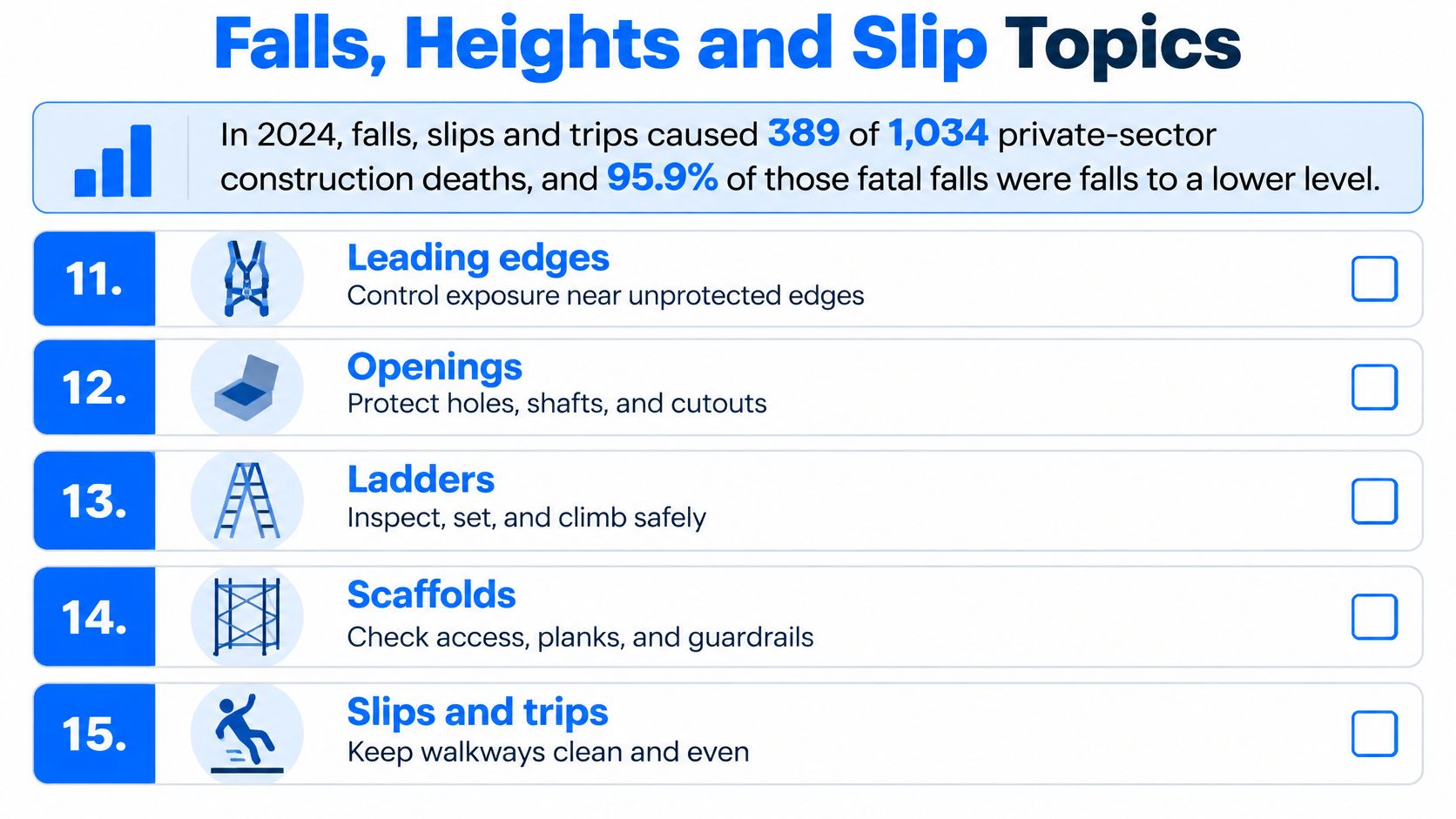
Elevated work and protected openings
-
Leading edges and guardrails. Have the competent person check guardrail and midrail dimensions, stability, and completeness against the applicable site requirements. Close-out: The work supervisor restricts access until missing protection is installed and verified.
-
Ladder setup. Demonstrate the appropriate setup angle, three points of contact, secure footing, and extension above the landing using the approved ladder instructions. Close-out: The access-equipment owner replaces an unsuitable ladder or corrects its setup.
-
Scaffold tags and inspection. Explain what the site’s green tag confirms, its inspection status, and who may alter or remove it; tag colors aren’t a universal permission system. Close-out: The scaffold supervisor resolves missing or outdated inspection information.
-
Floor openings. Show how to secure, identify, and protect an opening, including cutouts temporarily exposed during work. Close-out: The area supervisor verifies the cover or barrier before reopening access.
-
Fall-arrest harnesses. Inspect webbing, connectors, and labels, then identify the approved anchor, clearance needs, and compatible system. Close-out: The fall-protection lead removes suspect equipment and verifies the planned anchorage.
Walking routes, platforms, and rescue
-
Wet floors and spill response. Place barriers or cones, arrange prompt cleanup, and report the leak rather than repeatedly mopping beneath it. Close-out: The maintenance owner checks that the source is controlled.
-
Winter walkways. Identify icy transitions, treatment supplies, suitable footwear, and cleared routes between buildings. Close-out: The grounds lead checks the designated route before workers use it.
-
Stairs and access routes. Inspect handrails and lighting, and change carrying methods when loads obscure the next step. Close-out: The area lead verifies the repaired route or alternative handling method.
-
Mobile work platforms. Check gates, guardrails, ground conditions, and the fall-protection arrangement specified for the platform; never add a ladder to gain height. Close-out: The authorized operator demonstrates the approved setup before use.
-
Rescue planning at height. Identify trained rescuers, communication methods, equipment, and realistic access for assistance. Close-out: The work supervisor verifies rescue readiness before work at height begins.
A harness doesn’t make an incomplete work-at-height plan acceptable.
For a broader planning reference, use TP Training’s falls prevention guide alongside local requirements and competent assessment. Record physical fixes, not commitments to be more careful.
Machinery, Lifting and Vehicle Topics
Name the machine, aisle, or handling task before discussing machinery safety. Pinch points, stored energy, and vehicle movements require different controls, so a generic reminder to stay clear won’t resolve the exposure.
A toolbox talk reinforces approved procedures. It doesn’t qualify someone to isolate equipment, operate a forklift, or enter a confined space.
Isolation and material handling
-
Lockout/tagout. Use the equipment-specific procedure to identify energy sources, isolate and lock them, control stored energy, and verify isolation through the prescribed method. Close-out: An authorized employee demonstrates the sequence safely before maintenance starts.
-
Machine guards. Point out fixed guards, interlocks, and prohibited bypasses on the named machine. Close-out: The equipment supervisor confirms protection is restored before operation resumes.
-
Safe lifting. Assess weight, grip, destination, and route before lifting; keep manageable loads close and avoid twisting under load. Close-out: The team lead watches a planned handling demonstration and changes awkward storage positions.
-
Team lifts and mechanical aids. Identify when the task needs a cart, hoist, or coordinated team rather than extra effort from one worker. Close-out: The handling lead confirms the aid is suitable, available, and inspected before movement.
-
Forklift pre-shift checks. Walk through the truck’s checklist, including horn, brakes, forks, tires, and leaks, without exposing pedestrians during testing. Close-out: The authorized operator records defects and removes unsafe equipment from service.
Movement, cutting, and restricted entry
-
Pedestrian and vehicle separation. Trace the actual walking route and identify blind corners, crossings, and loading areas; use physical separation where feasible and trained spotters where the plan requires them. Close-out: The warehouse lead verifies the crossing control before traffic starts.
-
Racking damage. Show how to report bent uprights, displaced beams, or impact damage without approaching an unstable load. Close-out: The warehouse supervisor isolates the affected area and arranges competent assessment before further loading.
-
Cutting tools. Demonstrate the blade guard, safe cutting direction, and blade replacement method, with task-appropriate hand protection that doesn’t introduce an entanglement hazard. Close-out: The tool owner withdraws dull or damaged blades.
-
Pinch points and struck-by hazards. Mark where hands, feet, or bodies could enter a closing gap or a load’s swing path. Close-out: The lifting supervisor demonstrates the exclusion boundary and agreed communication signals.
-
Permit-required confined spaces. Review the entry permit, isolation, atmosphere testing, attendant duties, communication, and rescue arrangements for the identified space. Close-out: The entry supervisor verifies every prerequisite, and nobody makes an improvised rescue entry.
Make the demonstration safe
Ask workers to show the control on a safely isolated machine, stationary vehicle, or training setup. Don’t create a live hazard just to make the briefing memorable.
A useful demonstration reveals practical obstacles: a lock point that’s inaccessible, a cart that won’t fit the aisle, or a pedestrian route blocked by staging. Assign those problems to someone who can change the setup, not just remind operators.
Fire, Emergency and Seasonal Weather Topics
Emergency toolbox talks are rehearsals. Workers should be able to find the exit, identify the relevant emergency equipment, and reach the assembly point without waiting for a drill announcement.
Use the actual site layout, including night-shift access and contractor locations.
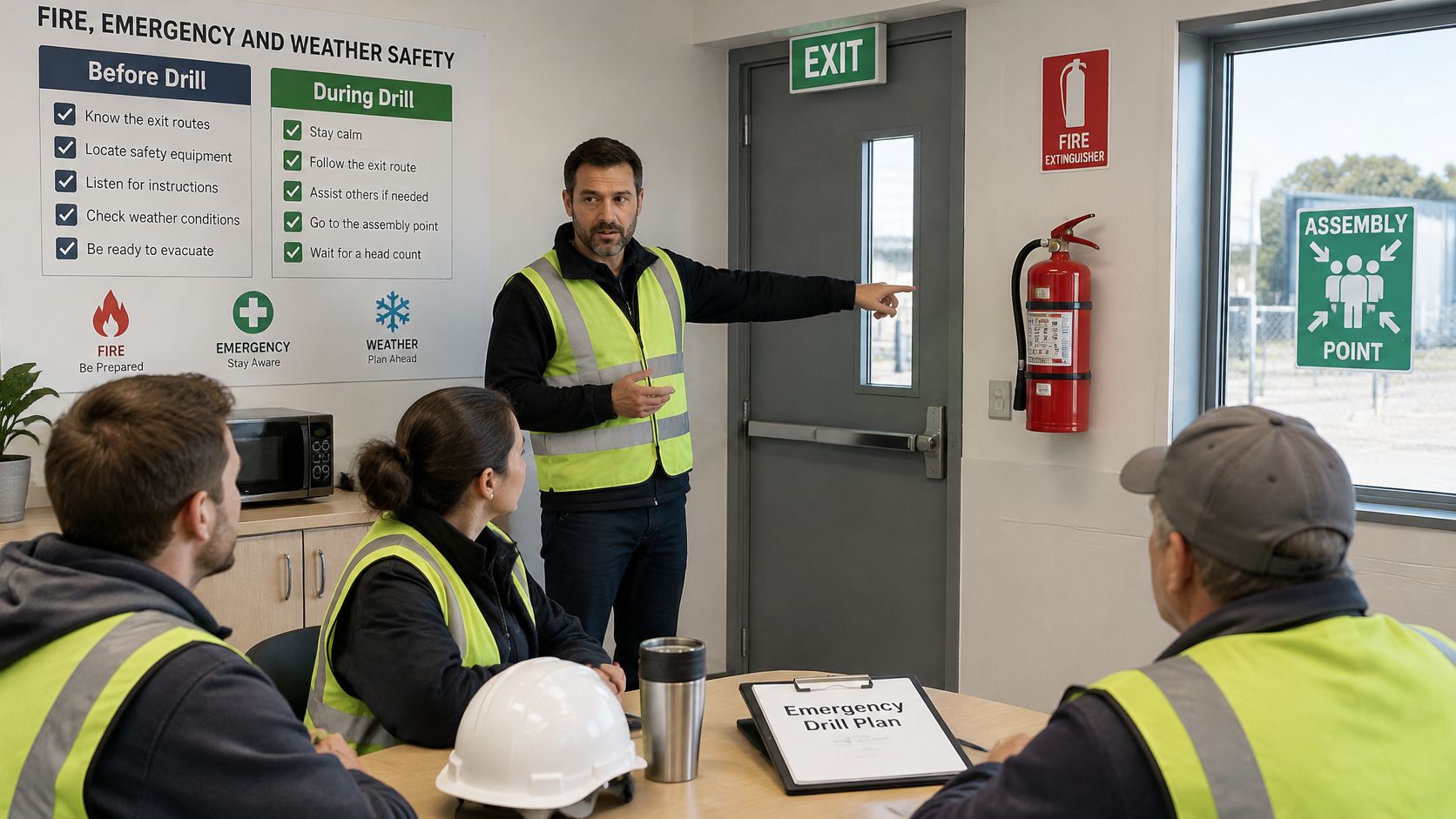
Fire prevention and evacuation practice
-
Fire extinguishers. Explain PASS, pull, aim, squeeze, sweep, only within the site’s trained-response arrangements and with suitable equipment and a clear escape route. Close-out: The emergency lead confirms workers know when to evacuate instead.
-
Exits and assembly points. Walk the primary and alternate escape routes from the work area, where available, and identify the gathering location. Close-out: The area supervisor clears obstructions and checks access.
-
Hot work. Review the permit, combustible-material controls, fire watch, and post-work monitoring period specified by the permit. Close-out: The permit issuer verifies monitoring responsibilities before releasing the area.
-
Extension cords and electrical equipment. Identify damaged insulation, unsuitable loading, and cables exposed to traffic or moisture. Close-out: The equipment owner disconnects unsafe items and arranges qualified repair or replacement.
-
Flammable liquids. Check suitable labeled containers, closed storage, and separation from ignition sources. Close-out: The chemical-storage owner corrects the storage arrangement before the task proceeds.
For battery charging and storage discussions, Knight Tek’s battery fire suppression guide can inform planning questions. Have competent fire-safety personnel determine the site response, rather than assuming a general extinguisher demonstration covers lithium-ion battery incidents.
Emergency roles and seasonal conditions
-
Emergency action plan. Name who calls for help, who performs any safe shutdown, and who reconciles headcount. Close-out: The incident lead tests contact routes and backup responsibilities using the crisis communication plan.
-
First-aid kits. Locate kits, identify trained first-aid contacts, and explain how to report missing supplies. Close-out: The kit custodian checks stock and replenishes gaps.
-
Heat stress. Confirm water, shade or cooling, recovery breaks, and gradual acclimatization arrangements for new or returning workers. Close-out: The shift manager verifies supplies and relief coverage before hot work begins.
-
Cold stress. Discuss dry layered clothing, warm-up areas, and reporting numbness or loss of dexterity. Close-out: The supervisor checks warming access and adjusts exposed tasks.
-
Severe weather. Identify shelter, the person monitoring conditions, and the authority to halt outdoor work for lightning or other dangerous weather. Close-out: The site lead tests the stand-down message and shelter access.
Schedule seasonal workplace safety talk topics before exposure begins. A poster telling people to take breaks won’t help if supervisors haven’t arranged staffing coverage.
Health, Fatigue and New Starter Topics
Health and fatigue belong beside visible accident hazards because occupational disease accounts for most work-related deaths. The International Labour Organization estimates that about 2.6 million of approximately 2.93 million annual work-related deaths result from occupational diseases, based on global estimates for 2019.
Keep these health and safety talk topics focused on work design, exposure controls, and access to support. Don’t turn a group briefing into a discussion of someone’s diagnosis.
Health and sustainable work
-
Ergonomics. Adjust working height, reach distance, and tool position to support neutral posture; rotate tasks only when the alternative changes the exposure. Close-out: The workstation lead checks an adjusted setup with the worker.
-
Noise. Explain how to report ringing ears or difficulty communicating at arm’s length without using those signs as a substitute for exposure assessment. Close-out: The safety lead reviews the reported location and arranges appropriate assessment.
-
Fatigue and long shifts. Review overtime rules, recovery opportunities, and the route for reporting inability to work safely. Close-out: The scheduling manager reviews assignments and coverage, including risks associated with employee burnout.
-
Hydration and rest breaks. Locate drinking water and explain break coverage across every shift, including lone or mobile roles. Close-out: The shift manager verifies workers can leave the task for their breaks.
-
Early symptom reporting. Name dizziness, rash, breathing changes, and numbness as concerns to raise through the appropriate private route, with urgent symptoms triggering emergency response. Close-out: The supervisor confirms workers know the contact and immediate escalation process.
-
Stress on high-pressure shifts. Give a practical route to request help when staffing, pace, or conflicting instructions make work unmanageable. Close-out: The manager resolves a workload obstacle rather than offering only resilience advice.
Joining, returning, and supervising
-
Light duty and return to work. Explain how approved restrictions affect assignments without sharing medical details with the crew. Close-out: The manager checks that the assigned task matches the agreed restrictions.
-
New starter orientation. Walk through exits, first aid, supervisor access, and the reporting channel, then assign a named buddy for the first week. Close-out: The onboarding supervisor asks the starter to demonstrate the routes and contacts.
-
Supervisor responsibilities. Set an expectation of daily floor walks, accessible answers, and escalation when a fix exceeds the supervisor’s authority. Close-out: The operations manager checks an unresolved concern and confirms its next owner.
-
Stop-work authority. Establish that every worker can call a stop to unsafe work without penalty and explain how the task is made safe before restart. Close-out: The supervisor practices the stop-and-escalate exchange with the crew.
Discuss the working conditions together. Handle personal medical information privately.
Sensitive details belong in restricted HR or leave-management systems, not group messages. Managers shouldn’t pressure employees to disclose diagnoses or assume a recurring absence pattern is misconduct.
Toolbox Talk Topics FAQs
Good toolbox talks answer a current work question and produce an observable action. Use these distinctions when planning daily workplace safety discussions or adapting free toolbox talk topics to a specific site.
What are the best five-minute safety meeting topics?
Choose a narrow issue workers can inspect immediately: a blocked exit, damaged glove, changed pedestrian crossing, or missing chemical label. A broad subject such as machinery safety needs narrowing to a named machine and task.
Which toolbox talk topics suit construction workers?
Prioritize the hazards in the planned work: leading edges, openings, ladders, scaffolds, lifting operations, vehicle movements, and rescue readiness. Changing site conditions should influence the agenda more than a fixed calendar.
What works for manufacturing employees and warehouse workers?
Manufacturing crews need equipment-specific discussions about isolation, guards, cutting tasks, and handling. Warehouse crews benefit from checking forklift condition, rack damage, loading areas, pedestrian separation, and awkward picking positions.
Do toolbox talks replace formal safety training?
No. Toolbox talks reinforce approved procedures and reveal practical gaps, but they don’t replace required training, authorization, competent assessment, or equipment-specific instruction. High-risk activities need their full control arrangements before work starts.
How should supervisors document a toolbox talk?
Record the task, participating crew, worker-raised concern, selected control, responsible person, deadline, and verification evidence. Keep attendance records where needed, but don’t confuse a roster with proof of understanding.
Can AI write toolbox talks?
Use AI to draft prompts or organize approved material, not to invent technical instructions or determine whether a site is safe. A competent reviewer should check the content against current procedures, equipment instructions, and actual conditions before delivery.
Before your next shift, choose one topic, walk to the exposure point, and ask a worker to demonstrate the control. Record the unresolved action in your existing task system, name its owner, and schedule the next-shift check. For more practical workforce operations frameworks, subscribe to Turn On Engagement, Turn On Work’s newsletter on communication, employee experience, and workplace technology.