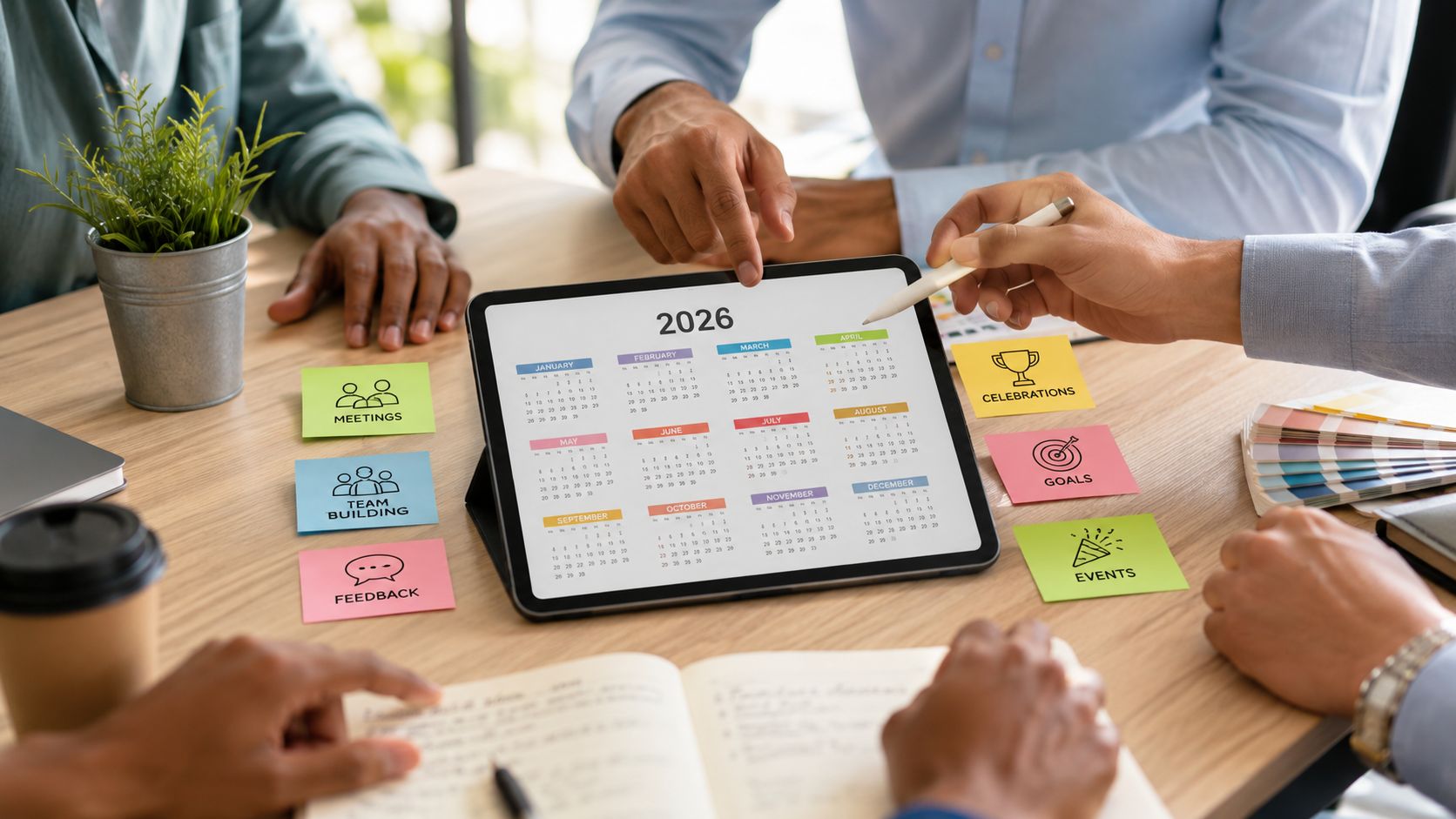
You’ve planned a year of recognition days, surveys, manager check-ins, and team events, but the calendar still feels like a list rather than a system. A 2026 employee engagement calendar should connect listening, communication, recognition, development, and operational follow-through. It should show what happens, who receives it, which channel delivers it, when workloads make participation difficult, and how leaders will act on the feedback.
What an Employee Engagement Calendar Is and Why 2026 Demands One
An employee engagement calendar is a year-round operating plan for listening to employees, communicating clearly, recognizing contributions, supporting growth, and reviewing action. It’s not a schedule of parties. For 2026, the strongest calendar will coordinate surveys, manager routines, workforce communications, and operational realities across office, hybrid, remote, and frontline teams.
Key takeaways:
- Start with one business-relevant engagement objective, not a collection of disconnected activities.
- Use monthly themes to create continuity, while keeping activities adaptable to local needs.
- Close the loop after every major listening event, so employees can see what changed.
- Segment delivery by workforce type, because email, mobile, shift briefings, and manager conversations don’t reach everyone equally.
- Measure action and participation together, rather than treating survey volume as progress.
A useful calendar answers five practical questions. What are we trying to improve? Which employee populations are included? When can people realistically participate? Which manager, communications, HR technology, or operational workflow will deliver the activity? Who owns the response afterward?
That operating view connects engagement to broader workforce experience priorities. A pulse survey may identify a problem, but communication explains the response, technology makes participation possible, and operations determines whether the promised change reaches the workplace.
The older model depended heavily on an annual questionnaire. That approach created a useful snapshot, but it left long gaps between measurement and action. Modern employee engagement strategies use a recurring rhythm of shorter listening moments, manager check-ins, peer recognition, learning, and action reviews. The calendar becomes the visible structure that keeps those activities from competing randomly for employees’ attention.
A 12-month plan also gives HR and internal communications teams a way to manage trade-offs. You can protect high-load periods, avoid stacking surveys beside performance reviews, and replace a large event with a lighter mobile activity when staffing conditions change. The aim isn’t to fill every month. It’s to create a cadence the organization can deliver consistently.
How Engagement Calendars Became an Operating System for Workforce Experience
The employee engagement calendar began with surveys, then expanded into a coordinated way to listen, decide, communicate, and act. Its value lies in connecting employee input with the operating rhythm of the business, from priority-setting and recognition to manager follow-up and workplace changes.
Employee-attitude surveys appeared in industrial companies in the 1920s. Among 3,500 companies, the National Industrial Advisory Board reported a 250% increase in companies using attitude surveys between 1944 and 1947, as documented in the history of employee surveys. William Kahn’s 1990 work is often credited with the first academic framing of employee engagement, while engagement became a mainstream business priority in the 2000s.
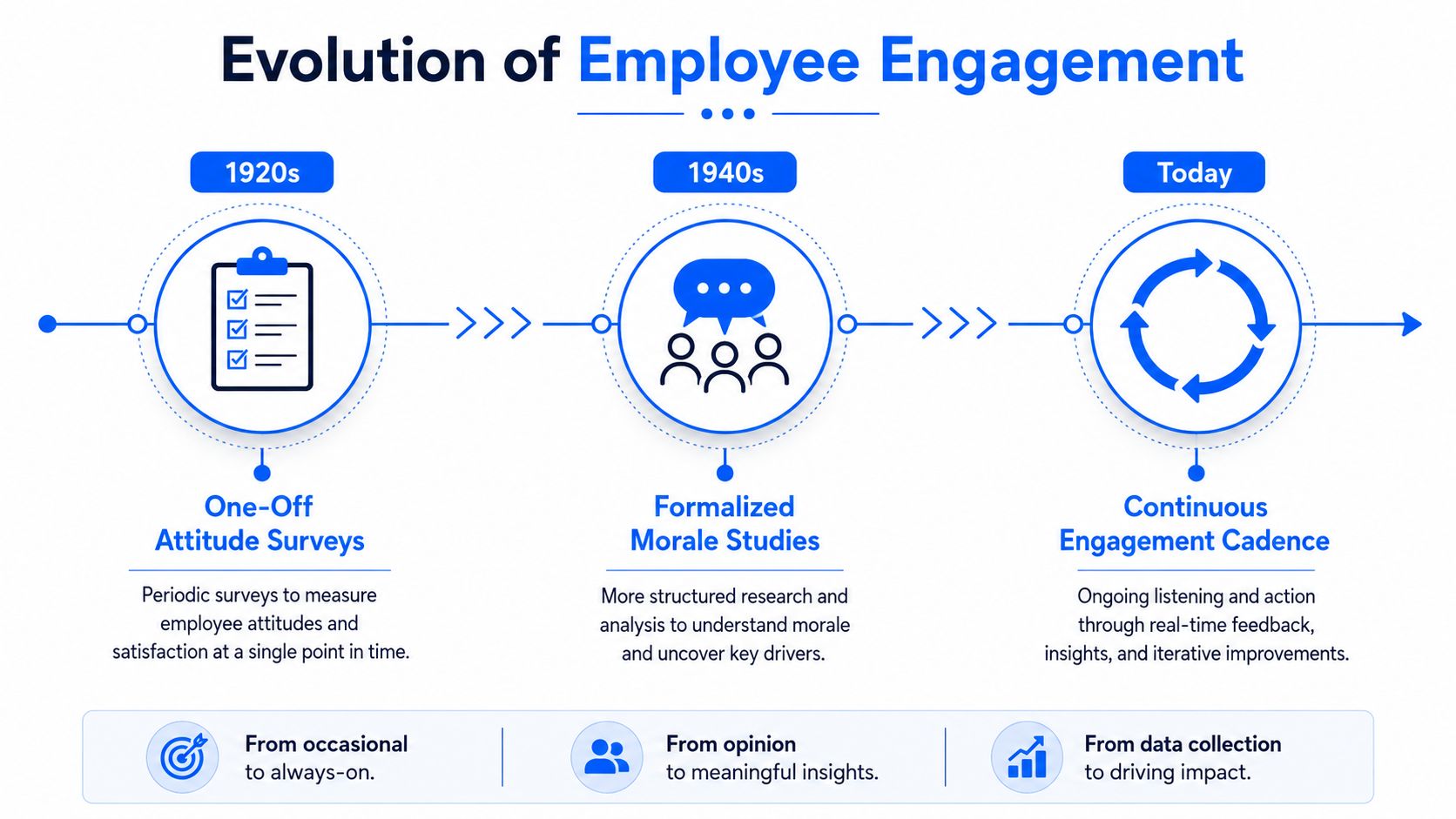
From measurement event to operating rhythm
A survey creates evidence, not improvement. Someone still needs to interpret the findings, set priorities, assign owners, explain decisions, and check whether working conditions changed. The calendar connects those steps and places them alongside business events, manager routines, and communication windows.
Gallup reported that only 20% of employees worldwide were engaged in 2025, down from 21% in 2024, the second global decline in 12 years and the lowest level since 2020. In the United States, engagement averaged 31% in 2025, unchanged from 2024 and below the 36% peak in 2020. Gallup estimates that each percentage-point change represents about 1.6 million full- or part-time U.S. workers, so the decline from the 2020 peak represents roughly 8 million fewer engaged employees. The figures appear in Gallup’s 2025 State of the Global Workplace report.
These results do not dictate one monthly schedule. They support a repeatable operating cadence, because employees experience priorities, workload, support, recognition, and management through repeated interactions rather than one annual campaign.
Why distributed work exposed the old model
Distributed and frontline workforces made survey-only programs harder to run. An office employee may see an intranet post immediately, while a warehouse associate, nurse, field technician, or hospitality worker may need a mobile notification, shift huddle, translated message, or manager-led conversation. Channel planning is therefore part of engagement planning, not a communications detail added later.
A modern workforce operating system needs coordinated communication, usable HR technology, manager support, and operational ownership alongside measurement. AI can group open-text themes or identify communication gaps, while human judgment determines which issues leaders should address and what employees should hear.
Practical rule: A calendar entry is incomplete until it names the audience, delivery channel, owner, response date, and evidence that the action happened.
How to Design a 12-Month Employee Engagement Calendar From Scratch
Build the calendar backward from the decisions employees need to see, rather than forward from awareness days. A useful planning process connects the annual objective to employee groups, listening windows, business constraints, actions, and review. The calendar becomes an operating schedule for hearing concerns and showing what changed.
1. Define the year’s objective
Choose one primary outcome for the annual employee engagement plan. Possible aims include improving confidence in organizational direction, strengthening manager communication, increasing recognition visibility, supporting development, or improving frontline voice. Supporting measures can remain, but too many equal priorities make ownership unclear.
Write the objective as an operating statement: “Employees understand the year’s priorities and can see how leaders respond to barriers.” That sentence should guide survey items, manager prompts, communication assets, and monthly themes. If the objective cannot shape a decision or activity, it does not belong at the center of the calendar.
2. Identify the populations in scope
Map groups by work pattern, location, language, shift, tenure, manager structure, and access to technology. One enterprise calendar can still require different employee experiences.
Document whether each group needs email, intranet, mobile, SMS, printed materials, digital signage, team huddles, or manager delivery. Name the local owner for every population. A frontline team without regular email access needs a different launch reminder and response route from a hybrid team that works in collaboration software.
3. Map census and pulse windows
Reserve the broad census or biannual benchmark survey first. Add shorter pulses only when the team has time to interpret results and act. Pulse instruments should typically contain 10 to 15 questions or fewer, according to the survey-design guidance summarized in this survey methodology reference.
Gallup advises creating an initial benchmark and surveying every six months to track progress. Treat that cadence as a starting point, then adjust it for organizational change, workload, and the team’s capacity to respond. A practical employee listening strategy also defines what happens after collection, including who reviews themes, who communicates decisions, and when employees receive an update.
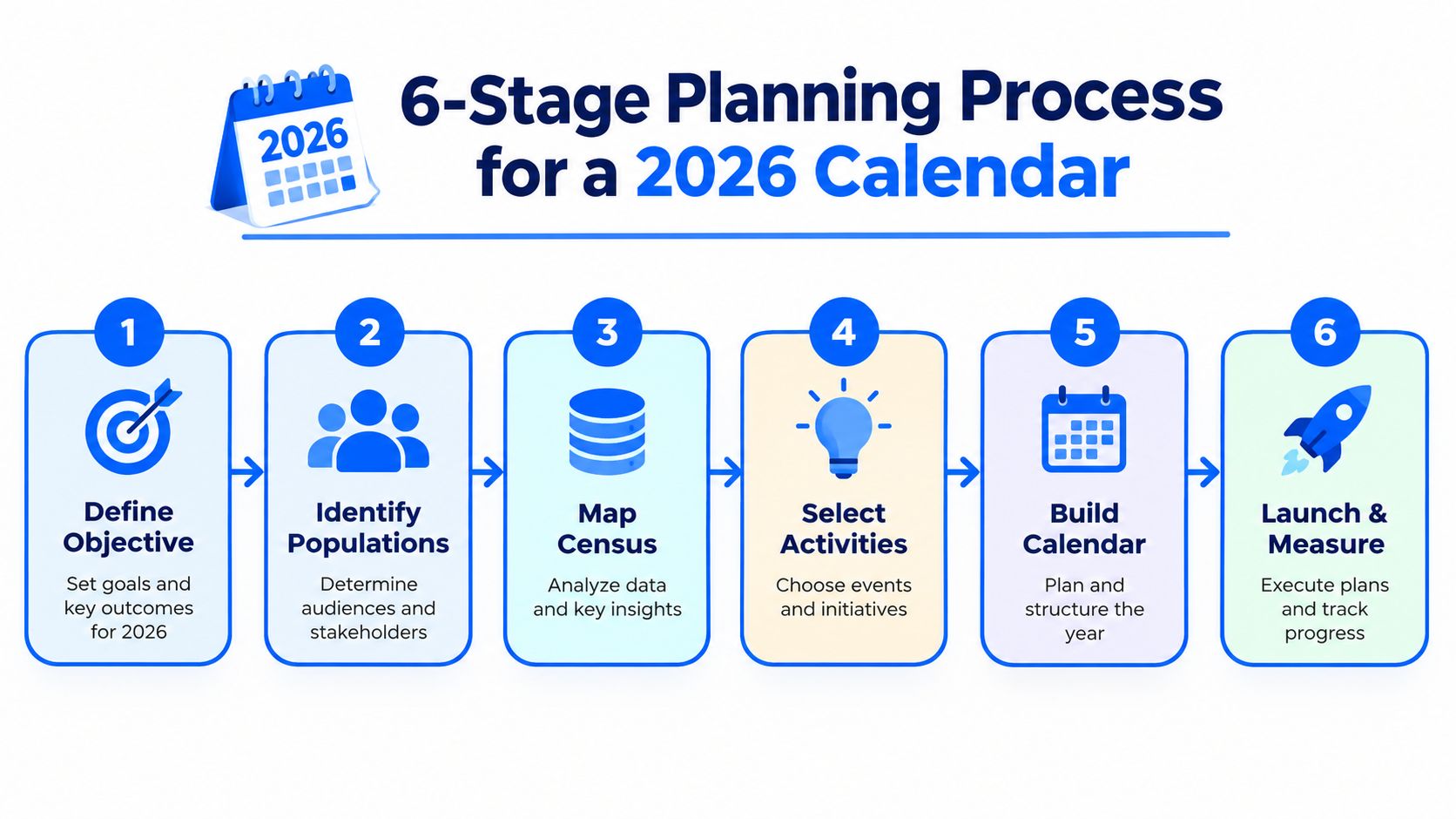
4. Mark blackout and business-critical periods
List annual planning, peak production, open enrollment, audits, major launches, holidays, seasonal demand, weather exposure, and known staffing constraints. Do not schedule a high-effort listening event while employees are struggling to complete core work.
Keep at least six weeks between major survey activity and performance review cycles, following the planning recommendation in this engagement program calendar guide. The gap gives managers time to review findings and prevents employees from experiencing every people process as one combined demand.
5. Place activities after listening
Schedule recognition, manager discussion guides, and action-planning sessions after each major listening event. Employees do not need every response immediately, but they do need a visible explanation of what leaders heard, what they will do, and what will not change yet.
6. Reserve review and adjustment time
Add a recurring owner review to examine participation, sentiment, delivery reach, and action status. Leave room for substitution. A weather disruption, operational incident, or staffing shortage may require a lighter activity or a different channel.
Copyable planning checklist:
- Objective: What employee experience condition are we trying to improve?
- Population: Which groups need different timing, language, or channels?
- Listening: Which census, pulse, and change-triggered moments are justified?
- Blackouts: Which periods should remain free of major requests?
- Action: When will leaders review results and communicate decisions?
- Ownership: Who delivers, approves, tracks, and closes each activity?
The common failures are predictable: overfilling the calendar, repeating surveys without visible action, scheduling activities during peak workload, and measuring attendance without checking whether the activity supported the stated objective. A smaller calendar with clear owners and response dates usually produces more trust than a crowded program that employees cannot follow.
A Month-by-Month Employee Engagement Calendar With Themes and Activities
Use the table as a working template, not a rigid national schedule. Each month has one primary theme, a small set of employee engagement activities, a practical KPI, and a delivery format that can be adapted for different employee groups.
The themes rotate across alignment, recognition, growth, feedback, community, and inclusion. The activity mix should balance development, team connection, and celebrations. One published planning model recommends a 40-30-30 split between training, team building, and celebrations, which can help prevent a calendar from becoming either all events or all mandatory learning. See the employee engagement events calendar framework for the model.
| Month | Theme | Sample Activities | Primary KPI | Channel |
|---|---|---|---|---|
| January | Alignment and confidence | Leadership priorities briefing, manager discussion guide, office hours | Priority understanding | All-hands, intranet, team huddles |
| February | Recognition and belonging | Peer gratitude wall, recognition stories, team connection activity | Recognition reach | Recognition tool, mobile message, team meeting |
| March | Growth and learning | Skill sessions, mentoring conversations, lunch and learns | Learning participation | Learning platform, live session, shift briefing |
| April | Voice and feedback | Short pulse, suggestion intake, leader response summary | Response rate and action visibility | Survey, mobile, manager huddle |
| May | Connection and community | Cross-team networking, virtual coffee, local team event | Cross-team participation | Video meeting, site event, mobile |
| June | Inclusion and culture | ERG-led discussion, inclusion learning, local listening session | Participation across groups | Live session, intranet, translated materials |
| July | Wellbeing and sustainable performance | Work-pattern reflection, workload discussion, resource reminders | Manager check-in completion | Manager toolkit, mobile, team meeting |
| August | Creativity and fun | Secret skills sessions, photo activity, employee-led clubs | Voluntary participation | Mobile, intranet, local event |
| September | Innovation and ownership | Improvement challenge, idea review, leader response | Ideas submitted and reviewed | Workflow tool, huddle, digital form |
| October | Team energy and morale | Team-building activity, site challenge, virtual event | Participation by population | Local event, video, mobile |
| November | Listening and reflection | Pulse survey, listening circles, suggestion review | Sentiment movement | Survey, focus group, manager discussion |
| December | Recognition and celebration | Achievement recognition, year-in-review, appreciation messages | Recognition coverage | All-hands, newsletter, local gatherings |
How to make the monthly rhythm usable
Keep the global theme consistent, but let teams choose the activity. A hospital unit may use a shift huddle for February recognition, while a hybrid product team may use a digital recognition board. The message remains connected to belonging, but the execution respects the work.
A heavy business month shouldn’t be protected only by deleting activities. Replace a live event with a short manager prompt, an asynchronous recognition form, or a mobile message. Your goal is continuity without adding avoidable load.
The best calendar entry is small enough to run during a difficult month and meaningful enough to reinforce the annual strategy.
Use local events as a second layer. Site celebrations, cultural observances, team milestones, and operational recognition can sit beneath the enterprise theme without taking over the entire narrative. That approach gives local leaders room to act while preserving a shared employee experience.
Adapting the Calendar for Office, Hybrid, and Frontline Employees
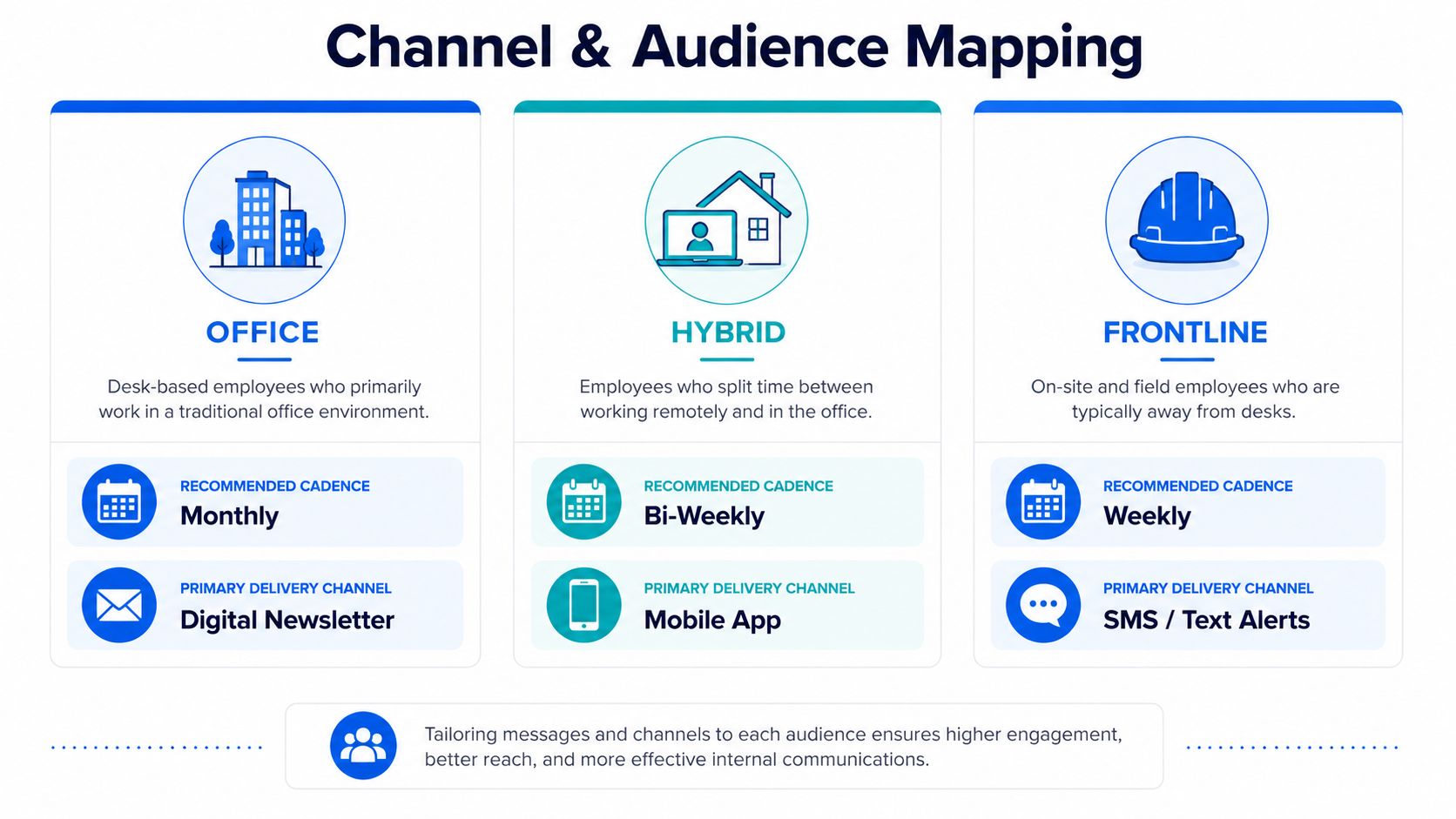
The calendar should serve one shared purpose while using different delivery methods. Frontline employee engagement planning starts with channel segmentation, because deskless workers may not have dependable access to email, intranet pages, or scheduled video meetings during working hours.
Email and intranet can anchor office and hybrid communications. Frontline teams often need mobile-first tools, shift-aware timing, site-level ownership, and concise messages. The 2025 internal communications report highlights the continuing importance of email and intranet overall, alongside communication designed for non-desk workers.
Design once, deliver three ways
For an alignment month, an office team might use a live town hall followed by an intranet summary. A hybrid team can combine a recorded briefing, a manager conversation, and an asynchronous question form. A frontline team may need a translated mobile card, a pre-shift huddle prompt, and printed signage with a QR code where appropriate.
| Workforce | What usually works best | What often fails | Planning adjustment |
|---|---|---|---|
| Office-based | Intranet, email, live forums, manager one-to-ones | Assuming attendance equals understanding | Add a response or discussion prompt |
| Hybrid and remote | Recorded updates, collaboration tools, virtual office hours | Making every activity synchronous | Offer asynchronous participation |
| Frontline and deskless | Mobile-first messages, shift huddles, local supervisors, site materials | Repurposing long corporate emails | Shorten content and align with shifts |
Segment by access, not by status
A frontline employee may have a smartphone but limited time. A remote employee may have strong digital access but few informal connection points. A multi-location organization may also need different languages, local examples, or site-level owners.
Build the employee engagement strategy for frontline employees around work reality. Record when employees can stop safely, who they trust to explain a message, which device they use, and how feedback returns to the central team. Keep those decisions in the calendar, alongside the activity and its owner.
Channel choice should follow the workflow. A mobile engagement platform, HRIS notification, collaboration tool, or scheduling system can support the plan, but automation cannot replace local judgment. Use automated reminders for consistency, then give managers a concise script and a clear escalation path. A short message delivered at the right shift change will often outperform a polished update employees cannot access.
How to Measure Whether the Engagement Calendar Is Working
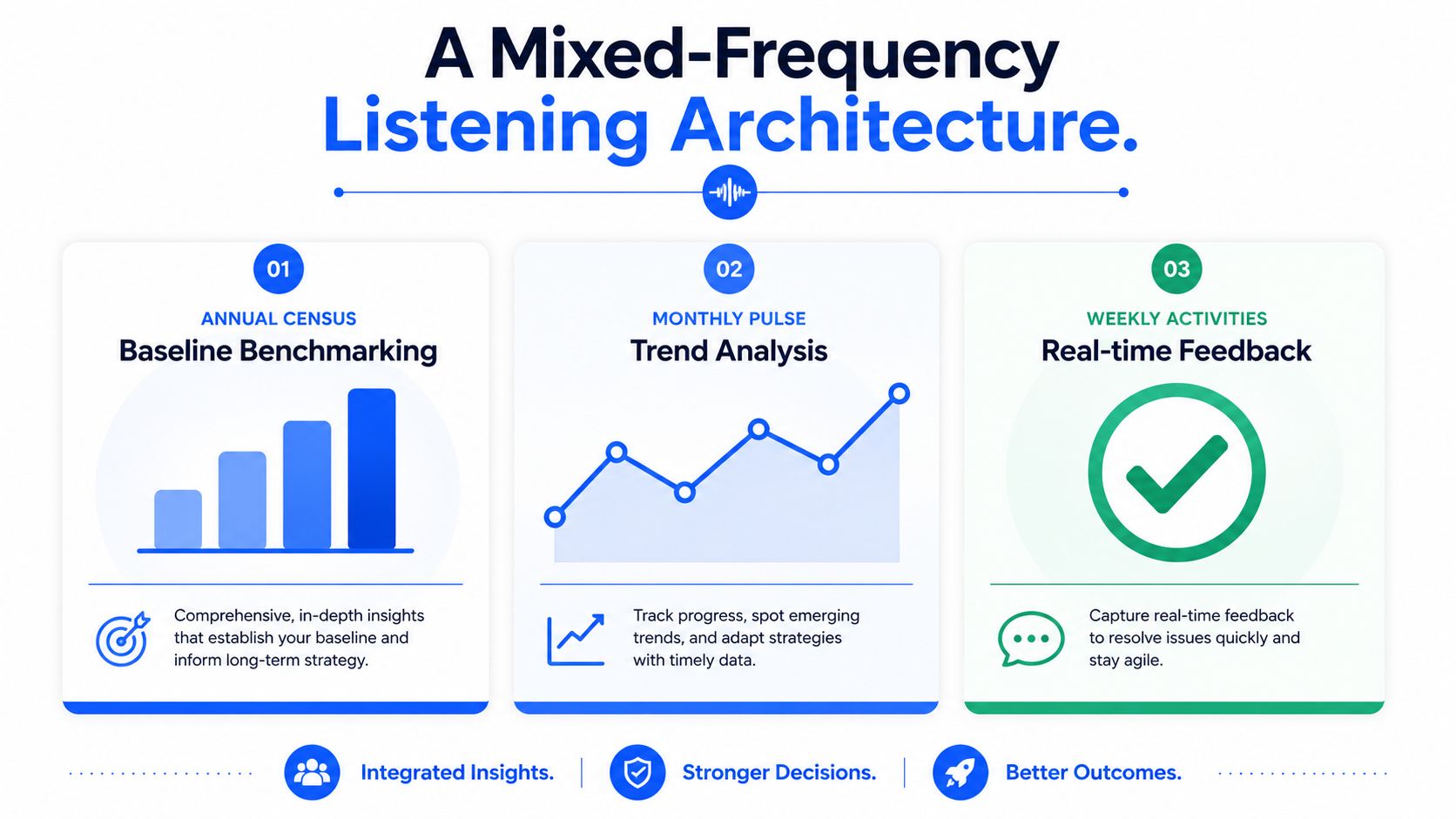
Measure the calendar as a listening-and-action system, not a contest for completed activities. A mixed-frequency design gives leaders a stable benchmark, timely signals on changing issues, and lightweight feedback from routine interactions.
Use an annual or biannual census survey for broad benchmarking. Add shorter monthly or quarterly pulses for a limited set of changing topics, then use change-triggered surveys after a significant reorganization, technology rollout, or operational shift. Short pulses work best when each one supports a defined decision, rather than adding another request to already busy teams.
Track five signals together
- Participation rate: Did the intended population receive and complete the activity?
- Sentiment movement: Did the relevant measure improve, decline, or remain stable against the established benchmark?
- Action completion: Did owners complete the commitments communicated after listening?
- Recognition reach: Which groups received recognition, and which groups remain invisible?
- Manager check-in frequency: Are managers holding the conversations the calendar requires?
A high response rate can coexist with low trust when employees see no follow-through. A well-attended event can still exclude night-shift employees or people without reliable desk access. Review results by site, shift, role, and access pattern where privacy and reporting thresholds allow.
Over-surveying creates its own problem. Long instruments, tightly stacked requests, and feedback without action can reduce response quality and morale. Before adding another pulse, confirm that the organization has a decision, an owner, and a communication plan ready.
The guide to measuring employee engagement supports a broader measurement program. Keep the calendar’s operating view simple: participation shows reach, sentiment shows experience, and action completion shows credibility. Review those signals alongside business rhythm, because a score without an accountable response is only a record of opinion.
Governance, Mistakes to Avoid, and Your 90-Day Starter Plan
A calendar stays useful when a small cross-functional group governs it. HR owns the engagement architecture, internal communications manages message design and channel coordination, operations protects timing and local execution, and IT or HR technology supports access, automation, data handling, and reporting.
Governance that prevents drift
Meet on a recurring basis to review upcoming workload, recent feedback, action status, and necessary substitutions. Publish the owner for every major activity. If a leader can’t identify who responds to a survey result, the activity isn’t ready to launch.
Avoid these common mistakes:
- Over-surveying: Don’t add a pulse just because the tool makes it easy.
- Treating the calendar as a communications checklist: Every listening event needs an action review.
- Ignoring workload peaks: Move, shorten, or localize activities when staffing pressure rises.
- Using one channel for everyone: Match delivery to access, shift, language, and work setting.
- Automating judgment: Use AI to organize themes or draft options, but keep people responsible for interpretation, privacy, and decisions.
- Measuring activity instead of change: Attendance matters, but it doesn’t prove that the intended experience improved.
A practical 90-day launch plan
Days 1 to 30, establish the operating base. Choose the annual objective, map employee populations, identify blackout periods, confirm survey windows, and appoint owners. Build a simple working calendar with columns for audience, activity, channel, owner, decision date, and evidence of completion.
Days 31 to 60, test delivery. Run one listening activity and one recognition or manager activity with representative office, hybrid, and frontline groups. Check whether employees could access the message, whether managers had enough context, and whether the feedback produced a decision.
Days 61 to 90, publish and adjust. Share the next quarter’s schedule, communicate what you learned from the test, and remove activities that created load without useful signal. Set the review rhythm for the rest of 2026 and keep a downloadable planning template that local owners can update.
Small HR teams don’t need a large event portfolio. They need fewer activities, clear ownership, reusable communication assets, and a reliable feedback loop. A practical first quarter can include one benchmark or pulse decision, one manager discussion cycle, one recognition rhythm, and one action-review process.
Employee engagement calendar FAQs
How often should an employee engagement calendar be reviewed?
Review it whenever business conditions, staffing, survey results, or employee availability changes. A recurring owner review keeps the plan responsive without forcing teams to rebuild the entire year.
How can a small HR team run a 12-month calendar without burnout?
Use a limited number of repeatable formats, such as manager prompts, short pulses, recognition stories, and asynchronous learning. Reuse templates, automate reminders, and cancel activities that don’t connect to a clear objective.
What should a first-year budget for engagement activities look like?
There isn’t a universal budget that fits every workforce. Start by separating activities that need technology, paid facilitation, travel, or materials from those that use existing meetings and communication channels. Approve spending against reach, relevance, and the team’s ability to act, not against the number of events.
What should HR do when survey participation drops?
Check timing, access, length, language, manager reinforcement, and recent follow-through before sending another survey. Explain what changed because of earlier feedback, then use a shorter, better-timed instrument with a clear response purpose.
Which employee engagement trends in 2026 belong in an annual plan?
Prioritize shorter and better-timed listening, stronger channel segmentation, mobile-first frontline access, manager check-ins, recognition, development, and responsible use of AI for feedback analysis. Treat these as planning considerations, not reasons to add more activities. The right trend is the one your organization can deliver and act on.
Build your 2026 calendar around one objective, one visible listening-and-action loop, and delivery methods that match how employees work. Download or create the planning template, appoint owners this week, and schedule the first 90-day review before the calendar fills with events.
Turn On Work helps HR, internal communications, operations, and workforce technology leaders connect employee engagement with the tools and processes that shape work every day. Explore the workforce experience resource hub for practical guides, frameworks, and frontline-focused strategies.