The usual advice is to announce the merger, stay upbeat, and answer questions as they come. That leaves night shifts, wards, docks, and stores hearing the news from customers. A merger communication plan is a written, owned schedule of what employees hear, who says it, which channels carry it, and how leaders confirm people understood it. It belongs with internal communications that connect manager action to how work really runs.
Key Takeaways
- Announcing the deal is not the same as communicating it. Employees need timed, accurate detail they can use on shift.
- Confirmed decisions and open questions must be labeled separately. Silence reads as withholding.
- Managers are the delivery layer. Executives own the rationale. Local managers own what changes today.
- Comprehension matters more than message volume. Extra emails don’t close a rumor.
- The plan runs from due diligence through post-close, with a recorded update even when the honest line is “not decided yet.”
What a Merger Communication Plan Covers and Why It Matters
A merger communication plan names audiences, message owners, channels, publication timing, manager talking points, and a way to check that the message landed. It is an operating workstream, not a press release with an intranet follow-up.
Think of it as a relay. Executives carry the strategic rationale. Managers pass the detail that changes a rota, a login, a pay date, or a reporting line. Employees have to receive that baton without a dropped handoff. One all-hands does not complete the relay. People on the floor never attended it.

A university study of 169 employees shows how wide that gap can get. Only 46 respondents (27.2%) said the merger was well communicated, while 123 (72.8%) said it was not. Just 44 employees (26%) found the information timely and accurate, and 81 (47.9%) judged it neither timely nor accurate. 90 respondents (52.3%) reported becoming very anxious when the merger was announced. The study is organization-specific, so treat those figures as a warning, not a global benchmark.
What the plan has to separate
Employees treat a vague update as proof that leaders are holding something back. The plan should mark confirmed decisions apart from unresolved issues, name who may speak, and set the next date people will hear from you. Delayed detail without that label feeds anxiety faster than a plain “we don’t know yet.”
What this means in practice: write the plan before the announcement, not after the first questions hit the group chat. The build steps come next. If you wait for the rumor, you are already late.
Merger Communication Timeline from Announcement to Day 90
Content has to change by phase. A review of HR practices across merger and acquisition phases describes communication and training as work that runs through planning, integration, and implementation, with a different job in each. Before close, that work includes cultural due diligence, risk analysis, human-capital audits, and the communication plan itself. During integration it shifts to combining structures and people, transferring knowledge, and targeted training.
Use the table as a starting template. Move the dates to match the regulatory timetable and the integration calendar. Rows from Day 2 onward are a TurnOnWork template, not an industry standard.
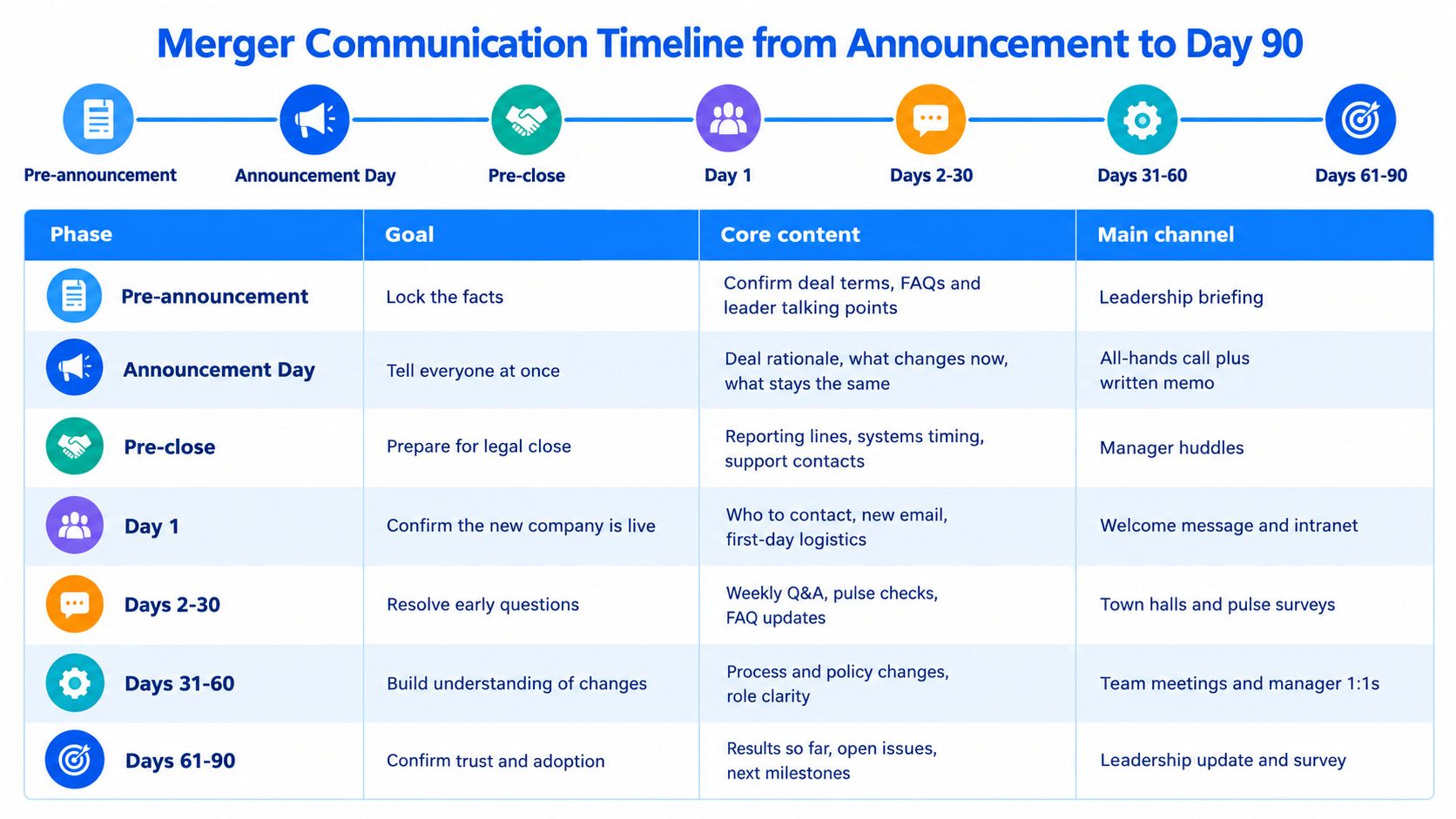
| Phase | Primary goal | Core content | Main owner | Key output |
|---|---|---|---|---|
| Pre-announcement (signing to announcement) | Lock messages and approvals | Confirmed rationale, known unknowns, approved FAQ | Deal lead with HR and legal | Approved message-control matrix |
| Announcement day | Be first and consistent | Strategic rationale, what is not changing yet, next update date | CEO with people leader | Manager briefing completed before broadcast |
| Pre-close | Narrow the rumor gap | Closing process, confidentiality limits, who to ask | HR and internal communications | Live question log |
| Day 1 | Confirm what changes today | Reporting line, system access, pay and schedule dates, contacts | Local managers | Shift huddles completed at every site |
| Days 2-30 | Close early gaps | Weekly answers, FAQ updates, what changed this week | Internal communications with site managers | Updated FAQ and closed questions |
| Days 31-60 | Make process changes clear | Policy, role, and system changes with training dates | HR with operations | Role and process briefs delivered |
| Days 61-90 | Reinforce and close the loop | Progress against commitments, remaining decisions, next update dates | Integration lead with internal communications | Day 90 review of unresolved items |
Pre-close versus post-close
Before closing, leaders can explain the rationale, the process, and what they can’t yet say. They must not promise outcomes. After closing, the job is to make changes operational and visible: who reports to whom, which system is live, which policy applies on this site.
Practical rule: end every phase with a recorded update, even when the honest update is “no decision yet,” and print the date of the next one.
Day 1 is when employees test every earlier promise. Local managers confirm the reporting line, system access, pay dates, schedules, and who to call. A welcome banner doesn’t do that. A short huddle on every shift does. A realistic account of what is known, what is uncertain, and what may change beats a single reassuring speech. Keep that preview going. Attitudes hold up better when people aren’t left to invent the missing half.
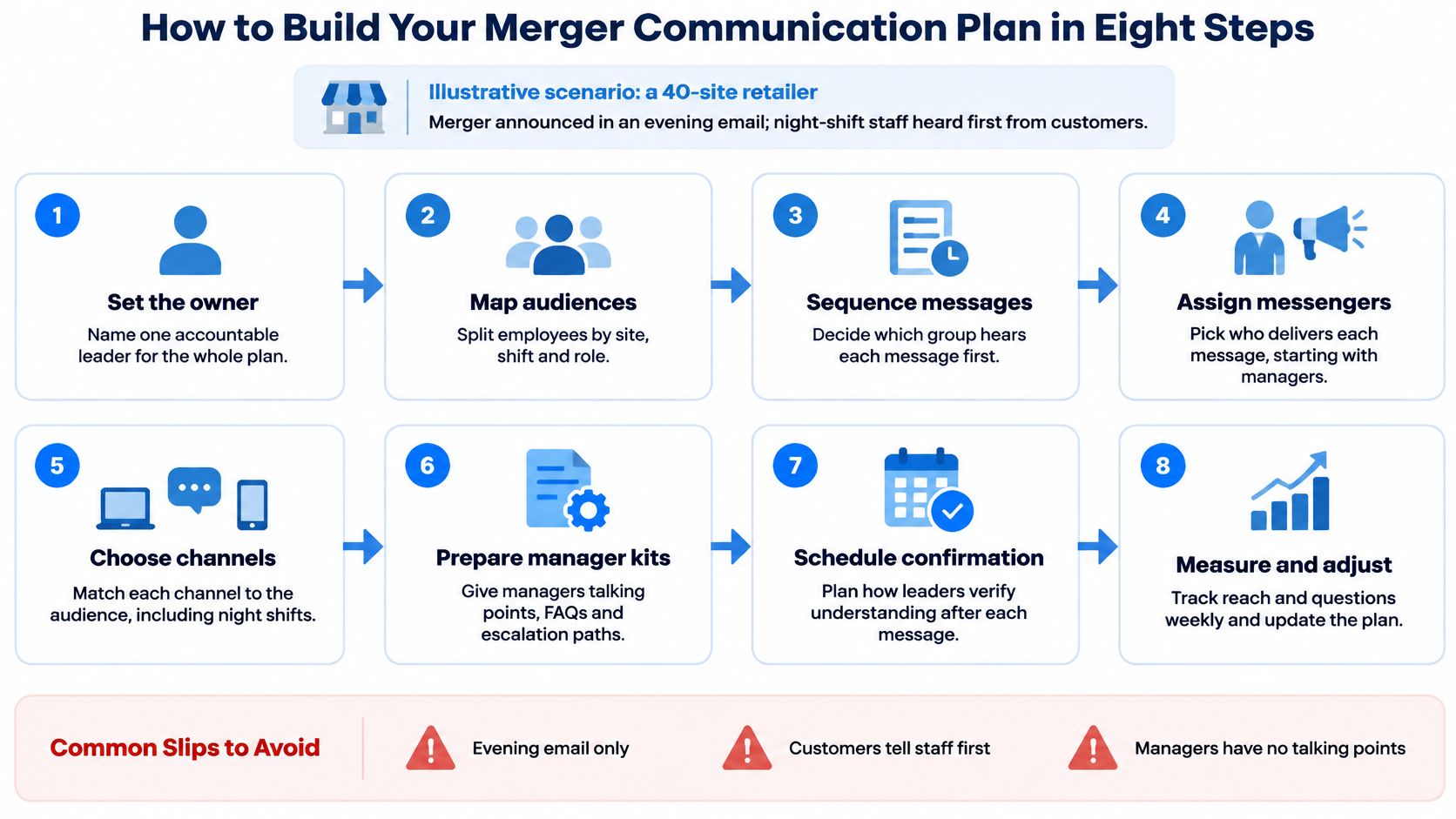
How to Build Your Merger Communication Plan in Eight Steps and Avoid Common Slips
Say a 40-site retailer announces a merger in an evening email. Night-shift staff hear it first from customers. Store managers have no talking points. Two weeks later the FAQ still says rotas are unchanged while those rotas are under review. That is the failure mode. The eight steps below are built to stop it.
A global M&A pulse survey tied open communication to deal execution, not just sentiment. Effective and open employee communication was a top priority in 65% of organizations reporting more successful transactions, against 40% of less successful ones. The same survey found effective leaders and managers can make employees six times more likely to be highly engaged during an M&A transaction.
- Name one owner. Appoint a communication workstream lead who reports to the integration steering group. Unowned messages drift between legal, HR, and the deal team.
- Map the audiences. Split executives, people managers, office staff, frontline and deskless workers, contractors, union representatives, and key customers. A store associate and a finance director don’t share a channel or a question.
- Build a message-control matrix. For each topic record the owner, approval status, legal constraints, audience, channel, date, translation need, and escalation path.
- Sort every item. Label it confirmed, in progress, not decided, or restricted. Don’t let “we’ll get back to you” stand in for a category.
- Brief managers first. Give talking points before the broad announcement, and only after leaders have approved the words. Release translations with the original, not a day later.
- Assign channels by segment. Match the mix in the channel section below to site, shift, and language. One intranet post is not a plan. The same discipline belongs in a change management communication plan for frontline teams.
- Publish one FAQ and one question log. Set response targets. Going silent is the slip. Keep a fixed cadence even when the update is that no decision exists yet. When benefits are in that FAQ, fix gaps in benefits communication before you promise parity you haven’t priced.
- Capture a baseline before you announce. Reach and trust numbers mean nothing if you only start measuring after the email goes out.
Tie messages to decisions
Sync every release to a real milestone: signing, regulatory clearance, close, organizational design, systems migration, and policy harmonization. Promising certainty before a decision is approved is how the retailer’s FAQ went stale.
Senior leaders state the rationale and the milestones. Frontline and middle managers translate that into role, schedule, and site. Measure understanding across locations, functions, employment types, and countries. Deskless, hybrid, and office employees don’t share the same access.
Best Channels for Frontline and Deskless Employees
For organizations managing employees across multiple locations and shifts, a multi-channel employee communication platform like HubEngage can help distribute merger announcements, policy changes, and important updates through mobile apps, SMS, email, and digital signage. This gives frontline employees more ways to access consistent information without depending entirely on corporate email.
An exploratory study of four financial-institution mergers found that needs changed with stage, setting, message, and what employees inferred about the speaker, and that no one style (participative, supportive, informative, or directive) was consistently tied to a better outcome. Fit beats frequency. That management communication research is a warning against one tone for every workforce.
| Channel | Reaches deskless staff? | Best use | Main limit |
|---|---|---|---|
| Shift huddle or team briefing | Yes, when scheduled inside the shift | Verbal explanation and live Q&A on Day 1 changes | Only as strong as the manager’s briefing |
| SMS or push alert | Yes, when contact details are current | Dates, short confirmations, and links | Can’t carry detail. Keep sensitive content out |
| Mobile app or frontline portal | Yes, if installed and used | FAQ, translated documents, shift-level updates | Adoption varies. Test on shared devices |
| Printed notice at site | On-site staff only | Required notices and rota changes | Slow to update. Off-shift staff may miss it |
| Recorded leader video on a shared screen | Partly | Leader message delivered at a site | One-way. Pair it with a Q&A huddle |
| Mostly desk-based staff | Detailed policy and benefits documents | Often unread by staff without company accounts | |
| Live town hall | Partly | Leadership narrative and open questions | Shift coverage and time zones limit attendance |
Why email alone fails
Email assumes a company login and a desk. People on the floor, the ward, the dock, or the shop floor hear the merger from colleagues or customers first. Shared kiosks help only if someone is scheduled to play the message on each pattern, including nights.
Where the rule changes by sector
- Healthcare: use shift handover and the charge-nurse huddle. Don’t bury a reporting-line change in a long email clinicians won’t open mid-shift.
- Manufacturing: put the confirmed facts on the line-side board and repeat them in the pre-shift safety talk.
- Logistics: brief the dock in person and push the same dates through the driver app.
- Retail: stock-room notices plus a store-manager huddle, with translated versions where the team speaks more than one language. More patterns for frontline employee communication sit alongside this channel mix.
Every written message needs a verbal version inside the same shift pattern. Off-shift and part-time staff should hear the same facts within one shift. Individual pay and collective agreements belong in a one-to-one or a consultative meeting, not an SMS.
Recorded leader video works when crews can’t attend a live call. Build those clips with a repeatable internal video communication workflow so the script, captions, and translations ship together.
Reach test: ask a sample of staff on each shift what they heard and through which channel. Treat the answers as site-level data, not a corporate average.
How to Explain Job Security, Pay, and Reporting Changes
Job security, pay, and reporting lines are the three answers employees judge a merger plan against. Say what is confirmed, label what is undecided with the date the decision will be made, and never offer reassurance the company cannot yet keep.
Run every answer through the TurnOnWork certainty ladder. Four rungs, applied the same way by every spokesperson and manager.
- Confirmed: state the fact and the effective date.
- In progress: name the review, who decides, and the decision date.
- Not decided: say so, describe the process, and give the next update date.
- Restricted: say the item cannot be shared, and why (confidentiality, a legal limit, or an unfinished consultation). Do not go quiet on it; unexplained silence reads as concealment.
| Employee question | Say once confirmed | Say while undecided | Avoid |
|---|---|---|---|
| Will my job change or end? | Confirmed role, location, and effective date | Decision process, criteria, and expected decision date | Blanket reassurance before decisions are approved |
| Will my pay or benefits change? | Exact effective dates and what stays the same | Scope and timing of the harmonization review | Promising parity without an approved plan |
| Who is my manager now? | New reporting line and escalation contact | Interim structure and who makes the decision | Naming individuals before approval |
| Will my schedule or shifts change? | Confirmed rota rules and notice periods | Scheduling review and which sites are affected | Saying “no change” where rota work is pending |
| Which systems will I use? | Login steps, training, and cutover dates | Systems under evaluation and decision timing | Giving dates IT hasn’t confirmed |
| What happens to role cuts? | Approved process and selection criteria | Options under review and next process steps | Disclosing selection lists or speculating on numbers |
| What about union agreements? | Agreed terms and consultation status | Consultation or negotiation schedule | Implying term changes before consultation ends |
Facts and fairness are both required
A 2025 study of 388 employees across five M&As in India shows people need factual communication for logical concerns and identity communication for belonging. Factual answers cover role, pay, and systems. Identity answers cover who was consulted, how the decision was made, whether legacy practices are being dropped selectively, how role cuts are justified, and what appeal route exists. Answer the first category and skip the second, and you get compliance without trust: people follow the new process while assuming the next decision is aimed at them.
Transparency isn’t “tell everything now.” Deal confidentiality, legal limits, and unfinished decisions make premature certainty dangerous.
Before any answer on individual terms, run a three-way check. HR confirms what can be shared. Legal counsel checks confidentiality and disclosure limits. Labor relations confirms consultation duties at unionized sites. Anything barred goes on the Restricted rung, stated plainly.
Frontline, deskless, and unionized employees judge fairness through local scheduling, staffing, safety, and job security, because they rarely sit in the executive channel. Close the loop by measuring comprehension of these answers. After the first Q&A round, ask a sample on each site to repeat back the decision date and the criteria. If they cannot, the answer is unfinished: sharpen the wording on that rung and carry it into the next update.
Leadership Versus Frontline Manager Communication
Leaders own the why and the milestones. Frontline managers own what the change means for this shift, and where someone can ask.
Leaders speak to strategy, financial logic, and commitments the company can stand behind. Managers translate those lines into role, schedule, site, and tools, then carry unanswered questions back up. Research on communication during mergers found that communication quality predicted employees’ uncertainty, and that managers need to be honest, specific, and willing to represent employee interests upward. That study of employees and managers during mergers also notes leaders hear earlier, because senior management involves them first. Use that head start. Brief managers before the wide broadcast, and only after the content is approved.
Managers who keep repeating the same unresolved point will burn out their teams. Change fatigue guidance for agency managers is a useful companion when the same site has lived through several restructures. How managers behave in that stretch is covered in manager behaviors and employee engagement.
Talking points a manager can use the same day
- What we know: the confirmed facts, with effective dates.
- What we don’t know yet: the open items and the date you’ll know.
- What this means here: role, schedule, site, and tools for this team.
- Where to ask: the channel and the response time you will meet.
- When you’ll hear from me next: a date, not “soon.”
Day 1 checklist for frontline managers
- Confirm the basics: reporting line, system access, pay date, schedule, and the contact for exceptions.
- Hold a short huddle on every shift, including nights and weekends.
- Log every question in the shared log before the shift ends.
Rumor protocol: acknowledge the question, check it against the approved register, answer it or give a date, and record it. Never give an answer you can’t verify. A guessed pay date does more damage than a dated “not decided.”
Sample Merger Announcement Email, SMS, Team Briefing and Employee FAQ
A usable announcement pack has four pieces drawn from one approved fact set: an email for people with accounts, an SMS for frontline staff, a briefing script for managers, and an employee FAQ. Label every line with the certainty ladder. Translate before release. Replace every bracket before you publish. Don’t ship a template field unfilled. More patterns sit in these internal communication examples for frontline employees.
Subject: Merger update: what was decided on October 27, 2026
We announced today that [company] is combining with [partner]. Confirmed: [one-sentence rationale] and [what is not changing yet], effective October 27, 2026.
Not decided: [roles / pay / systems]. The decision date is October 27, 2026. We will not guess before then.
Questions go to [channel]. You will get an answer within [response time]. Next update: October 27, 2026, from [owner].
SMS
Keep it inside one 160-character segment.
Update on the [company] merger: your site briefing is at [time] on October 27, 2026 with your manager. Questions and details: [link]. Next update: October 27, 2026.
Team briefing script
Read the confirmed facts. State the unknowns with dates. Explain what changes on this shift. Invite questions and log them before people leave the huddle. If someone asks about pay and the rung is Not decided, say the decision date out loud. Don’t soften it into “you should be fine.”
FAQ entry
Will my job change? Not decided yet. The decision criteria are at [link] and the decision date is October 27, 2026. We’ll update this entry that day, including if the answer is still open.
Set Up Measurement Before You Announce
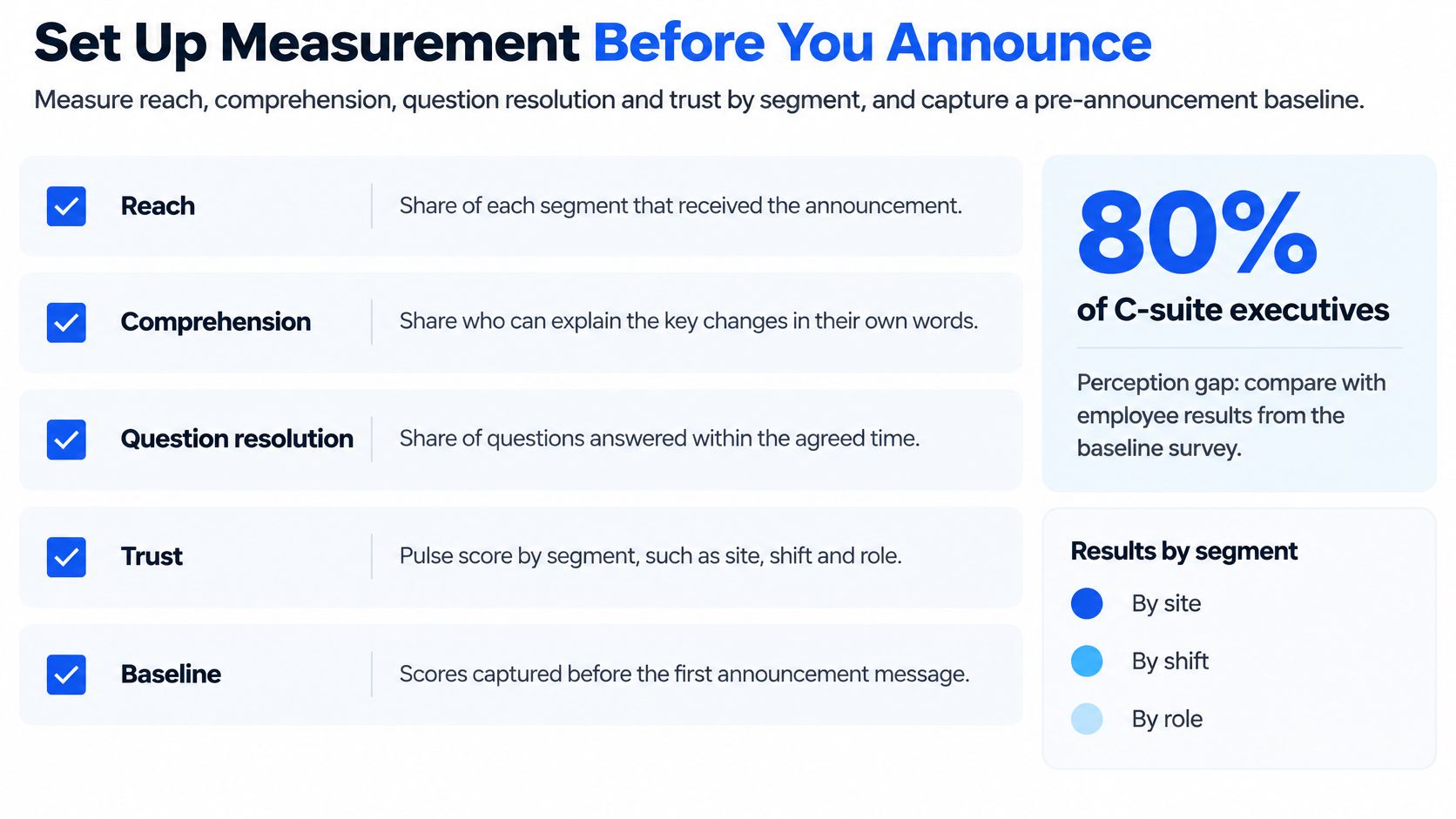
Measure reach, comprehension, question resolution, and trust by segment, and capture a pre-announcement baseline so later numbers mean something.
There is a real perception gap. In integration research covered by McKinsey, 80% of C-suite leaders said their messaging was helpful and relevant, compared with 53% of employees. 72% of leaders believed employees had an easy way to give feedback, while 46% of employees agreed. More messages can worsen overload if they don’t close that loop.
The TurnOnWork reach-to-understanding gap is an editorial model: messages sent minus comprehension confirmed, split by segment. The table below sets no benchmark thresholds. Set targets against your own baseline. Pair these counts with internal communications KPIs and metrics you already trust, so merger tracking doesn’t become a second, conflicting scorecard.
| Metric | How to measure it | Review cadence | Owner |
|---|---|---|---|
| Message reach | Share of frontline staff reached by huddle or channel, confirmed by sign-off | Daily during Days 1-5 | Site managers |
| Manager briefing completion | Share of managers briefed before the broad announcement | Before announcement, then weekly | HR business partners |
| Comprehension | Short pulse questions on what changes on Day 1 and who to ask | At announcement, on Day 1, and at each milestone | Internal communications |
| Question resolution | Share of logged questions answered within the response target | Weekly | Integration office |
| Question aging | Average days that unanswered questions stay open | Weekly | Integration office |
| Trust by segment | Trust items split by site, function, employment type, and union status | Monthly | HR analytics |
| Rumor volume | Count of recurring unverified claims in manager and hotline logs | Weekly | Internal communications |
| Attrition and absence | Regrettable leavers and absence rates compared with the pre-deal baseline | Monthly | HR analytics |
The listening loop
Run a baseline pulse before the announcement. Segment questions for acquired, acquiring, frontline, remote, and unionized employees. Review unanswered questions every week. Publish a short “you said, we did not do, here is why” note when you reject a request. Milestone surveys should test whether people can say what will and won’t change on day one. Comprehension is the control variable, not email volume.
Readiness checklist before you send anything:
- Matrix approved by the deal lead, HR, and legal.
- Managers briefed with the five talking points.
- FAQ published and the question log live.
- Translations ready in the languages your sites use.
- Pulse baseline captured, with an owner named for weekly review.
Name that owner and book the first manager briefing this week. A plan without a name on it will slip the moment the deal calendar gets loud.
Merger Communication Plan FAQs
How long should a merger communication plan run?
From due diligence through Day 90, and longer while open questions remain. The phase table is a starting template. Adjust it to the regulatory timetable and keep a dated update until the last item on the question log is closed or formally restricted.
Who writes the employee FAQ?
The communication workstream lead drafts it. HR and legal approve it. Frontline managers test it against the questions they hear most often before you release it. If managers can’t answer a line out loud, rewrite the line.
What should we say when the answer is unknown?
Say it isn’t decided, describe the decision process, and give the date of the next update. Log the question and come back on that date. Don’t fill the gap with reassurance you can’t keep.
How do we measure understanding at small sites?
Ask a sample of staff on each shift what they heard and through which channel. Record the answers as site-level data and compare them with that site’s own baseline, not with a larger site that has a different shift pattern.
Does this replace legal advice?
No. This is planning guidance. Confidentiality, disclosure, and labor-relations questions must be checked with HR, legal counsel, and labor relations before anyone answers them in a huddle, an SMS, or an FAQ.
Pick one open item on your current deal this week, put it on the certainty ladder, and brief the managers who will say it out loud before anyone else hears it. Turn On Work publishes practical guides on internal communications, frontline operations, and how managers carry change, so the next update your teams hear is one they can use on shift.