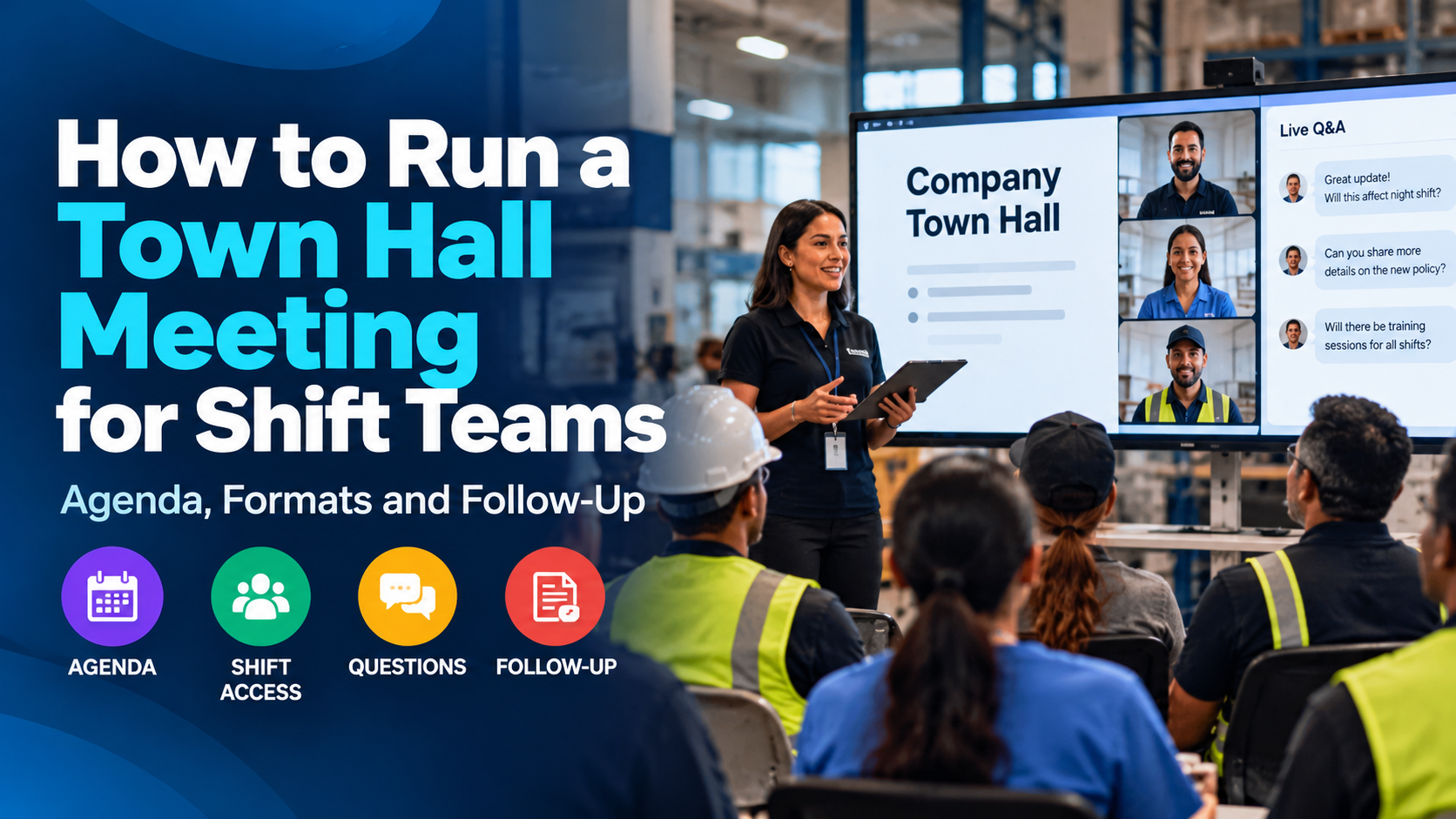
A town hall meeting for shift teams works only when employees who cannot leave the floor at the same time still have a fair chance to hear leadership, ask difficult questions, and see what happens afterward. The strongest format is usually not one company-wide livestream. It is a repeatable program: a common message, several accessible ways to participate, a moderated question process, and a visible record of answers and commitments.
This guide explains how to plan a frontline town hall meeting across day, evening, and night shifts; select between live, repeated, hybrid, and asynchronous formats; build a realistic agenda; collect questions without discouraging employees; and measure results beyond attendance. It is written for internal communications, HR, operations, and site leaders responsible for teams in retail, healthcare, manufacturing, logistics, hospitality, and field services.
The test is simple. Can a night-shift associate who was serving customers or operating equipment at the main event still hear the same facts, submit a question without taking an unpaid break, and find the decision or follow-up later? If not, the meeting might have gone well for headquarters without working for the people it was meant to include.
Why a Normal Company Town Hall Often Fails Shift Workers
The classic company town hall assumes a shared calendar. A senior leader joins a video meeting at 11 a.m., talks through slides, answers a few questions, and promises to share the recording. That can serve office employees who sit at a computer. It can quietly exclude workers whose schedules are designed around production, care, transport, security, store opening hours, and customers.
Consider a distribution center with three shifts. The day shift has enough supervisors to rotate people into a break room. The late shift handles the busiest dispatch period. Overnight teams have a smaller leadership presence and fewer shared devices. A single 11 a.m. event is effectively a day-shift meeting, regardless of what the invitation says.
The failure is not simply low attendance. Questions from employees who are harder to reach may never enter the discussion. Day-shift managers may receive clarifications that night-shift managers do not. One location might show the recording on a screen with good sound; another might put a link in an email workers cannot access.
Research and practical guidance from SHRM on employee town hall meetings emphasizes a clear outcome, a real agenda, and genuine space for employee questions. Those principles remain useful, but distributed shift workers need an additional layer: participation has to be designed around operations, not added as an afterthought.
The solution is not necessarily longer meetings or more technology. It is equal access to the conversation, a consistent version of the facts, and a mechanism for leaders to hear concerns from employees who are not in the room.
Decide What the Town Hall Meeting Must Accomplish
Before booking speakers or selecting software, define the job. A town hall is expensive in employee time and operational coverage. It should answer questions that a poster, a policy page, or a short update cannot handle as well.
Good reasons include explaining a meaningful business change, answering workforce concerns, discussing performance with context, connecting priorities to everyday work, hearing problems leadership is not seeing, and recognizing contributions across locations. A town hall can also explain a new strategy, but it should not become a substitute for the training employees need to perform a new task.
Write down the intended outcome in one sentence: “After the session, employees should understand why delivery priorities are changing, what stays the same for their shift, how to ask about staffing, and when leaders will provide the next update.”
That statement will help decide which information deserves live time. If the organization wants only to distribute a factual notice, a short targeted communication may be more efficient. If leaders need to hear challenge, uncertainty, and reactions, a two-way meeting is more appropriate.
A town hall is not automatically a consultation process, a grievance hearing, a bargaining session, or a safety training course. If the topic triggers a separate legal, contractual, or formal employee-relations procedure, complete that process as required rather than treating open questions as a replacement.
Define the audience rather than saying “all staff”
Company-wide may mean employees across several facilities, brands, departments, and shifts. It may also include temporary workers, agency staff, and contractors whose access and employment relationships differ. Decide who is invited, who can submit questions, who can see recordings, and which messages genuinely apply to each group.
The answer affects authentication, confidentiality, translation, shift coverage, and the final summary. A broad discussion of the company’s direction might include nearly everyone. A detailed site-closure discussion might require a different, carefully scoped audience and communication sequence.
Name the difference between a town hall, an all-hands, and a shift huddle

These formats overlap, but they are not identical. An all-hands often concentrates on business updates and alignment. A town hall generally gives more prominence to employees questioning leaders. A shift huddle is short, local, and operational. A recorded broadcast can communicate facts but does not, on its own, provide a live opportunity to challenge or clarify them.
For shift teams, the best solution may combine all three: a central leadership town hall with a shared question process, followed by short shift huddles to explain local implications.
Audit Shifts, Locations, Devices, and Operational Constraints
Start with the roster, not the event calendar. Record the number of employees on each shift, the shift start and finish windows, break patterns, staffing minimums, time zones, employee device access, languages, and meeting spaces. Include the groups who will be on leave, traveling, on routes, or working at customer locations.
Ask operations leaders which periods cannot safely be interrupted. A production line may need planned coverage. A hospital cannot send an entire clinical unit into a meeting. A store cannot leave a register unattended. In hospitality, front desk, housekeeping, kitchen, and events teams can have completely different workable windows.
Build a simple accessibility and participation map. Do employees have corporate email? Can they use the employee app? Is there a safe shared screen? Are headphones possible? Can they hear the audio in a break room? Does the site have adequate bandwidth? Can someone submit a question without disclosing it to a direct supervisor?
The map should identify the hardest-to-reach audience first. If the pilot works only for employees with laptops, the test did not challenge the problem.
Decide what coverage is safe
Meeting attendance should never compete with a required safety post or essential service. Supervisors need a coverage plan with relief staff or repeat sessions so people are not forced to choose between participating and doing their job properly.
Where the workforce is large, plan participation in groups. A site could release small teams in rotation across multiple 20-minute briefings, with a longer central Q&A available through another channel. Keep a consistent message and answer record across repeats.
Make sure the plan respects scheduled and legally required breaks. Do not quietly convert an unpaid meal period into mandatory town hall attendance.
Build a participation baseline
Before the first event, determine how many eligible employees normally receive leadership communications, how many can open the available channels, and which shifts are chronically underrepresented. Use those figures as the baseline for improvement rather than treating the number of people in one room as a measure of success.
TurnOnWork’s internal communication strategy for distributed workforces provides a broader way to think about audience mapping, channel ownership, and how information moves between central and local teams.
Pillar 1: Choose a Town Hall Format Every Shift Can Use
There is no single best format for every employer. A manufacturing site with a shared shift-change window can run repeated small-group events. A national retailer may need a short leader video, locally facilitated discussion, and one open Q&A system. A hospital may rely on multiple team briefings, recording access, and written answers that remain available after the event.
Choose the format from actual access conditions. Avoid selecting the most impressive production setup first and then expecting employees to adapt.
A practical format comparison
| Format | Best situation | Main benefit | Main limitation |
| Single live town hall | Small team with genuinely shared availability | Direct real-time dialogue | Excludes employees working elsewhere |
| Repeat live sessions | Multiple shifts at one site or region | Each shift meets leadership | Answers can drift between repeats |
| Hybrid live plus local rooms | Many locations with good screens and local facilitators | Central message and site discussion | Requires reliable AV and coordination |
| Recorded session with asynchronous Q&A | Field, mobile, overnight and dispersed teams | Flexible access to the core content | Questions are not immediately answered |
| Short leader update plus shift huddles | Safety-sensitive, customer-facing or high-volume operations | Local relevance and minimal disruption | Depends on manager quality |
| Rotating leadership visits | Trust-building across plants or stores | Direct contact and visible leadership | Slower and harder to scale |
Option 1: Repeat the live session across shifts
Repeat sessions are particularly useful when leadership dialogue is central to the event. A leader can attend one meeting around day-shift changeover and another in an overnight window, or divide the event across regional leaders while keeping common material.
Publish one approved briefing and question bank. The opening explanation, business facts, dates, and commitments should not change between sessions without a visible update. Let employees raise different concerns; do not try to force identical conversations.
The trade-off is speaker time. If the CEO cannot attend every session, make that explicit. A local operations leader can facilitate a repeat, but employees should know whether questions will reach the executive team and when answers will return.
Option 2: Broadcast the main session, then host local discussion
A central live session can work when sites have screens, speakers, protected meeting space, and a way for employees to ask questions. Assign a facilitator at every location who can explain how to participate and collect questions that are difficult to raise on camera.
Test the actual room. Employees need to hear and see without standing behind a crowded laptop. The local facilitator should know whether the room can speak live, whether questions must be typed into a moderated queue, and what to do if the connection fails.
Avoid treating the stream viewer count as the number of employees reached. A single screen might serve 20 people, or it might be playing in an empty break room.
Option 3: Record the core message and keep questions open
Asynchronous access is essential for employees on different schedules, but a recording alone is not a two-way town hall. Pair the recording with an accessible question route that stays open after the event and a commitment to publish answers.
Break the event into short chapters. A night-shift employee might need only the five-minute staffing update and the question about a policy change. Provide written highlights, captions and, where necessary, translated summaries. A 65-minute recording without a table of contents is likely to be harder to use.
Explain which questions were answered live, which are being researched, and when the next response will appear. A question box that closes at the end of the livestream excludes those who could not attend.
Option 4: Use short shift huddles to extend the discussion
Shift huddles work well for clarifying how leadership messages affect local schedules, equipment, workload, customers, or safety. Give managers a one-page briefing that covers what was announced, what it means locally, what remains undecided, and where employees can submit questions directly.
A huddle should not become the only source of company facts. Employees must be able to inspect the authoritative summary without depending on a supervisor’s memory. For teams with frequent roster changes, the frontline change-management communication plan is a useful companion for sequencing leader communication, local reinforcement, and follow-through.
Choose a Cadence Employees Can Anticipate
Monthly, quarterly, and event-driven town halls can all work. The right frequency depends on how fast the organization changes and whether leaders have meaningful information or unanswered questions to address.
A monthly session can help a fast-changing organization, but may create repetitive presentations if there is little substantive news. A quarterly town hall is easier to plan, yet may leave important concerns unresolved for too long. Urgent operational or employment changes should not wait for the next scheduled event.
A useful approach is quarterly central dialogue supported by short monthly site updates, clear mechanisms for questions between meetings, and additional targeted sessions when a significant change warrants them.
Protect predictable timing. Rotate convenient slots rather than always privileging headquarters, and announce the format early enough for supervisors to arrange coverage. Consistency builds confidence only when employees also see that the meetings produce useful answers.
Design the Town Hall Agenda Around Employee Questions
A town hall meeting should not be a slide presentation that happens to end with “Any questions?” Reserve the time for interaction before building the content. The agenda should answer three questions: What does the company need to explain? What do employees want leadership to address? What needs to happen afterward?
Keep updates relevant to the work. Revenue trends, expansion plans, customer performance, and strategic decisions can matter, but explain what each means for staffing, scheduling, equipment, workload, career opportunities, or service quality.
Do not fill the agenda with separate department speeches simply because every senior leader wants visibility. Employees should hear a coherent account of the company’s situation, including what is going well, what is difficult, and what leadership is doing about it.
A 45-minute town hall meeting agenda for shift teams
| Time | Segment | Purpose | Lead |
| 0–4 min | Welcome, purpose, participation rules | Explain the topic and how questions work | Independent moderator |
| 4–12 min | Business and workforce update | Share three essential facts and their impact on shifts | Senior leader |
| 12–18 min | Site-level example or employee recognition | Make the topic tangible, include overlooked teams | Operations leader / employee |
| 18–37 min | Moderated questions | Address pre-submitted and live questions transparently | Moderator plus accountable leaders |
| 37–42 min | Decisions and open issues | State what is decided, who owns unresolved items | Relevant leaders |
| 42–45 min | Next steps and accessible follow-up | Explain where summary and answers will appear | Moderator |
This is a starting template, not a universal standard. Some organizations will require 60 minutes. Others may need a 25-minute version repeated more often. Keep the core leadership explanation concise and preserve meaningful Q&A instead of allowing presentations to overrun it.
A 20-minute version for a busy shift
For teams that cannot leave the floor for 45 minutes, try a limited, repeated 20-minute format: three minutes of context, five minutes on the main business change, eight minutes on employee questions, and four minutes on actions and follow-up.
Publish the full Q&A record outside the live session and let employees contribute questions before and after. Short sessions can be effective if they are focused and connect to a broader conversation rather than pretending to answer every issue in 20 minutes.
A 60-minute multi-site format
Where employees have several major concerns, use a 60-minute run-of-show: five minutes to frame the purpose, ten minutes for business context, ten minutes for workforce and site priorities, five minutes of recognition, twenty-five minutes of moderated Q&A, and five minutes for commitments.
A larger event needs an experienced moderator, a producer who manages timing and technology, and a separate person capturing commitments. Without defined roles, the discussion tends to spend most of the hour introducing speakers.
Prepare Questions Before the Event
The questions are the editorial center of the town hall. Collect them through channels employees can actually access: app forms, QR-linked kiosks, paper cards in secure drop boxes, SMS where appropriate, a telephone option, and facilitated submissions at shift change.
Offer anonymous submission where the platform and policy allow it, and be precise about what anonymity means. A question may be anonymous to fellow attendees while still being visible to a platform administrator. Do not promise absolute anonymity if the tool or workplace context cannot provide it.
Give employees an opportunity to submit questions directly, without requiring their manager to screen them. Managers can help workers access the form, but should not have unilateral control over which concerns leadership sees.
Classify submissions by theme: staffing and scheduling, pay and benefits, safety and equipment, customer issues, career development, operational priorities, and leadership decisions. Prepare a list of recurring questions and identify a leader who can answer each one accurately.
Include hard questions without turning the event into a trial
A credible town hall answers more than easy questions about celebrations and new programs. Questions such as “Why has overtime been cut while output targets rose?” or “When will broken equipment be replaced?” are the questions that determine whether employees trust the event.
Prepare facts and decision boundaries ahead of time. If leadership cannot answer because a process is ongoing, it should explain why, identify the responsible owner, and set a date for a further update where possible. “We cannot disclose that yet” is sometimes legitimate. Pretending the question was never submitted is not.
Moderators should combine duplicates without erasing important differences. A scheduling complaint from nurses working nights may not be equivalent to a day-shift scheduling concern even when both contain the word “roster.”
Build a fair live-question process
Do not give the entire floor to the first confident person with a microphone. Combine pre-submitted questions, moderated live questions, and follow-up prompts. Use a visible queue when possible, and make the approach clear at the start.
Set reasonable limits on long questions while allowing clarifications. Protect sensitive personal matters by directing them into private HR or reporting channels without suppressing general questions about policies and working conditions.
For employees joining from a remote room, make sure someone is actively watching the remote queue. A live event with cameras focused on headquarters can make every other site feel like a spectator.
Brief Leaders, Moderators, and Local Hosts
A successful town hall needs more than a confident executive. Assign a small team with distinct responsibilities: an event owner, a moderator, a technical producer, a question coordinator, a note-taker for decisions, a workplace accessibility contact, and local shift facilitators.
The moderator should be able to interrupt politely, challenge vagueness, request a clearer answer, and move the discussion without being the person defending the decision. A leader can still be warm and approachable while another person keeps the process fair.
Brief executives on what is confirmed, what remains uncertain, and the evidence behind statements. Avoid overconfident guarantees about layoffs, compensation, contracts, or facility plans when those decisions have not been finalized. For a sensitive announcement, coordinate with HR, legal, safety, and employee relations before the event.
Local hosts need practical instructions: how attendance will be scheduled, whether participation is paid, how to join, how to collect questions, where to find captions or translations, and whom to contact when the connection fails.
Rehearse the difficult moments
A meaningful rehearsal includes more than advancing slides. Ask a colleague to pose a hard staffing question. Practice the response when a leader does not know the answer. Test how a moderator brings a lengthy answer back to a clear commitment.
Also rehearse an interrupted stream, a late presenter, the loss of a translator or caption feed, and a site that cannot receive audio. Prepare a fallback route such as a written summary and a repeat live discussion so access does not depend on one flawless broadcast.
Make the Meeting Accessible in Language and Format
Accessibility is part of participation quality, not a cosmetic production feature. Ask what employees need before choosing the technology. Consider captioning, sign-language interpretation or other individualized accommodations, appropriate microphones, a readable screen, plain-language slides, accessible written summaries, and a room that people can enter safely.
The EEOC’s accommodation guidance on accessible staff meetings discusses interpretation and other communication accommodations in employment contexts. The exact legal obligations depend on the employer and circumstances, so work through individual requests rather than assuming a standard caption setting solves every need.
If the workforce uses several languages, arrange translation or interpretation where necessary. Translate the practical meaning, not just the headline. Employees should understand terms related to safety, pay, shift changes, or benefits without having to guess at unfamiliar business vocabulary.
Do not rely on a tiny subtitle feed on a screen at the far end of a loud warehouse. Walk the room as an attendee would. Test visibility and sound from the back, near machinery, and from a seated position.
A recording should have usable captions and a transcript where feasible. Provide essential decisions in accessible written form so employees can revisit them without scrubbing through an entire video.
Handle Paid Attendance, Breaks, Privacy, and Labor Relations Correctly
For U.S. nonexempt employees, time spent in a required or job-related town hall may be compensable. The U.S. Department of Labor’s FLSA hours-worked guidance explains that meetings generally may be excluded from working time only when all four conditions are satisfied: outside regular hours, genuinely voluntary, not job-related, and with no productive work performed.
Do not label a required event “optional” while supervisors penalize employees who miss it. Do not require someone to watch an hour-long recording at home and assume that the time is free. Have payroll and HR review how meeting attendance, replay assignments, and follow-up tasks are recorded, including applicable state and local requirements.
Work with operations on a relief plan so employees do not lose a required rest or meal period to attend. Some employees may need a choice of paid attendance windows rather than an after-hours event.
Respect employees’ right to raise workplace concerns
In many covered private-sector workplaces, the National Labor Relations Act protects employees engaging in concerted activity about terms and conditions of work. The NLRB’s guidance on protected concerted activity explains that employees may raise group concerns about pay, hours, and other working conditions.
A town hall question process should not be designed to identify or punish employees for raising protected concerns. In unionized workplaces, leaders must also respect bargaining obligations, representation rights, agreements, and required processes. The fact that an executive offered an open microphone does not replace these duties.
Set clear expectations for recordings and sensitive information
Before recording, explain what is being recorded, how it will be used, who can access it, how long it will be retained, and the process for asking a question privately. Obtain legal advice where recording and consent rules or organizational policies require it.
Avoid displaying employee medical information, confidential personnel details, or personal complaints in an open session. Questions involving individual cases can be acknowledged and directed to the correct private process without revealing someone’s information to the whole workforce.
If an anonymous submission system is used, protect access to raw responses and report aggregated themes rather than publishing every identifiable detail. A candid discussion is more likely when employees understand the privacy boundaries.
Pillar 2: Run the Town Hall Meeting Well Across Every Shift
The difference between a professional town hall and a useful one appears in execution. Employees should know how long the session will last, what they will get from it, when they can participate, how they can submit questions, and what happens if they miss the live event.
Step 1: Send an invitation that explains the purpose
A weak invitation says, “Company town hall, Thursday at 11 a.m.” A stronger notice gives the topic, why it matters, the shift-specific options, the participation method, and the route for sending questions.
For example: “Leadership town hall: staffing, new equipment and site priorities. Sessions are available for each shift. Bring questions about workloads, maintenance or schedules. Submit questions anonymously before Tuesday using the QR code at the time clock or the employee app. Paid attendance arrangements will be confirmed by your supervisor.”
Do not make email the only invitation channel. Use the company app, break-room notices, signage, shift huddles and targeted messages as appropriate to the workforce. Keep one authoritative event page or poster with current instructions.
Step 2: Prepare the room and test participation
Check audio, lighting, seating, screen readability, captions, network stability, camera framing, and the microphone path for live questions. Confirm whether employees can access the poll or Q&A without a corporate account. A QR code on a slide is not useful if workers are prohibited from using phones or cannot connect to the network.
Have a local host test the experience from the last row. A professional-looking headquarters broadcast is not enough if the sound is unintelligible at a satellite site.
Prepare a printed shortlink, question card, or staffed alternative for people who cannot access the digital system. Avoid making employees disclose their concern aloud to request participation.
Step 3: Open with relevance and clear ground rules
The opening should establish why the meeting matters to employees and how the conversation will work. Explain which leaders will answer questions, how long the Q&A will run, how anonymous submissions will be handled, and where unresolved questions will go.
A useful opening is: “Today we’ll explain the next quarter’s operational priorities and what they mean for your shifts. We’ll spend the largest part of the session on questions. Some answers are final; where a decision is pending, we’ll say who owns it and when we expect to update you.”
Avoid a long motivational speech before sharing the information employees came to hear.
Step 4: Explain the business in language employees can use
Instead of saying, “We are optimizing capacity across operational verticals,” explain which service, line, site, or customer requirement is changing and what employees will notice. Separate the reason, the decision, the expected impact, and what remains uncertain.
If financial performance is discussed, show enough context to be meaningful and avoid a wall of numbers. Link business trends to outcomes employees can understand: planned recruitment, new equipment, training, shift demand, overtime, safety improvements, or customer expectations.
Do not imply that every good result will lead to an immediate pay increase or that every challenge signals job losses. Make promises only where there is an authorized decision behind them.
Step 5: Give frontline teams genuine representation
Recognition and employee stories can help connect leadership with work on the ground. Include employees from overlooked sites or shifts rather than repeatedly featuring the same office-based departments.
Make recognition specific: the night crew that identified a loading hazard, the clinical team that improved patient handoffs, or the store associates who suggested a simpler returns process. Obtain permission before sharing identifiable stories or images.
Do not let recognition replace difficult discussion. A session can celebrate improvements and still acknowledge unresolved staffing concerns.
Step 6: Moderate questions honestly and fairly
Start with a mixture of common pre-submitted questions and live questions. Name the issue plainly, allow the relevant leader to answer, and ask for a specific follow-up where the answer remains incomplete.
Distinguish three outcomes: answered now, referred to a named owner for later response, and legitimately confidential. Do not put all uncomfortable questions into the confidential category.
If a leader says, “We’ll look into that,” the moderator can ask, “Who will check it, and when will employees hear back?” That question is often more useful than another five minutes of explanation.
Step 7: Bring local and remote voices into the same discussion
Alternate between locations or channels rather than taking only headquarters questions. If a remote site has collected questions on paper, the local host should be able to submit them during the session. If a night-shift session happens later, its new questions should feed the shared question register.
When using a central livestream, ask moderators to call out contributions by location when appropriate, without exposing the identity of employees who requested confidentiality.
Ensure that a worker who cannot attend live still has a meaningful opportunity to submit questions and see answers. Access to a recording is not the same as access to dialogue.
Step 8: End with decisions, ownership and next contact
The last five minutes should not be a generic thank-you. Summarize the two or three most important messages, name any decisions employees must act on, and state which questions remain open.
For each unresolved issue, communicate an owner and an expected update date when known. If a deadline is not yet reliable, explain when the team can expect the next status check instead of inventing a date.
Explain exactly where employees can find the summary, replay, answers and feedback form. The person who misses the town hall should not need to ask five colleagues for the link.
A Simple Town Hall Moderator Script

The moderator needs a working script, not a theatrical performance. It should keep the event on time, protect questions, and prevent ambiguity around follow-up.
Opening: “This is a discussion about what is changing and how it affects your work. You can ask a question through the room microphone, the question form or the local facilitator. We will not share names for submissions marked anonymous.”
Transition to Q&A: “We received several questions about staffing at different sites. We’ll begin there, then take live questions from the room and remote locations. If we cannot answer something today, it will go onto the public follow-up list unless the subject requires a private process.”
When an answer is vague: “What will the employee actually see change, and when? Who is responsible for the next update?”
When time runs out: “We have not reached every question. The remaining themes will be logged and answered through the same follow-up page. We’ll tell you which items are still awaiting a decision.”
The point is not to make every moment scripted. It is to give the event enough structure that open conversation feels safe and productive.
Common Technical and Facilitation Problems
A failed microphone, a missing caption feed, a livestream that will not load on shared devices, or a QR code that needs a corporate login can eliminate participation before the first question is asked.
Give the producer permission to stop the agenda when an accessibility or sound failure makes the session unusable. Do not race through the content and pretend the remote audience received it. Provide a repeat session or equivalent accessible alternative.
When employees remain silent, use the prepared question bank rather than asking leaders to fill time with more slides. Silence may indicate uncertainty about anonymity or retaliation, a poorly explained topic, or simply a room where employees are not comfortable speaking before executives.
When one person dominates, thank them, summarize the issue, and invite voices from another team or shift. A good moderator protects fairness without dismissing legitimate concerns.
Pillar 3: Follow Up So Employees Know the Conversation Mattered
Follow-up is where the credibility of the town hall is established. Employees may forgive a technical problem or an awkward response. They are less likely to keep asking questions when leadership repeatedly promises action and nothing becomes visible.
Treat the post-meeting process as part of the event plan, not a communications task someone remembers two weeks later.
Publish the same core summary to every shift
Aim to release a concise summary promptly through channels workers use: employee app, intranet or knowledge hub, accessible shared device, break-room notice, and manager huddle when appropriate. Include the key decisions, what changes for employees, any dates, the question themes, and where to find the recording and detailed responses.
For employees without individual devices, a manager should be able to communicate the essential points in a short shift-start briefing while providing a way to inspect the original written record.
Avoid sharing only polished highlights. Employees also need to know what remains undecided. A summary that removes uncomfortable topics will make the recording and official account feel inconsistent.
Build a visible question-and-action register
A simple follow-up register prevents questions from disappearing between Internal Communications, HR and Operations. It should distinguish the question from the action and record the owner, status, update date and final answer.
| Field | What to record | Why it matters |
| Question or theme | Plain-language issue raised by employees | Prevents vague rewriting |
| Audience or site | Groups affected, without unnecessary personal data | Supports local relevance |
| Status | Answered, investigating, decided, closed | Shows what is still open |
| Accountable owner | Team or named role responsible | Prevents handoff gaps |
| Next update | Date or trigger for further information | Sets a realistic expectation |
| Evidence of closure | Published decision, action or explanation | Distinguishes work from promises |
Do not publish identifiable sensitive submissions on an open company register. For individual grievances or reports, use a protected private workflow and publish only nonidentifying general themes if appropriate.
Distinguish feedback from action
A meeting can attract a large number of questions and still change nothing. Some questions need only a clear explanation; others reveal a broken process, a missing resource, a manager inconsistency, or a policy that requires review.
Treat those differently. An explanation can be closed when the answer is published and understood. An equipment issue should remain open until the corrective action is actually completed or a documented decision explains why it will not be.
Use a simple “You asked / We checked / We decided / Next update” format. It is more credible than claiming that every concern has been resolved.
Follow up with the employees who missed the session
Track the eligible population, not only those who appeared in the live attendance list. If night-shift and remote workers viewed a recording, could they also submit questions afterward? Did employees on leave receive an appropriate update when they returned? Did locations with limited connectivity get a usable offline alternative?
Where an action must be taken by employees, confirm that affected groups received and understood the instruction through the relevant channel. Watching a recording is not proof of compliance or training completion.
Close the loop before inviting employees to the next town hall
At the next event, revisit a few commitments from the last one. Say which items were completed, which changed direction, and which remain open. If leadership decided not to proceed with a requested change, explain the decision rather than disappearing the issue.
This gives employees a reason to believe that asking questions is useful. It also makes future town halls less repetitive because unresolved issues have been tracked between meetings.
For a broader measurement framework, TurnOnWork’s internal communications KPIs and metrics guide helps distinguish message delivery, employee response and meaningful outcomes.
Measure a Town Hall Meeting Beyond Attendance
A crowded room can create a convincing photograph without proving that the relevant workforce was represented or that anyone understood the answers. Measure access, participation, clarity and action.
A practical town hall meeting scorecard
| KPI | What it tells you | Important breakdown |
| Eligible audience coverage | Whether every intended employee had an access option | Site, shift, role, employment type |
| Live attendance | How many participated in real time | Shift and site, not just total |
| Replay or summary reach | Whether non-attendees got the core information | Night shift, field, leave returners |
| Question participation | Whether employees could contribute | Submission channel and location |
| Topic coverage | Whether recurring issues were answered | Theme and affected workforce |
| Clarity or understanding | Whether people know what was decided | Shift, language and work group |
| Open-question closure | Whether promised answers were delivered | Owner and elapsed time |
| Action completion | Whether announced next steps happened | Responsible team and deadline |
| Trust in follow-up | Whether employees believe questions lead somewhere | Anonymous feedback over time |
A company could report an impressive 1,200 attendees and still have a serious access problem if nearly all night-shift workers were on duty. Compare metrics against the actual eligible audience and the available participation pathways.
Ask a small set of useful post-event questions
Keep surveys brief, especially for people with limited time or shared-device access. Useful questions include: Did you understand the main decision? Could you access the information in a format that worked for you? Did the event address a question that mattered to your team? Do you know where to find unanswered items? What should leadership explain next?
Make survey anonymity truthful and avoid publishing results for very small groups where respondents could be identifiable. Pair survey evidence with observed questions and follow-up activity.
Compare shifts before claiming success
Suppose 82% of participants say the town hall was useful. That looks positive until you discover that 95% of headquarters attendees responded but only 28% of overnight warehouse employees could access the survey.
The issue is not simply the score; it is who got the chance to respond. Segment reach and feedback by work pattern and investigate gaps rather than averaging them away.
Do not confuse one high satisfaction result with a sustained increase in trust. Trends over several events and the record of commitments delivered are more meaningful.
Connect the event to operational outcomes carefully
If a town hall explains a new safety process, the relevant outcome might be understanding and correct use of the process, not just watching the presentation. If it addresses scheduling, the useful measure might be fewer unresolved roster questions or clearer escalation routes.
Leadership behavior, staffing, training and systems also affect those outcomes. Avoid claiming that a town hall alone caused an operational improvement. Measure a plausible contribution supported by the evidence you actually have.
TurnOnWork’s internal communications ROI guide is a helpful companion when comparing the time invested in a communication program with changes in support demand, manager workload, or adoption.
Select Technology Based on the Participation Workflow

The software question is secondary to the employee-access question. Many organizations already have video-meeting tools but lack a reliable way for workers without corporate email or personal devices to watch, question and revisit the conversation.
Microsoft Teams town halls support Q&A and moderation controls, as described in Microsoft’s current town hall host documentation. Buyers should verify whether the intended employees can authenticate, access captions, join from shared devices and submit questions with the configuration the company actually has.
A video platform can carry the meeting; an employee communication platform may be better suited to reaching people before and after it. For organizations using HubEngage, Staffbase, Blink, Beekeeper or another frontline platform, evaluate the whole chain: invite, access, Q&A, recording, summary, follow-up and analytics.
Do not assume every product includes every workflow in its base package. Ask vendors to demonstrate the process with a frontline persona who has no company email and limited time between tasks.
A software evaluation checklist that reflects reality
Ask the provider to show a night-shift worker receiving an invitation, watching a short recording, asking a question, accessing the written answer and viewing the next update. Test captions and language options. Try a shared kiosk. Confirm that audience targeting respects locations and roles, and check who can see anonymous or private feedback.
Then review administrative work: Can communications teams publish a single source of truth? Can local managers receive a summary? Can the platform preserve a question record without exposing personal information? Can records be retained and deleted according to policy?
The goal is not to buy the platform with the most attractive town hall interface. It is to remove the points at which employees lose access or leaders lose accountability.
Industry-Specific Town Hall Formats
A national retailer may run a short monthly video update supported by live regional Q&A and store huddles. Associates need a repeatable route to questions about targets, incentives, staffing, and promotions, but stores cannot simply close during the same hour. Managers need a clear coverage plan and a version of the summary usable on a shared tablet.
In manufacturing, a site may schedule brief town halls at shift boundaries, with the same senior leader returning for night shift or a recorded leader message followed by facilitated Q&A. Audio quality, PPE rules, operational coverage and factual consistency matter more than production polish.
Healthcare teams may need several short sessions because staffing and patient care cannot be interrupted in bulk. Clinical leaders should distinguish organization-wide updates from clinical or safety instructions that require formal training or sign-off. A town hall is useful for leadership dialogue, not a substitute for competency assessment.
Hospitality employers often have employees across front desk, housekeeping, food service, maintenance and events, with varied languages and inconsistent personal-device access. A useful format may combine short on-shift rooms, translated summaries and a private question route for sensitive workplace matters.
For warehousing and logistics, site-specific question queues often matter. Workers may want concrete answers about equipment, safety, schedules, route changes and workload. A general corporate speech about customer growth is less useful unless it explains what those decisions mean for the next shift.
Field-service and construction teams might rely on mobile recordings and short scheduled video sessions. Support low-bandwidth access, give crews the chance to send questions without returning to headquarters, and do not require viewing during unsafe work or unpaid time.
Common Town Hall Meeting Mistakes for Shift Teams
The most obvious mistake is scheduling one live event at headquarters’ preferred time and describing it as “for everyone.” Another is showing attendance as a percentage of connected video accounts while ignoring the shift workers who had no route to attend.
Other mistakes are easier to miss. Leaders spend nearly the entire meeting on slides. Anonymous questions are collected but only comfortable ones are answered. Local managers paraphrase important decisions differently. A recording is shared without captions or a usable summary. Employees are asked to watch outside working hours without reviewing compensation requirements.
Sometimes the event generates a healthy number of questions, but nobody owns the follow-up. A month later, HR believes Operations is responding, Operations believes the plant manager will handle it, and employees conclude that nothing changed.
The common thread is treating the town hall as an event rather than an ongoing system for leadership dialogue. A well-produced event is useful only when the right employees could participate and the organization can show what happened after their questions.
A 90-Day Plan to Improve Town Halls Across Shift Teams
A new program needs a pilot that tests participation rather than merely launching a new meeting calendar.
Days 1–30: Diagnose access and define the purpose
Map all shifts and sites, including device access, language needs, key operational restrictions and current communication channels. Interview workers and supervisors from underrepresented groups. Examine the previous town hall, if there was one: who attended, who asked questions, who saw the recording and which commitments were completed.
Set a clear purpose and a few measurable goals. For example, improve access for overnight staff, get direct questions from every major site and publish an answer record that employees can find without email.
Agree on paid-time participation and accommodation arrangements with the relevant teams before announcing the pilot. Choose a meaningful subject—something employees actually have questions about—rather than launching with a presentation nobody needs.
Days 31–60: Design and rehearse the new format
Select a combination of live, repeated and asynchronous sessions based on the audit. Assign the event owner, moderator, producer and local facilitators. Build a common briefing, collect questions through at least one non-email route, rehearse difficult answers, and test a full end-to-end journey with workers who are not comfortable using company software.
Create the follow-up register before the meeting. Decide who publishes answers and who follows up with leaders. Confirm which personal details may be recorded and what is appropriate to share.
Run a pilot with one or two sites and different shifts. Watch whether employees can join or submit questions without help.
Days 61–90: Run, measure and close the loop
Hold the town hall and its repeat or accessible alternative. Track audience coverage, questions, accessibility problems, clarity and unresolved issues by shift. Publish the decisions and action register promptly, then monitor whether the responsible teams deliver the promised follow-ups.
Ask employees who missed the event why, rather than assuming a lack of interest. Did they have no relief cover, no working device, unclear pay arrangements, a language barrier or no confidence their question would be heard?
Change the process based on those findings before rolling out across the entire organization. A useful pilot proves that the hardest-to-reach employees have a workable voice in the system.
Frequently Asked Questions
What is a town hall meeting at work?
A workplace town hall meeting is a leadership-led gathering where employees hear important business updates and have an opportunity to ask questions. It differs from a normal broadcast because employee dialogue is a central part of the purpose. For shift-based organizations, that dialogue may need to happen through repeated live sessions and accessible question-and-answer follow-up.
How do you run a town hall meeting for employees on different shifts?
Start by mapping every shift’s availability, devices, language needs and operational coverage. Choose repeat live sessions, local facilitated rooms or recorded content with asynchronous questions rather than expecting everyone to attend the same livestream. Use one approved briefing and publish a common record of answers for every shift.
What should be on a town hall meeting agenda?
A good agenda usually includes a short welcome, a focused leadership update, one or two employee-relevant examples, substantial moderated Q&A and a closing summary of decisions and follow-up owners. Protect question time before building the presentation. The right duration depends on operational constraints.
How long should a town hall meeting last?
A 45-minute meeting is a useful starting template for many teams, while 20-minute repeated sessions may suit frontline work with little release time. Larger multi-site discussions may take around an hour. Do not choose a duration without considering worker coverage, meeting pay and the depth of questions that genuinely need answering.
How often should companies hold town hall meetings?
Monthly or quarterly town halls can work depending on the pace of change and the amount of meaningful dialogue available. More important than frequency is a predictable schedule, genuine accessibility across shifts and follow-up between events. Major workforce changes may require a separate meeting rather than waiting for the next scheduled session.
What is the difference between a town hall and an all-hands meeting?
An all-hands commonly emphasizes leadership updates and company alignment. A town hall typically allocates more time to employee questions, challenges and discussion. In practice, organizations use the names interchangeably, so the agenda and participation process matter more than the label.
How can workers ask town hall questions anonymously?
Use a question form, kiosk, paper card, or another secure submission method that does not require employees to identify themselves to their supervisor. Explain clearly whether submissions are anonymous to other staff, to event hosts or to system administrators. Offer a separate private route for sensitive individual concerns.
Do employers have to pay shift workers to attend a town hall?
In the United States, required or job-related meetings for nonexempt employees are commonly treated as compensable work time under FLSA principles. A meeting generally is not excluded from hours worked unless all four regulatory conditions are satisfied. Employers should review actual attendance expectations, replay requirements, state laws and pay practices with HR or legal advisers.
What if the night shift cannot attend live?
Provide a genuinely usable alternative: a paid repeat session, a short recorded briefing with captions and written summary, and a question route that remains open long enough for night staff to participate. Log and answer questions from those employees in the same follow-up process as live attendees.
How do you make a town hall accessible to frontline employees?
Test real access: readable screens, adequate sound, captioning or other appropriate accommodations, plain language, translation or interpretation as necessary, shared-device compatibility, and a way to participate without an office laptop. Accessibility needs may be individual, so ask employees and follow applicable employment requirements.
How should a company handle difficult town hall questions?
Prepare for recurring concerns, allow genuine questions, and have a moderator separate from the leader answering. Respond with facts and acknowledge uncertainty. When an answer requires further work, name an owner and an expected update rather than using vague assurances. Direct confidential individual cases to the proper private process without suppressing broader workforce issues.
What should happen after a town hall meeting?
Publish a concise summary, recording or transcript where appropriate, a list of answered questions, and a status register for unresolved items. Share it through channels shift workers actually use. At the next meeting, report what was completed, changed or remains open.
How do you measure whether a town hall meeting was successful?
Measure eligible audience coverage by shift, live and asynchronous reach, question participation, understanding, follow-up completion and relevant operational actions. Attendance and positive feedback are useful but insufficient on their own, especially when employees who could not participate are missing from the data.
Can a town hall replace safety training or an HR consultation process?
No. A town hall can explain changes and invite questions, but formal safety instruction, competency testing, required notices, bargaining obligations, individual accommodations and grievance procedures may still be necessary. Use the meeting to improve understanding without substituting it for a required process.
Final Take
A town hall meeting for shift teams should be judged by the conversation it creates across the whole workforce, not by the quality of a headquarters livestream. The right format may be several short sessions, one central broadcast with local facilitation, or recorded leadership updates paired with an open question process.
Choose a clear purpose, build an agenda around employee concerns, give every shift practical access, compensate participation where required, and protect the ability to ask difficult questions. Then publish what leaders said, what remains uncertain and who owns the next step.
If a night-shift worker can hear the same facts, question the decision and see whether leadership delivered its promises, the organization has built more than a meeting. It has created a credible channel for leadership dialogue.