
Global employee engagement fell to 20% in 2025, its lowest level since 2020, while low engagement carried an estimated $10 trillion economic cost. Employee engagement pulse surveys help leaders respond sooner by using short, recurring check-ins, typically 5–10 questions, to track sentiment, engagement, change readiness, and workplace issues between longer annual surveys.
A pulse survey is useful only when it leads to a decision, a conversation, or an operational improvement. For distributed, hybrid, and frontline workforces, the primary challenge isn’t collecting another data point. It’s building a reliable feedback loop across managers, communication channels, HR technology, and day-to-day operations.
Key Takeaways
- Start with action capacity, not survey frequency. A monthly pulse is a poor choice if nobody has time to analyze results or close the loop.
- Use focused employee pulse survey questions. Measure one or two decision domains, then include a small number of driver questions.
- Treat managers as part of the measurement system. Their communication and follow-through influence participation and data quality.
- Design for the whole workforce. Mobile access, multilingual communication, role-based analysis, and frontline context matter as much as question wording.
- Make visible change the primary outcome. A survey program earns trust when employees can see what leaders did with their feedback.
The Strategic Role of Pulse Surveys in the Modern Workforce
Employee engagement pulse surveys are more than lightweight versions of an annual engagement survey. They’re an operating signal. A well-designed employee pulse survey gives leaders a timely view of whether communication is landing, managers are removing friction, and employees have the support needed to perform their work.
That matters because annual surveys offer a broad organizational picture, but they can leave long gaps between detection and response. Pulse surveys narrow those gaps. They can track a specific change initiative, monitor manager effectiveness, test whether a new process is working, or identify emerging workload problems in a particular location or role.
Gallup reported that global employee engagement fell to 20% in 2025, the lowest level since 2020, and estimated the economic cost of low engagement at $10 trillion. In the United States, engagement was 30% in Q1 2024, the lowest level since 2013. These figures don’t prove that more surveys will solve disengagement. They do show why organizations need timely employee engagement measurement before sentiment problems become operational problems. Gallup’s global engagement findings provide the broader context.

Why pulse surveys belong in workforce operations
The Turn On Work view is that workforce experience sits at the intersection of engagement, communication, technology, AI, frontline enablement, and operations. A survey can’t repair a broken scheduling process or unclear manager instruction by itself. It can show where employees experience that friction, whether the issue is concentrated among deskless workers, and whether an intervention is improving the experience.
For example, a pulse about a new HR platform shouldn’t stop at “Are you satisfied with the tool?” Stronger employee feedback surveys ask whether employees can complete the task they need, find the right information, and get help when the system fails. That connects sentiment to execution.
A useful listening program combines:
- Consistent measurement: Repeated questions reveal movement over time.
- Targeted investigation: Follow-up questions identify the cause behind a weak score.
- Operational signals: Scheduling errors, support requests, absence patterns, or completion data can add context, without replacing employee voice.
- Manager dialogue: Local leaders explain what the results mean for their team and what they can change.
- Visible communication: Employees hear what was learned, what will happen next, and what isn’t currently feasible.
A broader employee listening strategy should therefore connect the pulse to existing engagement surveys, internal communications, people data, and workforce systems. The survey becomes the listening layer in a larger operating model, not an isolated HR activity.
How to Design Effective Pulse Survey Questions for 2026
The strongest employee pulse survey questions are specific enough to support a decision and stable enough to track over time. Start by naming the decision domain. If leaders need to improve manager support, don’t mix that pulse with questions about every aspect of culture, benefits, career growth, and wellbeing.
A practical survey usually combines a stable outcome question, a few diagnostic questions, and one optional open-text prompt. Keep wording neutral, avoid double-barreled questions, and use a consistent response scale so changes are meaningful.
A practical question design matrix
| Decision domain | Employee engagement survey questions | Useful context |
|---|---|---|
| Engagement | “I feel motivated to do my best work.” | Use as a recurring outcome item, not the only measure of engagement. |
| Manager effectiveness | “My manager gives me the information I need to do my work well.” | Particularly useful after a manager transition or process change. |
| Communication | “I understand the priorities that affect my work.” | Compare office, remote, and frontline groups carefully. |
| Change readiness | “I understand how this change will affect my role.” | Add an open prompt about unresolved concerns. |
| Workload | “My current workload allows me to meet important expectations.” | Pair with operational context before assigning blame to individuals. |
| Enablement | “I have the tools and access needed to complete my work.” | Useful for HR technology, scheduling, and frontline workflows. |
| Belonging | “People on my team treat my contribution as valuable.” | Avoid assuming belonging looks identical across roles or locations. |
| Action | “I’ve seen meaningful improvements based on employee feedback.” | This tests whether the listening program itself is credible. |
These employee pulse survey questions are templates, not a universal questionnaire. Adapt the language to the employee’s work. A warehouse employee may need a question about schedule visibility or equipment access. A remote employee may need one about decision clarity or collaboration. A clinical worker may need one about staffing communication and escalation support.
Use open-text prompts selectively. “What is one change that would make it easier to do your work?” is usually more actionable than “Any comments?” It directs employees toward a concrete improvement while leaving room for issues the team hadn’t anticipated. HR teams can use AI to cluster recurring themes, summarize large volumes of comments, and identify language that deserves human review. AI should support triage, not make final judgments about sensitive allegations, individual cases, or employee intent.
For more question ideas, the employee experience survey questions for HR leaders can help you build a focused item bank. Before launch, test each question against a simple standard: If the result is low, who can act, and what could they realistically change? If nobody has an answer, remove the item or redesign the process first.
Determining Your Optimal Pulse Survey Frequency
The right pulse survey frequency is the fastest cadence your organization can support with credible analysis, communication, and action. It isn’t automatically weekly, monthly, or quarterly.
For more guidance on choosing the right cadence, questions, and approach for recurring surveys, see these employee pulse survey best practices from HubEngage.
Research summarized by the Achievers Workforce Institute indicates that surveying more than four times a year can work when the program is credible, but monthly or repetitive pulses can reduce completion over time when employees don’t see visible change. The practical lesson is direct: frequency must follow action capacity. The Achievers listening research supports treating cadence and follow-through as one design decision.
Choose cadence by operating tempo
| Cadence | Best fit | Main risk |
|---|---|---|
| Quarterly | Large, fragmented, or distributed workforces that need time for local action | Leaders may wait too long to investigate a fast-moving issue. |
| Monthly | Teams with a narrow item set, strong governance, and quick feedback loops | Repetition can create fatigue if actions remain invisible. |
| Weekly | Small teams or periods of significant change | Employees may feel over-surveyed, especially if questions don’t change. |
| Event-triggered | Reorganizations, major technology launches, policy changes, or local incidents | Results can become reactive without a consistent baseline. |
A useful decision model is to score your readiness qualitatively across four questions:
- Can the team review results promptly?
- Can managers discuss findings with employees?
- Does someone own each priority?
- Can leaders communicate progress before the next pulse?
If the answer is weak across several questions, reduce the frequency. A quarterly employee engagement survey frequency may produce better data than a monthly program that repeatedly asks for feedback without response.
Don’t judge fatigue only by completion. Watch for repetitive comments, declining participation in the same groups, rushed responses, and managers who stop discussing findings. In frontline environments, timing matters too. A mobile survey sent during a shift change may perform differently from one delivered through a channel employees already use for operational updates.
The guide to measuring employee engagement can help connect pulse results to a wider measurement system. Use a stable core of employee engagement metrics, then rotate a small number of diagnostic items when a business decision requires deeper insight. That approach preserves trend visibility without turning every survey into a census.
The TurnOnWork Pulse Survey Action Planning Framework
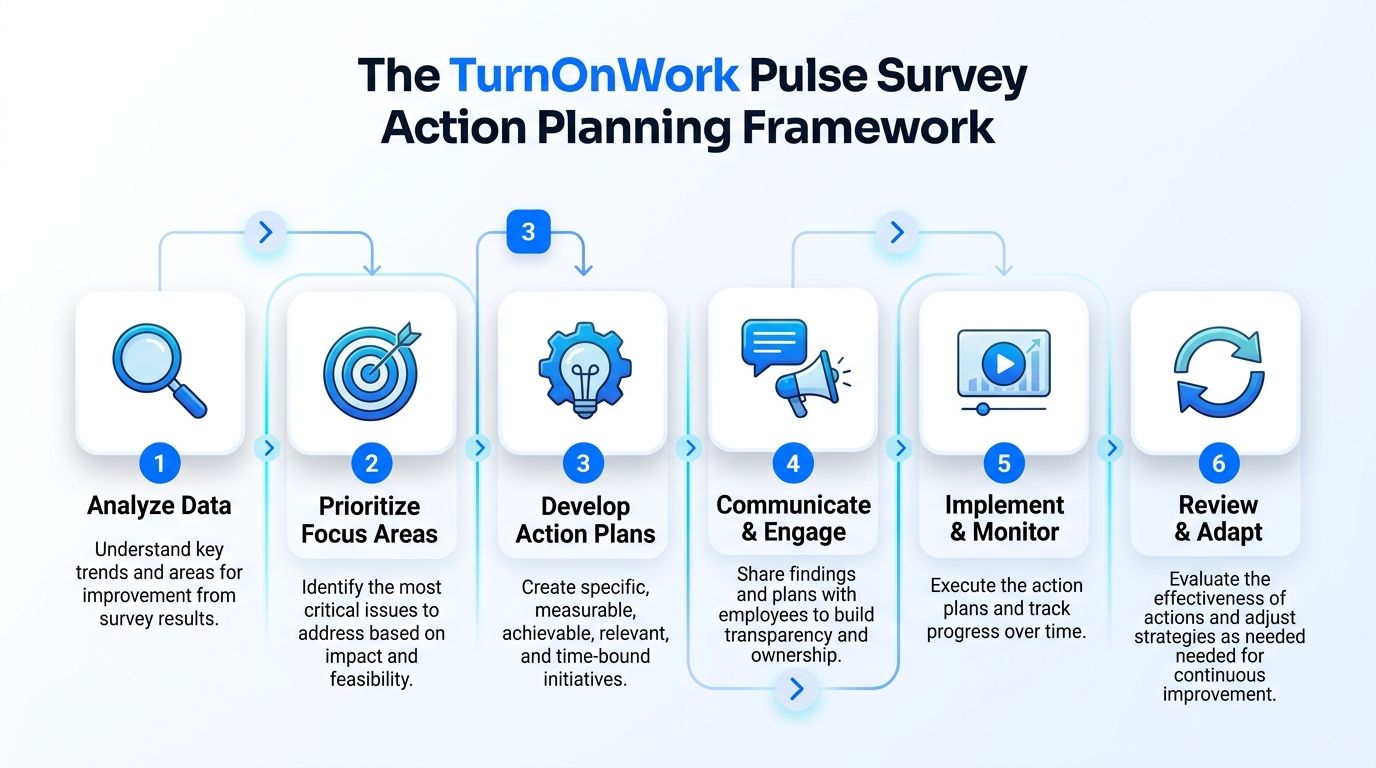
The TurnOnWork Pulse Survey Action Planning Framework is an editorial model, not an established industry standard. It uses three linked responsibilities, Calibrate, Communicate, and Commit, to turn feedback into visible change.
The model starts with a simple premise. A pulse survey earns credibility when employees can identify the connection between what they said, what leaders understood, what managers discussed, and what changed in the work.
Recent Perceptyx research describes a persistent action gap: 59% of companies create action plans, but only 51% of employees see actual improvements. It identifies HR workload at 27% and action planning at 22% among the top barriers. Perceptyx’s findings on listening and follow-through show why collection isn’t the hardest part of the program.
Calibrate the signal
Begin by separating signal from noise without dismissing uncomfortable feedback.
- Analyze the data. Review overall patterns, trends, role groups, locations, and manager populations where reporting is safe. Compare results with the prior pulse only when the questions and population are sufficiently consistent.
- Prioritize focus areas. Select issues using two tests, employee impact and operational feasibility. A widespread issue that managers can address locally may deserve earlier attention than a complex issue requiring a long corporate program.
- Check the story. Use open comments, manager conversations, and operational data to understand what the score means. Don’t treat a low score as a diagnosis.
The approach to analyzing employee survey answers is most useful when it moves from pattern recognition to a clear decision. Avoid giving managers a dashboard full of weakly connected charts. Give them a short readout with the issue, evidence, likely causes, and decisions within their control.
Communicate what you heard
Employees shouldn’t have to guess whether leaders saw the results. Share a concise “you said, we heard” message, then distinguish between actions already approved, actions under review, and requests that can’t be addressed yet.
Managers need a discussion guide, not a presentation deck. Give them:
- The local finding: What their team experienced.
- The conversation prompt: What employees think is driving it.
- The decision boundary: What the manager can change without approval.
- The escalation route: Where larger barriers should go.
- The follow-up date: When the team will review progress.
Commit to a small number of changes
A strong employee survey action plan names an owner, action, timing, and evidence of progress. It doesn’t promise to fix everything. A frontline action might adjust how shift information is posted. A hybrid team might clarify decision ownership in meetings. An HR technology team might simplify an access workflow after employees identify repeated friction.
Practical rule: If an action can’t be explained in plain language to the affected employees, it probably isn’t ready to launch.
Review progress through the next relevant pulse, operational check, or manager conversation. If the result doesn’t improve, don’t automatically blame the survey. Reassess whether the action reached the right population, whether managers had the authority to implement it, and whether the original question captured the actual problem.
How to Improve Employee Pulse Survey Response Rates
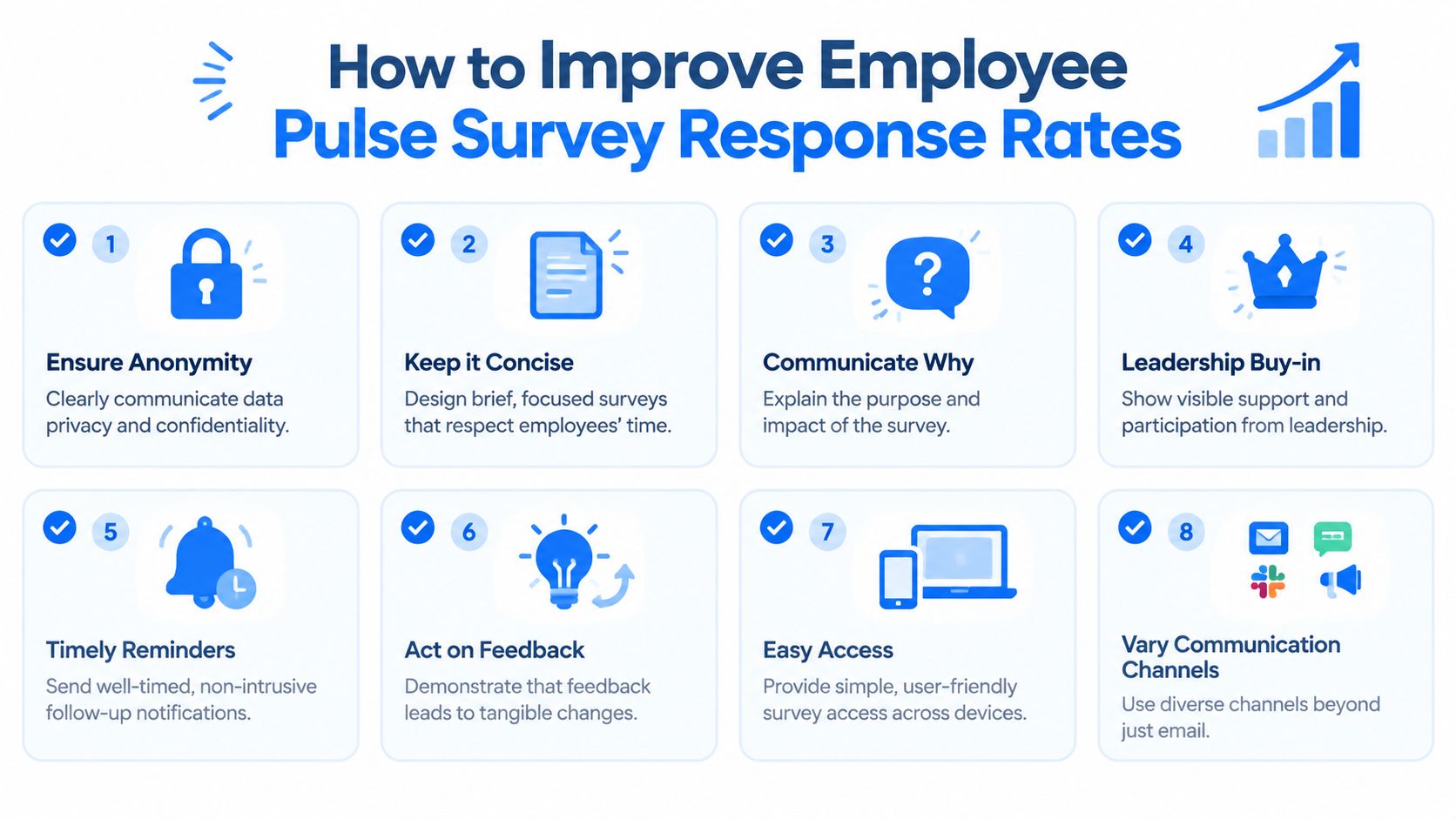
A strong pulse survey response rate begins before the first question appears. Employees participate when they trust the process, see a clear purpose, can access the survey, and receive visible follow-through. Reminders support participation, but they cannot repair weak confidentiality or feedback that never reaches a decision.
Independent benchmarks place strong pulse-survey response rates in the 70%–85% range, while programs with active first-line manager communication, discussion, and action can reach 80%–90%. Perceptyx’s analysis of missing survey data links participation with local manager involvement, not survey length alone.
Build participation into the process
Check these conditions before launch:
- Explain the purpose: State which decision the survey will inform and why each employee’s role is included.
- Protect anonymity: Describe reporting rules, set appropriate thresholds, and avoid small-group results that could identify respondents.
- Design for mobile access: Frontline and deskless employees should not need a corporate laptop or office email to respond.
- Use familiar channels: Pair email with the tools employees already use for schedules, tasks, and team updates.
- Keep the item set focused: A short survey respects time, but brevity cannot compensate for low credibility.
- Prepare managers: Brief managers on what to say, what not to promise, and how they will discuss results.
- Send proportionate reminders: Encourage participation without implying that individual responses are being monitored.
- Show the outcome: Publish the action taken, its owner, and the next check-in.
A 2026 industry report describes pulse surveys as typically 5–10 questions and reports 70%–85% participation for well-run programs, with a 77% median in its benchmark. The 2026 pulse survey benchmark also reports 61% participation for surveys with 1–9 questions and 88% for surveys with 50–59 questions. The comparison does not justify longer surveys. It shows that communication, timing, manager preparation, and confidence in follow-through can matter as much as brevity.
Your internal communications strategy should treat the survey as a communication event with a clear beginning, middle, and end. Give employees context before they respond, then show what their feedback changed. That visible loop is especially important for distributed teams, where operational barriers can otherwise hide behind low participation.
Employee Engagement Pulse Surveys FAQs
What are employee engagement pulse surveys?
Employee engagement pulse surveys are short, recurring check-ins that measure sentiment, engagement, readiness, or a defined workplace issue more often than an annual survey. They create value only when leaders connect the findings to a decision, operational change, or follow-up conversation.
What are the best employee pulse survey questions?
Start with the decision you need to make. Useful categories include engagement, manager support, communication clarity, workload, wellbeing, belonging, change readiness, and access to tools. Use consistent rating questions to track movement, then add an optional open question for context. In a distributed workforce, check that the questions apply across locations, shifts, and work arrangements.
How often should employee surveys be conducted?
Choose a cadence your team can support with analysis, communication, and action. Quarterly is often a practical default for large or fragmented workforces. Monthly or weekly pulses need a narrow topic, clear ownership, and enough operational capacity to close the loop on earlier feedback.
Should pulse surveys be anonymous?
Anonymous surveys suit sensitive subjects such as leadership, workload, wellbeing, and culture. Explain how responses will be protected, suppress results for groups small enough to identify individuals, and avoid promising anonymity that your survey tool or reporting process cannot provide. Confidentiality expectations should be agreed before launch.
What is a good pulse survey response rate?
A well-run program should aim for participation strong enough to support decisions across relevant teams. Interpret the response rate with manager involvement, employee trust, coverage of frontline workers, and whether people can see action after previous surveys. A high rate cannot compensate for feedback that leaders do not review or use.
How do I turn employee feedback into action?
Use the TurnOnWork model: Calibrate the signal, Communicate what was heard, and Commit to a small number of owned actions. State what will change, who owns it, when progress will be reviewed, and what the organization cannot address yet.
If the survey cannot support a clear conversation or decision, pause it. Define the issue, prepare managers, choose an accessible channel, and publish the first “you said, we did” update after reviewing results.
Build the survey around one operational decision, not a long list of curiosities. Prepare the questions, manager discussion guide, communication plan, and employee survey action plan together, then launch only when the team can show what feedback changed.