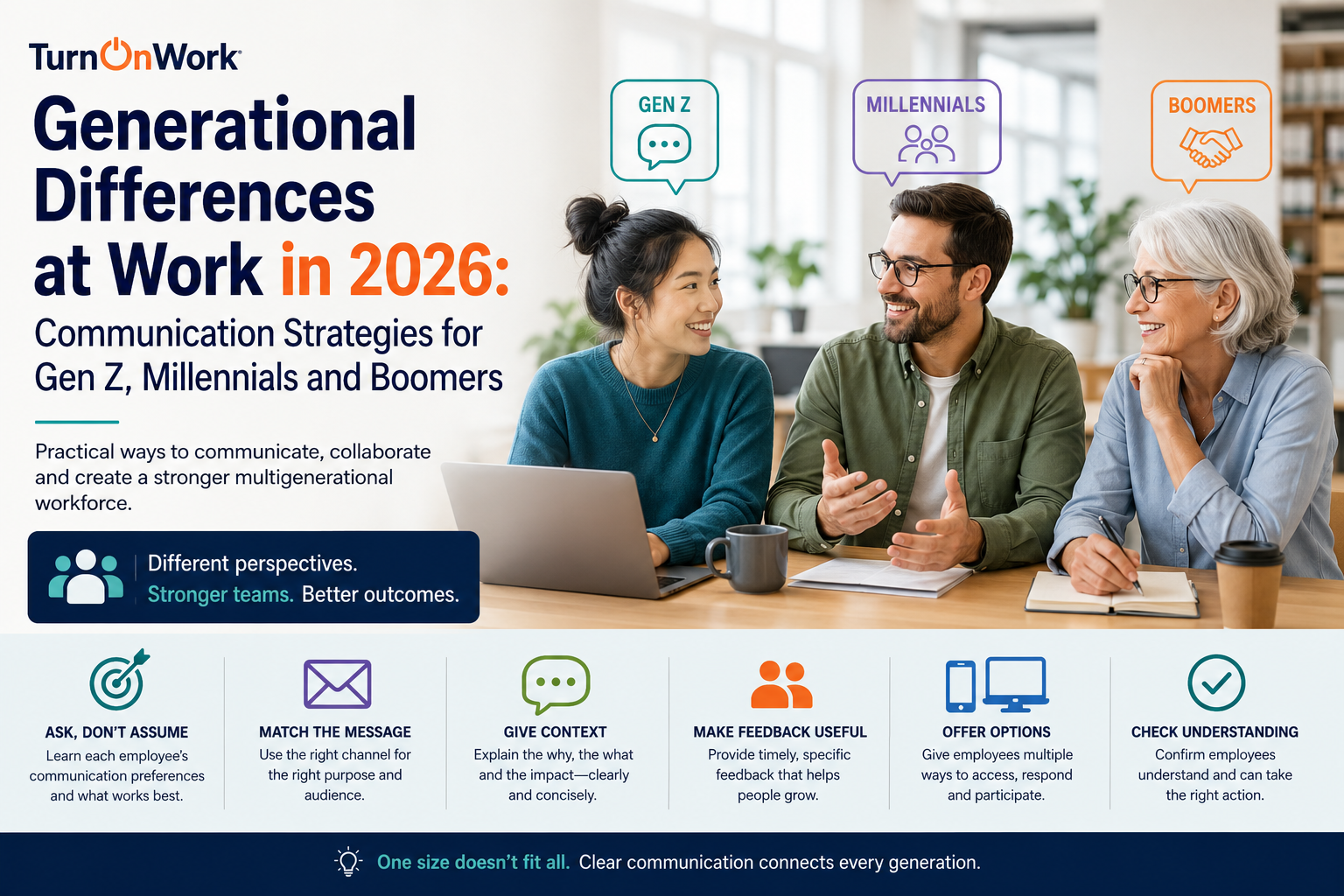
Generational workplace differences can affect how employees expect to receive feedback, use communication channels, approach flexibility, and interact with managers. But age alone is a poor communication strategy. In 2026, managers get better results by setting clear communication standards, learning individual preferences, giving employees more than one way to participate, and adapting delivery to the realities of each role rather than assuming every Gen Z, Millennial, or Baby Boomer employee communicates the same way.
Key takeaways
- Generational patterns can help managers ask better questions, but they should never become personality profiles for employees.
- Gen Z workplace communication often benefits from accessible managers, regular guidance, fast feedback, and clear explanations of expectations.
- Millennials may value many of the same things, particularly useful feedback, development, flexibility, and clarity about how work connects to larger goals.
- Baby Boomers should not automatically be treated as employees who prefer phone calls, office work, or less technology. Individual preferences and job requirements matter more.
- The strongest multigenerational workforce communication strategy creates a common communication baseline, then adapts channels, frequency, format, and manager support where employees actually need something different.
What are generational workplace differences?
Generational workplace differences are patterns sometimes observed among employees from different age cohorts in areas such as communication, career expectations, technology use, feedback, flexibility, and relationships with managers. These patterns describe groups. They do not reliably predict how one employee will behave.
A workplace may include Baby Boomers, Generation X, Millennials, and Gen Z employees working on the same project, shift or management team. In some organizations, employees from even older and younger cohorts may also be present.
That can make “generations in the workplace” sound like a management problem in itself. The evidence calls for more caution.
The American Psychological Association’s 2024 Work in America survey found that 87% of U.S. workers considered having employees from a range of age groups an advantage for their workplace. At the same time, 32% said people in their organization who were not close to their age did not see the value in their ideas. Among workers aged 18 to 25, that figure reached 48%.
So the practical issue is not simply that generations have different preferences. Employees may also interpret respect, participation, feedback and credibility differently based on what they experience at work.
There is another reason to be careful with generational labels. A meta-analysis covering 77 studies found no meaningful generational differences in Protestant work ethic among Baby Boomers, Gen Xers and Millennials. That runs against familiar claims that one generation inherently works harder than another.
Age, career stage, occupation, seniority, location, caregiving responsibilities and workplace conditions can all influence behavior.
A 24-year-old nurse on rotating shifts and a 24-year-old software developer working hybrid schedules belong to the same generation. Their communication needs can still be completely different.
That distinction should shape how HR and managers approach generational diversity in the workplace.
How do Gen Z, Millennials and Baby Boomers communicate differently at work?
There are observable differences in what age groups report wanting from work, but managers should treat them as starting hypotheses rather than communication rules. Ask employees what works, then watch what helps them perform.
Here is a more useful way to compare the groups.
| Area | Gen Z | Millennials | Baby Boomers | Better management response |
|---|---|---|---|---|
| Manager communication | Often benefits from accessible guidance and frequent clarity | Often values useful feedback and development conversations | Preferences vary widely by person and role | Agree on frequency individually |
| Feedback | Clear, timely feedback can help early-career employees develop | Regular, useful feedback can support growth | Do not assume less feedback is wanted | Make feedback specific and actionable |
| Digital communication | Often comfortable with digital channels | Usually comfortable across digital channels | Digital capability varies and should not be inferred from age | Train everyone on required tools |
| Meetings | Purpose and clarity matter | Purpose and flexibility matter | Purpose and clarity matter | Cancel meetings that do not need to exist |
| Flexibility | Often discussed as a priority, but preferences vary | Often values flexibility around work and life | Preferences depend heavily on role and circumstances | Base flexibility on work requirements where possible |
| Development | Coaching and learning can carry substantial weight | Career development often remains important | Growth may mean expertise, contribution or a different career path | Ask what development means to the individual |
Notice what is missing from the table: “Gen Z hates phone calls” or “Boomers prefer face-to-face meetings.”
Those statements are memorable. They are also poor management rules.
What Gen Z workplace communication looks like in 2026
Gen Z employees often need communication that reduces ambiguity about expectations, progress, development and their relationship with their manager.
Recent research points to a more complicated picture.
Gallup reported in January 2026 that U.S. engagement among Gen Z and younger Millennials had fallen eight percentage points between 2020 and 2025. The share who strongly agreed that a supervisor or someone at work cared about them as a person fell from 54% to 41%. Agreement that they had opportunities to learn and grow dropped from 48% to 37%.
Those numbers suggest that the manager relationship deserves more attention than stereotypes about preferred apps.
Communication preferences can vary across generations, but age should never become a fixed rule for how someone receives information. HubEngage’s multigenerational workforce communication resources provide further guidance on communicating with different generations and engaging employees across age groups. That does not mean every message needs to arrive through chat.
Deloitte’s 2025 Gen Z and Millennial research points in a similar direction. In India, 62% of Gen Z respondents said they wanted more guidance from managers, while 44% felt they received it. Among Millennials, 56% wanted more guidance and 47% felt they received it.
For a manager, the response can be quite practical:
- Explain what good performance looks like.
- Give feedback while the work is still fresh.
- Tell employees what changed and what action follows.
- Make it easy to ask questions without waiting for a formal review.
- Discuss development during normal management conversations, not once a year.
There is also a useful correction to the idea that young employees simply want to work remotely.
Gallup found in May 2025 that only 23% of remote-capable Gen Z employees in the U.S. preferred fully remote work, compared with 35% among older generations surveyed. Gen Z respondents were more likely to prefer hybrid arrangements.
That makes manager access, learning and workplace connection part of the Gen Z communication discussion.
How do Millennials tend to communicate at work?
Millennial communication preferences vary, but feedback, development, flexibility and useful manager contact frequently appear in workplace research involving this group.
Millennials are now experienced employees. Many are managers themselves, so treating them as the “young digital generation” is increasingly outdated.
The oldest Millennials are in their mid-40s in 2026.
That changes the conversation.
A Millennial department head managing 40 people does not have the same communication needs as an employee entering their first management position. Career stage matters.
Deloitte’s 2025 research found continuing demand among Millennials for manager support and development. The same survey also found gaps between what Gen Z and Millennial employees believed managers should provide and what they experienced.
For managers, useful communication with Millennial employees may include:
- direct feedback tied to actual work;
- honest career conversations;
- clear decisions rather than endless consultation;
- flexibility where the job permits it;
- context behind organizational changes;
- predictable access to managers.
None of those practices need to be restricted to Millennials.
How should managers communicate with Baby Boomers?
Ask Baby Boomer employees how they want to communicate instead of assuming they dislike digital channels, want more meetings, or resist workplace change.
Baby Boomers have spent decades adapting to new workplace technologies, including personal computers, email, smartphones, video meetings, cloud software and AI-assisted tools.
Age tells you very little about whether a particular employee wants a Teams message, phone call or scheduled conversation.
There can still be differences in career stage. An employee approaching retirement may have different questions about development, benefits or succession than someone building toward their first management role.
That is a career-stage issue rather than proof of a fixed generational communication style.
Managers can ask:
“What is the easiest way to reach you for something urgent?”
“How do you prefer to receive detailed feedback?”
“When we introduce a new system, what kind of training helps you learn it?”
Those three questions produce more useful information than a generational communication chart ever will.
What has changed about generational workplace communication in 2026?
The biggest 2026 change is that generational communication now sits alongside hybrid work, AI adoption, lower engagement among younger employees, fragmented communication channels and changing expectations of managers.
Several developments deserve attention.
AI has added another communication variable
Employees are now working with AI tools at very different levels of comfort and experience.
In Deloitte’s India findings from its 2025 Gen Z and Millennial Survey, 85% of both Gen Z and Millennial respondents reported using generative AI in their day-to-day work.
That does not mean older workers cannot or do not use AI. It does mean employers should avoid making AI adoption dependent on informal peer knowledge.
A company introducing an AI assistant should explain:
- which tools employees may use;
- which information employees may enter;
- where AI-generated information needs verification;
- who remains responsible for the final work;
- what employees should do when the tool produces a questionable answer.
Training should be based on skill and task, not age.
Younger-worker engagement needs manager attention
Gallup reported U.S. employee engagement at 31% for 2025. Its data showed the largest declines since 2020 among younger workers, while Baby Boomer engagement was unchanged over that period.
Globally, Gallup’s 2026 State of the Global Workplace report put employee engagement at 20% for 2025.
This gives managers a stronger reason to examine communication quality.
Employees cannot act confidently when expectations are vague, development conversations disappear, decisions arrive without context, or managers communicate mainly when something has gone wrong.
Channel overload has made preference-based communication harder
Many employees now move between email, chat, intranets, mobile apps, video calls, project software and manager meetings.
Giving every generation its preferred channel can make this worse.
Organizations need channel rules.
A policy update might live in one authoritative location. A mobile notification can tell frontline employees it changed. Managers can explain operational consequences during shift huddles. Chat can handle questions.
The source stays consistent even when delivery varies.
TurnOnWork’s guide to building an internal communication strategy for a distributed workforce covers this channel-design problem in more detail.
How can managers communicate effectively with different generations?
Create one communication baseline for everyone, then personalize where individual needs, roles or work conditions justify it.
A manager does not need four separate management systems for four generations.
Start with six practices.
1. Ask instead of assuming
During onboarding or a regular 1:1, ask employees about communication preferences directly.
For example:
- How do you want urgent information sent?
- What is the best format for detailed instructions?
- How often is a manager check-in useful?
- Do you prefer feedback immediately or during a scheduled conversation?
- What makes a meeting useful to you?
- What information do you regularly struggle to find?
Record preferences where appropriate and revisit them when someone’s responsibilities change.
2. Separate urgent communication from important communication
Urgent and important messages do not always need the same channel.
A production shutdown may require a mobile alert.
A benefits policy update may require a searchable written document.
Performance feedback usually deserves a conversation.
A project status update may belong in the project system.
The channel should follow the job the message needs to perform.
3. Give employees context, not extra words
Employees across generations can become frustrated when leaders announce a decision without explaining what changes for them.
A practical message answers four questions:
What changed?
State the decision.
Who is affected?
Name the relevant employees.
What do I need to do?
Give the action.
When does it happen?
Give the deadline or effective date.
If managers need to explain the announcement differently to every team because the original message is vague, the communication process has already created extra work.
4. Build feedback into normal work
Do not make feedback a generational perk.
A new employee may need it several times a week. An experienced specialist may prefer a monthly discussion unless something requires immediate attention.
The frequency should follow the person’s work and development needs.
TurnOnWork’s guide to manager behaviors that increase employee engagement scores gives managers practical ways to build shorter check-ins and structured conversations into normal work.
5. Give employees more than one way to participate
The loudest person in a meeting should not automatically have the most influence.
For an important decision, teams can collect input through a meeting discussion and a written follow-up channel.
That helps employees who think before responding, employees working another shift, remote workers, people using a second language at work and anyone who was unable to attend.
This is a better inclusion mechanism than assigning communication styles by generation.
6. Check understanding
Sending information is not proof that employees understood it.
For operational changes, managers can ask employees to explain the next action in their own words, check completion data, review recurring questions or run a short pulse question.
TurnOnWork’s guide to employee experience survey questions offers examples for gathering employee feedback without turning every issue into a large annual survey.
The TurnOnWork CLEAR Communication Model
The TurnOnWork CLEAR Communication Model is an editorial framework for managing communication in a multigenerational workforce without relying on generational stereotypes.
CLEAR stands for Context, Level, Expectation, Access and Response.
It is not an established industry standard. It is a TurnOnWork model designed to give managers a simple test before choosing how to communicate.
| CLEAR factor | Question to ask | Example |
|---|---|---|
| Context | What is happening? | Policy change, feedback, emergency, project update |
| Level | How much detail does this employee need? | 30-second alert versus detailed guidance |
| Expectation | What should the employee do next? | Read, reply, approve, attend, change a process |
| Access | Can this employee reliably receive the message here? | Email for office staff, mobile or shift briefing for frontline staff |
| Response | How can the employee ask, challenge or confirm? | Manager conversation, comments, form, survey or Q&A |
Consider a company changing its overtime approval process.
A weak approach sends a long company-wide email.
The CLEAR approach works differently.
Context: Overtime approval is changing Monday.
Level: Employees need a short explanation; supervisors need the full process.
Expectation: Employees must request approval before accepting overtime.
Access: Office employees receive the update through the normal employee platform. Frontline employees also receive it through mobile access and shift briefings.
Response: Employees can ask their supervisor or submit a question through the employee channel.
Nobody needs to decide whether Gen Z prefers a push notification or Baby Boomers prefer a meeting.
The company designs communication around the work.
How should communication work in a frontline multigenerational workforce?
Frontline communication should account for shifts, device access, location and manager availability before it accounts for generation.
A hospital, distribution center, manufacturing plant, hotel or retail chain may have four generations working together.
Yet their biggest communication difference may have nothing to do with age.
One employee works the morning shift and has a company device. Another works overnight and shares a terminal. A manager covers three locations. Some employees have corporate email accounts; others rarely check them.
An email-first strategy will create unequal access even if the message itself is perfectly written.
For frontline teams, use a mix of:
- mobile-accessible communication;
- short shift huddles;
- searchable policies;
- manager talking points;
- printed or QR-based access where appropriate;
- translation when employees need it;
- clear escalation routes for questions.
TurnOnWork’s first 90 days employee experience framework makes a similar distinction during onboarding: a nurse on nights, a warehouse employee using shared devices and a remote software employee may need the same information delivered in very different ways.
That principle applies throughout employment.
How can companies reduce generational conflict at work?
Reduce generational conflict by addressing the behavior or process causing the problem rather than attributing it to someone’s age group.
Consider this complaint:
“Gen Z doesn’t communicate professionally.”
That statement cannot be managed. It describes millions of people.
A manager needs to identify the actual behavior.
Perhaps an employee is sending one-word replies to customer escalations without enough context. Now there is something concrete to address.
Compare:
“You need to communicate more professionally.”
with:
“When you respond to an escalation, include the customer’s issue, what you checked, what you did and whether another person needs to act.”
The second instruction gives the employee a standard they can follow.
The same rule applies in the other direction.
“Boomers resist technology” is not actionable.
“Three team members have not completed the new scheduling-system workflow correctly” is actionable.
Train those employees on the workflow. If the interface itself causes repeated errors across age groups, fix the process.
Watch for age-coded language
Managers should pay attention when employees describe colleagues with phrases such as:
- “too young to understand”
- “old school”
- “entitled generation”
- “stuck in their ways”
- “kids these days”
- “too old for this technology.”
These phrases replace a work issue with an age judgment.
Ask the speaker to describe the actual behavior, decision or outcome instead.
That usually makes the disagreement easier to solve.
What mistakes should managers avoid with a multigenerational team?
The most common mistake is turning broad generational patterns into rules for individuals. Other problems usually follow from that first assumption.
Mistake 1: Assigning channels by age
Do not automatically message younger employees and call older employees.
Ask what works and establish company channel rules.
Mistake 2: Confusing seniority with age
A 50-year-old employee can be new to an industry. A 29-year-old can have eight years of specialized experience.
Communicate according to knowledge and responsibility.
Mistake 3: Giving younger employees constant feedback whether they want it or not
Frequent feedback is useful only when it contains information the employee can act on.
“Great job” five times a week is not a development system.
Mistake 4: Assuming experienced employees no longer want development
Development does not always mean promotion.
An experienced employee might want deeper technical expertise, mentoring responsibilities, a new project or preparation for a different role.
Ask.
Mistake 5: Making every preference a company policy
Personalization has limits.
If every employee chooses a different tool, meeting cadence and documentation process, collaboration becomes harder.
Set a common operating standard first. Personalize within it.
Mistake 6: Treating conflict as a generational problem too early
Start with the work.
What happened? What expectation was unclear? What behavior caused friction? What needs to happen next?
Age should rarely be the first explanation.
How should HR create a communication strategy for a multigenerational workforce?
HR should segment communication by employee needs and work conditions first, then use age data only when evidence shows a meaningful difference worth addressing.
A practical process looks like this:
- Map the workforce. Identify roles, locations, shifts, languages, device access, manager ratios and work arrangements.
- Audit communication channels. Document what each channel is supposed to do and which employees can actually access it.
- Ask employees about communication. Use surveys, interviews, manager conversations and channel data.
- Compare groups carefully. Look at age alongside tenure, role, location, shift and manager.
- Find specific gaps. For example, new employees may report poor manager access regardless of age.
- Change one communication practice. Introduce structured manager check-ins, clearer alerts or a new frontline access method.
- Measure again. Check whether reach, understanding, response or behavior improved.
TurnOnWork’s guide to building an employee listening strategy goes deeper into connecting employee feedback with action and follow-up.
How should companies measure multigenerational communication?
Measure whether employees receive, understand and act on communication. Then segment the results to find meaningful gaps.
Do not begin with “Which generation likes our newsletter?”
Start with business questions.
| Measure | Question it answers |
|---|---|
| Reach | Did employees receive the information? |
| Understanding | Did they understand what changed? |
| Action completion | Did they do what the message requested? |
| Response rate | Did employees participate when asked? |
| Manager follow-through | Did managers discuss or reinforce the message? |
| Repeated questions | Which parts remained unclear? |
| Channel access | Could every workforce group retrieve the information? |
| Employee feedback | Did employees consider the communication useful and clear? |
Then segment the data.
You might discover employees under 30 have lower understanding scores.
But do not stop there.
Perhaps most of those employees are new hires.
Perhaps they work on a particular shift.
Perhaps they report to managers with unusually large teams.
Perhaps they have less access to the main communication platform.
The useful question is not “What is wrong with this generation?”
It is “What explains this difference, and what can we change?”
For a broader measurement approach, see TurnOnWork’s guide to measuring employee engagement.
A practical multigenerational communication checklist for managers
Before introducing a new communication practice, ask:
- Have I asked employees how they prefer to receive feedback?
- Does everyone know which channel to use for urgent information?
- Can frontline and deskless employees access the same essential information as office employees?
- Do employees know where the authoritative version of a policy lives?
- Am I adapting communication because of evidence or because of an age stereotype?
- Do employees have a way to ask questions after an announcement?
- Are manager expectations consistent across teams?
- Can employees who miss a meeting retrieve the decision later?
- Do I measure understanding or only message delivery?
- Am I treating a performance issue as a generational issue?
- Does every employee have reasonable access to development conversations?
- Have I checked whether tenure, role, shift or location explains the difference better than age?
If several answers are “no,” changing the communication system will probably do more than another generational-awareness presentation.
What does good multigenerational communication look like in practice?
Good multigenerational communication feels consistent without forcing everyone into the same format. Employees know where information comes from, what managers expect, how to respond and where to find answers later.
Imagine a retailer introducing a new returns policy.
Headquarters publishes one authoritative policy.
Store employees receive a short mobile notification before their next shift.
Managers get a five-minute huddle guide with three customer scenarios.
Employees can scan a QR code to retrieve the full policy.
A short knowledge check confirms that people understand the change.
Questions feed back to the policy owner so confusing instructions can be corrected.
A 23-year-old employee and a 62-year-old employee may receive the same mobile alert. One may ask the manager a question; the other may read the detailed policy. A third employee may do both.
The communication system gives them options without lowering the standard.
That is a more practical model for generational differences at work in 2026.
FAQ: Generational workplace differences
What are generational workplace differences?
Generational workplace differences are patterns associated with age cohorts in areas such as communication, feedback, technology, flexibility and career expectations. They should be treated as broad observations rather than rules for individual employees.
What generations are currently in the workplace?
Most large workforces can include Baby Boomers, Generation X, Millennials and Generation Z. Some workplaces may also include members of older cohorts, while the oldest members of Generation Alpha are beginning to enter limited forms of work such as summer or part-time employment.
How do different generations communicate at work?
Communication preferences can vary by generation, but they also vary substantially within each generation. Role, career stage, work environment, personality, technology access and manager behavior can be more useful predictors. Managers should establish common communication standards and ask employees about individual preferences.
How do I communicate effectively with Gen Z, Millennials and Boomers at work?
Use clear expectations, accessible information, specific feedback and predictable manager communication for everyone. Then adjust channel, frequency and format when an employee’s role or preferences call for it.
What is the best communication strategy for a multigenerational workforce?
Start with one common communication system. Define which channels handle urgent alerts, policies, collaboration, feedback and company updates. Give employees more than one way to participate where practical, and personalize manager communication based on individual needs.
What are common generational communication differences?
Research sometimes finds differences in reported expectations around manager support, development, flexibility and workplace connection. These averages should not be used to assume how an individual employee prefers to communicate.
How can companies reduce generational conflict at work?
Describe specific behavior instead of attributing problems to age. Set shared standards, train employees on common tools, create clear escalation routes and address age-based stereotyping when it appears.
How should HR handle generational workplace differences in 2026?
HR should examine age as one workforce variable alongside role, tenure, location, shift, work arrangement and access to technology. Use employee data to find actual communication gaps, then fix the process producing them.
Does Gen Z prefer remote work?
Not universally. Gallup’s May 2025 U.S. research found that 23% of remote-capable Gen Z employees preferred fully remote work, compared with 35% among each of the older generations surveyed. Hybrid work was more attractive to Gen Z respondents.
Are younger generations less hardworking?
Evidence does not support treating younger generations as inherently less hardworking. A meta-analysis covering 77 studies and more than 40 years of research found no meaningful differences in Protestant work ethic among Baby Boomers, Gen Xers and Millennials.
Final thoughts
Generational workplace differences are useful when they prompt better questions. They become harmful when they give managers ready-made answers about people they have not bothered to understand.
In 2026, the more useful management question is rarely “How do I communicate with this generation?”
Ask instead:
What does this employee need to know, what action do they need to take, which channel can they reliably access, and what support will help them do the work well?
That approach works for a new Gen Z hire, a Millennial manager, a Gen X operations leader and a Baby Boomer specialist.
Generations can provide context. Good management still happens one employee, one team and one work situation at a time.