
Two teams can work for the same company, receive the same benefits and hear the same leadership announcements, yet describe their employee experience very differently. Often, what happens between the corporate message and the employee is the manager.
One manager explains why priorities changed, asks what the change means for workload and follows up on concerns. Another forwards the announcement and says little else.
That difference matters.
However, managers are not solely responsible for employee engagement. Pay, job design, staffing, career opportunities, senior leadership, organizational culture and personal circumstances all affect how people experience work. Still, managers influence many of the moments employees encounter every week.
That is why organizations trying to improve engagement scores should resist the temptation to “manage the score.” The more useful question is: What are employees consistently experiencing between surveys?
Key Takeaways
- Engagement scores are earned between surveys. Employees respond to what they experience every day, not what managers say during survey week.
- Managers shape the employee experience through small, repeated behaviors. Clear priorities, useful feedback, recognition, listening, and follow-through build trust over time.
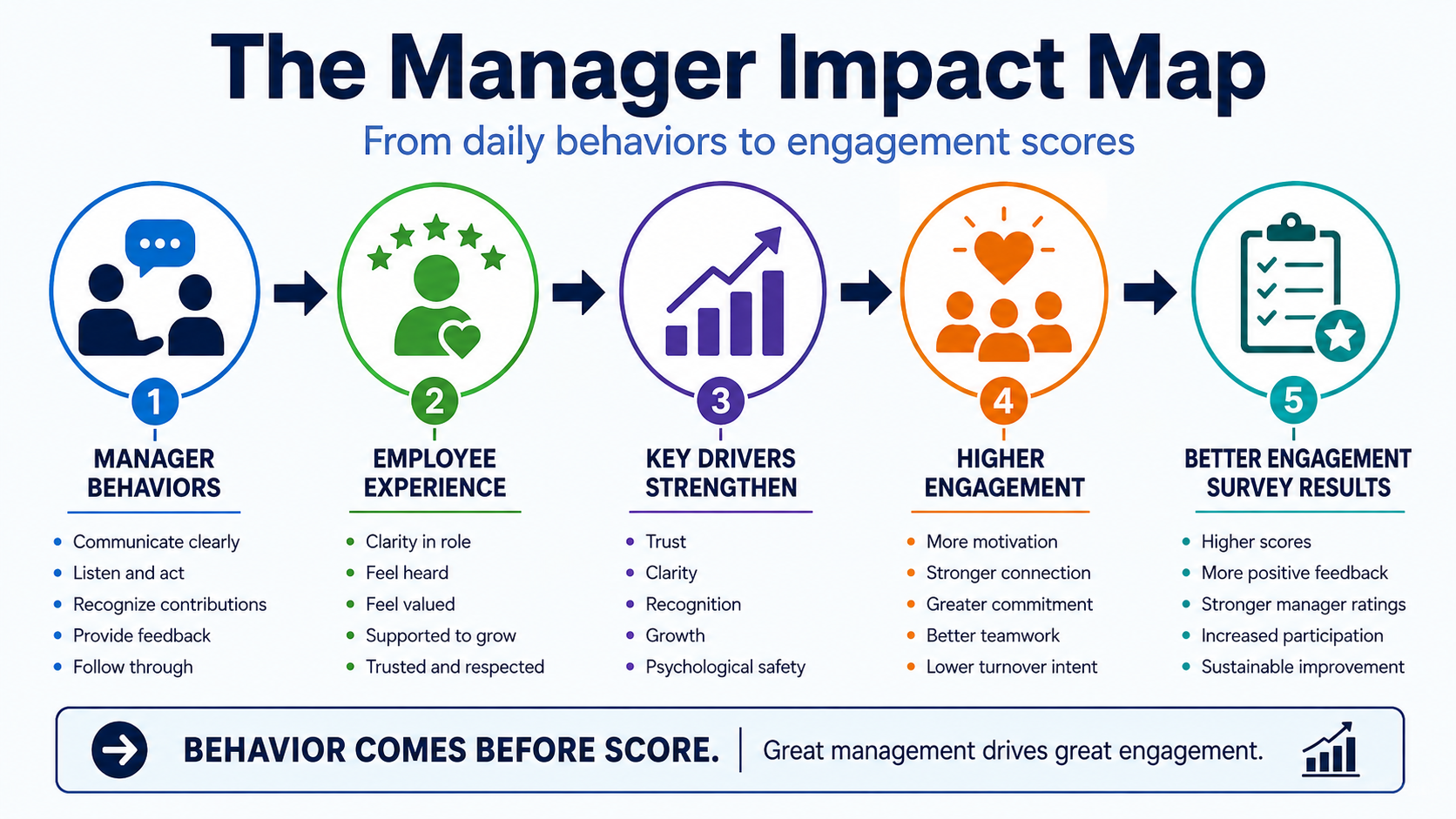
- Better management starts with behavior, not score-chasing. The goal is to fix the employee experience first; stronger survey results should follow naturally.
- Listening only matters when employees see action. Feedback without visible follow-through can weaken trust instead of strengthening it.
- HR must enable managers, not just hold them accountable. Managers need practical tools, coaching, time, data, and support to build stronger engagement consistently.
How much do managers really influence employee engagement?
Managers have considerable influence, but they do not have unlimited control.
Gallup has long found large differences in engagement between teams based on management quality, and its 2026 workplace reporting continues to emphasize the relationship between manager and team engagement. Gallup’s workplace research argues that manager selection, training and support remain central to improving workplace engagement.
That makes sense when you look at an ordinary workweek. Managers clarify priorities, explain decisions, approve time off, allocate work, respond to mistakes, recognize contributions, conduct 1:1s and decide who gets exposure to new opportunities.
For employees, those interactions are part of the organization.
At the same time, a capable manager cannot compensate indefinitely for chronic understaffing, uncompetitive pay or constant restructuring. A manager can acknowledge workload problems and reprioritize work, for example, but they may not have the authority to hire three additional people.
Similarly, CIPD’s people management research identifies manager behaviors such as fairness, respect, support, keeping promises, useful feedback and employee development as meaningful aspects of management quality. The research also emphasizes that organizations need to equip managers to manage people effectively.
So, HR should avoid both extremes: pretending managers have little influence and treating every poor engagement result as a manager failure.
Engagement scores are an outcome, not the behavior
Suppose a manager receives a team engagement score that has fallen six points.
A weak starting question is:
“How do I get the number back up before the next survey?”
A better question is:
“What are employees experiencing that may have contributed to this result?”
The distinction matters because the first question can lead to survey gaming. Managers may suddenly recognize more people, remind employees how much the team has achieved or become unusually attentive during survey week.
None of that repairs the employee experience if the behavior disappears once the survey closes.
Instead, engagement scores should be treated as one diagnostic signal. Survey comments, 1:1 conversations, employee relations themes, turnover, workload patterns and operational context can help explain what sits underneath the number.
The goal is not a happier dashboard.
The goal is a better experience that employees can actually recognize.
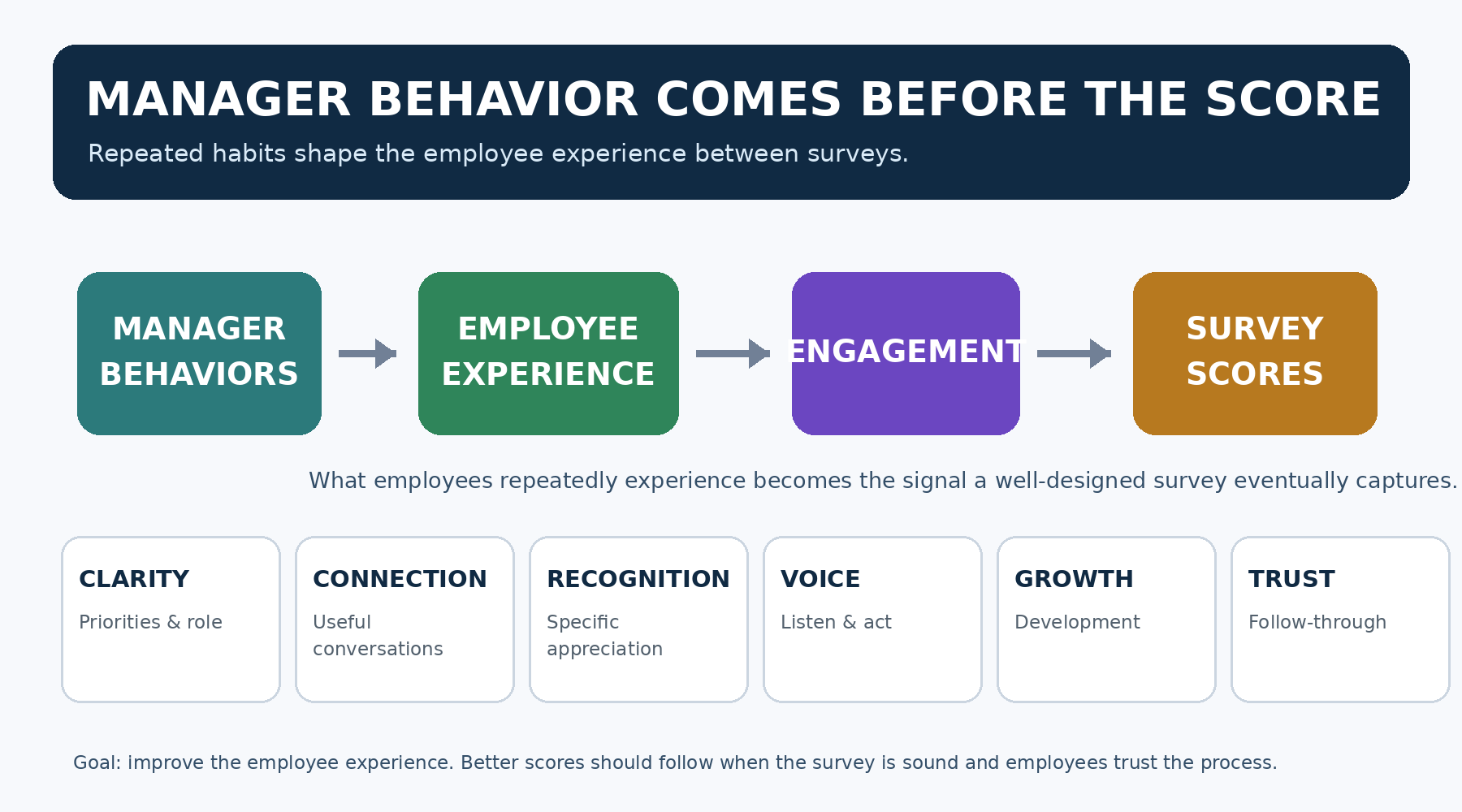
The survey is the signal. Repeated employee experience is what creates it.
1. Managers communicate expectations clearly
“Please prioritize this” sounds clear until an employee already has four other priorities.
Good managers resolve that conflict rather than transferring it to the employee.
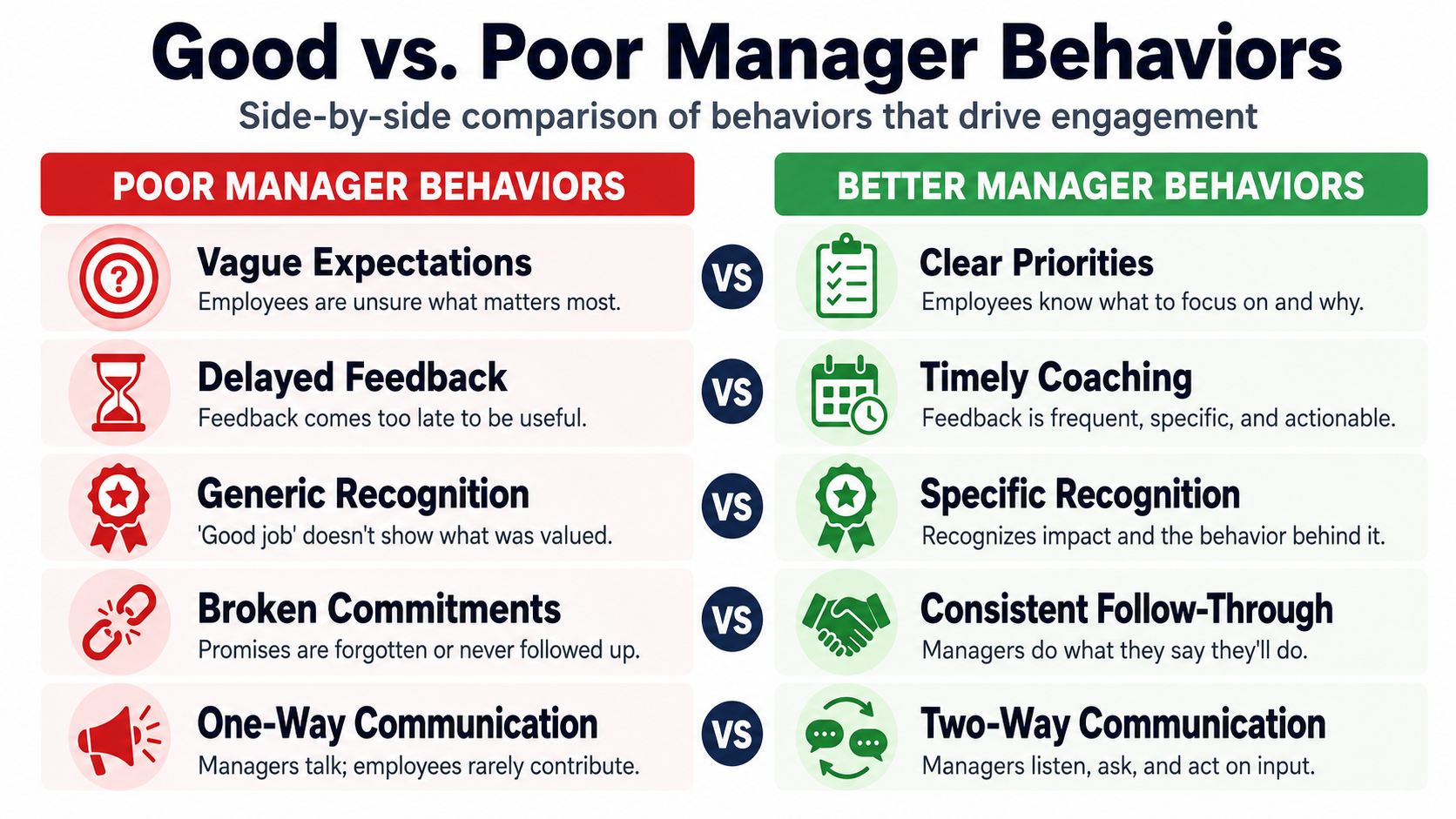
Weak manager behavior:
“Please prioritize the customer issue.”
Stronger manager behavior:
“The customer issue takes priority over the weekly reporting task. Finish the customer issue today and move the report to tomorrow. Let me know by 2 p.m. if that still isn’t realistic.”
The second version answers questions employees otherwise have to solve themselves: What moved? What can wait? What does success look like?
Clarity also becomes especially important when expectations change. If yesterday’s priority is no longer today’s priority, managers should say so explicitly.
Otherwise, employees can appear to be underperforming when the real problem is competing instructions.
2. Managers communicate consistently, not only when something goes wrong
Some teams mainly hear from their manager when a deadline is missed, a customer complains or leadership wants something.
Over time, that creates a strange information environment: silence means employees are expected to assume everything is fine, while communication becomes associated with problems.
A stronger manager develops a predictable communication rhythm. That might include a weekly team update, brief explanations after leadership announcements and direct communication when priorities change.
However, more communication is not automatically better communication.
Employees rarely need twelve messages repeating the same announcement. They need someone to explain what changed, why it matters and what they should do differently.
This is also where managers and internal communications teams need each other. Corporate communications can create the organization-wide message, while managers help employees interpret the practical implications for their team.
3. Managers recognize specific contributions
Recognition becomes weak when it could apply to almost anybody.
Weak recognition:
“Great job on the project.”
Stronger recognition:
“The way you prepared the client data before yesterday’s meeting meant we could answer every question without delaying the discussion. That preparation made the meeting much more effective.”
Specific recognition tells employees what they did well and why it mattered.
Timing matters, too. Recognition six months after the contribution has less value than recognition while the work is still fresh.
Managers should also pay attention to preference and fairness. One employee may appreciate public praise at a team meeting, while another may prefer a private message. Meanwhile, repeatedly recognizing the most visible employees while overlooking quieter contributors can create the opposite of the intended effect.
HR can make recognition easier through simple manager prompts, communication channels and appropriately designed employee recognition software. However, the tool should support the behavior rather than replace it.
4. Managers hold meaningful one-on-one conversations
A recurring 1:1 can exist on the calendar and still provide very little value.
That usually happens when the meeting becomes a project-status review:
“What did you finish?”
“What is due next?”
“Any blockers?”
Those questions have a place. Still, employees need some conversations about the experience of doing the work, not just the work itself.
Useful questions include:
- What is making your work harder than it needs to be?
- Is anything unclear right now?
- Where do you need more support from me?
- How is your workload feeling this week?
- Is there something I should stop, start or continue doing as your manager?
- Is there anything you want more exposure to over the next few months?
The manager does not need to ask every question every week. In practice, two thoughtful questions followed by genuine listening may be more valuable than racing through a standard template.
Managers should also resist repeatedly canceling 1:1s when work becomes busy. That sends an unintended message: employee conversations are important only when there is nothing more urgent.
5. Managers listen and visibly act on feedback
Asking for feedback is not the same as listening.
A team might tell a manager that the weekly project meeting is too long. The manager thanks everyone for being candid. Then the meeting stays exactly the same for six months.
Eventually, employees learn something: giving feedback creates no visible difference.
A stronger loop looks like this:
Ask → Listen → Understand → Act → Communicate → Follow up
For example:
Weak response:
“Thanks for your feedback about the meetings.”
Stronger response:
“You told us the weekly meeting was too long and that most project updates could be read asynchronously. Starting next week, written updates will move to the shared workspace and we’ll reduce the live meeting to 30 minutes. We still need the risk discussion live, so that part will stay. Let’s review the change in a month.”
Notice that the manager did not grant every request. They explained what would change, what would not change and why.
That is often more credible than trying to satisfy everyone.
6. Managers follow through on commitments
Trust can erode through surprisingly small promises.
“I’ll get back to you tomorrow.”
“I’ll ask leadership.”
“We’ll revisit your development plan next month.”
“I’ll check whether that process can be changed.”
Each commitment seems minor. However, when managers repeatedly make promises and fail to close the loop, employees eventually stop expecting follow-through.
A manager does not need to have the answer.
“I still don’t have the decision, but I said I’d update you Friday. Leadership is reviewing it on Tuesday, so I’ll come back to you after that meeting.”
That may sound less impressive than pretending the issue is resolved. Yet it provides evidence that the manager’s word means something.
A simple habit helps: managers should keep a short record of commitments made during 1:1s and team meetings.
7. Managers provide useful feedback
Employees cannot act on feedback they cannot interpret.
Weak feedback:
“You need to communicate better.”
Stronger feedback:
“In yesterday’s project meeting, the team wasn’t clear who owned the three next steps. At the end of future meetings, summarize each action, owner and deadline before everyone leaves.”
The second version describes behavior rather than labeling the person.
Good feedback is also closer to the event. Waiting for the annual performance review to discuss a communication problem that first appeared eight months ago turns coaching into archaeology.
That does not mean managers should comment on every minor imperfection. Instead, they should give timely feedback when an employee can reasonably do something with it.
Google’s current manager research similarly places coaching, effective communication, development and clear expectations among the behaviors it associates with effective management.
8. Managers create autonomy without disappearing
Micromanagement frustrates employees because every decision feels subject to manager approval.
Under-management creates a different problem: employees are given ownership but cannot get decisions, context or help when they need it.
The better operating model is:
Clear expectations + appropriate autonomy + accessible support
Imagine a manager delegates a customer webinar to an experienced employee.
Micromanagement means approving every slide, email and meeting invitation.
Disappearing means saying, “You own it,” then becoming unavailable until the event.
A stronger manager agrees on the intended outcome, budget, major deadlines and decisions that require approval. The employee owns execution, while the manager remains available for issues that exceed those boundaries.
Autonomy works when people know where their authority begins and ends.
9. Managers pay attention to workload and capacity
“Take care of yourself” is not a workload strategy.
When employees say they are overloaded, a manager’s most useful first response is often to look at the work itself.
What can be delayed? What can stop? Which deadline is negotiable? Can work be redistributed? Is an approval process creating unnecessary effort? Does a resource problem need escalation?
For example, if leadership adds an urgent customer project, a manager should not simply tell the team to “make it work.”
A better response is:
“This project now needs three days of Priya’s time. That means the reporting automation will move to next week. If both deadlines truly have to stay, I’ll escalate the capacity issue rather than expecting the team to absorb both.”
Of course, managers cannot fix structural understaffing by rearranging priorities forever.
When overload is systemic, HR and senior leadership need to treat it as an organizational issue rather than coaching managers to deliver better wellbeing messages.
10. Managers support employee growth
Development conversations often fail because managers assume growth means promotion.
It does not.
Growth can include a stretch assignment, deeper expertise, mentoring, exposure to another function, leadership of a project, formal learning or greater decision-making responsibility.
Instead of saying, “There probably won’t be a promotion this year, so there isn’t much we can do,” a manager can have a more useful conversation:
“We don’t currently have an open senior role. However, if that is where you want to move, let’s identify the two capabilities you’d need to demonstrate and find assignments that give you evidence in both.”
The manager should not promise an outcome they cannot control.
Still, honest development conversations are much better than leaving employees to guess whether there is a future for them.
11. Managers treat employees consistently and fairly
Fairness does not mean every employee receives exactly the same treatment.
Consider flexibility. One employee may need a temporary schedule adjustment for a personal reason while another does not.
Treating them identically is not necessarily fair.
The important question is whether the manager applies understandable principles consistently rather than making decisions based on favoritism, visibility or personal preference.
The same issue appears in work allocation, recognition and development opportunities. If the same two employees always receive the highest-profile assignments, others may conclude that growth opportunities are predetermined.
Managers should therefore be able to explain the reasoning behind consequential decisions.
Not every employee will agree with the outcome. However, transparent reasoning is very different from unexplained inconsistency.
12. Managers connect everyday work to a larger purpose
Purpose becomes vague when managers rely on statements such as “your work makes a difference.”
A stronger connection is specific:
Task → team result → customer or business impact
For example:
“The accuracy of these payroll files directly affects whether 4,000 employees are paid correctly on Friday.”
Or:
“When you document these support issues accurately, the product team can see which problems affect customers repeatedly rather than treating every ticket as an isolated case.”
Purpose does not require an inspirational speech.
Often, it simply requires showing employees who depends on their work and what happens when it is done well.
What managers should do after receiving engagement survey results
Survey results should create a conversation, not a verdict.
A practical process is:
- Do not become defensive. Managers may disagree with comments or feel that contextual factors are missing. Review the pattern before trying to explain it away.
- Identify patterns. One isolated score deserves different treatment from several related items and comments pointing toward the same problem.
- Choose one or two priorities. Trying to fix twelve survey dimensions usually means none receives sustained attention.
- Discuss the results with the team. Share what you heard without trying to identify who said what.
- Ask clarifying questions. “What does unclear communication look like in practice?” is more useful than guessing.
- Agree on realistic actions. Favor behaviors the manager and team can actually influence.
- Assign ownership. Someone needs to be responsible for the next step.
- Communicate progress. Employees should not have to remember what happened to their feedback.
- Revisit the action regularly. A short monthly check is often enough to keep the commitment visible.
For example, if the survey highlights both workload and recognition, a team might choose two actions: review priorities every Monday and add five minutes to Friday’s meeting for specific recognition of useful contributions.
The survey then becomes the beginning of the improvement cycle rather than the end of the listening exercise.
Organizations building that process can use employee engagement surveys to collect feedback and identify themes, but the value still depends on what leaders and managers do afterward.
Common manager behaviors that quietly reduce engagement
Some disengaging behaviors are dramatic. Most are not.
Repeatedly canceling 1:1s tells employees that their conversation is the easiest commitment to remove. Giving feedback only when something goes wrong can make manager communication feel synonymous with criticism.
Similarly, changing priorities without explaining what should stop creates artificial urgency. Taking credit for team work weakens recognition. Avoiding difficult performance conversations forces stronger performers to compensate for unresolved problems.
Other patterns are equally damaging: asking for feedback and never mentioning it again, giving the most interesting assignments to favorites, withholding context because “people don’t need to know yet,” or micromanaging employees who have already demonstrated competence.
One of the most damaging behaviors after a survey is treating the score as a competition.
Managers should never pressure employees to answer positively, speculate about anonymous respondents or challenge the team to beat another department’s number.
Once employees believe the organization cares more about a score than their experience, the survey itself can lose credibility.
A practical manager engagement framework
HR teams need something more useful than “be a better manager.”
The CLARITY framework converts engagement into six recurring management questions:
| Manager dimension | What employees should experience | What HR can look for | How HR can support |
|---|---|---|---|
| Clarity | I understand priorities, expectations and trade-offs | Role-clarity feedback, recurring priority confusion | Communication prompts and manager training |
| Connection | I have useful conversations with my manager | 1:1 quality, support themes, employee comments | 1:1 guides and coaching |
| Recognition | I know when my contribution is valued and why | Recognition feedback, distribution patterns | Recognition resources and tools |
| Voice | I can raise concerns and see a response | Feedback-loop completion, employee voice themes | Survey interpretation and action planning |
| Growth | My manager has honest conversations about my development | Development feedback, mobility, career themes | Career-conversation guides and learning resources |
| Trust | My manager communicates honestly and follows through | Manager trust items, broken-commitment themes | Coaching, accountability and leadership support |
The framework is deliberately behavioral.
Instead of asking, “Is this manager engaging?” HR can ask, “What evidence do employees receive that priorities are clear?” or “When employees raise concerns, what happens next?”
Those questions are much easier to coach.
Which manager behaviors should HR measure?
Engagement scores are useful, but they are lagging indicators.
HR can also examine behavioral signals such as whether employees are getting useful 1:1s, whether agreed engagement actions are completed, whether recognition is concentrated among a small group, and whether recurring comments point to communication or follow-through problems.
Other context matters as well: voluntary turnover, internal mobility, absence patterns, employee relations cases and manager-effectiveness survey items can help HR understand the picture.
However, measurement can easily become counterproductive.
A rule stating that “every manager must log four 1:1s per employee every month,” for instance, may produce perfectly logged meetings and terrible conversations.
Likewise, recognition quotas can create meaningless praise.
Use behavioral data to ask better coaching questions, not to create another leaderboard.
Survey comparisons also need context. Team size, participation, manager tenure, restructures and changes in team composition can all influence results. A two-point difference between managers is not automatically proof that one is better.
How HR can help managers improve engagement
Organizations sometimes tell managers that engagement is part of their job and then give them a dashboard twice a year.
That is not manager enablement.
If managers are expected to communicate change well, give them the context and talking points early enough to do it. If they are expected to coach employees, teach them how to give behavioral feedback. If they are expected to respond to survey results, give them an action-planning method.
HR can also provide practical scripts, manager communities, short coaching sessions, survey interpretation support and examples of strong 1:1 questions.
More importantly, HR should look at whether managers have time to manage.
A supervisor responsible for a large team, operational targets, scheduling, reporting and individual-contributor work cannot simply absorb another dozen “manager best practices.” CIPD’s evidence review similarly emphasizes that effective managers require adequate organizational support and resources, not merely more expectations.
Manager engagement practices for frontline employees
Advice developed for office teams does not always translate directly to frontline work.
A warehouse supervisor with 35 employees across shifts may not be able to hold an hour-long weekly 1:1 with everyone. That does not mean employees have to go without meaningful manager contact.
Instead, the manager might use short structured check-ins, shift huddles and scheduled deeper conversations when an issue requires more time.
A five-minute shift huddle can cover what changed, today’s priority, a safety or operational issue, recognition for a useful contribution and any concern requiring follow-up.
Communication accessibility matters, too.
Frontline employees may not sit in email all day or have regular access to the corporate intranet. Managers therefore need reliable ways to make sure operational changes and company information actually reach employees across locations and shifts.
Most importantly, follow-up has to survive shift changes. If an employee raises a concern Monday evening and their supervisor says they will investigate, the employee should not need to restart the issue with a different supervisor on Wednesday.
Manager engagement practices for remote and hybrid teams
Hybrid work creates another management problem: visibility is uneven.
An employee who works near the manager may hear informal updates, join impromptu discussions and be top of mind when an interesting assignment appears.
A remote employee may receive only the scheduled communication.
Good hybrid managers deliberately reduce that gap.
If an important decision happens in a hallway conversation, document it for the whole team. If a development opportunity appears, consider the complete team rather than whoever happens to be visible. During hybrid meetings, avoid allowing the physical room to become the real meeting while remote participants watch from the edge.
Recognition also needs to travel.
A manager who regularly thanks people during office conversations may mistakenly believe everyone is receiving recognition. Distributed employees need equally visible evidence that their contribution is noticed.
At the same time, trust matters. Remote management should not become a reason for excessive status reporting simply because a manager cannot physically see someone working.
Manage outcomes, availability expectations and commitments, not keyboard visibility.
How long does it take manager behavior to affect engagement scores?
There is no universal timeline.
Some problems can improve quickly. If employees say a weekly meeting wastes two hours and the manager fixes it next week, employees can experience the improvement immediately.
Trust problems are different.
A manager who has ignored feedback for two years will not rebuild credibility with one good team meeting. Employees may wait to see whether the new behavior continues before changing how they respond to the next survey.
Survey frequency matters as well. A quarterly pulse can detect movement differently from an annual engagement survey.
More importantly, engagement scores can remain weak even when manager behavior improves if employees are simultaneously dealing with layoffs, understaffing or another major organizational problem.
So HR should look for evidence of sustained behavioral improvement first.
The score may follow, but the behavior is what the organization can actually coach.
FAQs
How do managers influence employee engagement?
Managers shape many recurring parts of the employee experience, including priority-setting, communication, feedback, recognition, development, workload decisions and employee voice. However, engagement is also influenced by organization-level factors such as pay, leadership, culture, policies and job design.
What manager behavior has the biggest impact on engagement?
There is unlikely to be one universal behavior for every team. The strongest priority depends on what employees are experiencing. A team struggling with uncertainty may need clarity, while another may have clear priorities but little recognition or development. Diagnose the experience before prescribing the behavior.
How can managers improve engagement survey scores?
Managers should focus on improving the employee experience rather than the score itself. Review the results, understand the underlying issue, choose one or two priorities, agree on visible actions and consistently follow through. If the survey is well designed and employees trust it, stronger scores may follow.
What should a manager do after a poor engagement survey result?
Avoid defensiveness. Look for patterns across items and comments, discuss the findings with the team, ask what the issues look like in practice and choose a small number of actions. Then communicate progress and revisit those actions rather than waiting for the next survey.
How often should managers discuss engagement with employees?
Engagement does not need to become a formal agenda item every week. Instead, questions about workload, priorities, recognition, development, support and team effectiveness should be part of normal 1:1s and team conversations. Formal progress on survey actions can usually be reviewed periodically without turning every meeting into an engagement meeting.
How can HR hold managers accountable for employee engagement?
Hold managers accountable for behaviors and follow-through rather than ranking them only by survey score. Engagement results can inform coaching, but HR should consider team context, organizational conditions and qualitative feedback. Managers also need the training, time, information and resources required to meet the expectations placed on them.
Better engagement starts between surveys
Employees usually do not experience “employee engagement strategy” as a strategy.
They experience whether their manager explains a changed deadline, remembers a commitment, gives useful feedback, notices good work and responds when someone says the workload is unsustainable.
Those interactions accumulate.
Therefore, organizations looking for stronger engagement results should spend less time searching for last-minute ways to lift a survey number and more time making effective management behaviors easier to repeat.
Managers will not solve every engagement problem. Some require HR, senior leadership, better systems or organizational change.
Still, when managers consistently provide clarity, recognition, useful conversations, employee voice, development and follow-through, employees receive something much more valuable than an engagement initiative.
They receive a better day-to-day experience.
And when that experience is real and sustained, stronger engagement scores have a much better reason to follow.