
AI employee sentiment analysis uses artificial intelligence to review open-ended survey comments and other employee feedback, group recurring themes, assess sentiment around those themes, and show what changes across teams or survey periods. HR teams use it when feedback volumes become too large to code manually. It works best for pattern-finding, theme detection and summarization, not for reading an employee’s mind. Sarcasm, mixed emotions, and company-specific language can still be misinterpreted, so important findings need human review and clear privacy rules before action is taken.
What AI Employee Sentiment Analysis Actually Tells You
The simplest way to understand employee sentiment analysis is to separate the score from the explanation behind the score.
Imagine an engagement survey asks employees whether their workload is manageable. Sixty-two percent respond favorably.
That’s useful. It tells HR what employees selected. It doesn’t necessarily explain why the other employees answered differently.
The explanation usually sits in the written feedback:
“Most weeks are manageable, but month-end has become difficult since two people left.”
“The workload isn’t really the issue. Priorities change so often that we redo the same work.”
“My manager is supportive, but there simply aren’t enough people on the shift.”
All three comments touch workload, but they describe different underlying problems: staffing, prioritization and shift capacity.
This is where AI employee sentiment analysis becomes useful. The software can process a large set of open-text responses, identify recurring subjects and help HR see whether employees are talking positively, negatively, neutrally or in mixed terms about each one.
That is different from simply calculating an engagement score.
Employee engagement analytics is broader. It may include favorability scores, engagement indices, participation, manager results, intent to stay and trends across employee groups.
Sentiment analysis focuses more closely on the language employees use when explaining their experience.
The two work well together. Engagement data shows HR what changed. Open-text sentiment can help explain what employees believe is behind that change.
If you’re working with survey scoring, segmentation, and action planning more broadly, our guide on how to analyze employee survey answers covers that process in more depth.
How AI Analyzes Employee Feedback
Most current platforms put several technologies under the label “AI.” For an HR buyer, the terminology matters less than understanding what each layer actually does.
A useful employee-feedback workflow usually has four parts: understanding the text, identifying the subject, interpreting sentiment and summarizing the pattern.
Natural language processing helps identify what employees are talking about
Natural language processing, usually shortened to NLP, helps software work with human language.
One of its most practical uses in employee listening is recognizing that different phrases can describe the same underlying issue.
For example:
“There isn’t anywhere for me to progress.”
“Promotion paths are unclear.”
“I don’t know what role comes after this one.”
Those comments use different wording, but an analyst could reasonably group all three under career development.
Without automated text analysis, somebody would normally build a coding framework and manually tag responses. That works when the dataset is small. It becomes far harder when a global survey generates thousands of comments.
AI reduces that first layer of manual work. It doesn’t remove the need for HR to check whether the resulting categories make sense.
Theme detection shows which issues keep appearing
Theme detection answers a fairly simple question:
What are employees talking about most often?
A survey may surface themes such as workload, management, communication, recognition, career development and workplace processes.
The label itself is only the beginning.
Consider four comments that could all fall under “communication”:
| Employee feedback | What the issue may actually be |
| “I hear about changes after customers do.” | Timing |
| “There are too many company updates.” | Volume |
| “My manager explains what decisions mean for our team.” | Manager communication |
| “I can never find the policy after the announcement.” | Information access |
Simply telling leadership that “communication sentiment is mixed” would lose most of the useful information.
A good system should let the analyst move from the high-level theme back to the actual employee language.
Sentiment analysis looks at how employees describe each subject
Theme detection tells you what employees are discussing.
Sentiment analysis tries to understand how they are discussing it.
Consider:
“My manager has been excellent, but the new scheduling system is a mess.”
There is no useful single sentiment label for that entire comment.
A better interpretation separates the subjects:
| Topic | Sentiment |
| Manager | Positive |
| Scheduling | Negative |
That topic-level distinction matters because real employee comments often contain several opinions at once.
Current platforms increasingly use the survey question as context too. That can improve interpretation because the same sentence may mean something quite different depending on what the employee was asked.
Large language models can summarize what sits inside each theme
Once comments are grouped into themes, HR still has another problem.
Knowing that 750 employees mentioned workload is useful. Leadership will usually want to know:
What are those employees actually saying about workload?
This is where large language models can add value.
Instead of showing only:
Workload: predominantly negative
the software may generate something closer to:
Employees most often associate workload pressure with unfilled vacancies, shifting priorities and month-end deadlines.
That is far closer to the explanation a People Analytics team would normally write by hand.
But the generated paragraph is still an interpretation.
Before using it in a leadership report, HR should be able to inspect representative comments and verify that the summary reflects the underlying evidence.
If a platform gives you a neat conclusion but makes it difficult to see how that conclusion was produced, I would treat that as a warning sign.
Where AI Sentiment Analysis Is Most Useful in HR
The strongest use cases are not simply places where AI can be added. They are places where HR already has a meaningful feedback problem and needs a better way to analyze it.
Open-ended engagement survey responses
This remains one of the clearest applications.
A company might receive 8,000 written comments from an annual engagement survey. Reading every response is possible with enough analysts and time, but the work quickly becomes a large manual coding exercise.
AI can provide the first analytical layer by showing which topics appear repeatedly, whether sentiment differs across those topics and which employee groups are discussing them most often.
HR can then spend more time interpreting the issues that deserve attention instead of trying to remember what appeared most frequently while reading thousands of spreadsheet rows.
Pulse surveys after a workplace change
AI becomes especially useful when the written feedback is helping explain a change in a structured score.
Suppose employees are asked:
“I have the information I need to do my job effectively.”
The favorable result drops noticeably after the company introduces a new operating process.
The score says something changed.
Open-text analysis may show repeated comments about conflicting manager instructions, outdated documentation and information arriving too late.
Those themes do not prove why the score declined, but they give HR a much stronger place to investigate.
Onboarding, stay and exit feedback
Lifecycle surveys often contain some of the most candid written feedback an organization receives.
New hires can explain where onboarding broke down. Employees completing stay surveys can describe what keeps them. Departing employees may talk about management, progression, scheduling, compensation or expectations of the role.
AI can help identify which explanations repeat across hundreds or thousands of responses.
The important discipline is not to convert a recurring theme into a causal statement.
If career development appears frequently in exit feedback, the finding is:
Career development is repeatedly mentioned by departing employees.
It is not automatically:
Lack of career development caused those employees to resign.
The second claim requires more evidence.
Comparing employee experiences across locations or teams
Company-wide averages can hide the most useful part of the story.
An illustrative result might look like this:
| Employee population | Frequent issue | Pattern |
| Headquarters | Career development | Mixed |
| Retail locations | Scheduling | Negative |
| Customer support | Manager communication | Mixed |
| Engineering | Autonomy | Positive |
The company does not have one employee experience.
Different groups may be telling HR very different things.
AI becomes useful when it makes those differences easier to see without encouraging teams to segment the data so narrowly that employee confidentiality disappears.
How to Set Up AI Employee Sentiment Analysis
The implementation should begin with the question HR needs answered.
It should not begin with choosing an AI model.
1. Start with a specific listening question
“Understand employee sentiment” is too broad to guide a useful analysis.
A better question might be:
“Why has workload sentiment declined in Operations?”
or:
“How are frontline employees experiencing communication after the new operating model?”
or:
“Which onboarding problems are new hires mentioning repeatedly during their first 90 days?”
A clear question shapes the survey, the population, the analysis and the action that may follow.
It also makes it easier to judge whether AI has actually helped.
If the platform generates an interesting collection of themes but those themes do not help HR answer the question that prompted the survey, the project is drifting.
2. Start with feedback employees deliberately provided for analysis
Engagement surveys, pulse surveys, onboarding feedback, stay surveys, exit surveys and targeted questionnaires are usually the cleanest starting point.
Employees generally understand why those channels exist.
Routine workplace communication is different.
Analyzing email, Teams, Slack or other employee conversations for sentiment may be technically possible in some environments, but the privacy and trust implications are much greater. Employees may not reasonably expect ordinary conversations with colleagues to become material for continuous sentiment monitoring.
For most organizations, transparent survey-based listening is a much cleaner place to begin.
3. Write open-text questions that produce useful evidence
AI cannot rescue weak survey design.
Compare:
“Anything else you’d like to share?”
with:
“What is the biggest thing making your workload easier or harder right now?”
The first question can produce useful surprises, but it may also create a dataset about every imaginable aspect of work.
The second gives the employee more context and gives the analysis a clearer purpose.
A good listening program can use both. Broad questions leave room for issues HR did not anticipate. Focused questions make it easier to investigate a specific business concern.
4. Define confidentiality before employees respond
This is one of the most important design decisions in employee listening.
HR wants detailed information because detailed findings are easier to act on.
Employees want confidence that managers cannot work out who said what.
Both concerns are legitimate.
A report might begin with a department of 300 employees. A manager then filters it by location, tenure, job level and shift. The final population may contain six people.
Technically, the dashboard is still showing aggregated data.
Practically, the manager may know exactly who belongs to that group.
That is why reporting thresholds, comment suppression and filter controls should be agreed before the survey launches.
Some employee-listening platforms use or recommend reporting minimums around five responses in certain configurations. That should not be treated as a universal privacy or legal rule.
The right threshold depends on workforce structure, survey sensitivity and applicable privacy requirements.
5. Test the platform with difficult examples before buying it
Almost every AI demo can handle:
“I love working here.”
and:
“I hate the new policy.”
Those are not the comments I would use to evaluate employee sentiment analysis software.
Give the vendor something closer to real workplace language:
“My manager is brilliant, but I have absolutely no idea what leadership is doing.”
Then:
“Great. Another process improvement that now takes twice as long.”
Then:
“The schedule is technically fair. I just don’t see my children during the week anymore.”
Those comments test mixed sentiment, sarcasm and context.
Ask the vendor to show how the software handles them. Then ask whether the analyst can inspect the comments behind an AI summary, correct an inaccurate classification, manage multilingual feedback and understand what happens when the available employee group falls below the confidentiality threshold.
Also ask where the employee text is processed, whether third-party AI models are involved and whether customer data is used for model training.
The goal isn’t to catch the vendor out.
It is to understand the system’s failure modes before leadership begins treating its output as fact.
6. Pilot the workflow before rolling it out company-wide
A contained pilot is useful because company language is unusually specific.
The model may understand “workload” perfectly and completely misunderstand internal language around “bench,” “coverage,” “rotation” or “utilization.”
A pilot gives HR a chance to see whether the themes are sensible, whether important comments are being misclassified and whether summaries accurately reflect what employees actually wrote.
It also tests the human side of the workflow.
Can managers understand the report? Do they know what they are expected to do with it? Does the analysis create better decisions, or simply more charts?
That last test matters more than how sophisticated the AI looks.
Best AI Tools for Employee Sentiment Analysis in 2026
For this use case, five platforms worth comparing are HubEngage, Culture Amp, Qualtrics EmployeeXM, Perceptyx and WorkTango.
They are not interchangeable.
Some are broader employee engagement platforms. Others go much deeper into employee listening and text analytics. The right choice depends on how sophisticated the organization’s listening program is and what HR intends to do once the analysis is complete.
| Tool | Where it fits best | Relevant analysis capability | Pricing |
| HubEngage | Survey analysis connected with communication and employee engagement | AI sentiment and thematic analysis of employee survey responses | Quote based on employee count and configuration |
| Culture Amp | Structured engagement programs and manager action | Topic and sentiment classification plus AI comment summaries | Quote based |
| Qualtrics EmployeeXM | Large, complex employee experience programs | Text iQ topic tagging, searches and overall/topic sentiment | Employee-based commercial pricing; quote required |
| Perceptyx | Mature employee listening and People Analytics teams | Theme, sentiment, intent, emotion and narrative analysis | Contact sales |
| WorkTango | Survey programs where manager follow-through matters | AI comment summaries, themes, sentiment views and action planning | Request pricing; annual contract |
HubEngage: useful when listening needs to connect with the wider engagement program
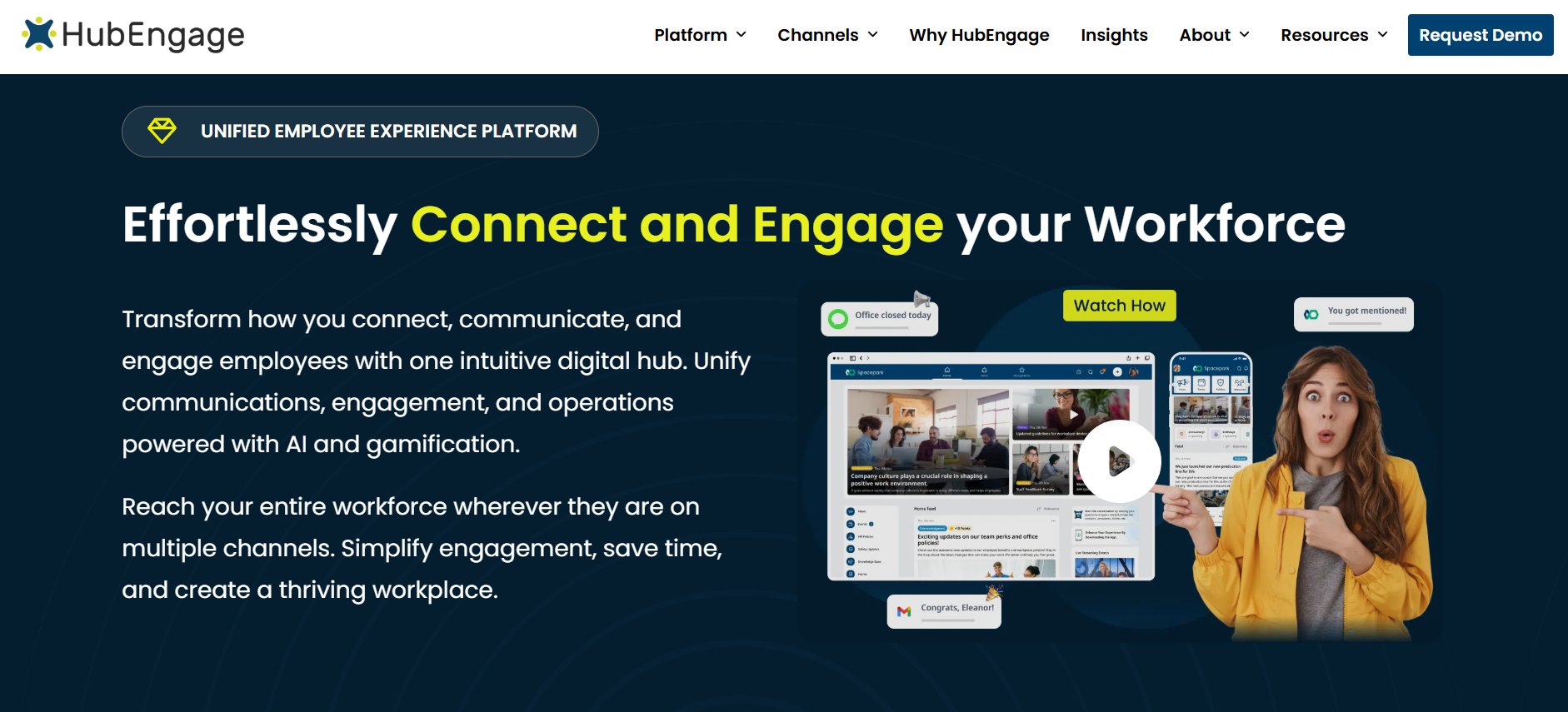
HubEngage’s Employee Survey Platform supports pulse surveys, recurring surveys, employee engagement surveys, anonymous survey options and open-ended responses.
Its current survey capabilities also include AI-driven sentiment analysis and thematic analysis, designed to help HR surface recurring concerns and common topics from written employee feedback.
The reason I would consider HubEngage is not simply that those AI capabilities exist.
The platform also connects surveying with employee communications, recognition and broader engagement workflows. Survey distribution can happen across web, mobile, SMS, email and digital signage, which is relevant when large groups of employees do not spend their working day in a corporate inbox.
That can make the workflow more practical for distributed or frontline organizations. The team collecting the feedback can also use the wider platform to communicate or run engagement activity after a problem is identified.
There is a boundary worth being clear about. If the main requirement is highly specialized qualitative research across large and varied open-text datasets, Perceptyx offers a deeper dedicated comment-analysis layer.
HubEngage makes more sense when collecting feedback, reaching distributed employees, understanding the response and running subsequent engagement activity need to sit closer together.
Pricing: HubEngage does not publish a fixed survey-platform price. Commercial proposals are based on employee count and configuration.
Culture Amp: useful when engagement surveys are already central to the People strategy
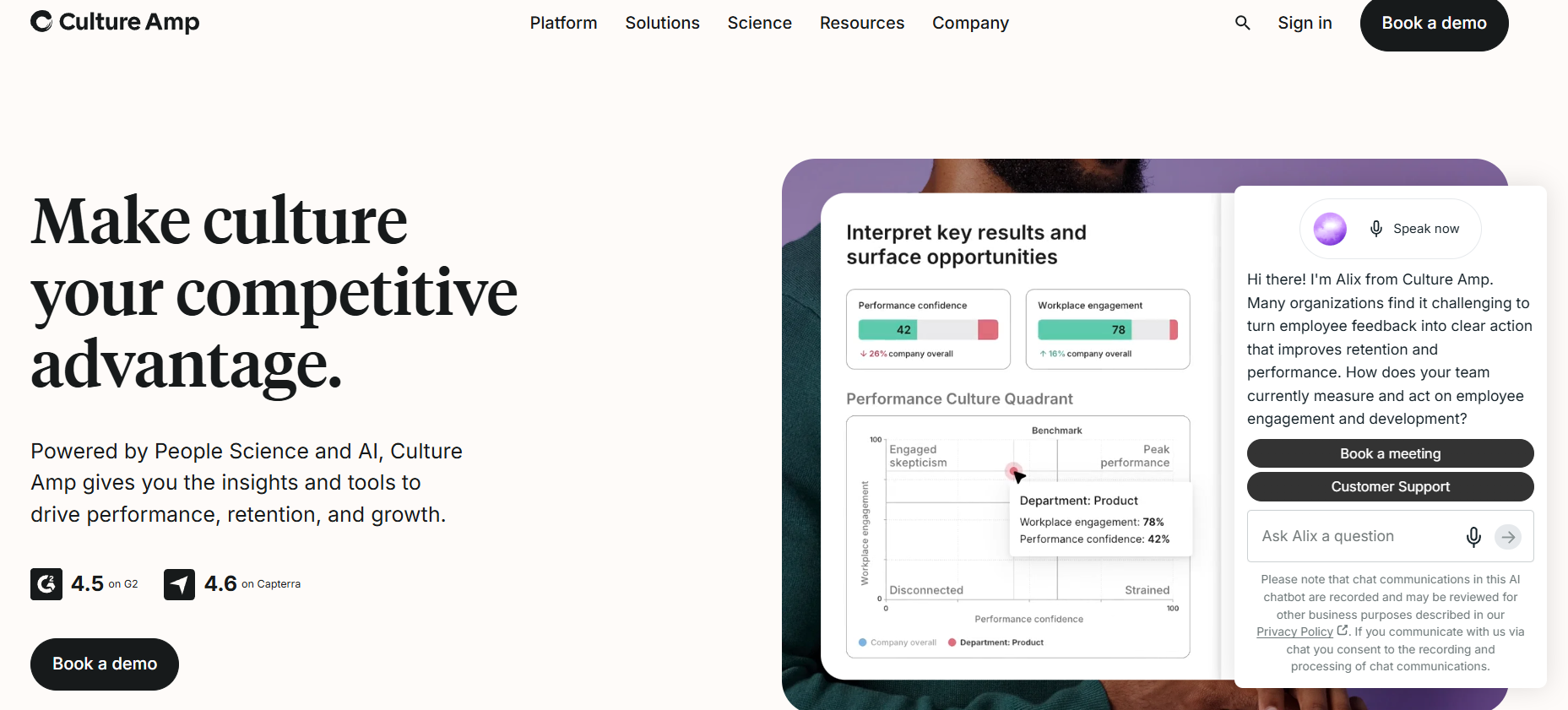
Culture Amp approaches sentiment analysis through a broader employee engagement and People Analytics platform.
Its current comment analysis can organize written responses by sentiment, topic and trend. AI Comment Summaries can then turn larger groups of responses into readable explanations while still giving analysts access to representative comments.
One important detail is context.
Culture Amp’s newer classification approach considers both the written response and the survey question. That’s useful because the same phrase can mean very different things depending on what the employee was asked.
The platform therefore fits organizations already running structured engagement programs and wanting to make the qualitative side of those surveys easier to interpret.
Culture Amp also distinguishes between analytical and generative AI capabilities. That separation is useful from a governance perspective because not every organization will want generative AI involved in employee-feedback workflows in exactly the same way.
Pricing: Culture Amp uses annual quote-based pricing determined by employee count, selected products and service level.
Qualtrics EmployeeXM: useful when employee listening is part of a larger experience program
Qualtrics EmployeeXM sits at the enterprise end of this category.
Its Text iQ functionality can analyze open-ended employee responses, assign topics, create searches that categorize incoming feedback and work with both overall and topic-level sentiment.
That level of control becomes more useful when the organization is running several employee-listening programs rather than one engagement survey.
A large People team might be analyzing engagement feedback, pulse surveys, onboarding experience and exit data inside a broader employee experience program.
In that environment, being able to build and refine topic structures becomes more valuable than simply receiving an AI-generated summary paragraph.
The trade-off is complexity.
A smaller HR function working with a few hundred comments every quarter may not need the same analytical infrastructure as a global enterprise managing several listening programs.
Pricing: Qualtrics does not publish a simple EmployeeXM list price. Employee Experience pricing is based on employee count and requires a commercial quote.
Perceptyx: the deeper option when open-text analysis is itself a major workload
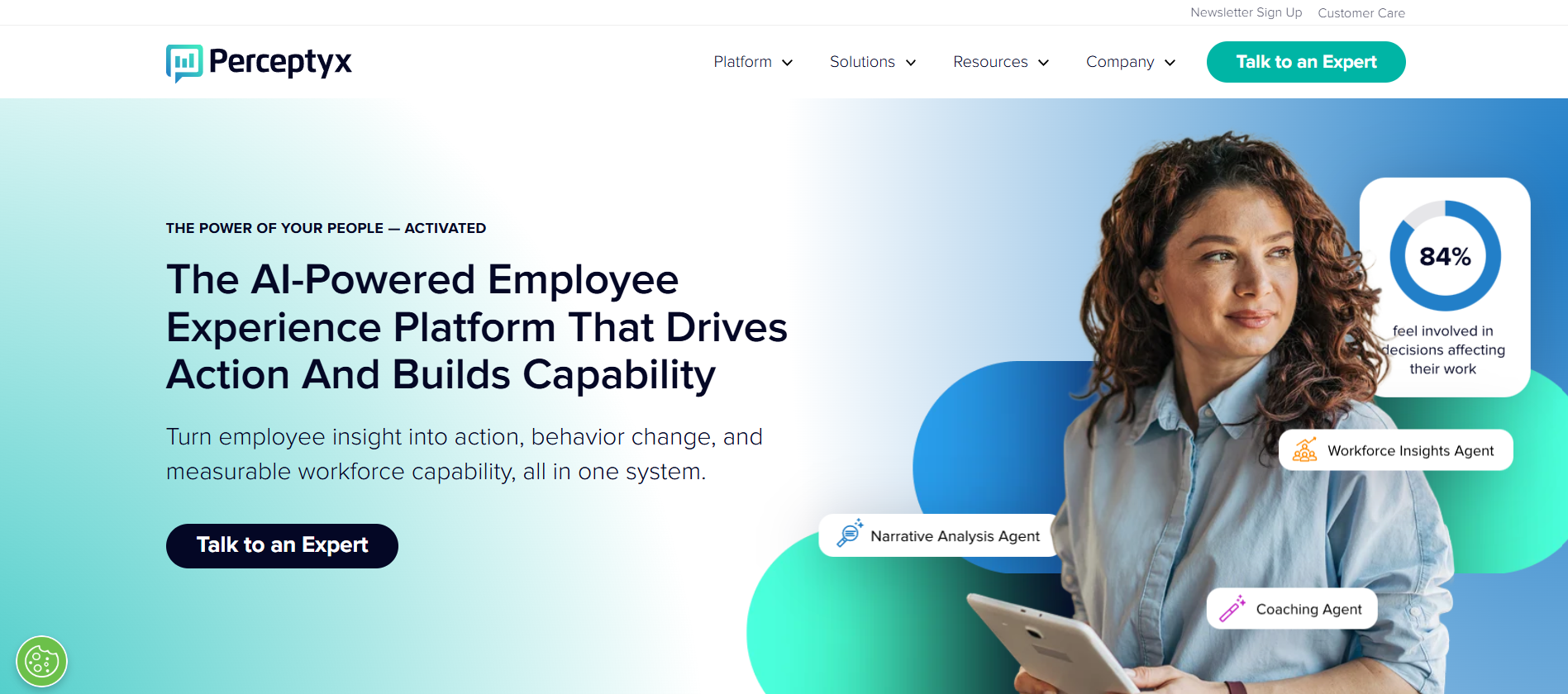
Perceptyx places more emphasis on employee listening and comment analytics than the other products in this comparison.
Its current Comment Analytics capabilities include theme detection, sentiment analysis, intent classification and emotion analysis. Its Narrative Analysis Agent goes further by synthesizing large volumes of employee feedback, surfacing representative comments and allowing People Analytics teams to ask plain-language questions of the dataset.
That changes the nature of the workflow.
Instead of only asking:
“What are our top negative themes?”
an analyst can investigate a more specific question such as:
“What barriers to performance are Operations employees mentioning most often, and how does that differ by location?”
For a mature listening program dealing with engagement surveys, onboarding feedback, exit responses and regular pulses, that level of specialization may be worthwhile.
For a smaller HR team primarily running periodic surveys, it may be more capability than necessary.
Pricing: Perceptyx does not publish numeric pricing on its current public product pages. Buyers need to contact sales.
WorkTango: useful when the difficult part starts after the survey closes
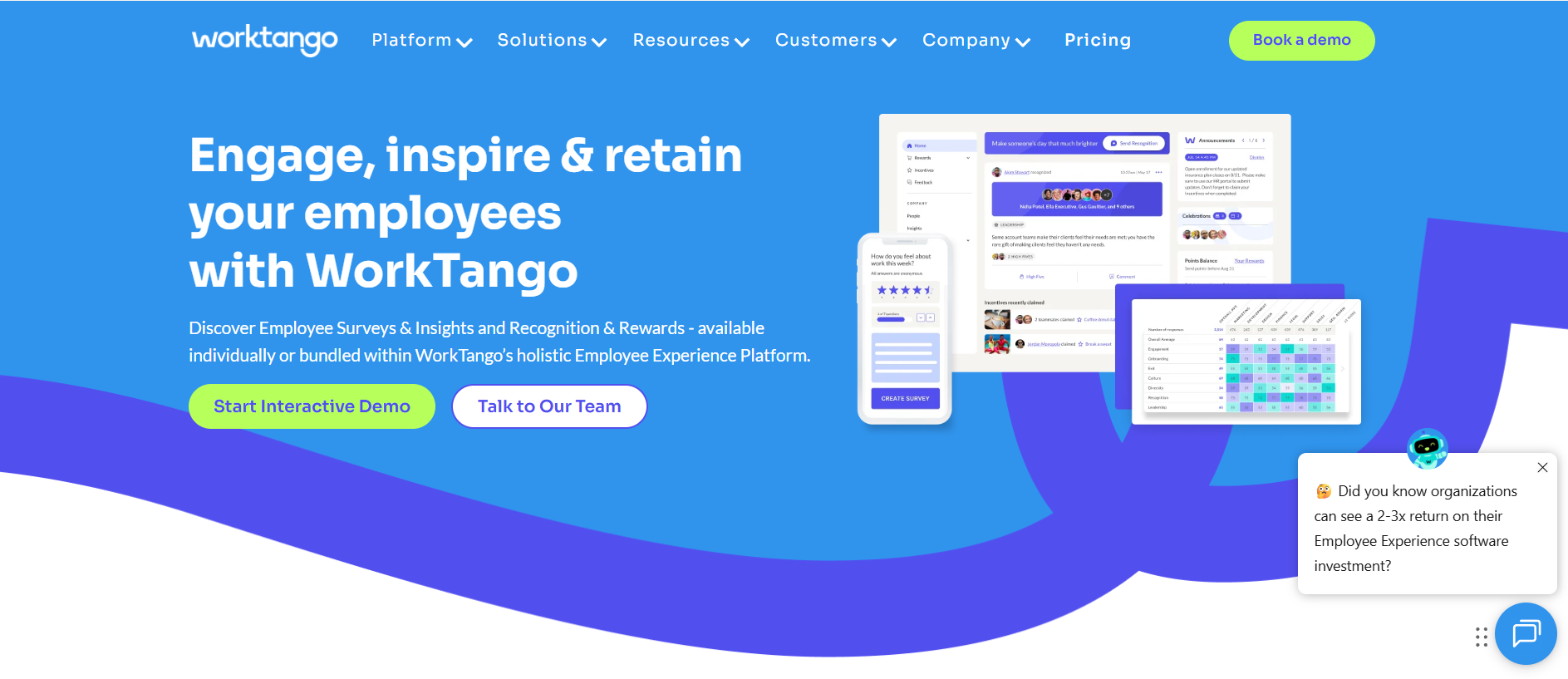
WorkTango’s Surveys & Insights product combines employee surveys, dashboards, open-text analysis and action planning.
Its current AI capabilities can summarize comments and group employee feedback into themes. Managers can then work with role-based results and action-planning workflows rather than simply receiving a static report.
That follow-through is the part I would pay attention to.
Many employee-listening programs do not fail because HR cannot calculate an engagement score. They fail because the report reaches managers and nothing changes.
WorkTango is therefore relevant when the organization wants survey analysis to move relatively quickly into manager-level follow-up.
Its survey workflows also support distributed workforces, including employee-access methods that do not rely entirely on a standard corporate inbox.
Pricing: WorkTango currently asks buyers to request pricing for Surveys & Insights and sells the product on an annual contract.
How Accurate Is AI Sentiment Analysis, Really?
There is no responsible universal percentage for the accuracy of AI sentiment analysis for employees.
Accuracy changes depending on the model, language, type of feedback, survey question, comment length, terminology and complexity of the interpretation being requested.
The more clearly defined the task, the easier it usually is for AI to perform well.
Identifying that a comment discusses career development is a fairly specific classification task.
Inferring that the employee is likely to resign because of career development is a much more complicated judgment.
Those should not be treated as the same level of inference.
AI is strongest at scale and first-pass classification
The clearest benefit is scale.
AI can process thousands of comments, apply a consistent initial coding approach and show which themes appear repeatedly.
That can remove a large amount of manual categorization.
It can also help counter a very human survey-analysis problem: memorable comments can dominate the discussion.
One angry paragraph may stick in an executive’s mind even if it represents one person’s experience. A less dramatic issue mentioned by hundreds of employees may deserve far more attention.
Automated analysis gives HR another way to understand frequency before choosing which examples make it into the leadership deck.
Context is where confidence should drop
Workplace language is full of ambiguity.
Consider:
“Another fantastic leadership announcement.”
Without context, that could be praise.
It could also be sarcasm.
Or:
“I love my team, but I can’t keep working these hours.”
One part is strongly positive. Another describes a serious workload problem.
A system that insists on producing one sentiment label for the entire comment is simplifying what the employee actually said.
Company language adds another challenge.
Words such as “bench,” “close,” “coverage,” “rotation” and “utilization” can carry very specific meanings inside different organizations. A model may understand the normal English definition and still misunderstand what the employee means at work.
A 2026 benchmark provides a useful reality check
A July 2026 benchmark from PYX Labs, a research initiative sponsored by Perceptyx, evaluated seven frontier AI models across 84 employee-listening tasks.
The reported overall pass rates ranged from 54% to 76%, with models performing better on more clearly defined themes and less consistently on nuanced, emotional and context-heavy interpretation.
Because the research initiative is sponsored by a vendor in this market, I would treat the benchmark as useful industry evidence rather than a universal independent certification of AI performance.
The practical lesson is still valuable:
Use AI more confidently for classification and pattern-finding. Increase human scrutiny as the system begins inferring cause, intent, emotion or individual risk.
Data Privacy and Employee Anonymity
This is the part I would design before choosing the AI model.
Employee feedback can contain names, health information, complaints about managers, allegations of discrimination, compensation concerns or descriptions of workplace conflict.
That makes an employee survey comment very different from a normal customer review.
Be precise about whether feedback is anonymous or confidential
Those words are often used interchangeably, but they aren’t the same.
An anonymous survey is designed so the response is not connected to an identifiable employee.
A confidential survey may retain employee attributes behind the scenes so HR can compare groups such as locations, tenure bands or departments while restricting what managers can see.
Confidential data can produce richer analysis.
It also requires stronger governance.
If the system retains employee-level attributes, telling employees the survey is “anonymous” simply because a manager cannot see their name can create an avoidable trust problem.
Explain how the survey works in plain language before employees respond.
Reporting thresholds reduce risk, but they do not guarantee anonymity
A minimum reporting threshold can stop a dashboard from showing results for a very small population.
That helps.
It does not eliminate contextual knowledge.
Imagine six people work on a specialist team. One employee was on leave and another joined after the survey opened.
Even if the dashboard meets its technical reporting threshold, a manager may have enough information to infer who wrote a distinctive comment.
That is why confidentiality requires more than one number.
HR should also consider whether demographic filters can be combined, whether verbatim comments should appear for small groups, who can access raw responses and when a population should be rolled into a larger reporting group.
Collect only data that improves the decision
Data minimization is particularly useful in employee listening.
If the objective is to understand workload differences between frontline and corporate employees, the survey may not need ten demographic fields attached to every comment.
Ask what each employee attribute genuinely enables HR to do.
Does exact tenure improve the analysis? Do managers really need raw comments? How long do written responses need to be retained?
The GDPR Article 5 principles provide a useful reference for purpose limitation, data minimization, storage limitation and appropriate security. The specific legal requirements will vary by jurisdiction, but the underlying design principle is useful globally: collect employee data for a defined reason and avoid collecting more simply because the system allows it.
Ask what happens when employee text reaches a generative AI model
This should be part of normal HR technology procurement in 2026.
The vendor should be able to explain which model processes employee text, where that processing happens, whether the model provider retains information, whether customer data is used for training and whether generative AI functionality can be disabled.
Also ask whether generated summaries follow the same confidentiality rules as the comments they summarize.
A system may correctly hide sensitive comments from a manager but undermine that protection if an AI-generated summary reveals what the small group said.
Privacy controls need to apply to the analysis layer, not only to the raw comments.
For organizations building a more formal AI governance approach, the NIST AI Risk Management Framework is a useful voluntary U.S. reference for thinking about reliability, transparency, privacy and accountability.
Do not quietly turn employee listening into employee surveillance
There is a significant difference between:
“We use AI to identify patterns in confidential engagement-survey responses.”
and:
“We analyze individual employee communication to determine who has a negative attitude.”
The second use case involves much greater privacy, fairness and employment risk.
For most HR teams, aggregate workforce listening is the safer and more useful starting point.
If an organization wants to move into passive monitoring or individual-level inference, that deserves its own legal, ethical and governance review rather than being treated as another feature inside an employee survey platform.
Turning AI Sentiment Analysis Into an HR Decision
The useful output is not:
“Sentiment is negative.”
That’s a description.
A stronger workflow moves from signal to evidence to interpretation to action.
| Stage | What HR should establish |
| Signal | What pattern did the analysis identify? |
| Evidence | Which survey results and comments support it? |
| Interpretation | What are the plausible explanations? |
| Action | What can the organization change, and how will progress be measured? |
Suppose the analysis finds increasingly negative sentiment around scheduling among frontline employees.
The first step is to check whether scheduling appears in structured survey results too and whether the problem is concentrated in particular locations.
Then read representative comments.
Employees may be objecting to unpredictable schedules, difficulty swapping shifts, insufficient notice or simple understaffing.
Those are all “scheduling problems,” but they require very different responses.
Only then should the organization decide what to change.
The follow-up measure might be another targeted pulse question or an operational measure such as shift-swap completion.
If employee feedback repeatedly points to internal communication problems, our Internal Communications ROI guide can help separate communication activity, employee outcomes and actual business impact.
Common Mistakes That Make Sentiment Analysis Less Useful
Reading an AI summary without checking the evidence
AI summaries are valuable because they are clean and fast.
That also makes them easy to over-trust.
If an executive report says:
“Employees are frustrated by unclear career progression.”
somebody should be able to answer:
How many comments support that? Which populations raised it? Did a related survey score move? What do representative comments actually say?
If those questions cannot be answered, the summary is not ready to become an executive conclusion.
Filtering until confidentiality disappears
The temptation is understandable.
A company-wide finding is too broad, so HR filters by division. Then location. Then shift. Then tenure.
Eventually the insight is more specific and much less confidential.
The boundaries for segmentation should be defined before managers begin exploring the dashboard, not after someone realizes a comment is identifiable.
Confusing frequency with severity
A theme mentioned 500 times deserves attention.
A serious allegation mentioned once may require a completely different response.
AI sentiment analysis is strong at finding recurring patterns. It should not become the only system an organization relies on to surface sensitive employee-relations concerns.
Collecting feedback faster than the organization can respond
AI can shorten the analysis cycle.
That does not automatically justify running more surveys.
If employees repeatedly answer pulses but never hear what changed, the organization may improve its listening technology while weakening trust in the listening process.
The right cadence is not “as often as the software allows.”
It is as often as the organization can reasonably listen, respond and show progress.
Frequently Asked Questions
What is AI employee sentiment analysis?
AI employee sentiment analysis is the use of artificial intelligence to analyze written employee feedback, identify recurring topics and assess the sentiment expressed around those topics.
Its biggest advantage is scale. It helps HR make sense of thousands of open-ended responses without manually coding every comment, while human reviewers remain responsible for checking important findings and understanding the workplace context.
How does AI analyze employee sentiment?
Most tools combine natural language processing with machine-learning or large-language-model techniques.
The software identifies what employees are discussing, groups related comments, evaluates sentiment around those themes and may generate summaries of the main patterns.
The quality of the result improves when the system has useful context, such as the survey question being answered.
What are the best AI tools for employee sentiment analysis in 2026?
Five platforms worth comparing are HubEngage, Culture Amp, Qualtrics EmployeeXM, Perceptyx and WorkTango.
They fit different types of listening programs. HubEngage connects survey analysis with communication and broader employee engagement. Culture Amp fits structured engagement programs. Qualtrics suits complex enterprise employee-experience environments. Perceptyx goes deeper into specialist open-text analysis, while WorkTango places more emphasis on manager follow-through after the survey.
How accurate is AI sentiment analysis for employee feedback?
It is generally more useful for pattern-finding than for high-stakes interpretation.
AI can identify recurring themes and summarize large comment sets quickly. It can still misunderstand sarcasm, mixed sentiment, culturally specific language and company terminology.
Important findings should therefore be checked against the underlying comments before HR presents them as conclusions.
Can AI analyze open-ended employee survey responses?
Yes. Open-ended survey analysis is one of the strongest uses of AI in employee listening.
The software can group written responses into themes, analyze sentiment, compare patterns across employee populations and summarize large comment sets.
That can reduce the manual coding workload considerably, but the system should still let HR inspect the employee language behind the summary.
What is the difference between sentiment analysis and employee engagement analytics?
Sentiment analysis focuses on the language employees use when describing their experience.
Employee engagement analytics is broader and may include favorable scores, engagement indices, participation, manager results, drivers and retention-related measures.
The two complement one another. Structured engagement data shows where the employee experience changed, while sentiment analysis can help HR understand what employees are saying about that change.
Is AI sentiment analysis safe for employee data?
It can be used responsibly, but the presence of an enterprise AI tool does not make an employee-listening program automatically safe.
Organizations still need a clear purpose, appropriate access controls, confidentiality or anonymity rules, retention policies, vendor due diligence and transparent communication with employees.
Privacy requirements also vary by jurisdiction and by how the analysis is being used.
Should HR analyze Slack or Teams messages for employee sentiment?
That should be treated as a separate decision from analyzing survey feedback.
Employees intentionally submit engagement-survey comments for workplace analysis. They may not have the same expectation about ordinary conversations with colleagues.
Passive communication analysis therefore introduces additional privacy, trust, labor and governance questions. For most organizations, transparent survey-based listening is the cleaner starting point.
Should companies score individual employee sentiment?
Individual sentiment scoring is substantially riskier than aggregated workforce analysis.
Turning an employee’s language into an attitude, loyalty or retention-risk score can create privacy and fairness concerns, particularly if the inference influences performance, promotion, compensation or other employment decisions.
For most listening programs, understanding patterns across groups is a safer and more useful objective.
Final Take
AI employee sentiment analysis solves a practical HR problem: organizations can now collect more written employee feedback than their teams can realistically analyze by hand.
The technology is useful when it organizes that feedback, surfaces repeated themes and helps HR decide where to investigate.
It becomes much less reliable when it is asked to infer exactly what an individual employee means, why they feel that way or what they are likely to do next.
The strongest implementation keeps the division of labor clear.
Let AI handle more of the first-pass classification and summarization. Let people validate the evidence, protect employee confidentiality, understand the organizational context, and decide what should change.
Use AI to find the signal. Keep people responsible for the judgment.