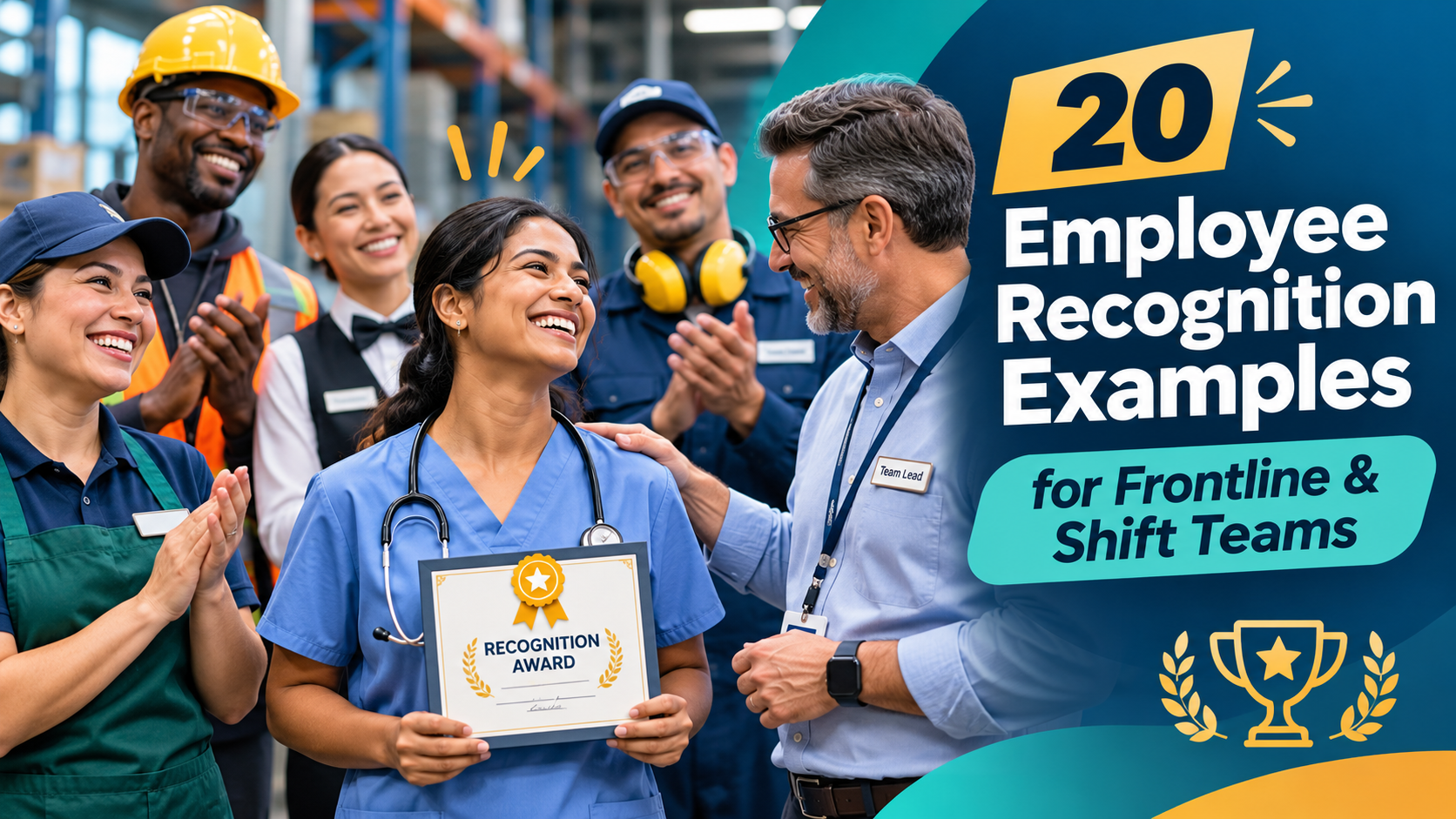
The most useful employee recognition examples for frontline workers are specific, timely, and accessible across every shift. They include thanking warehouse employees for preventing shipping errors, recognizing nurses for supporting colleagues, celebrating retail associates who handle difficult customer situations, and acknowledging night-shift teams whose contributions may otherwise go unnoticed.
Recognition does not always require financial rewards, expensive software, or formal ceremonies. A thoughtful message from a supervisor can be meaningful when it acknowledges a genuine contribution and explains why it mattered.
For larger or distributed workforces, platforms such as HubEngage can support peer recognition, milestone celebrations, and employee rewards across multiple communication channels. However, technology should make appreciation easier to deliver, not replace personal recognition.
This guide provides 20 practical frontline employee recognition examples, ready-to-use appreciation messages, industry-specific scenarios, monetary and non-monetary options, and guidance for creating fair recognition programs across rotating shifts.
Key Takeaways
- Recognize specific actions. Explain what the employee accomplished and why the contribution mattered to coworkers, customers, patients, safety, quality, or operations.
- Include every shift. Night, weekend, part-time, and rotating-shift employees need comparable opportunities for appreciation.
- Use different recognition methods. Verbal appreciation, handwritten notes, peer recognition, development opportunities, and financial rewards serve different purposes.
- Respect employee preferences. Some employees appreciate public celebrations, while others prefer private acknowledgment.
- Measure fairness and quality. Track who receives recognition and whether employees find it meaningful, rather than focusing only on award counts.
What Is Employee Recognition, and Why Does It Matter for Frontline Teams?
Employee recognition is the practice of acknowledging an employee’s contributions, achievements, effort, or positive workplace behavior.
Recognition may come from supervisors, colleagues, senior leaders, or customers. It can take the form of verbal appreciation, written feedback, public acknowledgment, development opportunities, or financial rewards.
For frontline employees, recognition has particular operational importance.
Retail associates, nurses, manufacturing operators, warehouse employees, hospitality staff, and other deskless workers often perform essential tasks outside conventional office environments. Their contributions may be visible only to the people working alongside them.
Consider a warehouse employee who notices a damaged pallet before it enters the loading process. The employee reports the hazard, follows the appropriate procedure, and helps prevent an unsafe situation.
That contribution may never reach senior management unless the organization has a process for recognizing important work across shifts.
The same principle applies when a nurse supports an inexperienced colleague, a retail associate resolves a customer complaint, or a manufacturing employee identifies a quality problem before additional products are affected.
Recognition makes these contributions visible and helps communicate which workplace behaviors the organization values.
What Does Research Show About Employee Recognition?
Research provides useful context for designing recognition programs, although it does not establish that recognition alone causes improvements in retention, productivity, or employee engagement.
A 2024 Gallup and Workhuman study tracked nearly 3,500 employees between 2022 and 2024.
Researchers reported that employees who received high-quality recognition were 45% less likely to have changed organizations over the two years than employees who were not well recognized.
This was an observed relationship across the study population, not proof that recognition independently caused lower turnover or that the same result applies to every frontline workforce.
A separate UKG global frontline workforce study, published in October 2024, found that 19% of frontline employees surveyed said their managers never recognized them.
The research involved nearly 13,000 frontline employees and managers across 11 countries. The result should therefore be understood as a global survey finding rather than a US-specific statistic.
The O.C. Tanner State of Employee Recognition 2025 report, based on a survey of 2,815 people across five countries and additional focus-group research, emphasized the importance of authentic, personalized recognition and human connection.
Together, these findings support a practical approach: organizations should make meaningful recognition part of everyday management while continuing to address other factors that affect employee experience, including compensation, scheduling, workload, and working conditions.
20 Practical Employee Recognition Examples for Frontline and Shift Teams
The following examples reflect situations that frontline managers may encounter in retail, healthcare, hospitality, manufacturing, logistics, and other shift-based operations.
Each example includes a workplace situation, a recognition method, and an appreciation message that managers can adapt.
The scenarios are illustrative. They should not be presented as documented employee incidents or organizational case studies.
1. Mobile Peer-to-Peer Recognition Across Different Shifts
Peer-to-peer recognition allows employees to appreciate colleagues whose contributions supervisors may not directly observe.
It is particularly useful in organizations where employees work different shifts, locations, or departments.
For example, a warehouse employee on the evening shift may want to recognize a morning-shift colleague who organized a complicated shipment and documented outstanding tasks clearly.
Organizations can support this appreciation through physical recognition boards, written nominations, or digital employee recognition platforms.
HubEngage example: The HubEngage Employee Recognition Hub offers vendor-described capabilities including customizable recognition programs, milestone celebrations, points-based rewards, and employee recognition features.
HubEngage also advertises communication through web, mobile apps, SMS, email, and digital displays, which may be useful for distributed and deskless teams.
Organizations should confirm which recognition features are available through each channel, along with licensing, access requirements, and implementation costs.
Example appreciation message:
Thank you for organizing the outgoing shipments and documenting the outstanding orders before our shift started. Your preparation helped us begin work with clear priorities and fewer questions.
Best for: Warehousing, manufacturing, retail chains, healthcare, and multisite operations.
The essential requirement is accessibility. Employees should be able to recognize colleagues without depending on an office computer or corporate email account.
2. Recognize Employees During Daily Shift Huddles
A short acknowledgment during an existing shift huddle is a practical non-monetary recognition method.
Supervisors can recognize employees for helping coworkers, identifying operational issues, improving communication, or delivering thoughtful customer service.
For example, a grocery store employee may help reorganize checkout lines during an unexpectedly busy period.
The supervisor can acknowledge that contribution during the next scheduled team briefing.
Example appreciation message:
I want to recognize how you handled yesterday’s checkout rush. You communicated clearly with customers, helped the team coordinate the lines, and kept the situation organized. That made a difficult period easier for everyone.
Best for: Retail stores, restaurants, hotels, distribution centers, and manufacturing facilities.
Keep recognition brief and genuine. Not every shift huddle needs a formal award or public announcement.
Employees who prefer private feedback should have that option.
3. Thank Employees for Accurate Shift Handovers
Effective shift handovers involve communicating unfinished work, safety concerns, equipment conditions, customer needs, and operational priorities.
Recognizing accurate handovers reinforces the importance of communication between teams.
Imagine a manufacturing operator who identifies an equipment issue, documents the relevant operating restrictions, and clearly communicates the situation to the incoming shift.
Even when the equipment problem remains unresolved, the employee’s careful communication deserves acknowledgment.
Example appreciation message:
Your handover included the equipment status, outstanding maintenance concerns, and the actions the next team needed to follow. That gave everyone a clear picture of the situation and helped prevent confusion.
Best for: Manufacturing, healthcare, logistics, security, utilities, and 24-hour operations.
Recognition should complement established handover procedures, not substitute for required documentation or accountability.
For practical guidance, see TurnOnWork’s article on shift handover communication, formats, and templates.
4. Create Dedicated Night-Shift Recognition Opportunities
Night-shift employees can miss celebrations, leadership visits, and recognition announcements scheduled around daytime working hours.
A more equitable approach is to recognize night teams during their scheduled shifts.
For example, a hospital could arrange for a night-shift supervisor to acknowledge employees during an overnight team briefing rather than expecting them to attend a morning ceremony after completing their work.
Example appreciation message:
Your team handled a demanding overnight workload while maintaining clear communication and supporting one another. We recognize the care and coordination required to keep the unit operating throughout the night.
Best for: Hospitals, hotels, distribution centers, security operations, and 24-hour manufacturing facilities.
Fair recognition does not require identical ceremonies. It requires comparable opportunities, meaningful acknowledgment, and equitable access to rewards.
Recognition activities should also respect rest periods.
The CDC’s National Institute for Occupational Safety and Health explains that work-related fatigue can be associated with nonstandard schedules, including night shifts and extended working hours.
Employers should avoid creating recognition activities that unnecessarily interfere with employees’ recovery time.
5. Recognize Employees Who Make Responsible Safety Decisions
Safety recognition should acknowledge employees who identify hazards, follow procedures, and report potentially unsafe conditions.
For example, a manufacturing employee might notice missing machine guarding and stop the affected operation in accordance with the facility’s safety procedures.
The manager can recognize the employee for reporting the problem and following the established response process.
Example appreciation message:
Thank you for reporting the missing guard and stopping the affected operation until the issue could be addressed. Your decision demonstrated the safety judgment we expect from everyone on the team.
Best for: Manufacturing, construction, warehousing, transportation, and industrial operations.
Avoid designing recognition programs that depend exclusively on injury-free periods or low reported incident numbers.
Such incentives can unintentionally discourage employees from reporting injuries or hazards.
The Occupational Safety and Health Administration recommends encouraging safe practices and worker participation without penalizing injury reporting.
Appropriate recognition may focus on hazard identification, near-miss reporting, safety training, and participation in preventive improvements.
6. Celebrate Manufacturing Employees Who Catch Quality Problems
Manufacturing recognition should reflect quality, teamwork, process discipline, and operational judgment rather than rewarding production speed alone.
Suppose an assembly-line operator discovers that a component does not match the required specification.
The employee escalates the discrepancy before additional units are processed, allowing the team to investigate.
Example appreciation message:
You noticed the component mismatch during inspection and raised it before production continued. Your attention to the specification helped the team address the issue at the right stage.
Best for: Assembly plants, food production, pharmaceutical manufacturing, and industrial operations.
Recognizing careful inspection can reinforce quality expectations.
However, managers should avoid comparing employees solely by the number of defects they discover. Workers may encounter different defect rates because of equipment, materials, production processes, or assigned tasks.
Recognition should account for the employee’s judgment and adherence to established procedures.
7. Appreciate Warehouse Employees for Accurate, Safe Coordination
Warehouse operations depend on accuracy, communication, safety, and coordination among employees.
For example, an associate may identify an incorrect shipment label, contact inventory control, and help resolve the discrepancy before dispatch.
This work may not appear in a productivity leaderboard, but it contributes to reliable operations.
Example appreciation message:
Thank you for catching the shipment-label discrepancy and working with inventory control to resolve it before dispatch. Your careful review helped the team avoid sending an incorrect order.
Best for: Warehouses, fulfillment centers, third-party logistics providers, and distribution operations.
Recognition programs should balance productivity with safety and accuracy.
Employees should not feel pressured to skip checks, rush physically demanding tasks, or overlook potential hazards to qualify for rewards.
8. Recognize Retail Employees Who Handle Difficult Customer Situations
Retail employees frequently deal with returns, customer complaints, product questions, and unexpected service problems.
Meaningful recognition can acknowledge an employee who stays professional during a difficult interaction, explains available options, and involves a supervisor when necessary.
Consider an associate handling a disputed product return.
The associate calmly explains the store policy, offers permitted alternatives, and requests management support when the situation requires additional authority.
Example appreciation message:
You remained professional during a difficult return conversation, explained the available options clearly, and involved the supervisor when needed. You handled the situation with patience and good judgment.
Best for: Grocery stores, supermarkets, specialty retailers, pharmacies, and large retail chains.
Recognition should reinforce respectful customer service without suggesting that employees must tolerate threats, harassment, or abusive behavior.
Employees should be supported when they need to seek help or disengage from an unsafe situation.
9. Recognize Healthcare Employees for Compassionate Teamwork
Healthcare recognition should acknowledge patient-centered behavior, professional judgment, communication, and support for colleagues.
For example, an experienced nurse may help a new team member understand a unit-specific workflow during a demanding shift.
The nurse provides guidance, checks the colleague’s understanding, and helps maintain continuity of care.
Example appreciation message:
Thank you for helping your colleague navigate the unit workflow during a demanding shift. You made time to explain the process clearly while maintaining attention to patient care.
Best for: Hospitals, clinics, long-term care facilities, and outpatient centers.
Healthcare recognition must respect patient confidentiality and applicable privacy requirements.
Avoid including patient names, diagnoses, identifiable treatment details, or other protected information in public announcements or digital recognition tools.
Managers should also avoid presenting teamwork recognition as a substitute for appropriate staffing and clinical support.
10. Celebrate Hospitality Employees Who Support Other Departments
Hospitality employees rely on cooperation across housekeeping, front desk operations, food service, maintenance, and guest services.
Recognizing cross-department contributions helps employees understand how their work supports the broader guest experience.
For example, a hotel housekeeping employee may identify a maintenance issue during a room inspection and promptly notify the appropriate department before the next guest arrives.
Example appreciation message:
Thank you for identifying the room issue during your inspection and alerting maintenance before the next check-in. Your attention to detail supported a smoother experience for the arriving guest.
Best for: Hotels, resorts, restaurants, event venues, and hospitality groups.
Recognition should reflect the employee’s actual contribution.
Avoid attributing an entire guest-service outcome to one employee when several departments were responsible.
11. Recognize Behind-the-Scenes Employees
Highly visible roles often receive more recognition because managers and customers see their work directly.
Employees responsible for sanitation, preventive maintenance, inventory preparation, equipment setup, and facility support may receive less attention despite their important contributions.
Consider a sanitation employee who follows the required cleaning procedures and prepares a production area for the next shift.
The work supports safe, reliable operations even though senior managers or customers may rarely observe it.
Example appreciation message:
Your careful preparation of the production area helped the next team begin with the equipment and workspace ready for use. Thank you for the consistency and attention you bring to this responsibility.
Best for: Manufacturing, healthcare, hospitality, warehousing, and facilities management.
Managers should periodically review whether recognition disproportionately favors customer-facing employees or teams that interact frequently with leadership.
12. Appreciate Employees Who Mentor New Hires
Experienced frontline employees often help new colleagues understand workplace procedures, responsibilities, and team expectations.
Recognition can acknowledge the patience, knowledge sharing, and communication involved.
For example, a warehouse associate assigned as an onboarding buddy may demonstrate inventory scanning procedures, explain how to report discrepancies, and encourage a new employee to ask questions.
Example appreciation message:
Thank you for supporting our new team member during onboarding. You explained the scanning procedure, checked their understanding, and made sure they knew where to find help.
Best for: Warehousing, retail, healthcare, manufacturing, and hospitality.
Mentoring responsibilities should be reflected appropriately in workload and staffing plans.
Recognition is valuable, but it should not be used to justify substantial additional responsibilities without adequate time, training, or support.
13. Celebrate Training Completion and Skill Development
Employees who complete relevant training contribute to the organization’s long-term capability.
Recognition may acknowledge approved equipment training, professional development, role-specific qualifications, or other verified learning milestones.
For example, a distribution center employee may complete the training and authorization requirements for operating a particular type of equipment.
Example appreciation message:
Congratulations on completing your equipment training and authorization requirements. Your preparation and commitment to learning have expanded the work you are qualified to perform.
Best for: Manufacturing, logistics, healthcare, retail, and other skill-based frontline environments.
Training recognition must reflect a verified accomplishment.
A recognition badge or appreciation message does not replace required licensing, certification, supervision, competency assessment, or equipment authorization.
14. Introduce Peer-Nominated Recognition Awards
Peer nominations allow employees to recognize contributions that supervisors may not directly observe.
Organizations can introduce monthly or quarterly recognition for teamwork, problem-solving, customer care, safety participation, or knowledge sharing.
For example, colleagues may nominate an experienced employee who consistently helps new team members understand receiving procedures.
Example appreciation message:
Your colleagues nominated you for consistently helping new team members understand the receiving process and answering questions during busy periods. They appreciate your patience and willingness to share your experience.
Best for: Multisite retail companies, healthcare organizations, manufacturing facilities, and distributed frontline teams.
A fair nomination process should include clear eligibility requirements and consistent selection criteria.
Ask employees to describe the contribution rather than simply nominate a popular colleague.
Avoid relying entirely on vote totals. Employees on larger shifts or with broader social networks may otherwise have an advantage.
15. Write Personalized Employee Appreciation Notes
A handwritten thank-you note remains a practical recognition method, particularly when employees do not regularly use workplace communication platforms.
A supervisor can deliver a card personally or leave it in an appropriate, secure location.
The value comes from acknowledging a real contribution rather than distributing generic messages.
Example appreciation message:
I appreciated how you helped the new associate understand the inventory process this week. You made time to answer questions while keeping your own work organized. Thank you for being someone the team can learn from.
Best for: Small businesses, retail stores, restaurants, healthcare teams, and local operating sites.
Personal notes can be particularly appropriate for employees who prefer private appreciation.
They can also provide a meaningful alternative when public recognition is unsuitable.
16. Ask Senior Leaders to Recognize Frontline Employees Directly
Recognition from senior leadership can connect everyday operational contributions with organizational priorities.
Plant managers, hospital administrators, regional retail directors, and operations executives can acknowledge employees during scheduled workplace visits.
For example, a regional manager may recognize a retail associate who helped colleagues adapt to a revised stockroom process.
Example appreciation message:
I heard about the work you did to help your team adopt the new stockroom process. Your explanations and practical feedback helped colleagues understand the changes. I appreciate your contribution.
Best for: Large organizations, regional management structures, and distributed operations.
Leadership recognition should include evening, weekend, and night teams where practical.
Otherwise, senior-management visibility may become another advantage concentrated among daytime employees.
Recognition from executives should also remain specific and credible rather than becoming a ceremonial exercise.
17. Recognize Employees Whose Suggestions Improve Workflows
Frontline employees frequently observe operational problems that may be less visible to managers working outside the process.
Their suggestions can help organizations identify opportunities to improve safety, quality, customer service, and daily workflows.
Imagine a retail employee suggesting clearer labels for replenishment carts.
The manager reviews the idea, tests it with the team, and adopts the change if it proves useful.
Example appreciation message:
Thank you for suggesting a clearer way to label replenishment carts. Your idea gave the team a practical improvement to test, and we appreciate you taking the initiative to raise it.
Best for: Retail, manufacturing, hospitality, healthcare, and warehouse operations.
Not every suggestion will be adopted.
Managers can still acknowledge thoughtful contributions and explain why ideas were accepted, modified, or declined.
Recognition becomes more credible when employees also receive feedback about what happened to their suggestions.
18. Celebrate Work Anniversaries With Meaningful Contributions
Service anniversaries offer an opportunity to recognize employee commitment and experience.
However, messages that focus only on years of service may feel impersonal.
Where possible, acknowledge the employee’s contributions during that period.
For example, a manufacturing employee celebrating five years with the organization may have supported onboarding, trained new operators, and helped colleagues understand operational changes.
Example appreciation message:
Congratulations on five years with the team. During that time, you have helped train new operators, shared your process knowledge, and supported colleagues through several operational changes. We appreciate the experience you bring to the team.
Best for: Organizations with frontline, shift-based, or hourly employees.
Part-time workers should not be overlooked when designing milestone programs.
Where anniversary rewards are offered, communicate how service dates, breaks in service, employee eligibility, and award values are determined.
19. Offer Employee-Choice Recognition Rewards
Financial or tangible rewards can complement recognition for significant achievements, formal awards, and workplace milestones.
Depending on the organization’s policies, available rewards might include gift cards, cash bonuses, paid time off, or approved development opportunities.
Employees may value these options differently.
One employee may prefer a practical gift card, while another might place greater value on a development opportunity or additional approved paid leave.
Example appreciation message:
Your contribution to improving the inventory process made a meaningful difference to the team. We would like to recognize that work through our employee award program and give you a choice among the available rewards.
Best for: Organizations with structured recognition budgets and consistent reward policies.
Employee-choice programs require clear rules.
Reward eligibility, value, and availability should be equitable across comparable roles and shifts.
Paid leave must be coordinated with scheduling requirements and applicable policies.
In the United States, the IRS’s 2026 Employer’s Tax Guide to Fringe Benefits explains that cash and cash-equivalent rewards, including gift cards, generally cannot be excluded from wages as de minimis fringe benefits, regardless of their small value.
Other types of employee awards may have different tax treatment.
Payroll and tax professionals should review specific reward arrangements.
20. Celebrate Collective Achievements Across Every Shift
Many frontline outcomes depend on cooperation among several teams rather than one employee.
Collective recognition can acknowledge that shared responsibility.
For example, a distribution facility may complete an important seasonal transition through coordination among receiving, inventory control, picking, packing, and dispatch teams.
Managers can recognize the achievement through team messages, shift-level celebrations, or an approved shared reward.
Example appreciation message:
Thank you to the receiving, inventory, picking, packing, and dispatch teams for coordinating the seasonal transition. Each shift contributed to the preparation, communication, and execution that allowed the work to move forward.
Best for: Distribution centers, hospitals, manufacturing sites, retail chains, and hospitality operations.
Make celebrations accessible to employees on every shift.
If daytime employees receive a catered lunch, other shifts should receive a genuinely comparable benefit rather than leftovers or an invitation requiring attendance outside their normal working hours.
Which Employee Recognition Methods Work Best for Different Frontline Teams?
The right recognition method depends on the contribution, employee preferences, organizational budget, and communication channels available to the workforce.
| Recognition method | Typical cost | Best use | Important consideration |
|---|---|---|---|
| Verbal appreciation during shifts | No direct reward cost | Immediate acknowledgment of everyday contributions | Must reach employees across shifts |
| Handwritten thank-you notes | Low | Mentoring, individual achievements, and consistent work | Messages should be specific and appropriately delivered |
| Mobile or SMS recognition | Software or messaging costs may apply | Distributed and deskless employees | Device access, privacy, notification timing, and licensing |
| Peer-nominated recognition | Low to moderate | Teamwork and contributions supervisors may miss | Transparent nomination and selection rules |
| Digital displays or recognition boards | Low to moderate, depending on infrastructure | Shared achievements and approved public recognition | Privacy and visibility across locations |
| Skills and development opportunities | Varies | Training achievements and career progression | Equitable eligibility and scheduling |
| Gift cards and financial spot awards | Monetary budget required | Significant achievements and formal awards | Tax treatment, eligibility, and reward value |
| Team celebrations | Varies | Shared operational milestones | Comparable access for every shift |
Most organizations will benefit from combining several approaches.
For example, a supervisor may thank an employee immediately after observing a useful contribution, share the achievement with the wider team when appropriate, and reserve financial awards for accomplishments that meet documented criteria.
This allows everyday appreciation to continue without making every recognition moment dependent on a reward budget.
How to Choose the Right Recognition Method
Before recognizing an employee, managers can consider four questions:
- What happened? Identify the specific contribution rather than relying on general impressions.
- Who should acknowledge it? Decide whether the most meaningful source is a supervisor, colleague, department leader, or senior executive.
- How should it be delivered? Consider a personal conversation, handwritten note, shift briefing, digital message, or formal award.
- What does the employee prefer? Choose an appropriate level of visibility and avoid unnecessary public attention.
For everyday contributions, a personal acknowledgment may be sufficient.
For verified milestones or significant achievements, a formal recognition process may be more appropriate.
Ready-to-Use Employee Appreciation Messages for Frontline Workers
Managers often recognize good work but struggle to express appreciation without sounding generic.
A useful message names the contribution, describes its impact, and explains why it mattered.
The following examples can be adapted for shift huddles, appreciation cards, employee apps, team announcements, and formal recognition programs.
| Employee group or situation | Employee appreciation message |
|---|---|
| Retail employee | “Thank you for helping customers navigate the busy checkout period while keeping communication clear and respectful. Your patience helped the team manage the rush.” |
| Manufacturing worker | “Your attention during the quality check helped us identify the issue before more units were processed. We appreciate your careful work.” |
| Warehouse associate | “You noticed the incorrect shipping information and worked with the team to correct it. Thank you for taking the time to get the details right.” |
| Nurse or healthcare employee | “Thank you for supporting your colleagues during a demanding shift and maintaining thoughtful communication throughout patient care.” |
| Restaurant employee | “You helped the team coordinate orders during a particularly busy service period. Your communication and support made the work easier for your colleagues.” |
| Night-shift worker | “The preparation and documentation you completed overnight gave the morning team a clear starting point. Your contribution deserves recognition.” |
| New employee | “You have made consistent progress in learning the procedures and asking thoughtful questions. We appreciate your commitment to doing the work correctly.” |
| Experienced mentor | “Thank you for sharing your experience with newer colleagues and helping them build confidence in their responsibilities.” |
| Safety-conscious employee | “Your decision to raise the safety concern showed good judgment and helped the team address the issue appropriately.” |
| Employee completing training | “Congratulations on completing your training. The effort you invested in developing these skills is appreciated.” |
| Employee supporting another department | “Thank you for responding to the other team’s request and helping resolve the issue. Your cooperation made the process easier for everyone involved.” |
| Long-serving employee | “We appreciate the experience, knowledge, and steady contributions you have brought to the team throughout your time here.” |
These messages are templates, not descriptions of verified workplace incidents.
Managers should adjust them to reflect contributions they observed or can reliably confirm.
For additional examples, see TurnOnWork’s positive feedback examples for managers.
How Can Managers Make Recognition Fair Across Different Shifts?
Fair recognition requires more than offering the same employee recognition program to everyone.
Organizations should examine whether employees working different schedules have comparable opportunities to be noticed, nominated, acknowledged, and rewarded.
A company may technically provide recognition opportunities to its entire workforce while unintentionally favoring daytime employees.
This can happen when leadership visits take place during business hours, award ceremonies occur in the morning, or nominations are distributed primarily through corporate email.
Several changes can help address these problems.
Give Every Shift a Clear Recognition Responsibility
Managers should know who is responsible for acknowledging employees on each shift.
In a three-shift manufacturing operation, each supervisor might recognize contributions within their own team.
The plant manager or HR department can then review recognition activity across all shifts to identify gaps.
This is more dependable than expecting a daytime HR coordinator to discover every important contribution across the facility.
Use Consistent Eligibility Criteria
Formal recognition programs should have clear eligibility and award requirements.
If an organization recognizes teamwork, safety participation, quality, or customer service, the underlying criteria should be consistent across comparable positions.
However, the evidence used to assess contributions may differ by role.
A warehouse employee may demonstrate quality through shipment accuracy, while a retail associate may demonstrate it through careful inventory handling.
Both contributions can reflect the same organizational value without requiring identical performance metrics.
Offer Recognition Through Accessible Channels
Employees have different levels of access to workplace technology.
Some have company phones, corporate email accounts, and regular computer access. Others rely on shared devices, supervisor communication, printed materials, or approved mobile applications.
Recognition programs should account for those differences.
Possible options include personal conversations, recognition cards, employee noticeboards, shared displays, and approved digital platforms.
Do not assume employees must or will use personal phones for workplace activities.
Device requirements, accessibility, data protection, and any compensable time should be reviewed with the appropriate internal teams.
Respect Public and Private Recognition Preferences
Public recognition can be meaningful for employees who enjoy celebrating achievements with colleagues.
Others may prefer a personal conversation or private written acknowledgment.
Managers should ask about employee preferences where practical.
Private recognition is particularly appropriate when the contribution involves sensitive employee circumstances, protected information, or other details unsuitable for public discussion.
Review Recognition Across Shifts
HR should review recognition participation and recipient coverage by shift, role, location, and manager.
If one shift consistently receives more recognition, examine possible explanations.
These may include differences in workforce size, actual contribution opportunities, managerial participation, recognition-channel access, or inconsistent application of program rules.
The goal is not necessarily identical award totals.
It is a fair process with comparable access and defensible selection criteria.
The TurnOnWork SHIFT Framework for Meaningful Frontline Recognition
Recognition can become ineffective when organizations focus on award distribution without considering whether the appreciation is specific, inclusive, or meaningful.
The TurnOnWork SHIFT Framework is an editorial checklist for evaluating frontline recognition practices.
It is a practical framework presented in this article, not a validated research instrument or established industry standard.
SHIFT: Five Checks Before Recognizing an Employee
| Step | Principle | Practical question |
|---|---|---|
| S — See the contribution | Identify a real, observable action | What did the employee actually do? |
| H — Highlight its impact | Explain the contribution’s value | How did the action help coworkers, customers, safety, quality, or operations? |
| I — Include every shift | Make recognition accessible | Could employees on other shifts receive comparable recognition? |
| F — Fit the employee | Respect individual preferences | Is the channel, visibility, and reward appropriate? |
| T — Track and improve | Review recognition quality and fairness | Who receives recognition, and what needs to change? |
How the SHIFT Framework Works in Practice
Consider a hypothetical distribution center where a night-shift employee identifies an incorrect shipping label and helps prevent an order from leaving with inaccurate documentation.
See the contribution: The supervisor confirms that the employee discovered the discrepancy and followed the appropriate correction procedure.
Highlight its impact: The supervisor explains that the employee’s attention helped the team avoid a shipping error.
Include every shift: Management ensures that the employee receives acknowledgment during their scheduled hours rather than being excluded from a daytime recognition event.
Fit the employee: The supervisor considers whether the employee prefers private appreciation or a public team announcement.
Track and improve: HR reviews recognition activity to determine whether employees making similar contributions receive comparable acknowledgment across shifts.
The recognition itself may take only a minute.
The framework helps managers ensure that the process behind that moment is credible, accessible, and fair.
How to Build an Employee Recognition Program for Frontline Workers
An effective recognition program should fit the organization’s existing operating routines.
Recognition becomes easier to maintain when managers incorporate it into shift briefings, handovers, employee development, onboarding, and regular communication.
The following four-week rollout is an illustrative implementation plan, not a research-backed guarantee of results.
Week 1: Understand the Workforce and Recognition Gaps
Begin by examining how employees currently receive recognition.
Review workforce schedules, job categories, locations, existing award programs, and access to communication channels.
Ask employees whether they feel appreciated, which recognition methods they prefer, and whether they believe recognition is distributed fairly.
HR should also identify roles and shifts that may be overlooked.
For example, a hospital might discover that formal recognition is concentrated in day-shift departments because senior leaders visit during conventional business hours.
A distribution center may find that employees without corporate email accounts rarely participate in digital nomination programs.
These observations can guide the initial program design.
Week 2: Introduce Everyday Manager Recognition
Give supervisors practical guidance on recognizing work-related contributions.
For manufacturing teams, useful categories may include safety reporting, quality, teamwork, and knowledge sharing.
For retail teams, categories might include customer care, inventory accuracy, responsible problem-solving, and support for colleagues.
Managers should acknowledge genuine contributions when they occur rather than distributing praise mechanically to satisfy a quota.
Recognition should fit naturally into normal conversations, shift huddles, and team communication.
The objective is to improve acknowledgment, not create another administrative reporting task.
Week 3: Add Peer Recognition and Cross-Shift Visibility
Introduce a straightforward method for employees to recognize colleagues.
Possible approaches include paper nominations, recognition cards, approved digital tools, or an employee app.
Keep the nomination process simple.
Employees should be able to explain what a coworker did and why it mattered without completing lengthy forms.
Where public recognition is appropriate, distribute selected acknowledgments through channels accessible to all shifts.
Before implementing recognition technology, define participation rules, employee access requirements, privacy controls, and reward eligibility.
For more detailed guidance, see TurnOnWork’s guide to choosing an employee recognition platform.
Week 4: Review Participation and Adjust the Program
Review which employees and teams received recognition, which supervisors participated, and whether the messages were meaningful.
Compare recognition coverage using the number of eligible employees in each shift or location rather than relying only on raw counts.
Gather feedback from employees who did not participate as well as those who received recognition.
High activity does not necessarily mean a program is equitable.
An organization might distribute hundreds of recognition messages while repeatedly overlooking night-shift workers, part-time employees, or support functions.
Use the findings to refine the process before expanding it.
How Often Should Frontline Employees Receive Recognition?
Employees should receive recognition regularly enough that meaningful contributions are acknowledged while they are still relevant.
There is no universal recognition frequency suitable for every employee, job, or organization.
Everyday appreciation can happen during normal work whenever someone makes a contribution worth recognizing.
Formal awards may occur monthly or quarterly, while service anniversaries and training achievements happen at specific milestones.
A practical starting cadence is:
| Frequency | Suggested recognition activity | Purpose |
|---|---|---|
| Daily, when warranted | Brief personal acknowledgment during normal work | Recognize genuine contributions close to when they occur |
| Weekly | Shift huddle acknowledgments or peer appreciation | Surface contributions that colleagues or supervisors may otherwise miss |
| Monthly | Review nominations and manager recognition patterns | Provide broader visibility and examine fairness |
| Quarterly | Review program performance and formal awards | Assess participation, quality, employee feedback, and accessibility |
| Annually or at milestones | Service anniversaries and development recognition | Acknowledge long-term contributions and verified achievements |
This schedule is a suggested management model, not an industry benchmark.
Managers should avoid manufacturing recognition moments to meet an arbitrary target.
The more useful question is whether valuable contributions are being acknowledged consistently, appropriately, and without favoritism.
How Do You Measure the Effectiveness of Frontline Employee Recognition?
The number of awards distributed does not establish whether a recognition program is effective.
An organization may send hundreds of messages while a large portion of employees receive no recognition.
Another organization may distribute fewer awards but achieve more balanced participation across different roles and schedules.
HR should therefore examine recognition coverage, participation, timing, quality, employee perceptions, and relevant organizational outcomes.
Recognition Metrics Worth Tracking
| Metric | How to measure it | What it reveals |
|---|---|---|
| Recognition coverage | Unique employees recognized ÷ eligible employees × 100 | Whether acknowledgment reaches the workforce |
| Recognition participation | Unique employees giving recognition ÷ eligible participants × 100 | Whether employees and managers actively participate |
| Recognition frequency | Number of recognition events during a defined period | How often recognition occurs |
| Recognition timing | Time between a documented contribution and acknowledgment | Whether recognition is reasonably timely |
| Shift-level coverage | Calculate recognition coverage separately for each shift | Whether particular schedules are overlooked |
| Recognition quality | Review a sample of messages for specificity, authenticity, and relevance | Whether recognition reflects meaningful contributions |
| Employee perception | Confidential employee feedback about appreciation and fairness | Whether employees feel appropriately recognized |
| Business outcomes | Examine retention, turnover, quality, and other measures alongside recognition data | Whether trends merit further investigation |
These are suggested management measures, not validated recognition-effectiveness benchmarks.
Example: Calculate Recognition Coverage
Suppose a distribution center has 240 eligible employees.
During 30 days, 156 different employees receive at least one recognition message.
Recognition coverage is calculated as:
Recognition coverage = (Unique employees recognized ÷ Eligible employees) × 100
Example calculation:
(156 ÷ 240) × 100 = 65%
In this hypothetical example, 65% of eligible employees received at least one recognition during the reporting period.
This does not mean that 65% felt appreciated or that the program was necessarily effective.
The overall figure also does not reveal whether recognition reached each shift equitably.
Management should calculate coverage separately for different schedules and locations, account for employee eligibility, and investigate groups that receive little recognition.
Recognition systems should avoid storing unnecessary sensitive employee information simply to produce these metrics.
Ask Employees About the Quality of Recognition
Program activity reports cannot fully explain whether employees consider recognition meaningful.
Confidential feedback can help identify problems that award counts may miss.
Useful employee survey questions include:
- During the past month, have you received meaningful acknowledgment for your work?
- Do employees on your shift have fair opportunities to receive recognition?
- When someone recognizes your work, does the message reflect a specific contribution?
- Do you prefer public recognition, private feedback, or another approach?
- What would make appreciation more meaningful or accessible?
Organizations should report survey results carefully, particularly where small teams or shifts could make individual employees identifiable.
Connect Recognition With Operational Outcomes Carefully
Recognition may be reviewed alongside retention, employee turnover, absence patterns, customer experience, quality outcomes, and engagement survey results.
However, improvements in these measures should not automatically be attributed to recognition.
For example, retention may improve after a recognition program begins.
That improvement might also reflect changes in pay, staffing, scheduling, management practices, or working conditions.
Where practical, compare similar employee groups over consistent reporting periods and consider other organizational changes that occurred.
The purpose is to understand whether recognition is contributing to a better employee experience, not to claim that appreciation alone explains business performance.
Common Employee Recognition Mistakes Frontline Managers Should Avoid
Even well-funded programs can disappoint employees when recognition is poorly designed or disconnected from everyday working conditions.
The following mistakes are particularly relevant to frontline and shift-based organizations.
Recognizing Only the Most Visible Employees
Employees who work closely with managers may receive more appreciation than colleagues working independently, overnight, or in support functions.
Peer nominations, shift-level manager participation, and periodic coverage reviews can help identify this imbalance.
Rewarding Speed While Ignoring Safety and Quality
Recognition programs should not encourage employees to rush tasks, skip checks, or conceal incidents.
Warehouse employees who identify hazards or prevent shipping errors may deserve recognition just as much as those who achieve strong throughput results.
Safety-related recognition should support responsible reporting and prevention.
OSHA advises employers to design worker participation and incentive programs so they do not discourage injury or hazard reporting.
Using the Same Generic Message for Everyone
Messages such as “Great job” and “Thanks for your hard work” are polite but provide little explanation of what the employee did well.
Specific appreciation helps employees understand which contributions were valued.
Managers can improve recognition by naming the action and connecting it to a relevant outcome.
Treating Recognition as a Replacement for Fair Compensation
Recognition and compensation serve different purposes.
A thank-you message does not resolve inadequate pay, unpredictable schedules, unsafe conditions, insufficient staffing, or excessive workloads.
Managers should address workplace concerns directly rather than presenting appreciation as a substitute for meaningful improvements.
Requiring Employees to Participate Outside Compensable Working Time
Employers should avoid creating uncompensated obligations around mandatory recognition ceremonies, required meetings, or workplace app activities.
Under the US federal Fair Labor Standards Act, attendance at lectures, meetings, training programs, and similar activities generally can be excluded from hours worked only when four conditions are satisfied:
- Attendance occurs outside regular working hours.
- Attendance is voluntary.
- The activity is not directly related to the employee’s job.
- The employee performs no productive work during attendance.
The U.S. Department of Labor’s hours-worked guidance explains these conditions.
Specific recognition activities may raise additional wage-and-hour considerations. State laws, employment agreements, and other applicable obligations may impose further requirements.
Employers should review required participation with their HR and legal teams.
Using AI to Produce Impersonal Recognition Messages
AI tools may help managers draft appreciation messages, improve wording, or translate messages into appropriate languages.
However, recognition should remain grounded in an actual contribution.
The 2025 O.C. Tanner research reported that 63% of surveyed employees feared AI would make recognition less personal.
This finding supports using AI as a drafting aid rather than a substitute for genuine human acknowledgment.
Managers should verify AI-generated messages before sending them.
They should also avoid entering confidential employee, patient, customer, or operational information into unapproved AI systems.
Ignoring Employees Who Prefer Private Appreciation
Not every employee wants their name displayed on a leaderboard, mentioned during a large meeting, or included in a public announcement.
Recognition programs should allow appropriate alternatives.
A private thank-you or personal note may be more meaningful than a public celebration for some employees.
Frequently Asked Questions About Frontline Employee Recognition
What Are the Best Free Employee Recognition Ideas for Frontline Employees?
Practical options with little or no direct reward cost include verbal appreciation, handwritten thank-you notes, recognition during existing shift huddles, peer nominations, and personal acknowledgment from managers.
The most appropriate method depends on the employee, contribution, and workplace setting.
Recognition should be genuine and connected to actual work rather than selected only because it is inexpensive.
Should Frontline Recognition Be Public or Private?
Both approaches can be effective.
Public acknowledgment may suit employees who enjoy celebrating achievements with colleagues. Private appreciation may be more appropriate for employees who dislike public attention or whose contributions involve sensitive circumstances.
Managers should consider individual preferences rather than assuming everyone wants the same experience.
Can Hourly Employees Receive Recognition Without a Company Email Address?
Yes.
Hourly employees can receive recognition through conversations, printed cards, recognition boards, approved mobile or SMS channels, shared displays, and other accessible methods.
A corporate email account should not be a prerequisite for participating in a recognition program.
Organizations should also consider accessibility, privacy, personal-device rules, and compensation requirements.
Are Gift Cards Considered Taxable Employee Recognition Rewards?
Generally, yes, under US federal tax rules.
Cash-equivalent rewards, including general-purpose gift cards, generally cannot be excluded from employee wages as de minimis fringe benefits, even when their value is small.
Certain other employee awards or noncash benefits may qualify for exclusions when the applicable requirements are met.
Payroll and tax professionals should review the specific award arrangement rather than assuming a small reward is tax-free.
Should Attendance Awards Be Part of an Employee Recognition Program?
Attendance awards require careful consideration.
Perfect-attendance incentives may encourage employees to work while sick or discourage the use of protected leave.
Organizations should review applicable employment laws, leave protections, disability accommodation requirements, and collective bargaining obligations before introducing such awards.
Recognition for teamwork, safety awareness, responsible communication, and verified contributions may offer a more practical starting point.
What Is the Difference Between Employee Recognition and Employee Rewards?
Employee recognition acknowledges a contribution, achievement, or meaningful workplace behavior.
Employee rewards provide something of value in response to a contribution, milestone, or defined program criteria.
For example, thanking a warehouse employee for reporting a safety hazard is recognition.
Providing an approved financial award for that contribution is a reward.
The two can work together, but meaningful recognition does not always require financial incentives.
Final Thoughts
Employee recognition for frontline and shift teams is most useful when it becomes part of everyday management and workplace communication.
The strongest examples are not necessarily expensive or elaborate.
A supervisor who notices careful work, a colleague who appreciates an effective handover, or a manager who acknowledges a night-shift employee can deliver meaningful recognition without organizing a formal ceremony.
For HR and operations leaders, the challenge is making those opportunities accessible and fair across the workforce.
Recognition should acknowledge safety, quality, customer care, teamwork, professional development, and behind-the-scenes contributions.
Start by giving managers practical ways to recognize genuine achievements during normal work. Make peer recognition accessible, respect individual preferences, and regularly review whether appreciation reaches employees across shifts and locations.
Technology and formal rewards can support that process, but they cannot replace genuine attention from managers and colleagues.
The objective is not simply to distribute more awards. It is to create a workplace where frontline employees understand that their contributions are noticed, respected, and valued.