The longest skip-level question lists are the wrong starting point. Skip-level meeting questions should ask about patterns, blockers, late information, support, and how the loop will close, not about a named manager’s performance. A useful answer names a workflow, a decision, or an information gap. A risky answer names a person and invites you to referee that relationship.
Key Takeaways
- Pick four to six questions for a 30-minute conversation. More than that turns the meeting into a survey.
- Judge the meeting by a named owner and a reply, not by how many prompts you used.
- Keep the direct manager out of the room and put them in the follow-up, with themes rather than quotes.
- Design a second path for people who cannot attend because of shift, site, language, or workload.
Skip Level Meeting Questions Worth Asking First
Start from the job the conversation has to do this month. Select from the eight prompts below. Leave the safety and past-voice rows for a private one-to-one or an anonymous channel. In a group, those two prompts push people to name colleagues.
| Purpose | Question to ask | Useful answer | Do not do |
|---|---|---|---|
| Purpose | What should this conversation help us improve in the next month? | One workflow, decision, or information gap | Treat it as a status update |
| Obstacles | What is blocking execution on your team or shift right now? | A process, tool, staffing, or approval constraint | Ask who is at fault |
| Decisions | Which decision is slowing the work, and who must approve it? | A decision, an owner, and the delay | Re-litigate a manager’s style |
| Support | What support from above your manager would change results? | A resource, priority, or decision | Promise a fix you cannot deliver |
| Safety | What issue would you raise if there were no negative repercussions? | A pattern rather than a personal attack | Demand names in a group |
| Past voice | What happened the last time you raised a concern? | Whether anything changed, or why it stalled | Defend the organization |
| Information | What update arrives too late to act on? | The channel, timing, and shift or site | Ask only if they saw the intranet |
| Close the loop | How should we report back, and what stays confidential? | An owner, a channel, and a boundary | End with no follow-up commitment |
What a usable answer contains
A usable answer is specific enough to assign. “Approvals” is a topic. “The night shift cannot get a parts exception approved before 7 a.m. because the only approver is on the day roster” is a theme you can own.
Push for the constraint, not the culprit. If someone offers a name, write the process and ask whether the same delay shows up on other shifts. Promising a fix you cannot make is as damaging as ignoring the comment. Say what you can decide, what a manager must decide, and when people will hear either outcome.
Why the last two rows stay private
The safety question and the past-voice question test whether speaking up has a cost. That test fails in a group. People edit themselves, or one confident voice becomes the record. Keep both prompts in the question bank, and keep them out of group sessions. Use them in a private one-to-one, or offer a separate anonymous route, and tell the person what you will and will not write down.
What Skip Level Meetings Are For
A skip-level meeting earns its place when it reveals a work barrier senior leaders can act on. A longer prompt list does not. The test is whether frontline employees can take part and whether their themes lead to a clear decision, owner, or explanation.
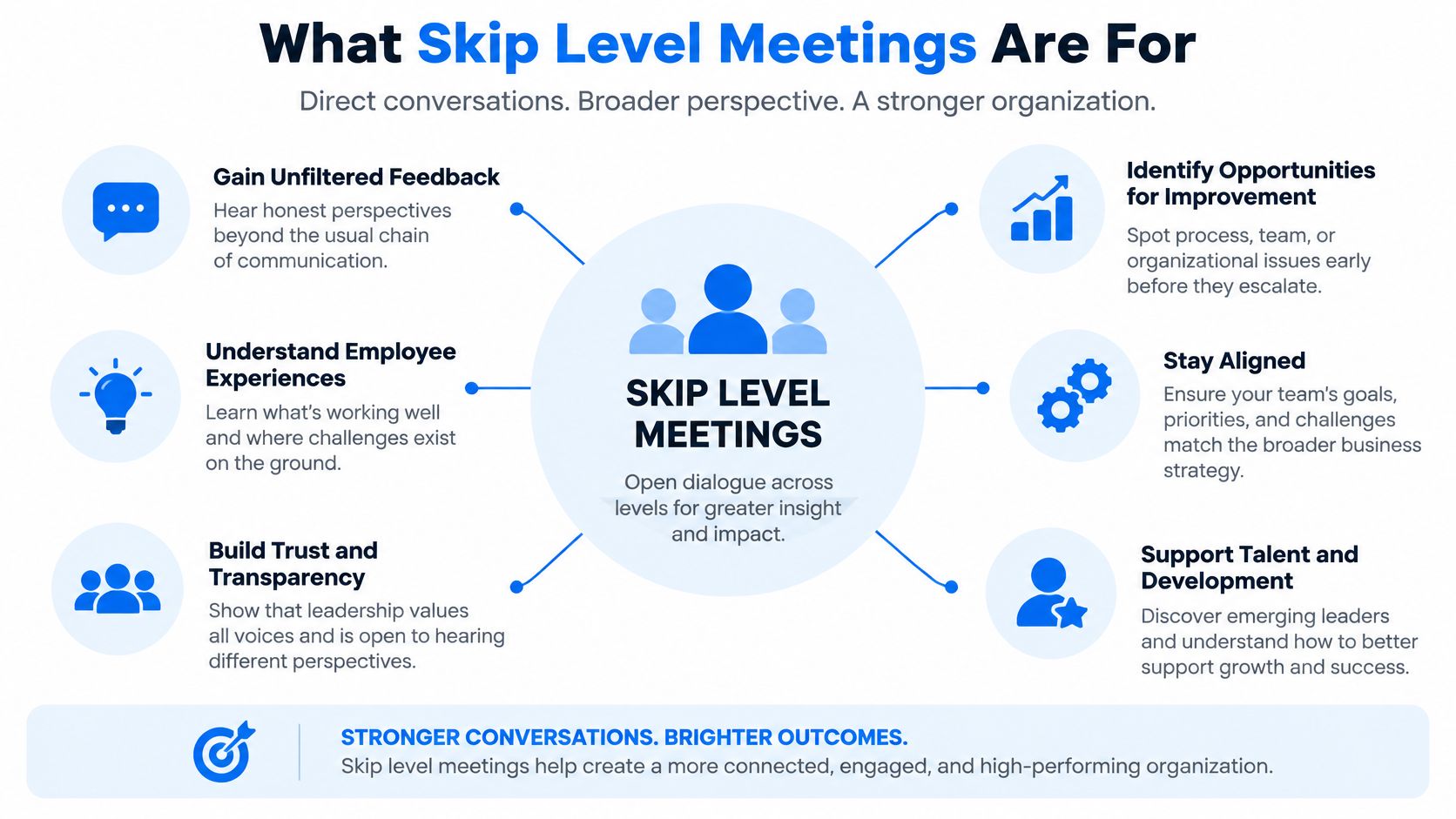
Skip-level conversations share a principle with management by walking around, a practice linked to Hewlett-Packard in the 1980s and later popularized by Tom Peters and Robert Waterman. The relevant evidence concerns visible senior contact, not a particular question list. In a field experiment, a divisional manager visited 79 bank branches employing approximately 1,000 people. Deposits and sales of products such as credit cards, insurance, and other financial services began increasing when visits were announced, peaked immediately after the visits, and stayed higher for at least one month, and in some cases two months, before returning toward prior levels, according to coverage of the branch-visit experiment. Visible attention can affect frontline results. Questions matter when they help leaders understand how work gets done and what is obstructing it.
A consistent employee listening strategy gives deskless and shift-based teams opportunities to share feedback beyond a single skip-level meeting, including pulse surveys, regular check-ins, and accessible feedback channels.
What the small samples cannot prove
Direct research on skip-level meetings remains limited. A study of 25 first-level engineering managers from U.S. technology organizations found broad support among participants, while pointing to differences in meeting format, culture, generation, psychological safety, and confidence in confidentiality. It also highlights a practical risk: direct managers may feel bypassed, and employees may hold back if they doubt comments will stay confidential.
The sample is qualitative and limited to U.S. technology managers. It cannot establish a global benchmark or prove that skip-level meetings improve performance. Use the findings as a reason to set clear boundaries and plan follow-through, not as a performance promise.
Before inviting employees, explain the meeting’s purpose, who can see raw notes, and when people will receive an update. Ask about obstacles to execution, slow decisions, and support that would change the work. Then assign an owner to each actionable theme and report what leaders will do, what they cannot change, and why. A standing employee listening strategy for deskless teams can keep access to feedback from depending on a single meeting.
How Question Sets Change by Meeting Format
Meeting format determines which answers employees can give safely and what leaders can do with them. Choose the format around the decision or follow-up required, then make clear who will hear the response.
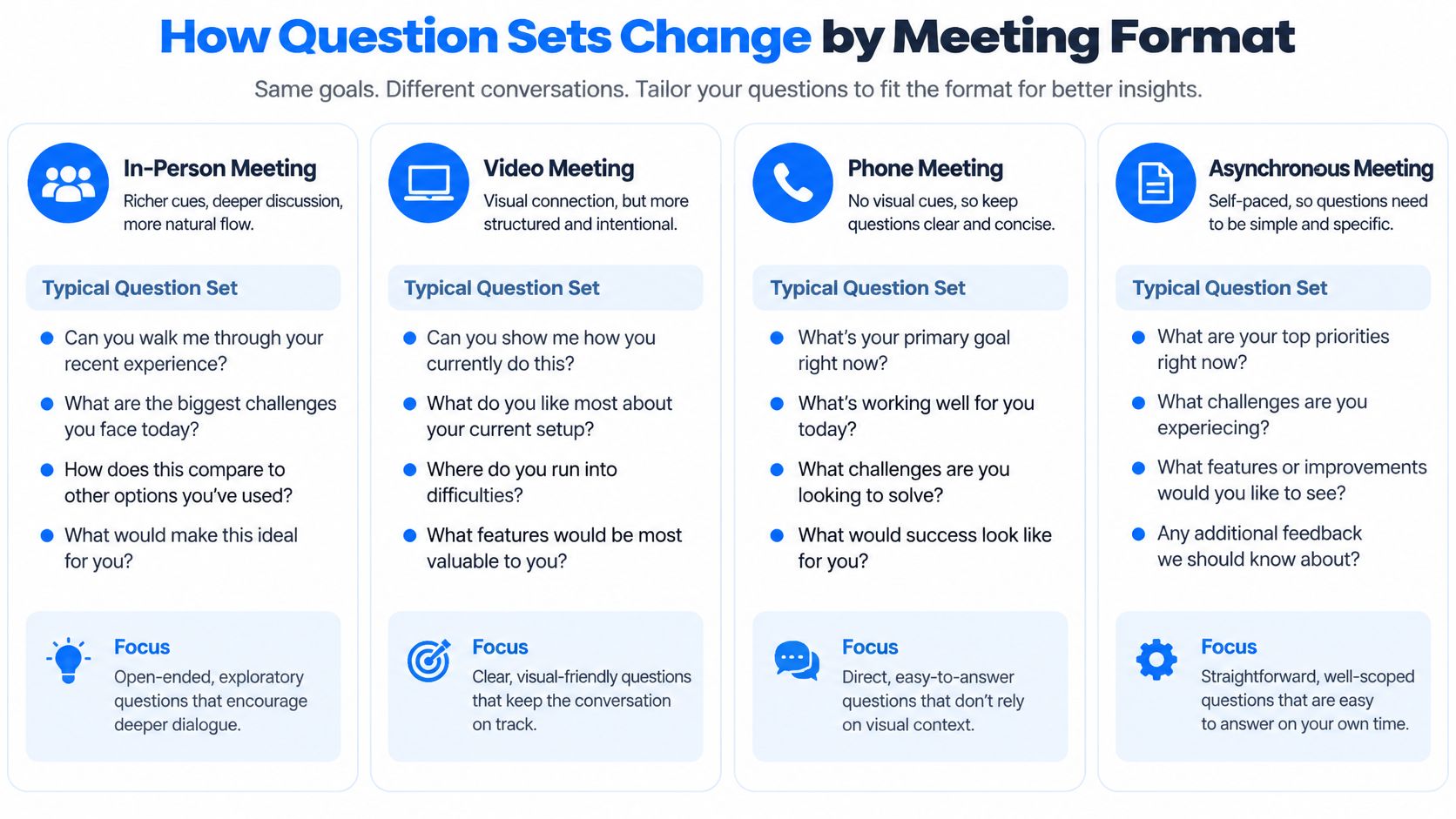
| Format | Questions to use | Direct manager | Main risk |
|---|---|---|---|
| Private one-to-one | Safety, past voice, confidentiality, and one blocker | Out of the room; briefed on themes afterward | A quote gets back to the manager |
| Same-shift peer group | Obstacles, stalled decisions, late updates | Excluded from the room; owns follow-up actions | One person speaks for everyone |
| Multi-team forum | Purpose, cross-site patterns, resources | Not used to collect grievances; included in follow-up | Lower psychological safety |
| Manager-present check-in | Alignment and resource questions only | Present | Employees self-censor |
| Asynchronous prompt | One friction question plus one access question | Sees summarized themes, not raw comments | Low response if unpaid or public |
Who hears what
In a private one-to-one, ask what happened the last time the employee spoke up. Keep raw comments restricted. Share themes and agreed actions with the manager, not a transcript.
Use a same-shift group to identify obstacles, stalled approvals, and late updates. Ask whether the same delay affects people who have not spoken, rather than inviting the group to identify who is afraid to speak. This keeps the discussion focused on operating patterns.
A multi-team forum is suited to purpose, cross-site patterns, and resource needs. The same 25-manager study cited earlier found that larger forums involving direct leaders brought more reports of misalignment and possible drops in psychological safety. The study also found that including those managers in follow-up nearly eliminated reported misalignment concerns. Keep the room and the follow-up distinct: employees need a safe space to raise themes, while managers need a clear role in resolving them.
A manager-present check-in can clarify priorities and missing resources. Keep grievance questions for a separate channel, since employees may self-censor in front of their manager.
An asynchronous prompt works best when it asks about operational friction and access, with a separate route for sensitive concerns. Ask one question about each, make time for a response during paid work, and avoid public threads for comments that require privacy.
A skip-level meeting is not an informal status update, and it is not a bypass for performance management.
For rotating shifts, choose a live, repeated, hybrid, or asynchronous format that gives each team a workable way to participate. The guide to planning a town hall across shift teams explains those format trade-offs; keep a skip-level meeting narrower, with a clear route from employee input to follow-up.
Frontline Questions for Shifts Sites and Languages
An office prompt fails when the person cannot attend privately, cannot open the channel, or gets the update after the work is done. Ask whether information arrives during the work, not whether someone posted it.
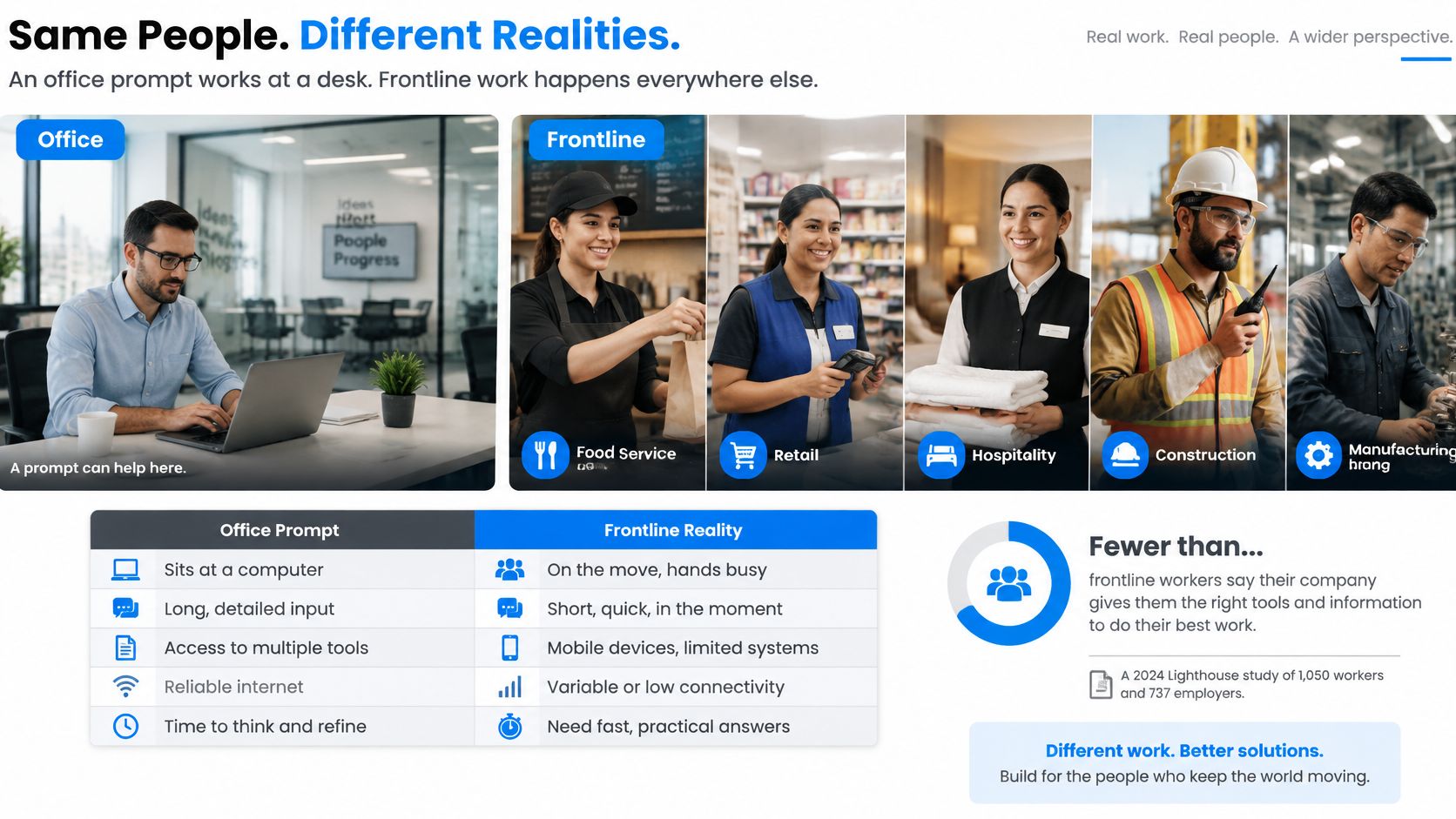
A 2024 Lighthouse Research & Advisory study of 1,050 workers and 737 employers across food service, retail, hospitality, construction, and manufacturing found that fewer than one in three workers believed their employer did a great job communicating news, information, and updates, and the most common method was on location or at the job site, as reported in the Lighthouse frontline development study. A message on an intranet is not evidence that a cook, a driver, or a night picker saw it.
Internal-communications research found that engaging frontline workers was the most prevalent challenge for 60% of surveyed practitioners, while 47% reported outdated information as a major problem, and a separate 2025 frontline finding said 29% of managers identified unclear priorities and insufficient leadership resources as barriers, in The State of Internal Communications 2025. Thin resources and stale updates are why a headquarters video call cannot stand in for the shift.
Substitute questions by barrier
| Access barrier | Substitute question | Useful answer |
|---|---|---|
| Late information | Which operational update arrived after the work it affected? | A channel, timing, and shift or site |
| Shift and location | Which policy is hardest to carry out on this shift? | A specific task, equipment item, or rule |
| Language and device | Which channel can you open on your own device without asking anyone? | A channel and its access limits |
| Night or remote absence | Who on your shift never hears these messages? | A group, shift, or site with a named route |
| Stalled decision | Which decision could this shift not get approved? | A decision and the approver |
Use paid listening time, translated prompts, an anonymous channel, a small same-shift group, and a written site follow-up. Our town hall guide covers how to plan across day, evening, and night shifts and how to choose live, repeated, hybrid, or asynchronous formats. Our channel guide covers the trade-offs between those channels. Language is one of those trade-offs. A prompt that only exists in the headquarters language misses the people you most need, which is why language barriers at work belong in the access design, not in a later translation pass.
Say a night warehouse crew cannot join a 10 a.m. skip-level. They still get the same two questions, on a device they already open, in a language they work in, with paid time to answer. They then get the same written theme report as the people who sat in the room.
A Voice to Action Close After the Meeting
A five-step close turns meeting comments into action. A meeting that collects comments and then goes quiet teaches people not to speak the next time.
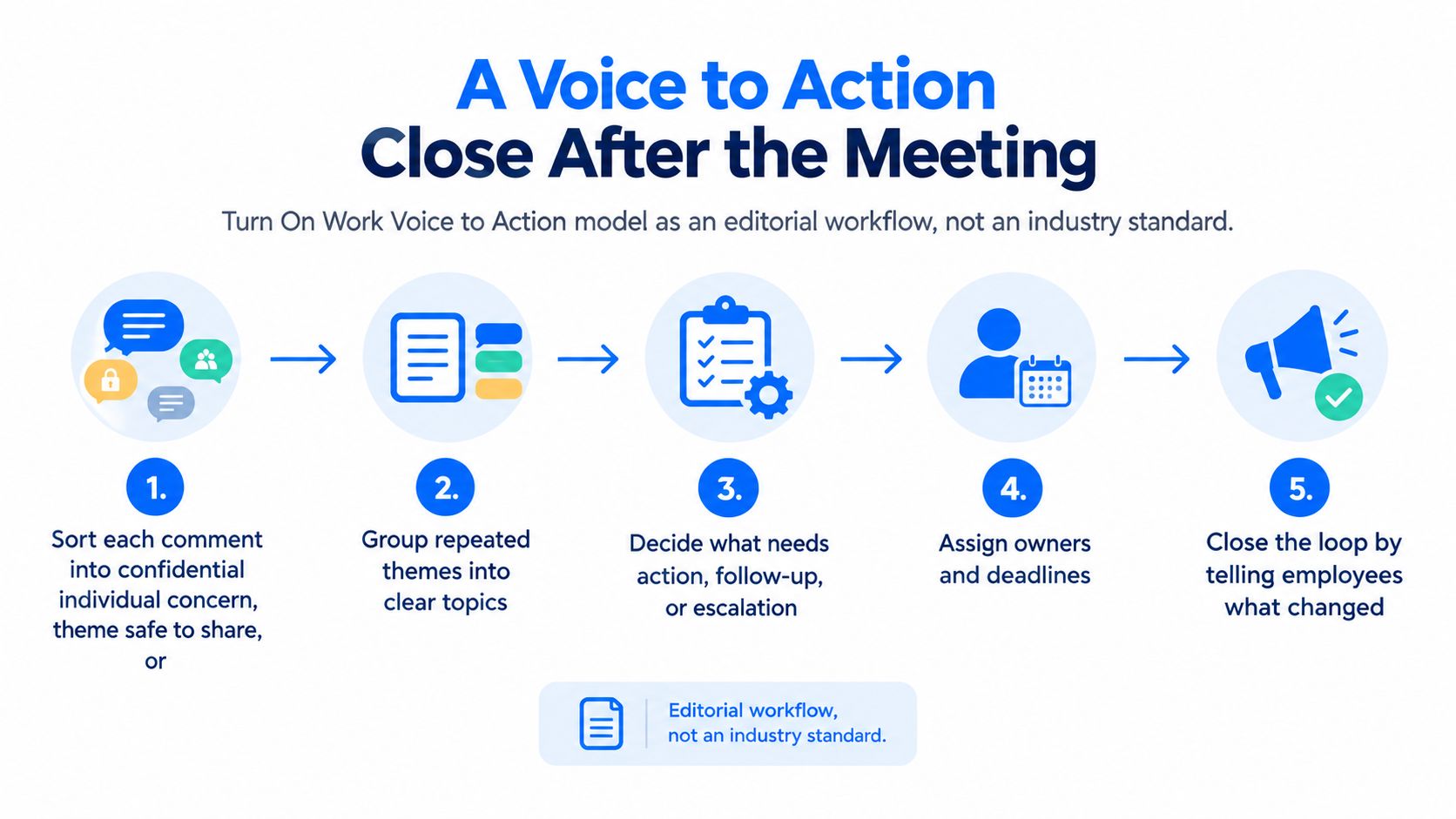
Silence after disclosure costs trust fast. Sort every comment the same day into three buckets: a confidential individual concern, a theme safe to share, or an item that belongs elsewhere like a grievance or an accommodation. Sensitive health details stay out of group notes and belong in restricted HR or leave systems.
Ask what evidence would let you investigate without exposing the speaker. Patterns, timestamps, and sites beat names. Decide what, if anything, the direct manager hears, and share it as a theme. Never forward a quote.
Name an owner and a due date, or say why no change is possible yet. “We are looking into it” leaves the loop open. Send the same closure to people who could not attend because of shift, site, or workload, so access does not depend on being in the room.
Four questions belong in this close, not in the opening. What would you hesitate to raise publicly? What evidence would help us investigate it? What may be shared anonymously with your manager? How should leadership close the loop?
Three measures, not a question count
Track only three things. The share of meetings that produce at least one substantive concern. The share that receive a named owner and a date. Whether that employee raises another constructive issue later.
Repeat voice matters more than prompt count. Even a leader who agrees with a comment can shut down the next one with an angry or defensive reaction. Acknowledge the issue, ask one clarifying question, and name the constraint.
The IABC frontline community report on voicelessness and leadership reach found 54% said they felt voiceless and 63% said leadership messages did not reach them. Record themes, assign owners, and keep a follow-up channel for people who were not in the room. A skip-level chat also does not replace a formal grievance or accommodation path.
Leaders who want a short, practical frame for owning the follow-up can use these leadership lessons for busy readers. Tie the closure note to an employee engagement action plan for documenting owners and timelines so the theme has a home after the meeting ends.
If you invite disclosure and then publish nothing, trust drops. Send the note even when the answer is no.
Questions That Reduce Trust
Asking people to speak and then doing nothing is worse than not asking. Most public lists stop at “What should leadership know?” and skip the system that separates a confidential concern from a theme, protects the speaker, and reports back when nothing can change yet. A 2025 study of 445 banking employees found that only 31% of sampled branches had formal, policy-backed worker-voice or grievance mechanisms. Where power distance or precarious work makes candor costly, an open question is not a safe question.
Failures and the one-line repair
Do not ask who the weak performers are, whether someone trusts their manager, or for a rating of that manager. Those prompts invite personal criticism and retaliation risk. Repair it by writing the theme, not the quote.
Do not collect a grievance, an accommodation, or a medical detail and paste it into a group recap. Route sensitive facts through the restricted HR channel, then return to the operational theme.
Do not surprise the direct manager with quotes. Brief them after the meeting on patterns and actions. Manager behaviors that support engagement depend on that manager hearing a pattern they can act on, not a complaint they can trace.
Do not run one headquarters session and call the night shift heard. Give absentees the same questions and the same closure.
Do not measure success by questions asked or meetings held. Measure whether a named owner replied, including when the reply is that no change is possible yet.
Stop adding prompts. The question bank is not the failure. The silence after the answer is.
Choose the Next Meeting and Report Back
Choose the next meeting this week using the format you already selected. Keep the plan manageable and make the follow-up visible.
- Rotate invitations across shifts, sites, and roles so one small group does not become the only source of input.
- Set a sustainable cadence. A quarterly private round plus a same-shift group when a site is changing is a practical starting cadence, not a research benchmark.
- Match the scope to the operation. For one shift-based team, choose one site and one shift, provide time to attend, and send a summary to missed shifts. Across several locations, gather site themes before holding a multi-team forum.
- Put three details in the invite: the purpose, who will see raw notes, and when the closure note will be sent.
- Publish three lines afterward: what you heard, what will change or why it will not, and who owns the next step. Send the same update to absentees through a second communication path.
Use audience mapping to identify whose input is missing before setting the next meeting. A useful sign of follow-through is that employees raise another constructive issue later, not just that the first meeting felt warm.
For guidance on communicating across shifts and sites, see Turn On Work’s frontline employee communication guide.
Skip Level Meeting Questions FAQs
Can employees raise concerns anonymously in a skip-level meeting?
Yes, but through a separate anonymous channel for safety topics, not by whispering in a group. You cannot follow an anonymous comment up in person. The closure note should describe the theme and the change, without trying to identify the sender.
What if someone reports harassment or discrimination?
Stop the group discussion. Do not investigate it in the meeting. Route the report to the organization’s formal reporting channel, then tell the employee who will follow up and by what date. Keep that detail out of the shared theme note.
Can a skip-level meeting be used for a performance review?
No. It may surface a process problem a manager should address later. Individual performance stays with the direct manager through the normal review and coaching channels. Say that boundary at the start so nobody treats the hour as an appraisal.
Should the leader take notes?
Record themes and owners only. Keep raw comments out of shared notes, and keep sensitive health details out of any group record. If you use an AI notetaker, say so before the meeting and turn it off for anything that belongs in a formal report.
Pick one site and one shift this week. Send an invite that names the purpose, who sees raw notes, and the date of the closure note. Ask four questions from the operating rows, keep the safety prompts on a private path, and publish the three-line reply to everyone who was not in the room.