
Gallup’s State of the Global Workplace reporting placed global employee engagement at 20% in 2025 and estimated $10 trillion in lost productivity, about 9% of global GDP (Gallup’s State of the Global Workplace reporting). Those figures demand operating action, not another survey presentation.
An effective employee engagement action plan assigns work that changes daily experience across workflows, communication, manager routines, tools, and AI use. It connects feedback to the 1:1, the shift handoff, and the systems employees rely on. Without that connection, plans stall after the readout.
- Diagnose first, before choosing perks.
- Segment results so frontline and hybrid experiences remain visible.
- Prioritize communication, managers, tools, and operations together.
- Assign each initiative an owner, metric, deadline, and decision rule.
- Measure behavior and business conditions, not survey participation alone.
What an Employee Engagement Action Plan Does in 2026
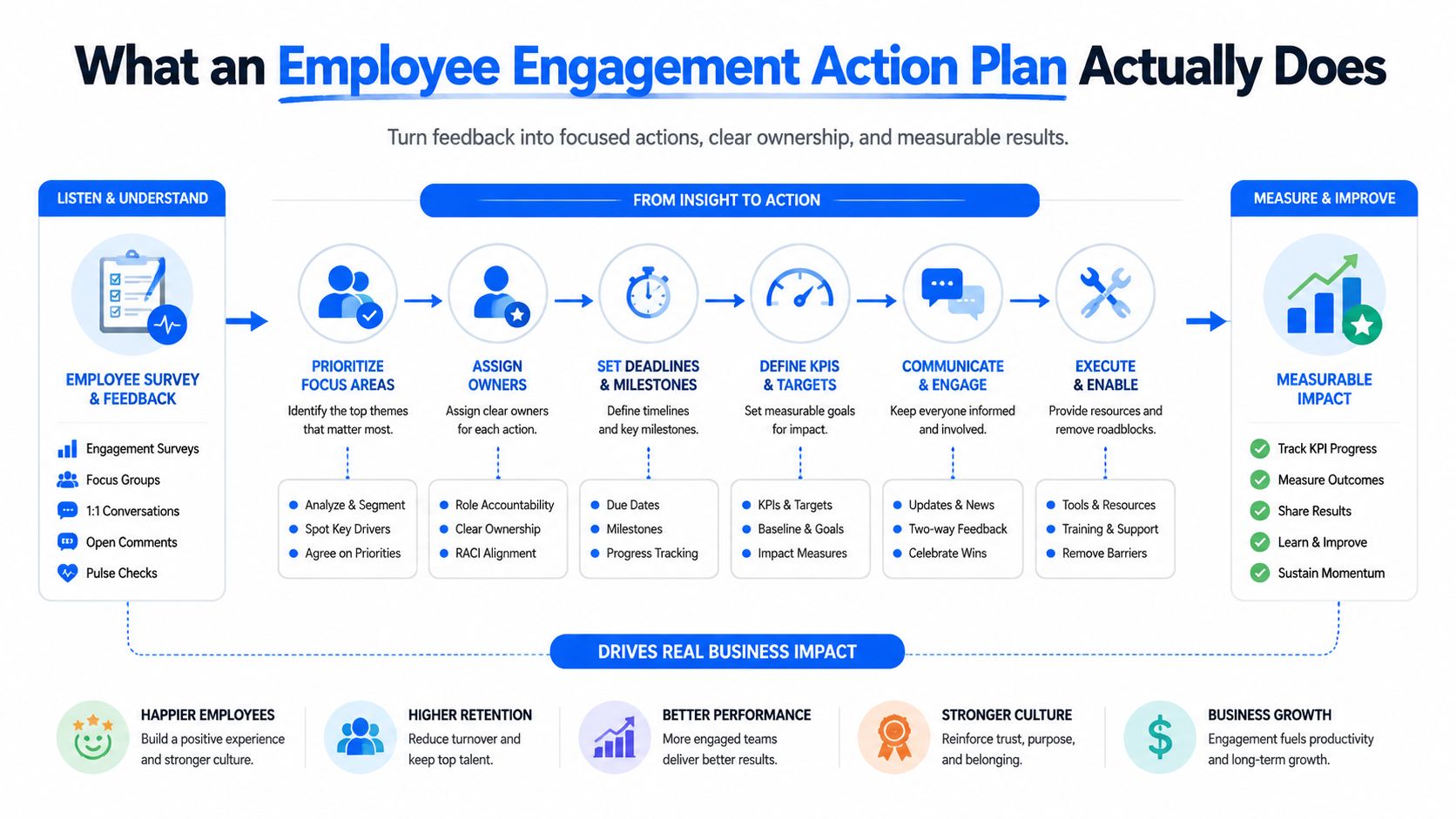
An employee engagement action plan turns feedback into operating decisions. It names the experience problem, assigns ownership, changes a workflow or manager routine, explains the change, and checks whether work improves. Gallup’s 2026 global workplace reporting, based on 2025 data, placed engagement at 20% worldwide and estimated $10 trillion in lost productivity, equivalent to about 9% of global GDP (Gallup’s State of the Global Workplace reporting).
The business case is clear. Gallup’s long-running benchmarks show worldwide engagement stayed below 25% for more than a decade, while best-practice organizations regularly reached 70% or higher (Gallup’s historical global engagement report). Persistent disengagement leaves leaders with a practical choice: change how work is managed or accept the cost of the current system.
Engagement is an operating problem
An annual survey, recognition campaign, and leadership presentation cannot carry the plan. Employees experience work across offices, homes, sites, shifts, vehicles, and customer locations. Managers also shape that experience through AI copilots, collaboration platforms, scheduling systems, and mobile tools.
Organizations often use employee communication platforms to centralize updates, improve frontline access, and create more consistent employee experiences across distributed teams. Platforms such as HubEngage help companies manage internal communication, employee engagement, and workforce experience initiatives from a unified environment.
Practical rule: If an initiative does not change something employees encounter during work, place it in a communications plan, not an engagement action plan.
The historical record shows why a single campaign will not fix the problem. In 2013, only 13% of workers worldwide were engaged, compared with 63% who were not engaged and 24% who were actively disengaged. By 2024, engagement was reported at 21%, after reaching 23% in 2022. The figure then fell to 20% in 2025, as covered in Turn On Work’s employee engagement trends coverage.
For 2026, use a simple operating test. A readout deck creates awareness. A manager 1:1 creates local understanding. A changed workflow provides evidence that leadership listened. Build the plan around decisions employees can see in their schedules, handoffs, tools, and daily communication, rather than around a culture poster.
Diagnose Engagement Before You Plan Anything
Before approving an initiative, identify what employees experience, where the problem is concentrated, and which operating conditions may be causing it. A useful diagnosis combines a baseline survey, workforce segmentation, qualitative follow-up, and a short list of evidence-backed themes. Skip this work and the plan will default to visible perks instead of fixing daily friction.
Start with a baseline you can defend
Choose one consistent instrument, such as eNPS, Gallup Q12, or a custom engagement index. Document the methodology before launch: population, survey window, confidentiality rules, response handling, and comparison segments. Gallup’s guidance on employee engagement measurement recommends establishing an initial benchmark and repeating measurement every six months, giving leaders a fixed rhythm for checking progress.
Segmentation exposes problems a company-wide score can hide. Separate office, hybrid, remote, and frontline employees, then examine tenure, manager, location, role family, and shift pattern where the sample supports responsible interpretation. A stable office result can conceal poor experiences among field crews or warehouse employees. Treat those differences as operating signals, not statistical noise.
Explain the signal, don’t just display it
Use skip-level interviews, focus groups by workforce segment, manager listening sessions, and open-text analysis to explain why a score moved. Group comments into themes such as manager effectiveness, workload, recognition, career growth, tools, scheduling, or communication access. Then connect each theme to a workflow, policy, handoff, or leadership behavior that can change.
This guide to analyzing employee survey answers can support the interpretation stage. Leadership still has to choose which problems receive time, budget, and manager attention.
| Step | Activity | Output Artifact |
|---|---|---|
| Baseline | Run a consistent survey and lock the methodology | Benchmark and methodology note |
| Segmentation | Compare workforce types, teams, managers, locations, and roles | Segment heat map |
| Qualitative follow-up | Conduct interviews, focus groups, and open-text analysis | Evidence-backed themes |
| Prioritization | Rank themes by reach, severity, controllability, and business relevance | Shortlist for action |
The diagnostic should identify affected segments, likely operational causes, supporting evidence, and what requires action now. Test it with managers: can they explain the likely cause without blaming employees? If they cannot, collect better evidence before adding initiatives. A readout creates awareness. The plan starts only when the diagnosis points to a change employees will encounter in their work.
Prioritize Initiatives That Move the Numbers
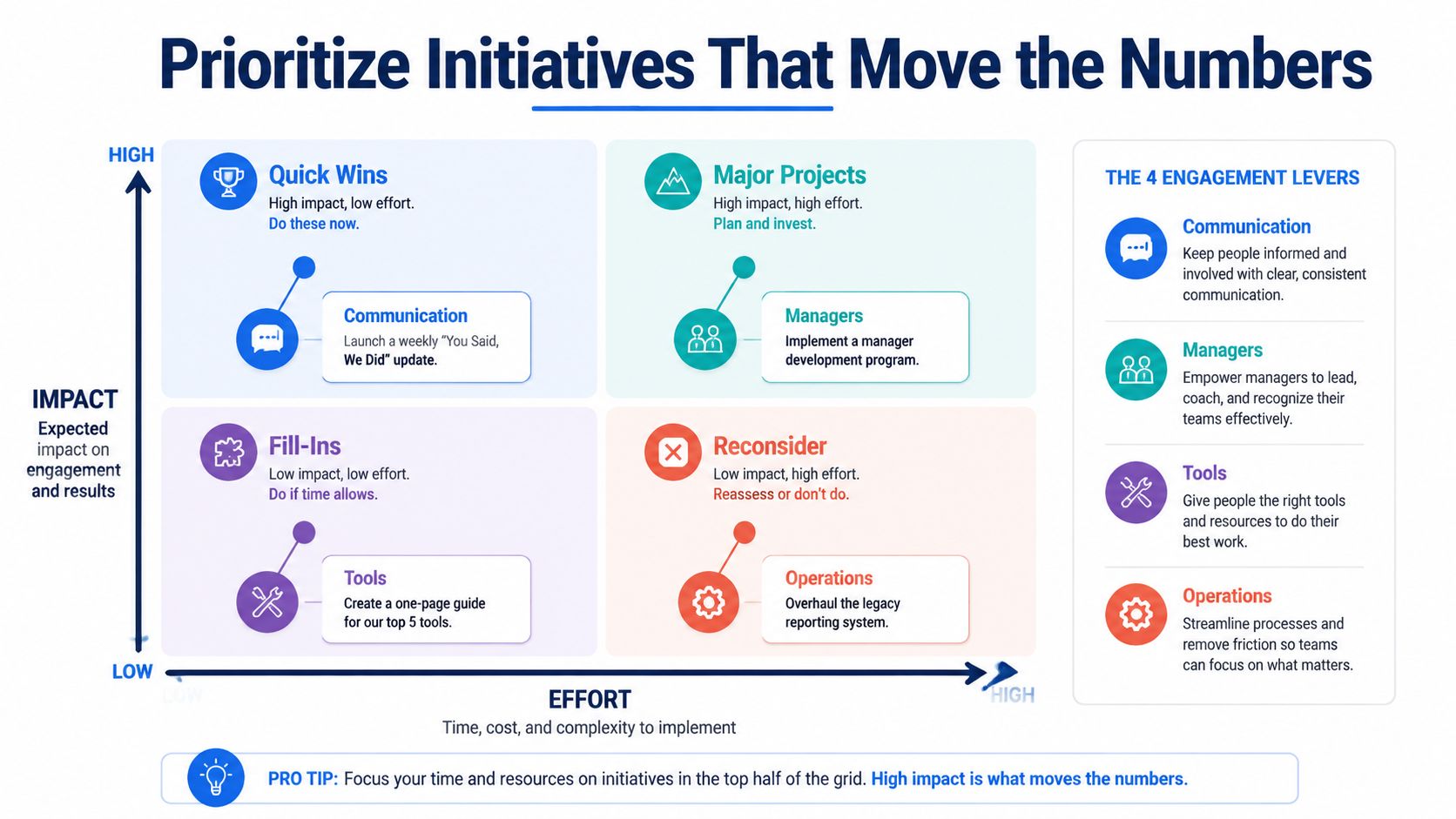
Rank engagement initiatives by expected impact and implementation effort. Test every proposal against four levers: communication, managers, tools, and operations. A workable plan funds a small set of changes employees will experience in daily workflows, rather than approving every attractive idea.
Use an effort and impact grid
Score each initiative from 1 to 5 for impact and effort. These scores support a decision, not an industry benchmark. Impact should account for the number of employees affected, the seriousness of the problem, and its connection to an outcome leaders care about. Effort includes budget, manager time, technology work, policy review, training, and access for frontline employees.
For hybrid teams, a communication change might consolidate project updates in a governed Teams or Slack channel. For frontline teams, it might be a shift-handoff playbook posted at the point of work and delivered through a mobile channel. A manager initiative could use coaching circles for hybrid leaders or a structured pre-shift conversation for supervisors. Tool work may remove duplicate systems. Operations work may improve schedule visibility or reduce approval friction.
Apply the trade-off organizations often overlook
Manager capability usually deserves priority over another perk. Funding it requires protected time, coaching, and leadership accountability, so it lacks the visibility of a launch event. Managers still control many interactions that determine whether communication, recognition, feedback, and workload changes reach employees.
Gallup reports that workgroups in the top quartile on action planning increased engagement by an average of 10%, while workgroups in the lowest quartile saw engagement decrease by 3% (Gallup’s post-survey action-planning guidance). The operational lesson is direct: disciplined follow-through on a modest initiative can outperform a complex program managers never use.
| Initiative | Lever | Impact | Effort | Decision |
|---|---|---|---|---|
| Weekly team update template | Communication | 4 | 1 | Quick win |
| Manager coaching circles | Managers | 5 | 3 | Major project |
| Mobile recognition workflow | Tools | 3 | 2 | Quick win |
| Shift-handoff standard | Operations | 5 | 3 | Major project |
| New enterprise recognition platform | Tools | 2 | 5 | Reconsider |
| Company-wide culture event | Communication | 2 | 4 | Reconsider |
Use Turn On Work’s coverage of manager behaviors and employee engagement to convert survey themes into observable manager expectations. Sequence quick wins first. Give major projects a named sponsor, budget, dependency map, and a clear decision on what will not be funded.
Build and Launch the 90-Day Action Plan
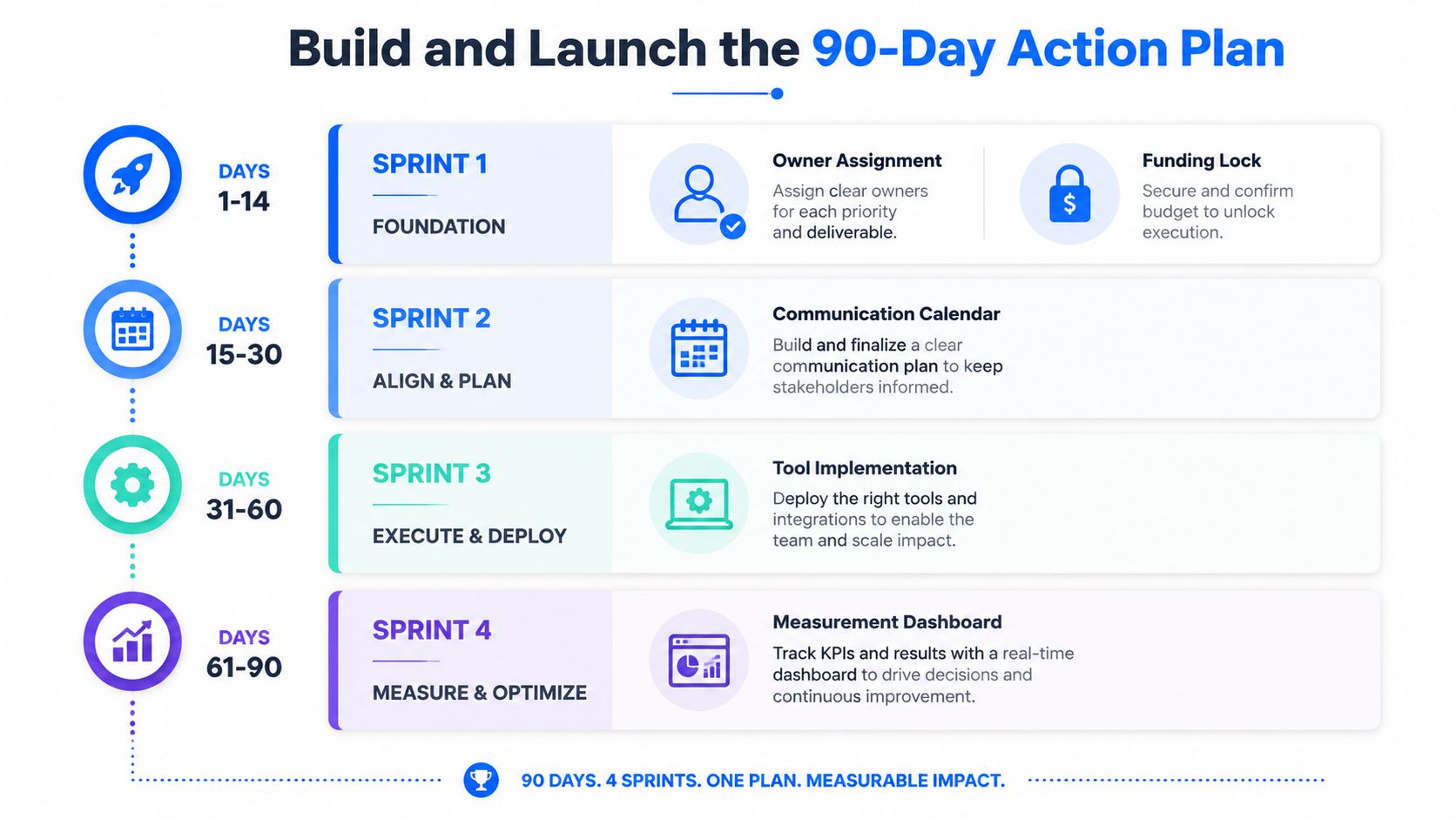
A 90-day employee engagement action plan should operate as four sprints, each producing a usable artifact. Every initiative needs one accountable owner. A committee can advise, but it cannot carry responsibility when decisions stall.
Sprint 1 covers days 1 to 14
Assign owners, confirm the executive sponsor, lock available funding, and record which trade-offs the sponsor can approve. Create a one-page brief for each initiative covering the problem, affected workforce segment, desired behavior, metric, deadline, dependencies, and escalation path.
Do not assign ownership to “HR” or “leadership.” Name the person who can convene the right teams, remove blockers, and report progress. Internal communications, IT, operations, learning, and workforce scheduling may provide support, but accountability stays with one person.
Sprint 2 covers days 15 to 35
Build the manager playbook before announcing the initiative. Give managers scripts for team meetings, 1:1s, skip-level conversations, and responses to difficult feedback. For shift workers and field crews, include pre-shift rituals, supervisor prompts, printed or posted updates, and a route for employees who rarely access email.
The playbook must specify what managers should say and ask, what they can decide locally, and what requires escalation. Asking managers to “communicate the results” without these tools leaves the plan unfinished. Use the first-90-days employee experience guide as a reference for turning experience work into a staged operating rhythm.
Sprint 3 covers days 36 to 60
Configure the systems that make execution visible. Set the pulse survey cadence, collaboration channels, recognition workflow, reporting permissions, and approved AI use cases. AI can draft follow-up questions or summarize themes. A human must review the output, protect confidentiality, and make the decision.
Gallup’s 2026 AI workplace reporting found that only 22% of employees said their organization had communicated a clear AI plan or strategy, although 44% said AI had already been integrated. Engagement reached 53% where frequent AI use, a clear plan, and manager support existed together (Gallup’s AI adoption and engagement findings). Set AI expectations inside the employee experience plan, including approved uses, review responsibilities, and limits on sensitive information.
Sprint 4 covers days 61 to 90
Pilot the plan with two teams, collect feedback through existing workflows, correct weak points, and launch through channels employees already use. Set a weekly leadership update, a biweekly manager touchpoint, and a monthly company-wide readout. If an initiative slips, its owner escalates the dependency, the sponsor chooses whether to reduce scope or move the deadline, and employees receive a clear update.
Launch only after managers can explain the change and employees can access the workflow. That is the point where a survey readout becomes an operating system rather than another culture poster.
Measure Progress With KPIs That Hold Up
Engagement scores alone cannot run an action plan. Use a three-tier KPI stack: organization measures show whether the strategy affects business outcomes, team measures show whether managers are executing, and frontline measures reveal the daily conditions shaping work.
Match the metric to the decision
Keep each dashboard tied to a decision. Executives need a short set of organization indicators. Managers need signals they can influence. Operations leaders need frequent visibility into schedules, tools, safety, and execution.
| Tier | Key Metrics | Owner | Cadence |
|---|---|---|---|
| Organization | Engagement score, eNPS, retention, regrettable attrition, internal mobility, manager AI adoption | People leader and executive sponsor | Quarterly |
| Team | Pulse score, 1:1 frequency, recognition activity, meeting load, after-hours messages, time-to-feedback | People managers | Monthly |
| Frontline and operational | Schedule stability, overtime, safety incidents, tool downtime, break compliance | Operations and site leaders | Weekly |
Treat this list as a measurement model, not a demand to collect every field. Start with data already available, assign one owner to each measure, and define the threshold that requires action. A sustained drop in a team pulse score can trigger a manager review. Repeated tool downtime should open an operations ticket, not produce another listening session.
Use the same rule for hybrid and frontline teams: measure the condition, name the owner, and connect the result to a workflow.
Separate lead indicators from lagging indicators
Pulse scores, 1:1 frequency, feedback response time, and schedule stability can provide early signals. Retention, regrettable attrition, and internal mobility usually show what happened after the employee experience changed. Give lagging measures time to respond, while acting quickly when leading indicators weaken.
Engagement has a business connection, but the KPI only helps when leaders use it to choose an intervention. Wire pulse checks, collaboration telemetry, and appropriate AI usage signals into existing reporting routines instead of creating a disconnected HR dashboard. Keep access and privacy rules clear, especially for individual-level collaboration data and AI activity.
This employee engagement measurement guide helps teams separate sentiment from behavior and operational outcomes. A useful dashboard should answer three questions: what changed, who owns the response, and what happens next. If it cannot, remove metrics until the thresholds and decisions are clear.
Pitfalls That Kill Action Plans and How to Avoid Them
Engagement plans fail in execution. Every commitment needs a workflow, an owner, and a decision that employees can see.
Six patterns that turn plans into shelf-ware
-
Survey theatre: Teams run a pulse, present findings, and change nothing. Publish three decisions within 30 days, including what leadership will not change and why.
-
Manager overload: People leaders receive another initiative without scripts, training, or protected time. Reserve two hours each week for engagement work, and give managers AI-drafted talking points to review and personalize.
-
Frontline invisibility: Office workers shape the plan, then the organization emails it to warehouse or field teams. Repeat key information through shift supervisors, mobile channels, posted materials, team huddles, and other accessible surfaces.
-
Tool sprawl: A recognition platform sits beside Slack, Teams, an intranet, scheduling software, and local spreadsheets. Use two primary surfaces where possible, and retire tools that create duplicate work.
-
AI as a buzzword: The organization buys copilots without changing a workflow. Choose one workflow per quarter where AI removes a manual step, define the human review point, and state what data the tool can and cannot use.
-
Activity without outcomes: Leaders celebrate response rates, message volume, or recognition counts while employee conditions stay the same. Tie each KPI to a business measure already reviewed by finance, operations, safety, customer service, or workforce planning.
Fix the communication and enablement gap
Frontline employees experience engagement through access, timing, workload, and manager connection. Internal communications research from 2025 found that 60% of internal communications leaders struggled to engage frontline workers, 53% reported low intranet engagement, and 47% cited outdated information as a major challenge. Information overload and heavy workloads were each reported at 62%, while limited digital access reached 31% (The State of Internal Communications 2025 report).
A separate 2025 international employee communication study reported that only 9% of non-desk employees were very satisfied with internal communication, while 38% rated it fair or poor. Among employees considering leaving, 63% cited poor internal communication as a contributing factor (Staffbase’s 2025 employee communication impact study).
Replace the extra newsletter with channel design that fits the work. Pair reliable information with supervisor enablement and a clear way for employees to act on what they receive. If the plan cannot reach a shift worker during a busy day, it is not an engagement plan. It is a document waiting to fail.
Checklist and FAQs for Your Action Plan
Use this checklist before launch. A plan is ready when a manager can explain it, an employee can find it, and an owner can prove whether it worked.
Copy-ready launch checklist
- Diagnostic readiness: Confirm the survey method, baseline, confidentiality approach, and workforce segments.
- Theme discipline: Select a short list of evidence-backed priorities instead of responding to every comment.
- Named ownership: Assign one accountable owner and one executive sponsor to each initiative.
- Operational fit: Document the workflow, manager behavior, tool change, or frontline condition the initiative will change.
- KPI selection: Choose lead and lagging indicators, owners, cadence, and intervention thresholds.
- Manager enablement: Provide scripts, prompts, training, protected time, and escalation routes.
- Channel access: Reach office, hybrid, remote, frontline, mobile, and shift-based employees through appropriate surfaces.
- Communication cadence: Schedule weekly leadership updates, biweekly manager touchpoints, and monthly company-wide readouts.
- Review points: Hold formal reviews at 30, 60, and 90 days, then reassess the plan quarterly.
- Retirement rule: Define what evidence will cause the team to stop, redesign, or scale an initiative.
Employee engagement action plan FAQs
How often should we run pulse surveys?
Use a cadence employees can recognize and managers can act on. Gallup recommends an initial benchmark followed by surveys every six months, while teams may use shorter pulse checks for a specific operational change (Gallup’s measurement recommendations). Don’t survey more frequently than your organization can respond.
Should engagement scores belong in performance reviews?
Use engagement data to coach managers and identify support needs, not as a blunt individual performance score. Team-level patterns can inform leadership expectations, but confidentiality and context must remain protected.
What should we do when one manager drags down a team score?
Validate the signal through comments, interviews, and operational data. Then give the manager a specific behavior plan, coaching, support, and a review date. Escalate when the manager refuses the agreed actions or when the issue involves safety, misconduct, discrimination, or another formal risk.
How should we budget engagement initiatives?
Budget the work employees will experience. Include manager time, communications production, technology configuration, training, frontline access, measurement, and maintenance. A cheap initiative that adds tool friction can cost more than a focused workflow change.
How do we include shift workers without email access?
Use shift supervisors, huddles, noticeboards, mobile channels, printed summaries, translated materials where needed, and listening windows that match shift patterns. Give frontline employees a response route that doesn’t depend on sitting at a desk.
Can AI tools serve as an employee listening channel?
AI can help summarize themes or route questions, but it shouldn’t replace human listening or make opaque decisions about employees. Explain the purpose, data handling, human review, and escalation process before introducing it.
What should go to leadership?
Escalate decisions involving budget, policy, safety, staffing, privacy, technology access, or cross-functional dependencies. Managers should own local actions, while sponsors remove barriers they can’t control.
When should we retire an initiative?
Retire or redesign it when the evidence shows low use, weak relevance, duplicated effort, or no meaningful movement in the intended behavior after a fair test. Explain the decision to employees so stopping an initiative doesn’t look like another ignored commitment.
What should we do when engagement scores remain flat?
Check implementation before changing the strategy. Review manager adoption, channel reach, workflow completion, operational constraints, and whether the selected initiative addressed the actual cause. Flat results can indicate weak execution, poor diagnosis, or a measure that reacts slowly.
How can a company keep the plan alive?
Review it quarterly, refresh priorities when workforce conditions change, and publish progress against commitments. Treat the document as a working operating system, not a binder artifact.
An employee engagement action plan earns credibility through visible follow-through. Select one or two priority themes, assign accountable owners, equip managers, include frontline realities, and publish the first decisions within 30 days. Then review the plan with your people team and operating leaders, retire what isn’t working, and fund the workflow changes employees need to do good work.