Recruitment teams are under pressure from both directions. Candidates expect faster replies, clearer communication and less friction, while hiring managers want qualified people in front of them sooner. Recruiters, meanwhile, still have requisitions to manage, interviews to coordinate, systems to update and hundreds or thousands of applications competing for attention.
AI can remove a meaningful amount of that administrative pressure.
However, there is a point at which efficiency starts working against the hiring experience. A candidate can move quickly through an automated process and still come away feeling that nobody at the organization actually understood them.
That is the real decision facing talent acquisition teams. It is not whether recruitment should be human or AI-driven.
Instead, the question is which parts of recruiting deserve automation, which benefit from AI support, and which still require a person who can listen, interpret context and take responsibility for a decision.
Used well, AI should give recruiters more capacity for that work, not less.
Key Takeaways
- AI should remove recruiting friction – not human interaction. Use it for repetitive work like scheduling, summaries, sourcing support, and routine candidate questions.
- The more important the hiring decision, the more human involvement matters. Interviews, motivation, negotiation, difficult conversations, and final decisions need context and judgment.
- Automation should create a “human time dividend.” The real value of AI is not just hours saved, but whether recruiters can reinvest that time in candidates and hiring managers.
- AI recommendations should inform decisions, not become decisions. Recruiters need the ability to question scores, review unusual candidates, and override automated recommendations.
- A faster hiring process is not automatically a better one. Measure efficiency alongside candidate experience, hiring quality, recruiter experience, fairness, and trust.
What does AI in recruitment actually mean?
AI in recruitment refers to technology that uses techniques such as machine learning, natural-language processing, generative AI or related computational methods to analyze information, generate content, make recommendations or support recruitment activities.
In practice, that could mean suggesting candidates whose skills match a role, summarizing an application, generating a first draft of a job description, answering routine candidate questions, analyzing recruitment data or producing interview notes.
It helps to distinguish that from ordinary workflow automation.
Sending an application confirmation automatically because a candidate completed a form is automation. A system analyzing the content of a resume and recommending how closely the applicant appears to match specified criteria involves a different level of computational judgment.
The distinction matters because the second activity carries different risks. As a system moves from completing an administrative action to influencing how a person is assessed, recruiters should expect stronger requirements around testing, oversight, transparency and accountability.
Government guidance on responsible recruitment AI similarly distinguishes between useful automation and the risks that can arise in sourcing, screening, interviewing and selection.
Why recruitment teams are turning to AI
The attraction is not difficult to understand.
Recruiters spend a considerable amount of time on work surrounding hiring rather than talking to candidates: updating systems, reviewing applications, coordinating diaries, finding information, preparing communications and compiling recruitment reports.
At the same time, application volumes can make thoughtful individual attention difficult.
AI offers another layer of capacity. For instance, it can help organize a talent pool, find patterns across applicant data, prepare summaries before recruiter review or respond immediately to straightforward candidate questions.
Adoption is already substantial. SHRM’s 2025 research found AI use growing across HR, with recruiting a major area of application. Among organizations using AI in recruiting, reported use cases included job-description generation, resume review, candidate searching and applicant communication.
Still, adoption does not prove effectiveness.
An AI feature is useful only when it solves a real recruiting problem without introducing a larger one elsewhere.
Where AI can genuinely improve recruitment
Candidate sourcing
AI-assisted sourcing can help recruiters search larger talent pools and recognize relationships between skills, job histories and potential roles that simple keyword searches may miss.
For example, a recruiter filling a customer implementation role might normally search for candidates who already hold that title. A more sophisticated matching system could surface people from customer success, technical account management or implementation consulting whose experience overlaps with the actual requirements.
That can broaden the search.
However, the recommendation should still be treated as a lead, not a conclusion. If the underlying model consistently associates success with a narrow set of employers, universities or career histories, it can narrow the pool just as easily as it expands it.
Recruiters therefore still need to review why candidates are appearing or disappearing from recommended lists.
Resume and application processing
Application review is one of the most tempting areas for AI because it is high-volume and time-consuming.
A sensible use is summarization. An AI system can pull out relevant experience, flag required credentials or organize evidence against predefined criteria before a recruiter reviews it.
The risk increases when summarization quietly becomes elimination.
Imagine a candidate who moved from hospitality operations into customer success, then spent two years caring for a family member before returning through freelance consulting. A conventional career pattern may be easier for a model to classify, but the unconventional candidate may possess exactly the stakeholder management skills the role requires.
This is where a human reviewer adds context.
Recent Stanford research is also a useful warning against assuming automated selection is inherently neutral. Researchers analyzing more than four million applications found job-level racial disparities in recommendations produced by an AI screening system, including disparities that were less visible when results were considered only in aggregate.
Interview scheduling
Scheduling is much easier to automate aggressively.
If a recruiter and candidate have already agreed to interview, software can identify available slots, handle time-zone conversions, send reminders and process straightforward rescheduling requests.
The candidate probably does not need a recruiter personally comparing calendars.
However, there should still be an escape route.
A candidate juggling shift work, accessibility requirements, international time zones or an urgent conflict should be able to reach a person instead of repeatedly cycling through a scheduler that cannot understand the situation.
Candidate communication
AI can help recruitment teams respond more consistently to common questions:
- Where is the role located?
- What happens after this stage?
- How long is the interview?
- Which documents should I bring?
- Can I reschedule?
For high-volume recruitment, immediate answers may be better than leaving candidates waiting several days for basic information.
Yet communication becomes more sensitive as the relationship develops.
A candidate asking whether the company supports a particular career path does not necessarily need a generated answer assembled from a knowledge base. Neither does someone raising concerns about an interview experience.
The more personal, uncertain or consequential the question becomes, the stronger the case for a recruiter to take over.
Recruitment analytics
AI can help TA teams identify patterns that would otherwise be buried in reports.
For example, it might show that candidates from one source progress normally through screening but drop out disproportionately after the first interview. That does not tell HR why it is happening, but it gives the team somewhere useful to investigate.
Similarly, analytics can help examine recruiter workloads, application bottlenecks, response times and sourcing patterns.
The important distinction is between identifying a pattern and explaining a person.
Data may indicate where the process deserves attention. It should not tempt HR teams into believing every individual decision can be reduced to the pattern.
Talent matching
Matching tools can be particularly useful when organizations move beyond exact job-title comparisons and think in terms of capabilities.
However, matching criteria need close scrutiny.
If the system learns primarily from people who were historically hired or promoted, it may learn what the organization traditionally selected rather than what the job actually requires.
For recruiters, that means starting with validated job requirements and examining outcomes instead of assuming a sophisticated model must be making sophisticated judgments.
Interview support
AI can also support interviews without conducting the relationship itself.
Useful applications include transcription, structured note organization, interview-question preparation and summarizing evidence against agreed competencies.
That can reduce note-taking pressure and help interviewers remain engaged in the conversation.
However, automatically converting conversational behavior, speech characteristics or other signals into candidate judgments deserves far greater caution. The EEOC has specifically warned that AI-assisted employment practices remain subject to existing anti-discrimination laws, including situations where technology disadvantages applicants with disabilities.
The best use of interview AI is often to help the interviewer listen more closely, not to remove the interviewer.
Where the human connection matters most
The closer recruitment gets to understanding a person rather than processing an application, the more valuable human involvement becomes.
Understanding candidate motivation
Motivation is rarely a single data point.
Someone may be prepared to accept a less senior title because they want to move industries. Another candidate may prioritize flexibility over compensation because of family commitments. A third may look overqualified on paper but genuinely want a narrower individual-contributor role.
These details usually emerge through conversation.
A ranking system may identify an unusual pattern. A good recruiter asks what the pattern means.
Building trust
Candidates make judgments about employers throughout recruitment.
They notice whether recruiters understand the role, whether difficult questions receive straight answers and whether what one interviewer says matches what another says.
Trust develops through those small interactions.
Meanwhile, trust in automated recruitment cannot be assumed. Recent candidate-centered research found that transparency is particularly important around the selection stage, reinforcing the value of adapting AI use to the point a candidate has reached in the hiring process.
Interviews
An interview is not simply a mechanism for extracting answers.
A skilled interviewer follows an unexpected detail, asks for clarification, adjusts a question when it has been misunderstood and distinguishes nervousness from lack of knowledge.
The candidate is also interviewing the organization.
For that reason, replacing every early conversation with automated interviewing may solve a capacity problem while creating an employer-trust problem.
Communicating rejection
Not every rejection needs a personal phone call. A recruiter handling hundreds of early applications may reasonably use automated communication.
Context changes after substantial candidate investment.
Someone who has completed several interviews, prepared a presentation and met senior leaders deserves a different level of interaction from someone who submitted an application yesterday.
Automation can prepare the communication or trigger the workflow. The relationship should determine whether a human delivers it.
Negotiating offers
Negotiation is full of context.
A candidate may say the salary is too low when the real issue is commuting. Another may be comparing equity, parental leave, flexibility and development rather than base compensation alone.
A recruiter can explore those trade-offs and judge where flexibility exists.
This is not administrative friction to remove. It is part of recruiting.
Making final hiring decisions
AI may contribute evidence or summaries.
However, important hiring decisions require accountable human judgment, particularly where evidence conflicts.
Suppose a candidate performs strongly in structured interviews but receives a weak automated matching score because their experience comes from an adjacent industry.
The recruiter and hiring manager should be able to examine the discrepancy rather than defer to a score nobody can explain.
Human oversight is not simply having a person click “approve.”
It means giving that person enough information, authority and confidence to disagree.
AI should create more time for human recruiting, not less
One of the best ways to judge an AI recruiting initiative is surprisingly simple:
What are recruiters doing with the time it saves?
Before automation, a recruiter might spend part of the morning sorting applications, another block coordinating interviews, time copying information between systems, and several smaller periods answering the same process questions.
With appropriate automation, some of that work disappears.
The important part comes next.
Recovered capacity can be reinvested into better intake meetings with hiring managers, more thoughtful candidate calls, interview preparation, faster feedback and stronger relationships with talent communities.
Call this the Human Time Dividend.
It changes the ROI conversation.
Instead of measuring only “hours saved,” ask whether recruiters are spending a greater share of their time on the parts of talent acquisition where their professional judgment actually matters.
If AI saves 10 hours but every recovered hour simply results in recruiters carrying more requisitions, the organization has gained productivity.
It has not necessarily made recruitment more human.
The risks of relying too heavily on AI in recruitment
AI risk is not limited to spectacular technical failures. Often, the biggest problems come from ordinary systems being trusted more than they should be.
Algorithmic bias and poor data
Models learn from data, definitions and objectives chosen by people.
If historical hiring favored certain profiles, a system trained around those patterns can reproduce them. Likewise, a model optimized for an imperfect proxy for job success may consistently make the wrong distinction.
Therefore, HR teams need outcome testing rather than assurances that a tool is “objective.”
Lack of contextual understanding
AI can identify patterns without understanding the full story behind them.
Employment gaps, career changes, unusual job titles, international experience or nontraditional education can all require interpretation.
A recruiter should be able to revisit applications that do not fit expected patterns.
Automation bias
A less visible risk occurs when the AI is officially advisory but recruiters start treating its recommendations as decisions.
A score of 72 suddenly feels more scientific than a reviewer’s judgment, even when nobody can explain what separates 72 from 68.
Human oversight fails if the human becomes a rubber stamp.
Candidate distrust
Candidates may accept automation for convenience while resisting it for judgment.
Scheduling an interview with software and being evaluated entirely by software are fundamentally different experiences.
Transparency, clear expectations and access to a person become more important as technology moves closer to selection decisions.
Generic communication
Generative AI makes it easy to produce polished emails.
Unfortunately, it also makes it easy to produce thousands of polished emails that sound exactly alike.
AI can prepare first drafts. Recruiters should still recognize moments when the message needs to sound like it came from someone who actually knows the candidate.
False positives and false negatives
Every screening method makes mistakes.
The operational question is what happens when the system gets one wrong.
Can recruiters recover an incorrectly screened candidate? Can candidates challenge inaccurate information? Are rejected pools ever sampled for quality review?
A mature process designs for error rather than pretending error will disappear.
Privacy and compliance
Recruitment technology may process substantial amounts of candidate information, and legal requirements vary across jurisdictions.
AI recruitment tools are still subject to existing employment laws. In the U.S., the EEOC guidance on AI in employment decisions makes clear that federal anti-discrimination laws apply when employers use AI and other technologies in recruiting, screening, hiring, and other employment decisions. Because of this, HR teams should evaluate not only how an AI tool works, but also whether its use could create unfair outcomes for particular groups of candidates.
In Europe, employment-related AI is specifically addressed within the EU AI Act’s high-risk framework, with requirements applying according to the Act’s phased implementation timetable. Organizations operating internationally should therefore review the specific systems, locations and decisions involved rather than relying on a generic “AI compliant” label.
This area changes quickly and should be reviewed with appropriate legal and privacy specialists.
Signs your recruitment process has become too automated
Automation usually becomes excessive gradually.
No one decides, “Candidates should never talk to us.” Instead, teams optimize one step at a time.
Watch for these signals:
Candidates cannot find a real person.
Self-service is useful until the question falls outside the script.
Recruiters cannot explain important recommendations.
If the answer to “Why was this person screened out?” is effectively “the system scored them poorly,” oversight is too weak.
Candidates receive the same communication regardless of stage.
Someone rejected after a CV review and someone rejected after four interviews should not necessarily have the same experience.
Automated tools keep handing candidates to other automated tools.
A chatbot directing someone to a help page that directs them back to the chatbot is an obvious example.
AI scores have become shorthand for candidate quality.
A recommendation should direct attention, not replace investigation.
Recruiters are speaking to fewer candidates.
If automation was introduced to remove administration but human interaction decreased as well, examine where the saved capacity went.
Nobody reviews negative outcomes.
Teams frequently study who was hired. Mature AI governance should also examine who was filtered out and whether the filtering worked as intended.
Candidate complaints about automation are treated as resistance to technology.
Sometimes the candidate is identifying a genuine design flaw.
The key point is that an automated process can be individually efficient and collectively poor.
A practical human + AI recruitment framework
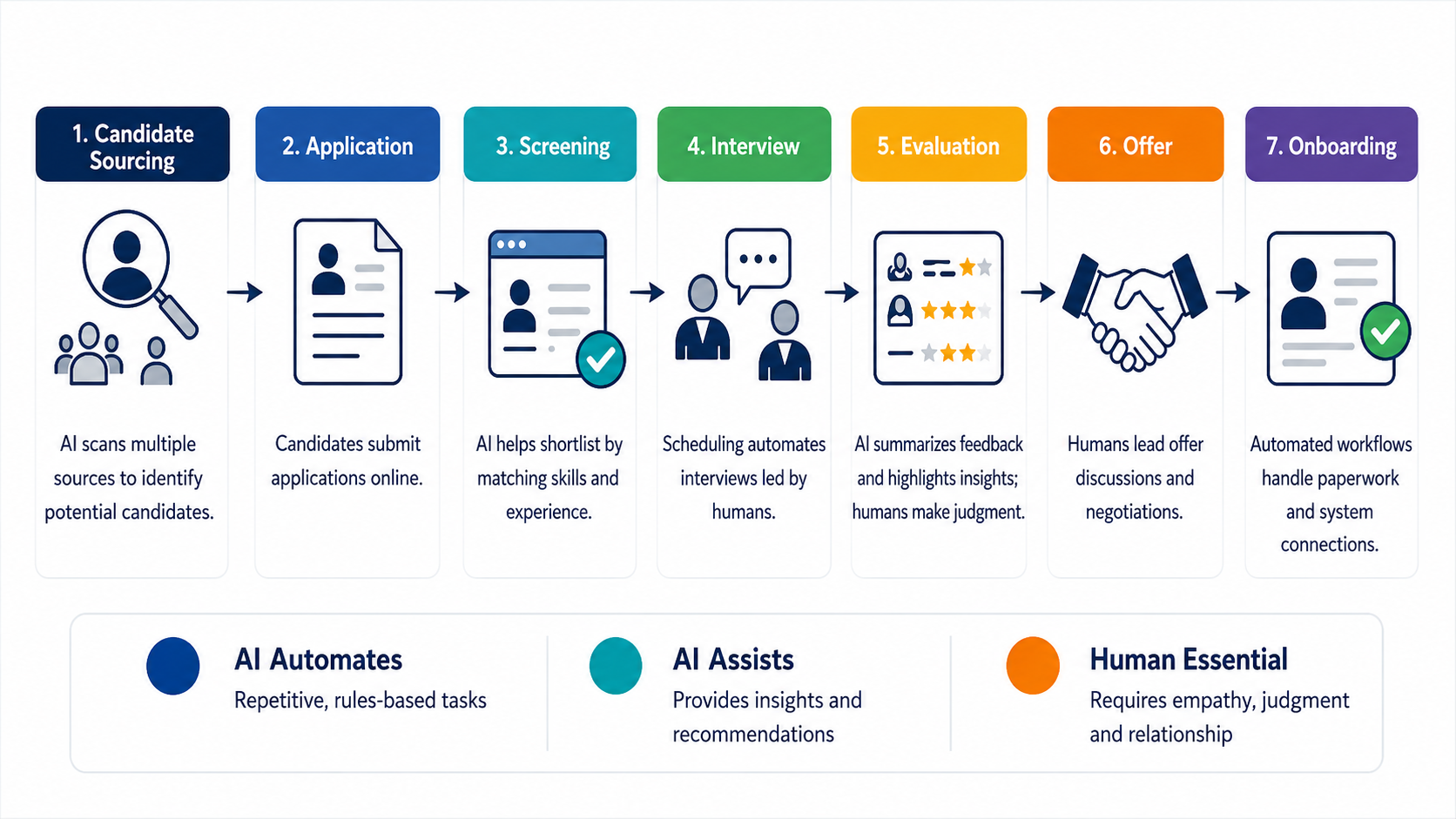
A useful starting point is to divide recruitment activities into three categories.
Automate
These are generally repetitive, administrative, high-volume activities where errors are relatively easy to correct and little human judgment is required.
Assist
AI prepares information, identifies patterns or makes recommendations, while a recruiter remains responsible for interpreting the output.
Human-led
These activities involve meaningful consequences, ambiguity, negotiation, empathy, trust or contextual judgment.
The categories should not be treated as permanent. A high-volume hourly hiring workflow may justify different automation from executive search, for example.
| Recruitment activity | AI role | Human role | Recommended approach | Human handoff trigger |
| Interview scheduling | High | Low | Automate | Complex availability, accommodation or repeated scheduling problem |
| Application acknowledgement | High | Low | Automate | Candidate raises a substantive question |
| Basic candidate FAQs | High | Low–medium | Automate with access to human help | Question becomes personal, sensitive or role-specific |
| Candidate sourcing | Medium–high | High | AI-assisted | Narrow or surprising candidate slate |
| Resume summarization | Medium | High | AI-assisted | Unusual career history, conflicting evidence or uncertainty |
| Candidate matching | Medium | High | AI-assisted | Score conflicts with recruiter evidence |
| Recruitment analytics | High | High | AI-assisted | Pattern is being used to make individual-level conclusions |
| Interview transcription | High | Medium | Automate with verification | Sensitive or inaccurate transcript |
| Interview evaluation | Low–medium | Very high | Human-led with structured AI support | Any consequential judgment |
| Candidate interview | Low | Essential | Human-led | — |
| Rejection after early application | Medium–high | Medium | Automation may be appropriate | Candidate requests clarification |
| Rejection after multiple interviews | Low–medium | High | Human-led communication | Usually human by default |
| Offer negotiation | Low | Essential | Human-led | — |
| Final hiring decision | Low | Essential | Human-led | — |
A useful rule is:
As consequence, ambiguity, context and relationship value increase, human involvement should increase too.
That is more useful than declaring individual technologies universally good or bad.
How to introduce AI without damaging candidate experience
Start with administrative friction
Do not begin with, “Where can we use AI?”
Begin with, “Where are candidates, recruiters and hiring managers wasting time?”
Perhaps interview scheduling regularly requires six emails. Fix that first.
Starting with a genuine problem helps prevent technology from becoming a solution searching for a use case.
Automate tasks, not relationships
The same technology can improve or weaken candidate experience depending on where it is deployed.
Automatically reminding someone of tomorrow’s interview removes friction.
Automatically conducting every conversation may remove the relationship.
The distinction should be intentional.
Keep humans accessible
Candidates should know how to reach someone when an automated process cannot resolve their issue.
This is especially important around accommodations, assessment concerns, unexpected circumstances, complex questions and consequential decisions.
Be appropriately transparent
Government responsible-AI guidance increasingly emphasizes transparency, explainability, accountability, feedback and opportunities for human review.
Transparency should be useful rather than legalistic.
Candidates need to understand what matters: where AI is involved, what role it plays and what they can do if something appears wrong.
Review generated communication
A perfectly grammatical message can still be a poor recruiter message.
Recruiters should review AI-generated communication for accuracy, specificity, tone and whether the situation deserves something more personal.
Audit outcomes
Do not audit only whether software works technically.
Examine progression rates, candidate drop-off, errors, overrides and relevant demographic outcomes where lawful and appropriate.
Most importantly, disaggregate results when possible. The Stanford hiring study is a useful reminder that aggregate outcomes can obscure disparities occurring at the level of individual jobs.
Train recruiters to challenge recommendations
AI literacy should include skepticism.
Recruiters need to understand what the system does, what it does not know, which signals influence recommendations and when an override is expected.
Otherwise, “human in the loop” becomes ceremonial.
Collect candidate feedback
Ask candidates about specific parts of the process:
Was it clear what would happen next?
Could they reach someone when necessary?
Did automated communication answer their questions?
Did they understand how assessments were being used?
Specific questions identify fixable problems better than a generic satisfaction score.
Review the whole journey
Finally, review automation cumulatively.
A recruiter may reasonably automate six individual activities. However, after those six decisions, trace the candidate journey from application to offer.
How many meaningful human interactions remain?
That exercise frequently reveals automation debt that individual workflow reviews miss.
Questions HR leaders should ask before adopting AI recruitment technology
Procurement should begin with the hiring problem, not the AI feature list.
Ask vendors:
- What specific recruitment decision or activity does the system influence?
- What candidate data does it use?
- Which data is unnecessary for the stated purpose?
- How were the models developed and validated?
- How do you test performance across relevant candidate groups?
- Can we examine outcomes using our own recruitment data?
- Can recruiters understand why a recommendation was produced?
- What happens when the system has weak or conflicting evidence?
- Can recruiters override recommendations?
- Are overrides logged and measurable?
- Can candidates correct inaccurate information?
- How can candidates reach a person or request appropriate review?
- How does the product support accessibility and accommodations?
- What information is retained, for how long, and for what purposes?
- Does candidate information train other models?
- Which third parties process the data?
- How are model or product changes communicated to customers?
- What reporting can our HR, privacy and legal teams access?
- What evidence supports claimed improvements in hiring outcomes?
- How will the system integrate into the recruiter’s actual workflow?
- What measurable problem are we solving by buying it?
Those questions are more important than whether the vendor has the most AI features.
NIST’s AI Risk Management Framework similarly emphasizes governance, mapping risks, measuring them and actively managing them rather than treating responsible AI as a one-time technical assessment.
How to measure whether AI is actually improving recruitment
Speed matters, but speed alone creates a dangerous definition of success.
Measure four categories together.
Efficiency
- Administrative time per recruiter
- Scheduling time
- Candidate response time
- Time-to-hire
- Cost per hire where useful
Hiring quality
- Hiring-manager satisfaction
- Appropriate quality-of-hire indicators
- New-hire performance measures used responsibly
- Offer acceptance
- Early attrition
Candidate experience
- Candidate satisfaction
- Drop-off by recruitment stage
- Candidate complaints or escalation
- Clarity of communication
- Access to recruiter support
- Offer acceptance
- Candidate willingness to apply again or recommend the employer
Recruiter experience and judgment
- Recruiter workload
- Time spent interacting with candidates
- Time spent with hiring managers
- AI recommendation override rates
- Frequency of corrections to AI-generated content
- Recruiter confidence in understanding system recommendations
Then add fairness and risk monitoring appropriate to the technology and jurisdiction.
The Human Time Dividend belongs here too.
If scheduling automation saves recruiters hundreds of hours, calculate how much more capacity is going into candidate calls, feedback, interview quality or talent-pipeline work.
A faster recruitment process can be better.
However, speed should be treated as one outcome, not the definition of quality.
The future of AI in recruitment is human-centered
AI is becoming part of normal recruitment infrastructure rather than a separate experiment. Current talent-acquisition research already shows organizations deploying it across screening, candidate communication, assessment and sourcing.
The more interesting question is what kind of recruiting function emerges around it.
One possibility is simply greater throughput: more applicants processed, more roles handled and more automated interactions.
The better possibility is a function in which recruiters spend less time coordinating work and more time applying judgment.
That means understanding the candidate whose career path does not fit a template. Challenging the hiring manager who is searching for an impossible profile. Explaining honestly why a role may or may not be right. Giving useful feedback. Negotiating. Building trust.
AI can support all of that by reducing work that never required a recruiter in the first place.
But organizations have to deliberately reinvest the capacity.
The same principle extends beyond hiring. Used responsibly, AI in employee engagement can surface useful workforce signals while leaving interpretation, conversations and action with HR leaders and managers.
FAQs
Will AI replace recruiters?
AI is likely to automate or reshape parts of recruiting rather than eliminate the need for human recruitment judgment. Administrative coordination, information organization and some early-stage activities can increasingly be automated. However, candidate relationships, contextual judgment, interviewing, negotiation, hiring-manager advisory work and accountable hiring decisions remain strongly human-dependent.
How can recruiters use AI without making recruitment impersonal?
Automate low-context administrative work first, preserve easy access to recruiters and define clear points where automation hands the conversation to a person. Then measure whether saved recruiter time is actually being reinvested into candidate and hiring-manager interaction.
Which recruitment tasks should not be fully automated?
There is no universal list. However, the stronger the requirement for empathy, ambiguity resolution, negotiation, contextual interpretation or consequential judgment, the stronger the case for human ownership. Final hiring decisions, substantive interviews, complex candidate concerns and offer negotiations are good examples.
What are the biggest risks of AI in recruitment?
Important risks include bias, inappropriate training data, weak explainability, overreliance on recommendations, privacy problems, accessibility issues, false positives and negatives, candidate distrust and excessive automation. Legal requirements also vary by jurisdiction and use case.
How can HR reduce bias when using AI recruitment tools?
Start with job-relevant criteria, understand the data and assumptions behind the system, test outcomes, examine results at sufficiently detailed levels, give recruiters meaningful override authority and investigate disagreements between recruiter evidence and AI recommendations. AI should not be assumed to remove human bias automatically.
Should candidates be told when AI is used?
Organizations should review the applicable legal requirements in every jurisdiction where they hire. Beyond minimum compliance, useful transparency can strengthen candidate trust, particularly when AI influences assessment or selection rather than merely handling administration. Government guidance on responsible recruitment AI also emphasizes transparency, explainability, feedback and opportunities for appropriate human review.
Successful AI recruitment should make recruiters more human, not less
The goal of AI in recruitment should not be to remove recruiters from the candidate journey.
It should be to remove work that prevents recruiters from doing their best work.
Let technology coordinate calendars, organize information, find patterns and prepare first drafts where it can do so responsibly. Then give recruiters the capacity and authority to handle the moments that require curiosity, judgment, empathy and accountability.
That distinction matters because neither humans nor AI are automatically good at hiring.
The quality of the process depends on how responsibilities are designed.
If AI helps recruiters spend more time understanding candidates, advising hiring managers and having meaningful conversations, automation can strengthen the human side of recruitment rather than weaken it.
That is a much better standard for AI adoption than simply asking how much of the hiring process can be automated.