Communicating policy changes to employees who work shifts requires more than replacing an email with a text message. A warehouse associate on nights, a nurse finishing a twelve-hour shift, and a hotel housekeeper moving between floors may not share an inbox, a device, or a convenient moment to read. To make a policy change stick, the organization must explain what changed, reach every affected shift before the policy applies, provide a dependable place to find the current rules, and check that people understand what to do differently.
A practical no-email policy rollout combines one approved source of truth, a channel plan matched to employee access, paid-time explanations or training when required, a clear acknowledgement or competency check for consequential changes, and follow-up by location and shift. SMS, employee apps, printed notices, digital signage, team huddles, kiosks, and supervisors can all help, but none of those channels on its own proves that a policy was understood or followed.
The central question is not, “Did we send the policy?” It is, “Could every affected employee access the approved version, understand how it changes their work, ask a question, and act correctly when the effective date arrives?”
Why Policy Announcements Fail With Shift Workers
Most organizations have a formal method for announcing a new policy. HR revises the handbook, Legal approves the language, Communications circulates the announcement, and managers receive a note to share with their teams. On a calendar, the launch looks complete. On the floor, the news arrives unevenly. For a wider look at why channels fail to reach deskless teams, see TurnOnWork’s frontline employee communication guide.
The morning shift hears about a new attendance rule at its daily meeting. The afternoon shift sees a printed notice that does not explain the exception process. The overnight crew is told the next day by a supervisor who paraphrases the policy from memory. Someone on leave returns two weeks later and finds that the old policy is still pinned in a team chat. Every person works for the same organization but receives a different version of the change.
This is often an access and timing problem, not employee indifference. In SHRM’s reporting on research about deskless-worker benefits communication, HR professionals identified limited computer access during the workday, irregular schedules, and limited face-to-face contact as important barriers. The findings concerned benefits communication, but the underlying challenges apply to many workplace-policy announcements.
Policy changes also carry a higher burden than ordinary company news. Employees may need to change a safety practice, use a new scheduling process, follow a different absence-reporting rule, record time differently, or understand an updated benefit. A missed recognition post is disappointing. A missed operational or safety requirement can have very different consequences.
The common failure is treating publication as the finish line. Sending, seeing, understanding, agreeing, acknowledging, and complying are separate events. A process that measures only the first two can look successful while the policy is still being applied inconsistently.
Start by Defining Exactly What Is Changing
Before choosing channels, make the policy change precise enough that a frontline employee can understand it without interpreting a lengthy document. Do not ask a communications platform to solve ambiguity in the policy itself.
A useful change brief should answer six questions: What was the previous rule? What is the new rule? Who is affected? When does it take effect, including time zone and shift boundaries? What must employees do differently? Where do they go for an exception or clarification?
Consider a fictional manufacturing company changing how an equipment defect is reported. “Updated equipment reporting procedure, effective November 15” is technically a notice but tells operators almost nothing. A better explanation says that, starting with shifts beginning on November 15, employees must use the new incident form before leaving their assigned area, must immediately notify a supervisor when equipment presents an urgent danger, and can find the approved procedure through a posted QR code or shared terminal. That is a change employees can act on.
Separately identify what is not changing. If an attendance policy changes the method of reporting absence but not the entitlement to approved leave, say so. Otherwise employees may fill the information gap with rumors about discipline, pay, scheduling, or benefits.
Classify the change by risk and required action
Different changes need different levels of evidence and explanation. Use a simple internal classification rather than treating every handbook edit as an emergency.
| Change type | Typical example | Recommended communication approach | Evidence to collect |
| Informational | Renamed department or revised contact details | App, noticeboard, huddle, or other normal channel | Publication and reasonable reach |
| Routine operational | New uniform-ordering process | Targeted update, quick demonstration, searchable instructions | Reach plus observed questions or task success |
| Employee-impacting | Attendance, scheduling, leave, pay administration, conduct | Clear before/after summary, manager briefing, private Q&A, accessible full policy | Individual delivery or acknowledgement where appropriate; escalation of gaps |
| Safety-critical | Lockout procedure or emergency response change | Formal training or instruction, practice and supervision as required | Documented training and demonstrated competence where applicable |
| Legally or contractually sensitive | Terms covered by law, collective agreement, required notice, or bargaining | Legal/HR review before implementation; prescribed communication steps | Records required by applicable law, agreement, or internal controls |
These are planning categories, not legal classifications. A change may fall into several rows. A revised safety procedure may also affect scheduling, training, or a collective bargaining agreement.
Separate the approved policy from its explanation
Keep the authoritative policy in one controlled location with an owner, version number, approval date, effective date, and change history. Then create shorter versions for different channels without allowing any channel to invent a new rule.
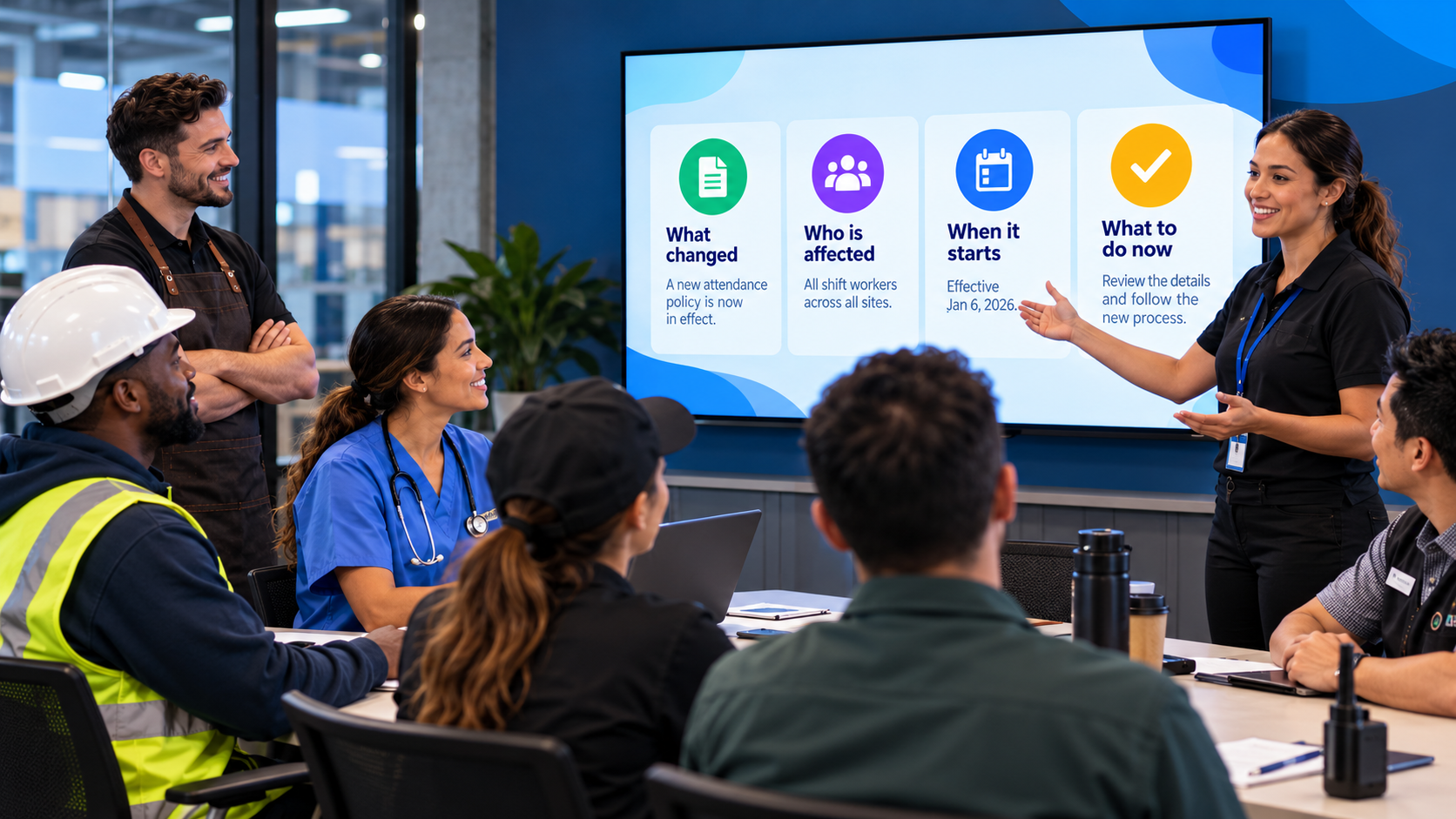
The employee-facing summary can use ordinary language: What changed / Why it changed / What I need to do / When it starts / Where I can ask. A supervisor’s talking points should use the same facts. SMS and signage should point to the same approved version. A quick-reference card should not contradict the long policy or omit an important exception.
If the full document is too long for a phone screen, that is a design problem. Break the action steps into accessible sections while keeping a link or physical route to the complete, approved text. Avoid distributing multiple uncontrolled PDFs that remain in circulation after the next revision.
Map the Employees, Shifts, Devices, and Working Conditions
The audience must come from the policy, not an indiscriminate corporate list. Account for part-time staff, float workers, weekend teams, new hires, transfers, employees on leave, and temporary workers or contractors who are in scope. A forklift-policy change may apply to three facilities; a timekeeping change may affect everyone but require different explanations for managers and hourly staff. TurnOnWork’s internal communications strategy for distributed teams offers a broader framework for audience segmentation and channel ownership. Communicating policy changes to employees without email begins with knowing which channels each shift can realistically access.
Build the roster from HR and scheduling data and confirm it with local leaders. Employee locations and assignments change. A targeting list can be accurate on Monday and incomplete by Friday.
Audit access instead of assuming that everyone has a phone
For each important employee group, document whether people have corporate email, personal or company-owned phones, permission to use phones at work, shared terminals, reliable internet, an existing workforce-management app, approved messaging channels, and time during a paid shift to review a change.
Add language, reading accessibility, hearing and vision access, and alternative-format requirements. Employees who can technically receive a message are not necessarily able to read, hear, or navigate it. In some manufacturing environments personal devices are restricted; in healthcare, alerts compete with clinical workflow; in hospitality, workers may have very different access between front desk and housekeeping teams.
The EEOC’s reasonable-accommodation guidance explains that employees with disabilities may require accessible ways to receive workplace information provided to others. A digital-only policy rollout should not leave those employees dependent on someone remembering to pass along the news.
Put the effective date on a shift calendar
A policy described as effective “Monday” may start halfway through a Sunday-night shift. A deadline at midnight can mean different moments at sites in different time zones. For overnight operations, specify whether the rule applies to shifts beginning on or after a stated local date and time, or to all work performed after that time.
This is not a small editorial detail. It determines which supervisor must train the night team and when the old and new procedures stop being valid. The owner should also decide how the change applies to employees returning from leave, newly assigned employees, workers on cross-site shifts, and staff who were absent during the rollout window.
A practical audience register contains the affected group, site, shift, primary channel, fallback channel, responsible manager, deadline, and verification status. The point is not to create another elaborate spreadsheet; it is to make missing employees visible before the policy takes effect.
Pillar 1: Communicating Policy Changes to Employees Without Email
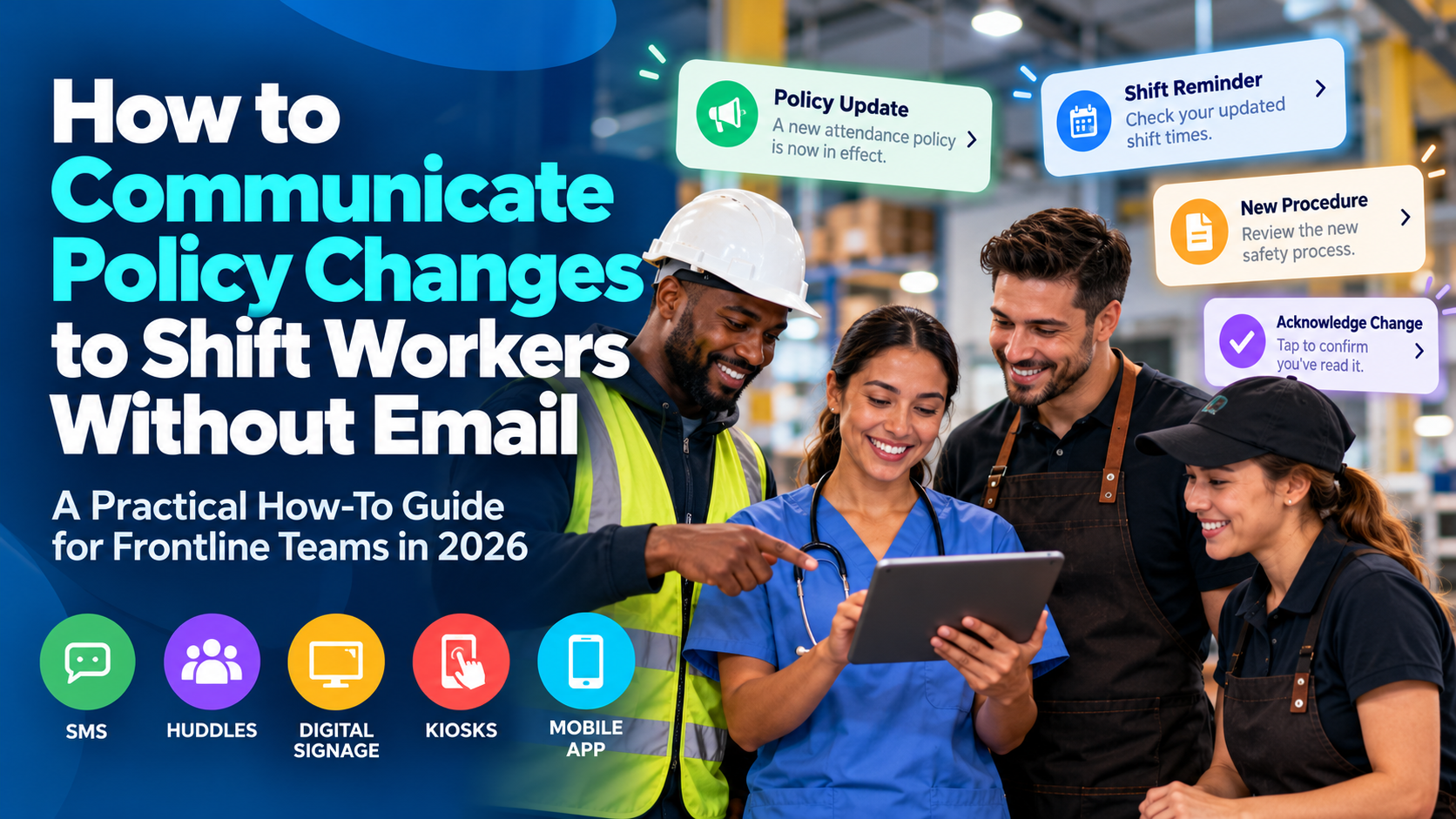
The strongest approach uses multiple channels with deliberately different jobs. One channel alerts. Another explains. Another preserves the official document. Another provides a conversation. For consequential changes, another records that the employee received the information or successfully completed the required instruction.
Using several channels does not mean pasting the full policy everywhere. That creates inconsistent versions and notification fatigue. It means using the same approved message in formats appropriate to work.
A practical channel model for shift-worker policy changes
| Channel | Best role in a policy rollout | Main strength | Important limitation |
| Employee mobile app | Targeted notification, mobile policy summary and follow-up | Personal access and measurable engagement | Requires onboarding, access and continued use |
| SMS | Urgent alert or notice that a change requires attention | Works without corporate email or app adoption | Short, may expose information on shared/personal phones; delivery is not understanding |
| Shift huddle | Explain operational meaning, invite questions and demonstrate a task | Reaches employees during real work | Quality varies by supervisor and shift |
| Digital signage | Repeated visual reminder in shared spaces | Reaches people without requiring a login | Cannot replace a full policy or prove individual receipt |
| Printed quick-reference card | On-the-job instructions and visual reminders | Useful where phones are restricted | Becomes stale unless replacement is controlled |
| Shared kiosk or terminal | Full policy access, acknowledgement or training in a physical workplace | Can serve staff without individual devices | Access, privacy and automatic logout must be designed |
| Workforce-management or scheduling app | Notices at a tool workers already use | Close to shift workflow | Access and acknowledgement capabilities vary |
| QR code | Bridge from a poster or card to approved policy | Reduces typing and navigational effort | Requires a suitable device and connection |
| Manager conversation | Answer local questions and confirm practical understanding | Trusted, contextual and two-way | Should not be the only delivery or historical record |
| Paper handout or posted notice | Accessible fallback or required physical notice | Does not depend on digital activation | Individual receipt and version control are harder |
The choice should reflect the policy’s seriousness. An updated dress-code photo can be delivered in the normal app feed with huddle reinforcement. A change in emergency evacuation instructions requires a much more controlled process, potentially including formal instruction and practical exercises.
Use the employee app for the full change journey
An existing employee app can carry a targeted alert, plain-language summary, approved document, question form, and any required acknowledgement. Keep the effective date, action, and policy version prominent, and let employees find the current rule after the announcement disappears.
But publication is not access. If part of the overnight crew has never signed in, the organization needs a fallback. An attractive homepage does not solve restricted phones, shared devices, or weak connectivity. Use app metrics to identify access gaps rather than treating every employee as reachable.
Use SMS to get attention, not to carry the whole policy
A useful SMS says: “Attendance reporting changes for shifts starting Nov 15. Review the update during your next shift at [approved link] or ask your supervisor. Do not reply with personal medical details.” It gives the essential fact and a path to detail.
Do not put private HR matters, passwords, or a complex policy into a text. Check personal-phone use, privacy, contact permissions, and alternatives for workers who cannot or do not use SMS. Delivery does not prove understanding; when individual evidence is necessary, point employees to a suitable authenticated workflow.
Make signage and printed notices lead to the current answer
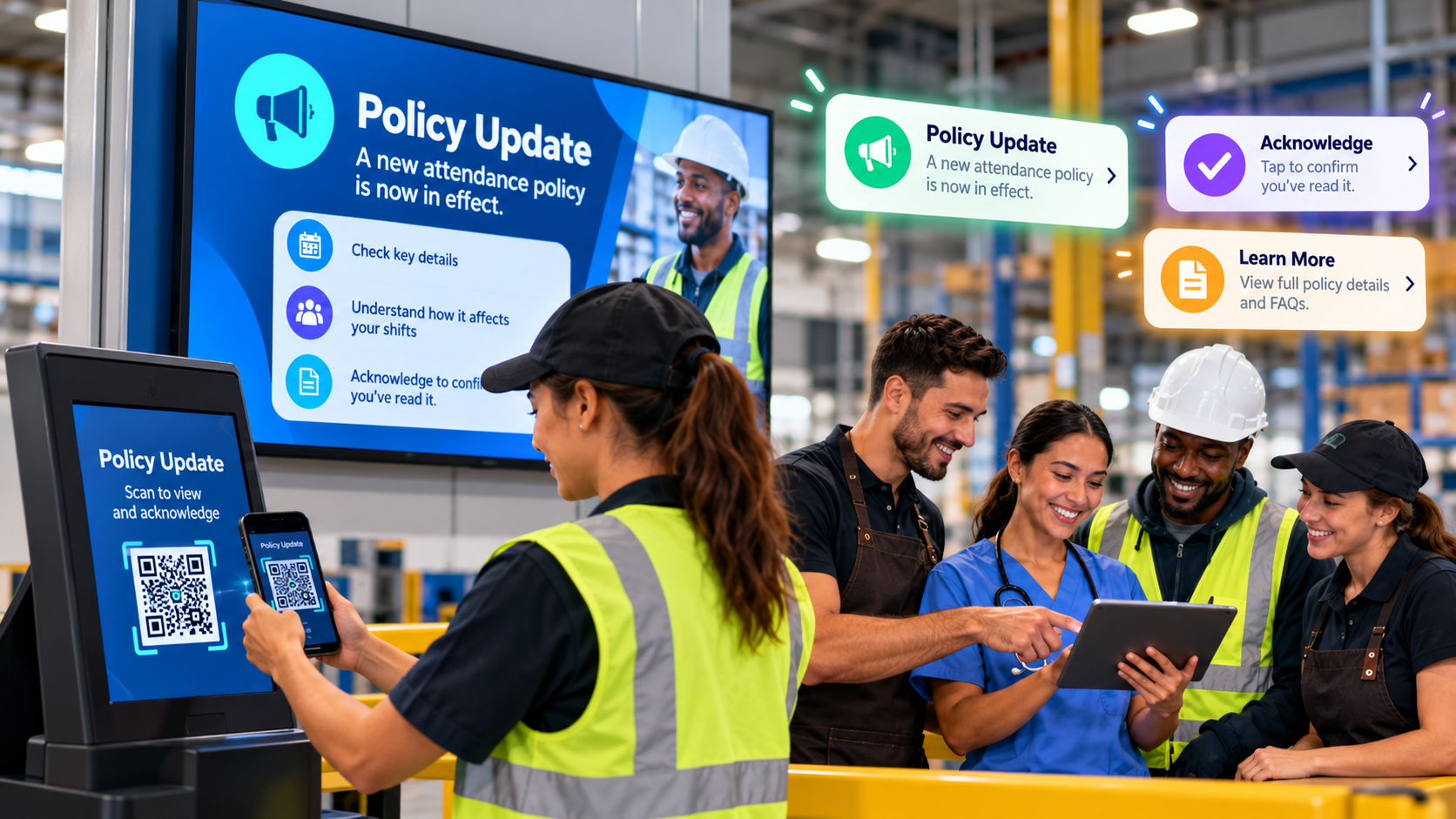
A break-room screen can say, “New equipment reporting steps start Nov 15. Review the 3-step guide before your next shift. Scan here or ask your supervisor.” Keep messages short and repeat them across days, nights, and weekends. The wider channel trade-offs are explained in TurnOnWork’s frontline communication channel guide.
Every notice should identify the effective date and point to the approved document. Replace old posters and laminated job aids during rollout. Signage creates visibility; it cannot deliver a nuanced exception or establish that one employee understood the change.
Make shift huddles a genuine explanation channel
A short shift huddle can explain what changes in today’s work and invite questions. Give each supervisor a consistent sheet: changed rule, effective point, who is affected, practical examples, and escalation contact. Include nights and weekends.
Use private routes for questions about leave, accommodations, pay, or personal circumstances. The huddle should clarify the policy, not authorize a manager to invent local rules.
Treat shared devices as a real primary channel where necessary
Shared tablets, kiosks, and terminals may be the only approved route for employees whose phones are restricted. Make the experience convenient during paid work, keep sessions private, log users out automatically, and offer an accessible alternative where needed.
If the network fails, follow an approved contingency rather than reverting informally to an old policy. A kiosk hidden in a closed HR office is not meaningful access for an overnight crew.
Make the authoritative policy available after the announcement
Keep the current approved policy in a stable, searchable location, with a named owner, effective date, version, and applicable audience. Include terms employees use: “call out sick” may be easier to find than “Unscheduled Absence Notification Procedure.”
Make exceptions and questions easy to find beside the rule. A worker facing an unfamiliar situation mid-shift should not have to ask which of three PDFs is current.
Dedicated Software That Can Support No-Email Policy Rollouts
Software should be selected after the organization understands employee access and the proof it actually needs. A broadcast tool, a mobile knowledge hub, a training system, and an employee acknowledgement workflow solve overlapping but different problems. Do not buy an entire platform just because a demo shows a beautiful announcement feed.
HubEngage
HubEngage brings together employee communication across channels such as mobile, web, SMS, and digital displays, along with other engagement features. Its documentation also describes read acknowledgements, which may be useful for selected policy messages. It is worth evaluating when the same policy must reach office staff and frontline groups through different channels without recreating the campaign separately.
Ask the vendor to show how it handles an employee without corporate email, failed delivery, acknowledgement, localization, data export, and the path from a brief notification to a controlled policy document. Confirm the exact channels and modules included in the quote rather than assuming every capability is in the base package.
Blink
Blink is relevant when the central problem is giving frontline employees a practical mobile home for communication and knowledge without relying on an office inbox. Its platform emphasizes employee updates, chat, resources, and access to policies and procedures. This can help where workers need to find guidance between tasks rather than navigate a complex legacy intranet.
The procurement test should concentrate on sign-in, shared-device considerations, targeting, source-of-truth management, accessible content, and the specific level of acknowledgement or proof available in the required configuration.
Staffbase
Staffbase spans employee app, intranet, digital signage, and enterprise communications. It is particularly relevant when Corporate Communications needs central control but plant, store, or regional managers publish local information. Its current site discusses policy updates across channels with acknowledgement tracking.
For policy rollouts, test the actual publication and approval workflow, how local editors are restricted, how different channels resolve to one current document, and how a policy revision reaches people who already read the earlier version.
Beekeeper by LumApps
Beekeeper, now part of LumApps, is geared toward mobile frontline access, operational tasks, forms, workflows, and location- or shift-relevant communication. That can be useful when a policy change also requires employees to complete a checklist, submit a form, or change a daily operating action.
Because the combined product experience has evolved, buyers should request a precise demonstration of what is available in the proposed package today, what may depend on separate components, and what is still roadmap work.
Firstup
Firstup makes sense when a large enterprise needs audience segmentation, planned follow-up journeys, and evidence that important updates reached or prompted action from specific employee groups. The platform emphasizes targeting, multichannel campaigns, acknowledgements, and analytics.
That depth may be valuable for complex, multi-location change programs; it may be more than a smaller operation needs for straightforward shift huddles and mobile policy access. Confirm the licensing for advanced reporting and journey features.
Speakap
Speakap focuses on frontline employee communication through mobile channels and workplace information. It can be worth considering when the first priority is direct access for workers who are not desk-based, along with localized updates and ongoing communication.
For consequential policy changes, ask specifically whether the proposed plan supports individual acknowledgement, immutable evidence, document versioning, identity linkage, and export of records. Do not assume that a read indicator has the same meaning as a training or acceptance record.
Compare workflows, not feature checkboxes
| Buying priority | Platforms worth examining | What to test live |
| Several channels for one workforce | HubEngage, Staffbase, Firstup | Cross-channel targeting, fallback and duplicate suppression |
| Mobile access without company email | Blink, Beekeeper, Speakap, HubEngage | First-day login with a representative hourly worker |
| Policy linked to frontline work | Beekeeper, Blink and applicable integrations | Updated procedure, form or task available during the shift |
| Complex enterprise campaign evidence | Firstup, Staffbase and comparable platforms | Group-level gaps, version history, reports and follow-up |
| Formal competency or compliance training | Specialized LMS or safety-training system plus communications channel | Whether policy communication and required training records can be connected |
No single product should be treated as automatically meeting legal notice, accessibility, records-retention, or training obligations. Buyers need to validate their own use cases, configuration, contractual scope, and applicable requirements. A good decision begins with a shift worker completing a realistic policy task—not a dashboard slide.
Pillar 2: Deliver the Change Across Every Shift and Verify Understanding
A channel plan is only a plan until it survives a real rollout. The most common weakness is that headquarters announces the change at a convenient office time, then assumes every location will somehow catch up. Good policy communication has a defined sequence and clear ownership from approval to the first affected shift. In practical terms, communicating policy changes to employees is a sequence of approvals, shift-level explanations, questions and verified actions—not a one-time announcement.
Step 1: Create one approved change package
Assemble an approved full policy, old-versus-new summary, employee notice, supervisor talking points, FAQ, any required training or demonstration, and an escalation contact. HR, Safety, Operations, and Legal should review matters within their scope.
Give each asset an owner and version. The local manager should not be left to decide whether a poster or PDF is the latest approved instruction.
Step 2: Set the sequence around the first affected shift
Work backward from the earliest shift when the rule applies. Allow time for required consultation or notice, translation, questions, training, manager preparation, and fallback communication. Scheduling changes also need a reliable source of truth and advance notice; TurnOnWork’s shift scheduling best practices guide covers those operating rules.
A policy effective November 15 needs to reach relevant night, weekend, and rotating staff before their first affected work. Employees away from work need a catch-up route; genuinely urgent changes require a controlled escalation process, not wishful assumptions about ordinary scheduling.
Step 3: Brief managers before employees—but do not depend only on managers
Brief supervisors on what changed, when it applies, concrete examples, where the current text lives, what they can answer, and what must go to HR, Safety, or Labor Relations. Do not let them improvise policy exceptions. For a fuller manager toolkit and rollout sequence, see TurnOnWork’s change management communication plan for frontline teams.
Then give employees direct access to the same approved information. Managers explain local implications, but they should not be the only fragile route from headquarters to the night shift.
Step 4: Deliver a plain-language message with a specific action
Lead with the change, not a long introduction about organizational values. For many employees, a useful notice has six short elements: What is changing, who is affected, when it starts, what I need to do, where I can read the policy, and who can answer questions.
Avoid language such as “Please familiarize yourself with the recently enhanced standards.” It hides the action. Say, “Starting with shifts beginning November 15, report a missed shift through the scheduling line instead of sending a text to your supervisor. Your existing leave rights are unchanged. Ask HR if you cannot access the line.”
Keep the announcement separate from the full document so employees can understand the essential action quickly. Link or point to the complete approved policy for exceptions, definitions, and details. Use a clear date in the local time zone, not a relative phrase like “next Monday” that becomes misleading when a poster stays up.
A usable policy-change message template
Subject / poster headline: Attendance reporting method changes November 15
What’s changing: Employees assigned to affected sites must use the designated scheduling line to report an absence instead of notifying a supervisor by personal text message.
When: Applies to shifts beginning on or after November 15 at 12:00 a.m. local site time.
What you need to do: Save the number provided at work, review the two-minute instructions during your next scheduled shift, and use that line if you need to report an absence under the policy.
What is not changing: Approved leave rights and the process for requesting an accommodation are not changed by this reporting-channel update.
Questions or access problems: Speak privately with HR or your site supervisor during your next scheduled shift. A printed copy and a shared terminal are available at the staff office.
Approved policy: Attendance Reporting Procedure, version 2.1, effective November 15. [Insert the verified internal link or location before publication.]
This is an illustrative template, not a policy suitable for publication without checking the employer’s actual rules and legal requirements. Its value is that it makes the change and the employee action unmistakable.
Step 5: Explain the change in every relevant shift huddle
Use a repeatable huddle: state the new rule, illustrate one realistic example, name the effective date, show the authoritative document, invite questions, and identify a confidential follow-up route. Record attendance and plan for absentees.
Match the instruction to the risk. A benefits deadline may require explanation and an HR contact. A changed machine procedure may require formal instruction and observed practice. Attendance or a signature alone is not evidence of task competence.
Step 6: Offer accessible and multilingual explanations
Start with plain, unambiguous source text; then translate the approved meaning and review high-risk terminology. Caption videos, support assistive technology, provide readable alternatives, and avoid relying on color alone for important distinctions.
For safety instruction, OSHA’s training guidance and language-policy interpretation emphasize information delivered in language and vocabulary workers understand. A translated poster cannot substitute for training that a particular hazard or task requires. Give employees a route to ask questions in an accessible way.
Step 7: Create a private route for questions, objections, and exceptions
A huddle can answer general questions about shift boundaries or where forms live. It should not require someone to disclose medical information, a complaint, or a personal employment issue in front of coworkers.
Assign each question a responsible owner: HR for leave and employee policy, Safety for procedures, Operations for implementation, IT for login problems. If managers cannot answer, they escalate. Repeated questions signal unclear wording or access problems that should be fixed in the approved FAQ.
Step 8: Choose the right level of acknowledgement
Organizations often use “acknowledgement” to describe several different events. Be precise, especially when the policy may affect employee rights or safety.
| Evidence level | What it establishes | What it does not establish |
| Sent or posted | An organization initiated distribution | That the intended person encountered it |
| Delivered | A system or channel reported delivery | That the employee read or understood it |
| Viewed or opened | Someone accessed the material | Understanding or correct action |
| Receipt acknowledged | An identified employee confirmed receipt or review, depending on wording | Agreement, comprehension, or legal waiver |
| Knowledge check or demonstration | Evidence of understanding or ability for the task tested | Perfect future behavior in every situation |
| Observed correct practice | Evidence of implementation at the observed time | Ongoing compliance without monitoring |
The wording of the acknowledgement matters. “I received this policy” is different from “I understand this procedure,” and both are different from “I agree to a contractual change.” Do not blur those categories. An acknowledgement should not be used to imply that an employee has waived rights or consented to changes merely because they confirmed receipt.
For lower-risk updates, broad reach and ordinary manager reinforcement may be enough. For consequential changes, an identified receipt record can reduce uncertainty. For safety-critical or skill-based changes, a demonstration or assessed training may be required. HR, legal, labor relations, and Safety should define which evidence is appropriate rather than choosing a universal signature button.
Step 9: Follow up with employees who were absent or unreachable
Track who still lacks the communication, acknowledgement, or training appropriate to the change. Include leave returns, weekend-only staff, transfers, new hires, and workers whose app or SMS route failed.
Use an approved fallback at the next suitable paid shift, and arrange any required practical instruction before assigning affected tasks. The aim is a documented catch-up path, not endless personal messages from supervisors.
Step 10: Retire old versions at the same time
Replace outdated posters, laminated instructions, onboarding materials, training scripts, and digital copies as part of launch. Mark retained history clearly as superseded; redirect old links where practical.
A new policy is not truly implemented while the old one remains the easiest version to find.
Legal, Privacy, and Employment Issues That Should Be Reviewed Before Rollout
“Without email” describes a delivery challenge, not a legal exemption. The organization’s notice and consultation duties depend on what is changing, where employees work, which agreements apply, and what the relevant rules require. No generic checklist can replace review for a policy affecting compensation, scheduling, protected leave, discipline, workplace safety, or employee rights.
Do not make required policy work invisible unpaid work
A mandatory policy review, training task, quiz, or acknowledgement performed outside scheduled hours may raise compensable-time questions for covered nonexempt employees in the United States. The U.S. Department of Labor’s off-the-clock guidance explains that work an employer requires or allows may count as hours worked, even when not specifically requested in advance.
That does not mean every phone notification creates paid work. It does mean HR and payroll should examine the actual task, whether it is mandatory, where and when it is performed, and applicable federal, state, and local rules. A robust design allows affected hourly employees to review and complete required steps during paid work time and records time where legally required. Avoid suggesting that employees are expected to check policies constantly while off duty.
Check notice, scheduling, and employment requirements by jurisdiction
A policy changing pay practices, shift scheduling, leave processes, or employment terms may trigger written-notice or timing obligations in some jurisdictions. Certain industries and localities have additional scheduling rules. Do not use an internal app post as a substitute for a required individual notice or prescribed posting method without confirming that it meets the applicable requirement.
A multi-state employer should ask counsel or its compliance team to identify which rules apply to each affected population. The same change may need distinct notices and lead times at different locations. Labor agreements, handbooks, offer documents, employee classifications, and past practices can also matter.
In unionized workplaces, communication is not a substitute for bargaining
For represented employees, a policy affecting mandatory subjects of bargaining may require bargaining or other contractual steps before the employer implements the change. The National Labor Relations Board’s employer guidance describes duties concerning changes to wages, hours, and other working conditions.
Do not mistake the ability to notify an employee for authority to change the underlying term. Involve labor relations before finalizing the rollout, examine the relevant collective agreement, and coordinate both bargaining communications and employee explanations. Avoid language suggesting employee acknowledgement itself validates a change that required a different process.
Safety policies may require instruction, not merely notice
When a policy changes exposure controls, emergency procedures, equipment operation, or another safety-critical practice, a poster and read receipt may be inadequate. OSHA standards have topic-specific training and information requirements, and the employer needs to determine which apply to the actual hazard. OSHA’s education and training guidance emphasizes instruction that employees can understand and additional training when changes introduce relevant hazards or tasks.
A sound process includes explanation, a chance to ask questions, and practical assessment where needed. The manager should observe whether the worker can use the new method correctly, not assume that a signature proves skill. Records should be retained according to the requirements applicable to the training program and employer.
Protect employee contact information and sensitive responses
Personal phone numbers, policy acknowledgements, survey responses, and login records are employee information. Limit collection to what the rollout needs, restrict access by role, define retention, and use approved providers and security settings. An SMS list should not be exported and circulated casually between managers.
Avoid public channels for individualized medical, disciplinary, leave, or complaint matters. Provide private alternatives to group chat and shared kiosk screens. Where personal devices are used, explain what the app accesses and what happens when employment ends or a device is lost. Verify requirements for messages, workplace monitoring, privacy, and employee consent in the relevant jurisdiction.
Keep records useful without keeping everything forever
For each change, decide which evidence is necessary: approved version, audience snapshot, delivery logs, manager briefing record, acknowledgement record, training results, accessibility or accommodation steps, remediation, and closure of outstanding cases. Preserve what the employer needs for legitimate operational and legal purposes, under a documented retention and access policy.
More data is not automatically better. A record that says an employee clicked a link three times may be less useful than one showing which policy version they acknowledged before their next assignment. Do not describe a system’s evidence as “legally compliant” without an assessment of the employer’s actual obligations.
Pillar 3: Measure Whether the Policy Was Received, Understood, and Applied
Policy-change communication is successful when affected employees know the current rule and can follow it, not simply when a dashboard reports a high open rate. The measurement model needs to follow the actual path from publication to employee action. The central test of communicating policy changes to employees is whether the right people understood and applied the instruction, not just whether a channel recorded an opening.
Measure five stages of a policy change
- Coverage. Is the audience complete? Compare the intended employee population with the roster from HR and scheduling. Look for missing contractors, recent transfers, leave returns, weekend staff, agency staff within scope, and newly assigned employees.
- Access. Could each affected employee obtain the approved information through an available channel? Track app access, shared-device availability, notice distribution, briefing coverage, and failed or bounced messages. If a segment cannot access the content, its read rate is irrelevant.
- Receipt. Is there credible evidence that the employee encountered or received the change when that evidence is needed? Distinguish system delivery from a person’s acknowledgement and record which version was involved.
- Understanding. Can employees explain the new rule and perform any required task? Use brief scenario questions, manager observation, task demonstrations, or a qualified training assessment appropriate to the policy’s risk.
- Implementation. Did behavior actually change? Monitor corrected timekeeping entries, use of the new reporting line, completion of the revised checklist, safety observations, avoidable support requests, or other outcomes directly related to the policy.
These stages should not be collapsed into a single percentage. A high receipt rate paired with frequent incorrect applications is a signal to improve the explanation, the underlying process, or both.
Use a policy-change measurement scorecard
TurnOnWork’s internal communications KPIs and metrics guide expands on reach, comprehension, action, and outcome measurement.
| KPI | Question answered | Practical segment |
| Audience coverage | Are all affected employees on the rollout list? | Site, shift, role and employment status |
| Reachable employees | Can people access at least one approved channel? | Device access and location |
| Briefing completion | Did every planned shift receive the explanation? | Supervisor, shift and site |
| Delivery failure | Which notifications or notices did not reach their targets? | Channel and employee group |
| Receipt/acknowledgement | Who has confirmed the specified step, where necessary? | Person and policy version |
| Understanding | Who can apply the new requirement? | Role, language and worksite |
| Training completion | Who completed required practical instruction? | Qualified task and assignment |
| Time to readiness | Was the employee ready before the first affected shift? | Shift start and date |
| Exception resolution | Were substantive questions and access problems closed? | HR, Safety or Operations owner |
| Operational adoption | Is the new process being used correctly? | Team, site and policy action |
A scorecard should show the denominator for every rate. “92% acknowledged” is misleading if the audience excluded the weekend shift. Distinguish truly out-of-scope employees from those who were missed, excused, on leave, or awaiting a reasonable accommodation; avoid counting everyone in the same failure category.
Segment by shift before claiming success
Imagine a fictional retailer announcing a new incident-reporting procedure. The overall acknowledgement rate reaches 89%. Leadership sees a successful rollout. But the detail shows headquarters at 99%, store day shift at 95%, evening shift at 83%, and the distribution-center overnight shift at 48%.
That is not an organization with uniform readiness. The audience that handles overnight receiving and loading has a significant access or briefing problem. A local manager may have been absent, phones may be restricted, the notice may have appeared after the shift ended, or the kiosk may be unavailable at night.
Track policy readiness by site, role, shift, language, manager, and access route where relevant and lawful. Investigate outliers before issuing reminders. A repeated push to employees who cannot log in is not a remedy; it is more noise.
Measure the first few weeks after the effective date
The day a policy takes effect is the beginning of implementation measurement. Watch whether employees perform the new step correctly, whether supervisors have to reinterpret instructions, whether older forms still circulate, and what questions continue appearing.
For a revised absence-reporting policy, monitor whether people are using the approved reporting route and whether the route actually works outside office hours. For a new warehouse safety procedure, monitor practical adherence and any required competency. For a benefits process, track whether affected staff can find the guidance and complete the action without repeated support calls.
Be cautious about causal claims. A fall in process errors may reflect training, staffing, process redesign, equipment, or manager follow-up as well as communication. The sensible conclusion is that the rollout contributed to the outcome when there is evidence, not that one notification caused every change.

Close the loop with the people who asked questions
When repeated employee questions expose an unclear phrase, fix the source wording and inform the affected population. If a broken link is repaired, say where the correct document now lives. If a manager is applying an exception inconsistently, address that problem directly rather than issuing another generic announcement.
A simple closure message works: “You asked whether the new reporting line works overnight. We tested it and added 24-hour instructions to the policy summary. The approved number is now also on the staff noticeboard.” Employees are more likely to trust a communication process that visibly responds to reality.
Build One Source of Truth Across Shifts and Sites
A source of truth is a controlled chain linking the approved policy, summary, signage, manager scripts, training materials, and required records to one version. The owner approves changes; local teams may add authorized contact details but not alter the rule. Communicating policy changes to employees across multiple sites requires every channel to point back to the same approved, dated policy.
Each employee should be able to find the current version, effective date, scope, exceptions, and question route. Where regional or labor-agreement variations exist, label them as approved variants. An authoritative document that headquarters can open but a warehouse employee cannot is not a usable source of truth.
Give Local Managers Clear Responsibilities Without Letting Rules Drift
Central policy owners control substance; local leaders control the practical delivery. Give each site an accountable person for briefing every shift, updating materials, reporting missing employees, escalating questions, and recording required completion.
Managers may show employees how the new process works. They should not independently waive the rule, alter discipline, or invent a leave exception. Document genuine local variations and their authority. If two sites give different instructions, the organization should know whether that is deliberate or a mistake.
Design the Rollout Around the Rhythm of Work
Shift workers experience time through pre-shift preparation, handoffs, breaks, and sign-out rather than a headquarters publishing calendar.
Before shift: Use alerts for information that truly matters before arrival; do not assume required review happens unpaid off duty.
At shift start: Use a brief explanation and approved reference; complete necessary instruction before the affected task.
During shift: Keep job aids and full guidance accessible at the point of need.
At handoff: Transfer unresolved procedural questions through the authorized route, without exposing sensitive employee details.
On return from leave or reassignment: Provide missed instruction before the employee is expected to follow a new procedure.
Industry-Specific Examples of Policy Changes Without Email
Manufacturing: A new machine-cleaning procedure must be explained before employees use affected equipment. Use qualified instruction, demonstration, updated work instructions at the machine, and an appropriate record of readiness. Night shifts and maintenance crews should not be an afterthought.
Healthcare: A revised incident-reporting or shift-handoff rule may affect people who work twelve-hour shifts and have limited time to check an employee portal. Coordinate briefing windows, access to approved guidance on shared systems, supervisor reinforcement, and privacy protections. Patient-sensitive information should not be placed in general policy notifications.
Retail: A new return-processing or attendance procedure may apply across hundreds of stores. Target the correct roles, use the existing employee or scheduling app where possible, provide a short store-manager script, and inspect coverage of weekend and part-time employees. An app activation statistic by itself is insufficient.
Hospitality: Updated housekeeping, guest-safety, or timekeeping procedures may affect teams with different languages and device access. Combine a plain-language brief, multilingual approved materials, visual quick references, paid-time huddles, and a private HR question route.
Logistics and warehousing: If a loading or driver check-in policy changes, provide guidance at dispatch, kiosks, shared devices, and the point where the workflow occurs. Drivers who rarely visit the main office need an approved remote access route, and changes to regulated practices may involve separate training or notice obligations.
Construction and field service: Teams may work at temporary sites with weak connectivity. An approved offline job aid, supervisor briefing, accessible mobile copy, and a process for refreshing documents when connectivity returns can matter more than a sophisticated portal. Check which entity is responsible for instruction when employees work alongside contractors.
Common Mistakes When Communicating Policy Changes to Employees
The obvious failure is emailing staff who never use email. A close second is replacing email with a text linking to a policy that requires a corporate login. Organizations also publish contradictory versions, assume day-shift signage reaches everyone, count delivery as understanding, and demand signatures instead of practical training.
Other problems surface after launch: managers teach the old method, outdated job aids remain on the floor, returnees are missed, confidential exceptions spill into group chats, and company averages conceal weak overnight coverage. Speed is not a substitute for required notice, bargaining, accessibility, or safety instruction.
The common thread is treating policy change as content distribution rather than an operational transition. The test is whether the affected employee can find the rule, understand it, and follow it on the first applicable shift.
A 90-Day Plan to Improve No-Email Policy Change Communication
Days 1–30: Diagnose where the current process breaks
Choose two or three recent policy changes and trace them from approval to the last affected shift. Compare the official communication plan with what frontline employees actually received. Interview night-shift and weekend workers, managers, HR, and relevant operations staff. Check which devices they can access and what happens when someone is on leave.
Inventory the channels already in use: app, SMS, scheduling tools, signage, shared terminals, printed notices, and manager huddles. Inspect old policies still available in physical spaces and digital search. Review the evidence of acknowledgement or training when the changes required it.
End the first month with specific findings. “Policy communication is weak” is not actionable. “The attendance-policy update reached 94% of day-shift employees but only 41% of overnight employees because the shared kiosk is locked after 10 p.m.” is actionable.
Days 31–60: Standardize the content, channels, and ownership
Create a change-brief template, a policy versioning standard, a risk classification, an audience register, a shift-aware rollout calendar, a supervisor briefing sheet, and a defined fallback for workers who cannot use the primary channel.
Choose where the authoritative version will live and who can update it. Agree which changes need a manager huddle, employee acknowledgement, formal training, or additional legal review. Write accessible and multilingual content procedures into the normal workflow rather than treating them as exceptions.
Pilot the approach with a low-to-moderate-risk change that still requires a real employee action. Test the rollout on an overnight shift and with employees who do not have corporate email. Fix the practical problems revealed during the test before expanding.
Days 61–90: Run a consequential pilot and measure real action
Select a policy whose results can be observed without exposing unnecessary personal information. A revised equipment-reporting route or updated non-sensitive operating checklist can be useful, assuming required approvals and training are in place. When leaders need the financial case, TurnOnWork’s internal communications ROI guide explains how to value attributable improvements without treating opens as ROI.
Measure audience completeness, access, shift-huddle coverage, appropriate receipt evidence, understanding, and use of the new process. Investigate missed employees rather than simply sending reminders. Confirm old job aids are retired and employees returning from leave have a reliable catch-up path.
After the effective date, gather questions and observe whether the change works. Update the approved FAQ and supervisor instructions when necessary. Compare night, day, weekend, and multi-site results before calling the approach successful.
The objective of the pilot is not a perfect dashboard. It is a repeatable method for getting a policy from the approving owner to every affected employee without depending on an inbox or one supervisor’s memory.
Frequently Asked Questions
What is the best way to communicate policy changes to employees who do not have email?
Use a coordinated mix of channels matched to employees’ real access: a clear policy summary, app or SMS alert where appropriate, paid-time shift huddles, signage or printed job aids, and a controlled place to read the full approved policy. For consequential changes, add appropriate acknowledgement or training and follow up with people who were missed.
Is a text message enough to notify shift workers of a new policy?
Sometimes a text can provide useful notice, but it is rarely sufficient by itself for a complex change. SMS should usually point to the approved full policy and the action required. Applicable legal or contractual notice rules may prescribe another method. Delivery of a text also does not prove understanding.
How do you tell night-shift employees about a policy change?
Put the rollout on the actual shift roster, brief the night supervisors, give workers an accessible copy or route to it, and explain the change before the first affected shift. Provide paid-time instruction when required. Track coverage and practical understanding by shift instead of assuming a day-shift announcement was cascaded.
How much notice should employees receive before a policy changes?
There is no universal lead time for every employer policy. The answer depends on applicable law, jurisdiction, the policy topic, bargaining or contractual duties, required training, and the amount of time employees need to prepare. Set the effective date only after those requirements are understood, then schedule communication backward from the first affected work.
Do employees have to sign that they read an updated policy?
Not for every change. Some organizations request acknowledgement for consequential updates, and particular rules, contracts, or training programs may require specific records. Distinguish proof of receipt from agreement, comprehension, and competency. A signature alone does not prove that an employee can safely perform a new procedure.
How do you get proof that a policy reached staff without email?
Depending on the need, use an authenticated app acknowledgement, documented briefing, kiosk record, training completion, or approved paper receipt. Link records to the employee, policy version, date, and required action. Do not assume an SMS delivery report or generic page-view count is equivalent to individual receipt.
What if employees do not use smartphones or personal phones at work?
Offer another workable channel, such as a shared terminal, paid-time huddle, approved printed materials, accessible workstation, or an employer-provided device where appropriate. Do not make an individual’s private phone the sole route to required instructions. Check privacy, accessibility, security, and any relevant employment requirements.
How should policy changes be explained to multilingual workforces?
Write the original clearly, translate the approved meaning, review high-risk language, and offer opportunities for clarification. For safety training, instruction may need to be delivered in language and vocabulary employees understand. Use accessible visual or practical demonstrations where they help, while keeping the same rule across versions.
How do you communicate a policy change while respecting off-duty time?
Avoid expecting employees to read, complete training, or acknowledge required work instructions on their own time without examining compensation rules. Schedule review and instruction during paid shifts where appropriate, limit urgent after-hours alerts to genuine needs, and explain off-duty expectations. Ask HR or employment counsel to assess applicable rules.
Can a new policy take effect during an overnight shift?
It can be planned that way when legally and operationally appropriate, but the effective point must be explicit. State whether the change applies to shifts beginning after a specified local time or to work performed after that time. Ensure workers receive needed instruction before the rule governs their work, and address the transition between old and new procedures.
How do you know employees understood a policy change?
Ask them to apply it to a realistic scenario, demonstrate the revised task where appropriate, or complete a short targeted knowledge check. Monitor questions and actual use after the effective date. Reads and acknowledgements provide limited evidence; the right understanding test depends on the risk and the employee action.
Which software is best for policy changes to frontline employees?
The answer depends on access and verification needs. Mobile-first tools such as Blink and Beekeeper may help with frontline access, while platforms such as HubEngage, Staffbase, and Firstup may suit broader multi-channel campaigns and enterprise measurement. Evaluate a real end-to-end workflow and necessary modules. Formal safety or compliance training may still require a separate qualified training system.
Final Take
Communicating policy changes to employees who work shifts is an operational discipline. Approve one clear version, identify every affected workforce group, use the channels people can access, explain the change on every relevant shift, give employees a question route, and collect evidence proportionate to risk.
Email can be absent without making communication unreliable. App notifications, carefully used SMS, huddles, signage, shared terminals, and job aids all have a role—but none should be confused with understanding on its own.
The test comes when a night-shift worker faces the changed situation. Can they find the authoritative instruction and act correctly without guessing? If yes across sites and shifts, the organization has done more than announce a policy. It has made the change usable.