If you’re comparing Staffbase alternatives in 2026, the six platforms I’d put on the shortlist are HubEngage, Blink, Unily, Speakap, Firstup and Haiilo.
They aren’t interchangeable. HubEngage makes sense when internal communication needs to sit alongside recognition, surveys and wider employee engagement. Blink is more mobile-first and publishes starting prices. Unily fits complex global enterprises. Speakap is built heavily around frontline adoption. Firstup goes deeper into targeting and communication orchestration, while Haiilo takes a modular intranet-and-comms approach.
We’ve put HubEngage first because this comparison gives weight to multi-channel communication across desk and frontline employees, not because it’s the automatic answer for every Staffbase buyer.
The more useful question is: what part of Staffbase are you actually trying to replace?
For some teams, it’s the employee app. For others, it’s the intranet, email distribution, frontline reach or the amount of infrastructure needed to run all of it.
If you’re still defining that requirement, our guide to employee communication tools covers the wider category before you start comparing individual vendors.
What to Look for in a Staffbase Alternative
A Staffbase replacement decision gets much easier once you separate the communication problem from the software category.
Start with workforce access. If most employees have Microsoft 365 accounts and laptops, the requirements are very different from a retail, logistics or healthcare workforce where thousands of employees may not have a company inbox.
Then look at channel coverage. Staffbase can span employee app, intranet, email and digital signage. If you use all four today, replacing it with a good mobile app but a weak email or intranet product may simply move the problem elsewhere.
Audience targeting matters too. A useful employee communication tool should be able to show different information to different locations, roles or employee groups without forcing communications teams to maintain dozens of manual lists.
For IT and workplace leaders, I’d also look closely at:
- SSO and identity management
- User provisioning and deprovisioning
- Permissions and governance
- Security certifications and audit controls
- HRIS and workplace integrations
- Frontline authentication
- Analytics and acknowledgement tracking
- Implementation effort
- Total cost across required modules
And don’t ignore team size. Staffbase is clearly built for serious employee communication programs, but not every buyer needs that level of infrastructure.
Sometimes the best Staffbase alternative is simply the platform that removes complexity you aren’t using.
Staffbase Alternatives Compared
| Platform | Best For | Team Size Fit | Standout Feature | Pricing Model |
| HubEngage | Multi-channel communication plus employee engagement | Small business to enterprise | Communications across app, web, email, SMS and signage alongside surveys and recognition | Custom quote |
| Blink | Mobile-first frontline communications | Small business to enterprise | Frontline employee app with published starting pricing | Core from $3.75/user/month annually in the U.S. |
| Unily | Complex global employee experience programs | 1,000 to 10,000+ employees | Personalization, enterprise search and frontline + knowledge-worker experience | Custom quote |
| Speakap | Frontline-first distributed workforces | Small business to enterprise | Mobile communication designed for employees without corporate email | Custom quote |
| Firstup | Advanced audience targeting and communication orchestration | Mid-market to enterprise | Retargeting, intelligent delivery and employee journeys | Custom quote |
| Haiilo | Modular intranet and communications programs | Typically 500+ employees | Separate Engage, Align, Measure and AVA capability areas | Custom quote |
Team Size Fit reflects our assessment of each platform’s current packaging and market positioning. Where a vendor publishes a specific employee range or minimum, we’ve used it directly.
That table is probably enough to remove two or three products immediately.
A smaller frontline business doesn’t need to evaluate Unily in the same way a 50,000-person global organization does. Likewise, an enterprise communications team looking for sophisticated delivery logic will probably find more to investigate in Firstup than in a straightforward employee-app purchase.
Best Practices for Secure Internal Communications With Distributed Teams
Security for distributed employee communication is mostly about controlling who can see what, on which device, and for how long.
Start with managed identity. Use SSO where appropriate, synchronize employee data from a trusted HR or identity source and make sure access can be removed quickly when someone changes roles or leaves.
For sensitive communication, use role-based permissions and restricted audiences rather than publishing broadly and relying on employees not to share it.
Frontline access deserves its own review. If employees are using personal phones, ask how authentication works, whether sensitive areas can require additional verification and what information is stored locally on the device.
Critical messages may also need:
- Read acknowledgements
- Audit logs
- Retention policies
- Controlled publishing permissions
- Escalation workflows
- Clear ownership of urgent channels
Technology helps, but governance still does most of the heavy lifting.
Our internal communications strategy guide goes further into channel ownership, audience planning and the operating model behind the software.
1. HubEngage
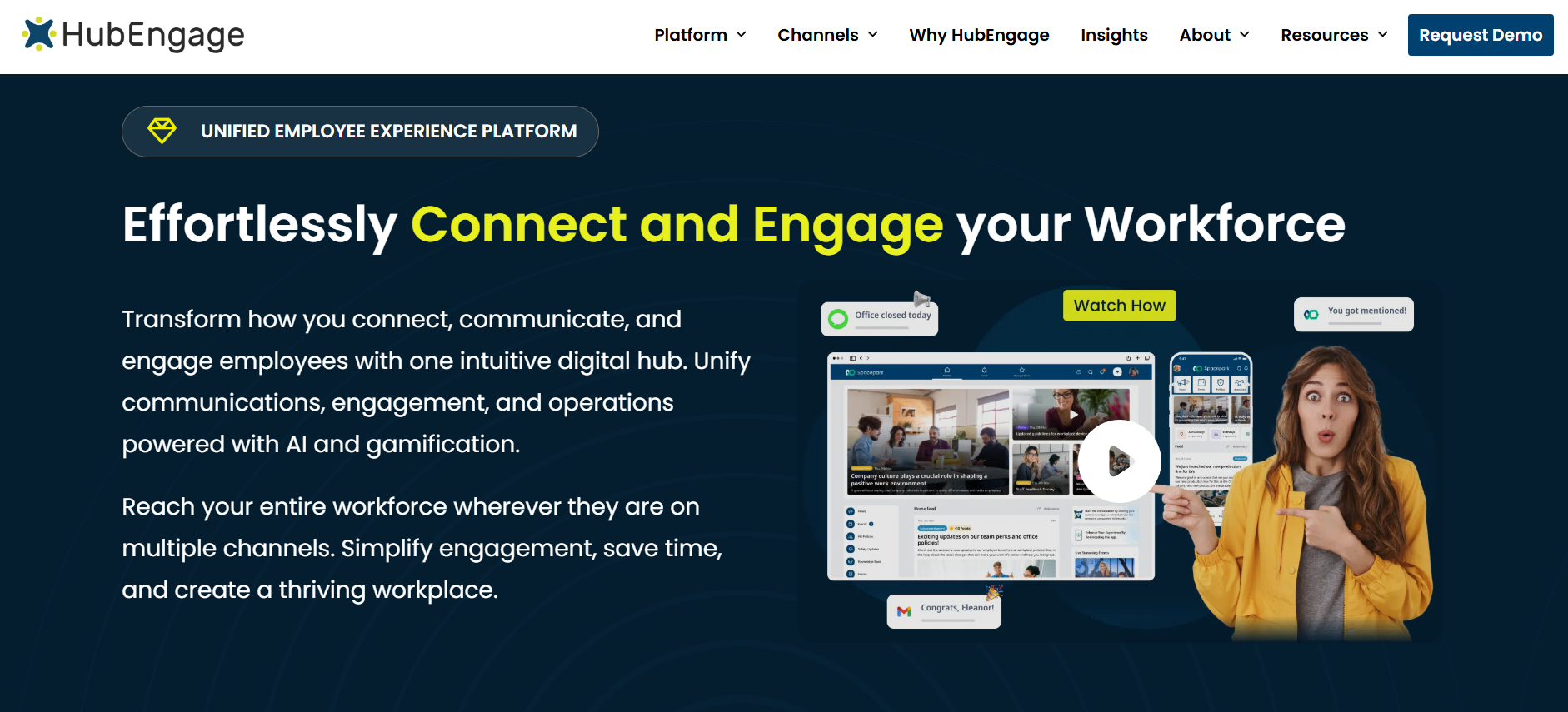
If the reason you’re looking beyond Staffbase is that communications have become disconnected from the rest of employee engagement, HubEngage is worth examining first.
HubEngage combines employee communications with an intranet, mobile apps, SMS, email, digital signage, messaging, surveys, recognition and social engagement. The point isn’t simply that those features exist. It’s that companies can use communication as one part of a wider employee experience rather than maintaining a separate platform for every interaction.
Best for: Small businesses through enterprise organizations that want a centralised workforce communication tool for both desk and frontline employees, with engagement capabilities available in the same environment.
Key features
- Targeted communications can be segmented using employee attributes such as department, location and cost center, making it possible to show different content to different employee groups.
- Communication can move across mobile apps, web, email, SMS and digital signage, rather than making the employee intranet the only route to employees.
- Read acknowledgements and communication analytics help teams see whether important messages are actually being consumed.
- Recognition, surveys, social engagement and messaging can sit alongside internal communications, which is useful when communication and engagement are managed by the same HR or Internal Comms team.
- HRIS, payroll and identity integrations can keep employee information and audiences synchronized.
This is also one of the places where the Staffbase comparison gets more nuanced.
Staffbase is highly communications-led. HubEngage spreads its weight more evenly across communication and engagement. If your organization wants an employee app, intranet, surveys and recognition to feel like parts of the same system, that’s relevant. If all you need is a very deep enterprise communications stack, the decision becomes less obvious.
For frontline teams, HubEngage supports iOS and Android access alongside SMS and digital displays. That’s useful when frontline internal communication can’t depend on everyone checking a corporate inbox.
How it compares to Staffbase: Both can support multi-channel communication across desk-based and frontline workforces. Staffbase goes particularly deep into enterprise communications across app, intranet, email and signage. HubEngage becomes more interesting when communications also need to connect with surveys, recognition, gamification and broader employee engagement.
For teams specifically asking which employee communications tools provide targeted feed capabilities for different employee audiences, HubEngage belongs on the shortlist because its communication targeting can use employee attributes such as location and department.
Pricing: Custom quote based on employee count and selected capabilities.
If you’re comparing internal communication as part of a larger frontline strategy, our guide to frontline employee engagement is also worth reading before deciding which modules you actually need.
2. Blink
Blink starts from almost the opposite end of the market.
Instead of beginning with a large enterprise intranet and extending it toward frontline workers, Blink is fundamentally built around the employee app. That makes the product easier to understand if your communication challenge lives in stores, hospitals, warehouses, transport operations or other places where employees spend most of the day away from a desk.
Best for: Small, mid-sized and enterprise organizations that want a mobile-first communication experience, particularly for frontline employees.
Blink is also the easiest product on this list to put an initial price against, which matters if you’re doing early-stage budgeting before sitting through six vendor demos.
Key features
Its Core package includes internal communications, collaboration and a unified knowledge hub.
Pro adds features including greater personalization, integrations, multilingual publishing and an AI assistant.
At the Enterprise level, Blink adds more advanced administration, security, compliance, data controls and integrations.
For communications teams, features such as mandatory reads and persistent notifications are particularly relevant when a policy or safety message can’t just disappear down a social feed.
What about Blink for regulated industries?
This deserves more than a generic “enterprise-grade security” sentence.
Blink’s current Enterprise materials list ISO 27001, SOC 2, GDPR and HIPAA readiness, alongside capabilities such as SAML SSO, detailed audit logs, configurable data-retention policies, permissions and user/data compartmentalization.
Its security materials also describe encryption at rest using AES-256 and encrypted transmission over HTTPS/TLS.
For healthcare organizations, Blink positions its controls as helping customers meet HIPAA compliance requirements. That’s useful, but it doesn’t remove the buyer’s responsibility to complete a proper security, legal and compliance review.
Blink has also expanded its frontline AI positioning in 2026, including AI-assisted communication, knowledge access and frontline agents that work within existing permissions.
The combination is interesting for regulated industries: AI features are useful only if the access model underneath them is properly controlled.
How it compares to Staffbase: Staffbase offers a broader enterprise communication suite, particularly across app, intranet, email and digital signage. Blink is more app-centric and easier to price at the lower end, making it a more realistic Staffbase alternative for smaller or strongly frontline-led organizations that don’t need the entire Staffbase footprint.
Pricing: In the U.S., Core starts at $3.75 per user/month billed annually and Pro starts at $5.00 per user/month billed annually. Enterprise pricing is custom. Blink also offers a free trial.
3. Unily
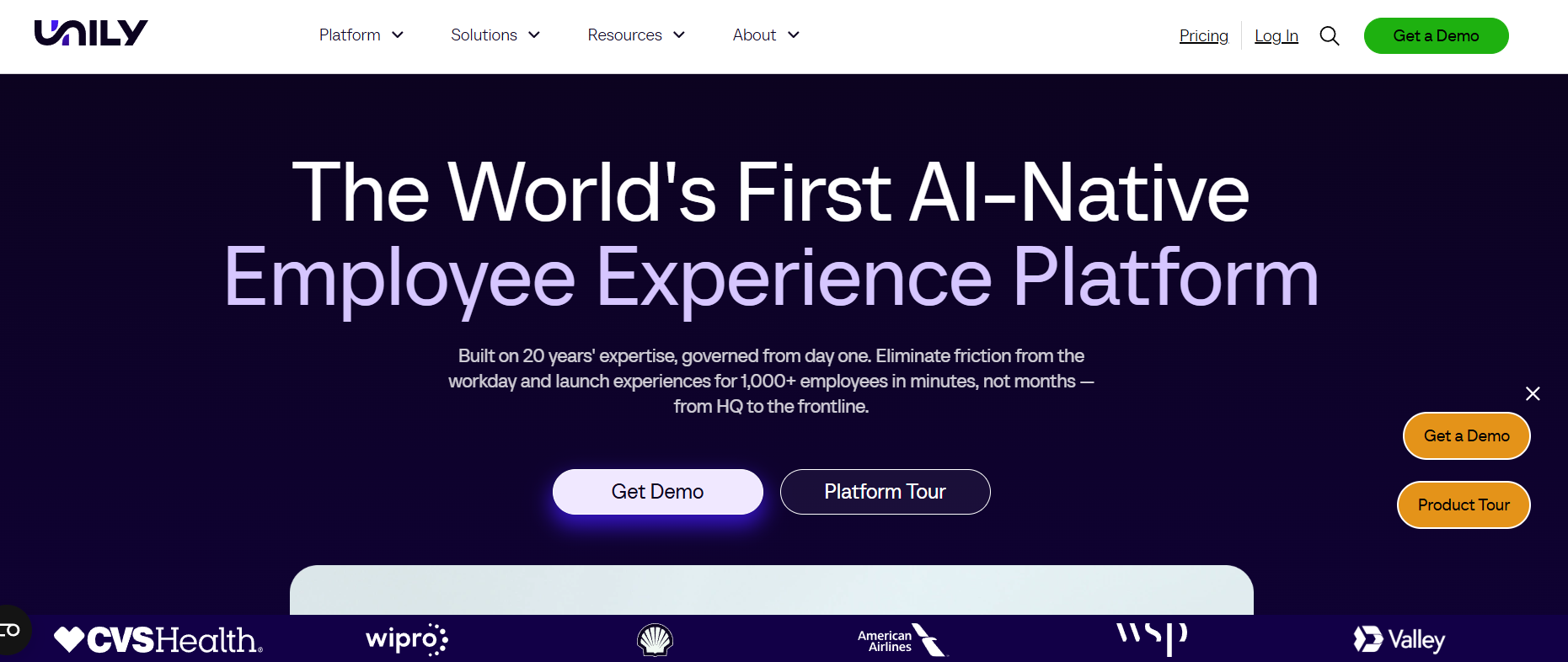
Unily sits at the other end of the spectrum.
I wouldn’t put it on a shortlist for a company looking for a simple communications app for 600 people. Unily starts to make more sense when the workforce spans countries, brands, business units, information systems and a serious mix of frontline and knowledge workers.
Its current pricing positioning runs from 1,000 to 10,000+ employees.
Best for: Large global organizations that want internal communications to sit inside a broader employee experience and enterprise knowledge layer.
Key features
- AI-powered personalization can tailor information using employee profile data, preferences and behavioral signals.
- Targeted communications let teams vary content for different locations, roles and workforce segments.
- Enterprise search helps employees find information across connected repositories and workplace systems.
- Broadcast Center can distribute communication across channels including email, mobile, Microsoft Teams and Slack.
- Mobile and frontline capabilities extend the same wider employee experience beyond office-based employees.
How does Unily deal with information overload?
This is one of the more credible reasons to compare Unily with Staffbase.
The answer isn’t simply “better notifications.”
Unily combines audience targeting, personalized content, enterprise search and prioritization so employees don’t have to manually filter one giant information stream.
A store employee and somebody in corporate finance can therefore have different home experiences while still working from the same underlying employee platform.
That’s particularly relevant in large organizations because information overload is rarely caused by a shortage of publishing tools. It’s usually caused by too much content reaching people who don’t need it.
Unily’s customer examples also show the mixed-workforce use case in practice. British Airways uses Unily across more than 40,000 employees, around 80% of whom are frontline workers. Its Alshaya case study likewise covers a mobile and personalized experience spanning corporate and frontline employees.
Those examples don’t guarantee the same outcome elsewhere, but they do make the use case much more concrete than a generic claim about “global engagement.”
How it compares to Staffbase: Both belong on serious global-enterprise shortlists. Staffbase is particularly strong when the communications function itself is the center of the purchase. Unily becomes more compelling when communications need to connect with enterprise search, personalization and the broader workplace experience.
Pricing: Custom quote based on enterprise scale and requirements.
4. Speakap
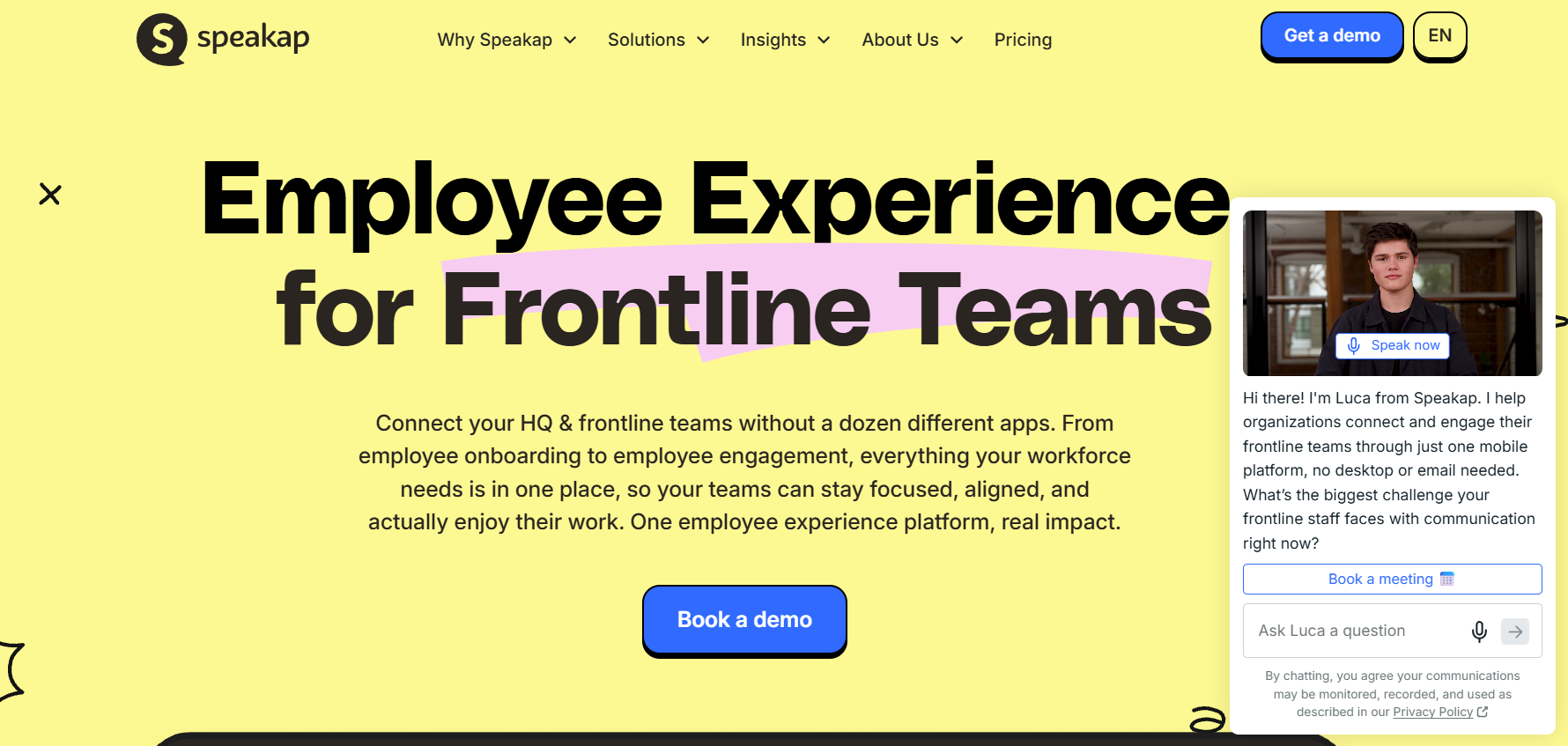
Speakap has a narrower job to do, and that’s part of its appeal.
It is built heavily around frontline employee communication, particularly for workforces where corporate email isn’t a realistic primary channel.
Rather than trying to be everything from an enterprise portal to a workplace operating layer, Speakap puts a lot of attention on mobile access, direct communication and getting the employee app adopted across locations.
Best for: Retail, hospitality, logistics, construction and other frontline-first organizations that want to reach employees directly on mobile.
Key features
The Basic plan includes a timeline, news, polls, files, employee profiles, groups and individual or group chat.
Premium adds capabilities such as branded mobile apps, HR-system synchronization, workforce analytics, automatic translation to 100+ languages, dynamic pages and SSO.
Premium Plus moves further into tasks, journeys, advanced workforce analytics, API integrations and additional implementation support.
News acknowledgements also help communication teams confirm that important content has been received.
The real question with Speakap is adoption
A frontline employee app is only useful if frontline employees actually use it.
Speakap’s approach includes mobile-first access, reduced reliance on corporate email and implementation/customer-success support. More importantly, its published customer stories show how adoption is handled operationally.
Puttshack UK made its employee app part of onboarding so new hires were activated within their first 48 hours. Speakap reports a 98% adoption rate in that customer case.
Center Parcs reported 93% onboarding activation in a deployment covering more than 10,000 employees across 28 parks in five countries.
Those are customer-specific results, not benchmarks every Speakap buyer should expect.
What I find more useful is the mechanism behind them: onboarding, manager involvement and making the app part of normal work. That’s a more believable adoption strategy than assuming frontline employees will download another app because HR sent an announcement.
Other current Speakap customer stories include Takko Fashion, SPAR Netherlands and Intergamma. Takko Fashion’s published case covers around 18,000 employees across more than 17 countries.
How it compares to Staffbase: Speakap is the more focused frontline option. Staffbase covers a wider enterprise communications environment across more channels. Speakap makes more sense when the core requirement is direct mobile access and adoption across a deskless workforce.
Pricing: Quote-based. Speakap currently offers Basic, Premium and Premium Plus plans, with final pricing based on plan and licensed employee count.
5. Firstup
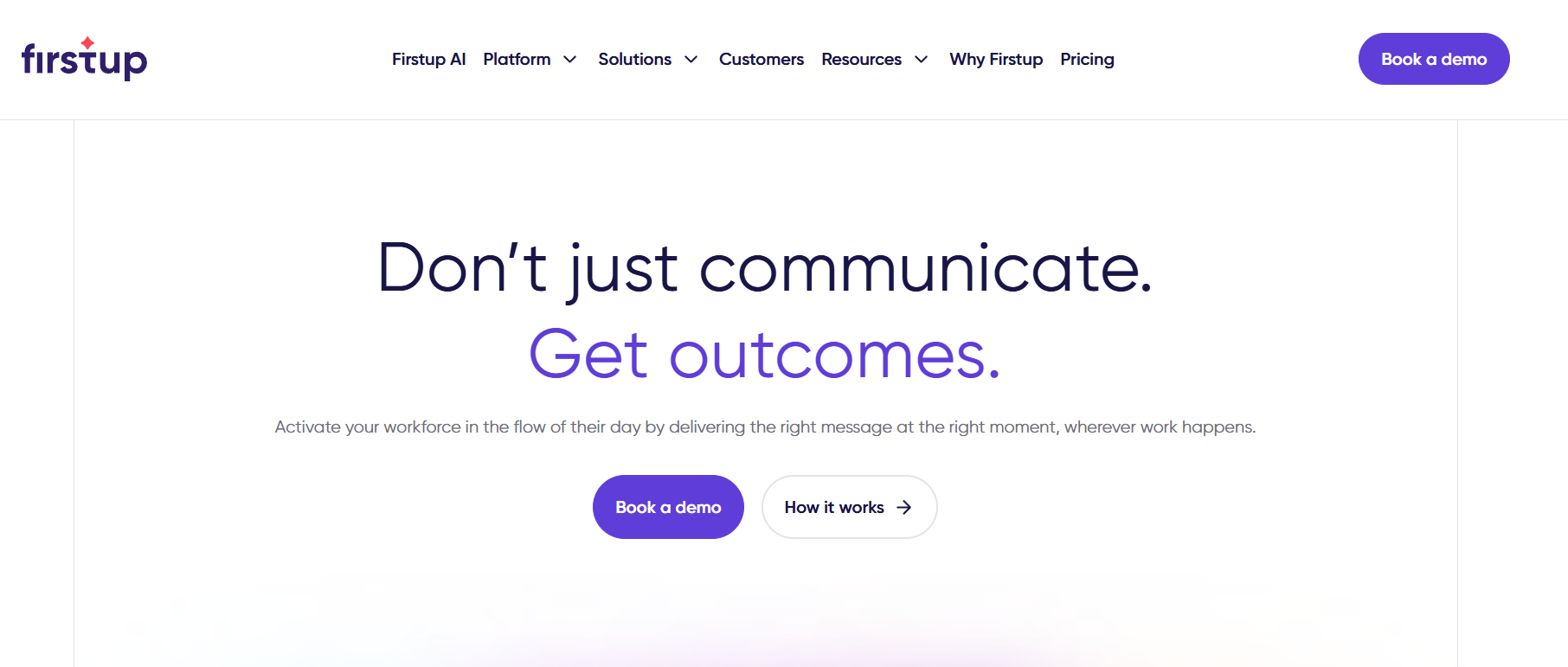
Firstup is the product I’d look at when the complaint is:
“We’re already publishing enough. People still miss the right messages.”
That’s a different problem from needing a new intranet.
Firstup focuses heavily on audience segmentation, delivery logic, retargeting and employee journeys. The communication itself matters, but so does what happens after you press publish.
Best for: Mid-market and enterprise Internal Communications teams that need more precise control over who receives information, when it arrives and what happens if employees don’t engage.
Key features
- Audience Builder can segment employees using several employee attributes and behavioral signals.
- Communication can move across email, mobile app, desktop, third-party destinations and digital signage.
- Automatic retargeting can follow up with employees who haven’t read or completed a required action.
- Intelligent Delivery can optimize communication timing and channel using behavioral information.
- Employee Journeys can sequence communication around dates, events, audience rules and completion conditions.
Firstup’s 2026 Custom Homepage release also allows organizations to create different homepages for different employee audiences.
That gets closer to the real-world problem of targeted feeds. A plant employee, office worker and nurse don’t need the same home screen just because they share an employer.
Firstup vs. Staffbase is really an orchestration question
Staffbase has a mature multi-channel communication environment of its own.
Firstup’s stronger point of differentiation is the delivery logic behind communication. Audience rules, automatic retargeting and employee journeys matter most when the problem isn’t generating information but reliably getting the right information to each workforce segment.
That’s why Firstup can look excessive for a smaller Internal Comms team and very appealing to a complicated enterprise.
How it compares to Staffbase: Staffbase offers a broad communications stack spanning employee app, intranet, email and signage. Firstup makes the strongest case when precise audience targeting, intelligent delivery, retargeting and journey-based communications are the main buying requirements.
Pricing: Firstup does not publish numeric pricing. Its current packages are Essential, Professional and Premier, with the employee intranet available as an add-on.
6. Haiilo
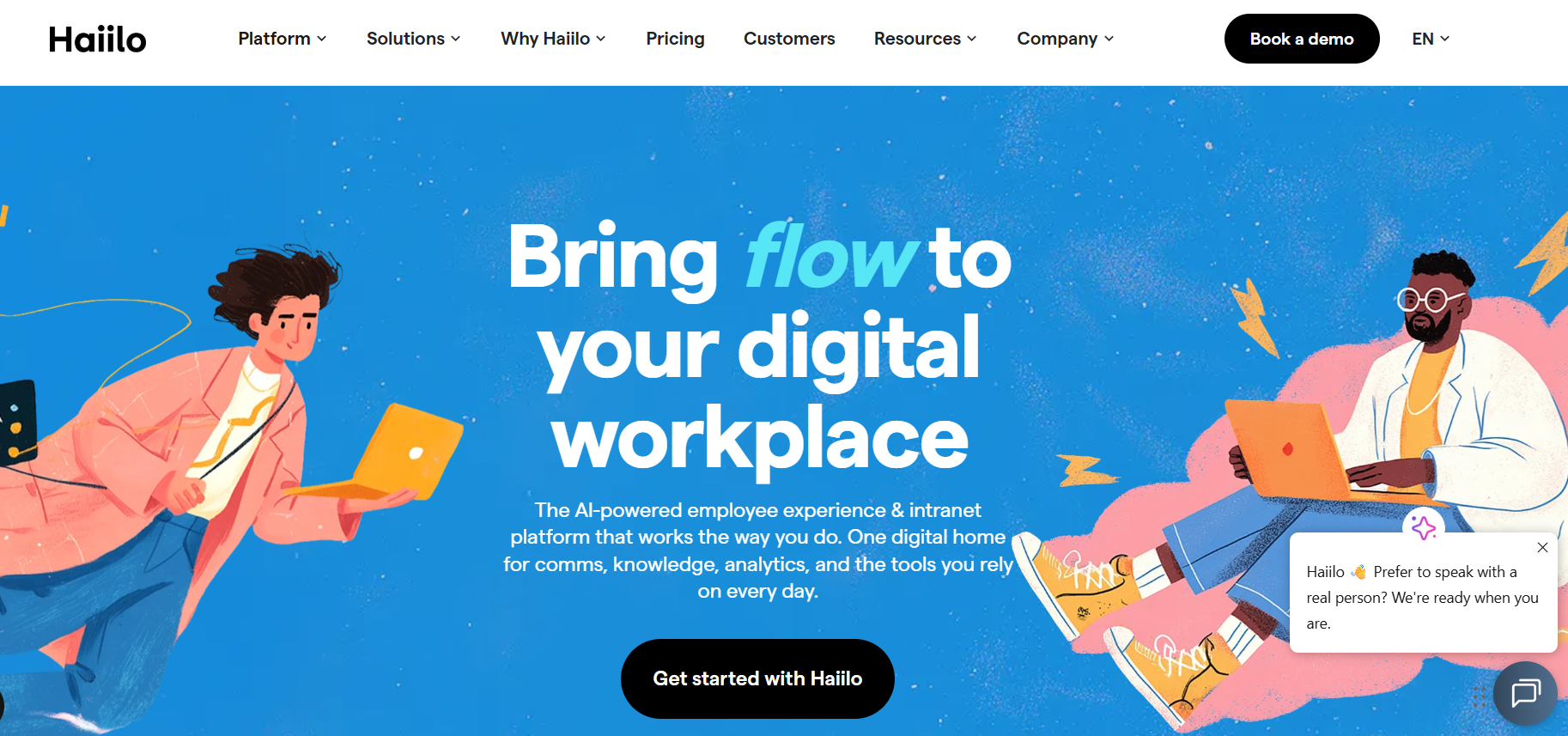
Haiilo is probably the easiest platform here to think about in modules.
Rather than describing everything as one giant employee experience product, Haiilo separates its main capabilities into Engage, Align, Measure and AVA.
That structure won’t automatically make the implementation simple, but it does make the buying conversation easier to follow.
Best for: Organizations, usually from around 500 employees upward, that want intranet, employee communications and analytics but prefer to think about them as distinct capability areas.
What each part does
Engage is the intranet and employee-app side. It includes personalized timelines, homepages, communities, employee profiles, documents, knowledge content and mobile access.
Align focuses on communications. It includes audience targeting, scheduling, newsletters, digital signage, communication workflows, Microsoft Teams and Slack integrations, read receipts and reach metrics.
Measure covers analytics across intranet activity, communications, communities and search.
Then there’s AVA, Haiilo’s AI capability area, which adds functions such as AI-supported search, writing, summarization and analytics.
Haiilo also supports more than 130 integrations across Microsoft 365, Google, Slack and HR systems.
For frontline teams, the mobile app can support employees without company email addresses. Personalized timelines can also vary content according to role, interest or location.
That makes Haiilo a relevant answer to the targeted-feed question in this category. The system can be more specific than simply publishing one news stream and hoping employees filter it themselves.
How it compares to Staffbase: Both cover intranet, employee communication, mobile access and digital signage. Staffbase packages itself around a broad enterprise communication environment, while Haiilo’s Engage, Align, Measure and AVA structure creates a clearer separation between intranet, communications, analytics and AI.
Pricing: Custom quote. Haiilo says pricing depends on organization size, setup and required capabilities, with most platform customers starting at around 500 employees.
Which Staffbase Alternative Fits Your Setup?
Rather than ranking the six again, I’d use the shortlist this way.
If you’re replacing Staffbase because you don’t need all of Staffbase
Start with Blink or Speakap.
Blink is easier to price and particularly strong for mobile-first frontline communication. Speakap makes sense when direct deskless-worker adoption is the bigger concern.
If you’re replacing Staffbase because communication needs to connect with more HR engagement activity
Look at HubEngage.
The argument isn’t that it has a longer communication feature list. It’s that communications can sit alongside recognition, surveys and other engagement activity inside the same wider platform.
If Staffbase isn’t broad enough for the employee experience you’re building
Look at Unily.
This is especially true when enterprise search, personalization and one experience across office and frontline employees are becoming as important as publishing communications.
If employees are missing messages despite having plenty of communication channels
Firstup is probably the most interesting comparison.
Its audience segmentation, retargeting and delivery logic attack that particular problem more directly.
If you want to assemble the environment more modularly
Haiilo is worth a look.
Engage, Align, Measure and AVA create a fairly clear split between intranet, communications, analytics and AI.
The decision should get easier once you know which of those problems sounds most like yours.
Frequently Asked Questions
What does workplace experience platform mean?
A workplace experience platform is broader than an internal communication tool.
It usually brings several parts of the digital employee experience together, such as communication, workplace knowledge, employee services, collaboration or access to business tools. A platform such as Unily or HubEngage can therefore overlap with internal communication software without being limited to internal communications alone.
Which employee communications tools provide targeted feeds for different employee audiences?
HubEngage, Firstup, Unily and Haiilo all have relevant targeting or personalization capabilities.
HubEngage can use employee attributes such as location and department. Firstup can build audiences and different homepage experiences around attributes such as role and location. Unily uses personalization and audience targeting, while Haiilo supports targeted communications and personalized timelines.
When you demo any of them, ask how those audiences are maintained. Creating a targeted feed is easy. Keeping thousands of employee records, roles and locations synchronized over time is the harder part.
How can a mobile-first intranet improve communication with frontline workers?
It removes one obvious barrier: the employee doesn’t have to sit at a company computer to get company information.
A good mobile-first intranet can put targeted news, policies, search and workplace links on a device employees actually carry. Push notifications can also make urgent communication easier to surface.
But simply moving an intranet onto a phone doesn’t solve frontline communication. Login friction, irrelevant content and weak manager adoption can still kill usage.
Is Blink suitable for regulated industries in 2026?
Blink has a substantial security and compliance feature set, particularly in its Enterprise configuration.
Its current materials list ISO 27001, SOC 2, GDPR and HIPAA readiness alongside SSO, audit logs, data-retention controls, protected content and additional access controls.
That’s enough to make it a reasonable product to evaluate for regulated environments. It isn’t enough to skip your own security or compliance assessment.
How does Unily reduce information overload for global organizations with frontline and knowledge workers?
Mostly by trying to make the employee experience more selective.
Personalization, audience targeting and enterprise search help reduce the amount of irrelevant content an employee needs to sort through. Mobile and desktop employees can still use the same underlying platform without being given identical information.
For a global company, that’s often more useful than simply adding another communication channel.
Which companies use Speakap for frontline employee engagement?
Current Speakap customer material includes Puttshack UK, Center Parcs, Takko Fashion, SPAR Netherlands and Intergamma.
The examples are useful because they aren’t all the same deployment. Puttshack focuses heavily on onboarding and app adoption, while Takko Fashion shows the platform operating across a much larger international retail workforce.
How does Speakap get frontline employees to use the app?
Speakap can’t guarantee adoption, and the customer examples shouldn’t be read that way.
What its published cases show is a combination of mobile-first access, onboarding, manager involvement and making the app part of ordinary work. Puttshack, for example, incorporated activation into the first 48 hours of onboarding.
That’s a better adoption lesson than any single software feature.
Final Take
Staffbase is already a serious internal communications platform, so choosing an alternative should start with a specific reason for changing.
Pick Blink or Speakap when frontline mobile communication is the center of the problem. Look at Firstup when delivery and targeting are breaking down. Unily fits the biggest employee-experience programs, Haiilo offers a more modular structure, and HubEngage becomes relevant when communications need to sit closer to recognition, surveys and employee engagement.
The shortlist gets much easier once you know which part of Staffbase you actually need to replace.