

A new employee can receive their laptop on time, sign every document, complete every required training module and still reach the end of their first month thinking, “I am not sure what my manager actually wants from me.”
That is the gap between completing onboarding and creating a good first 90 days experience.
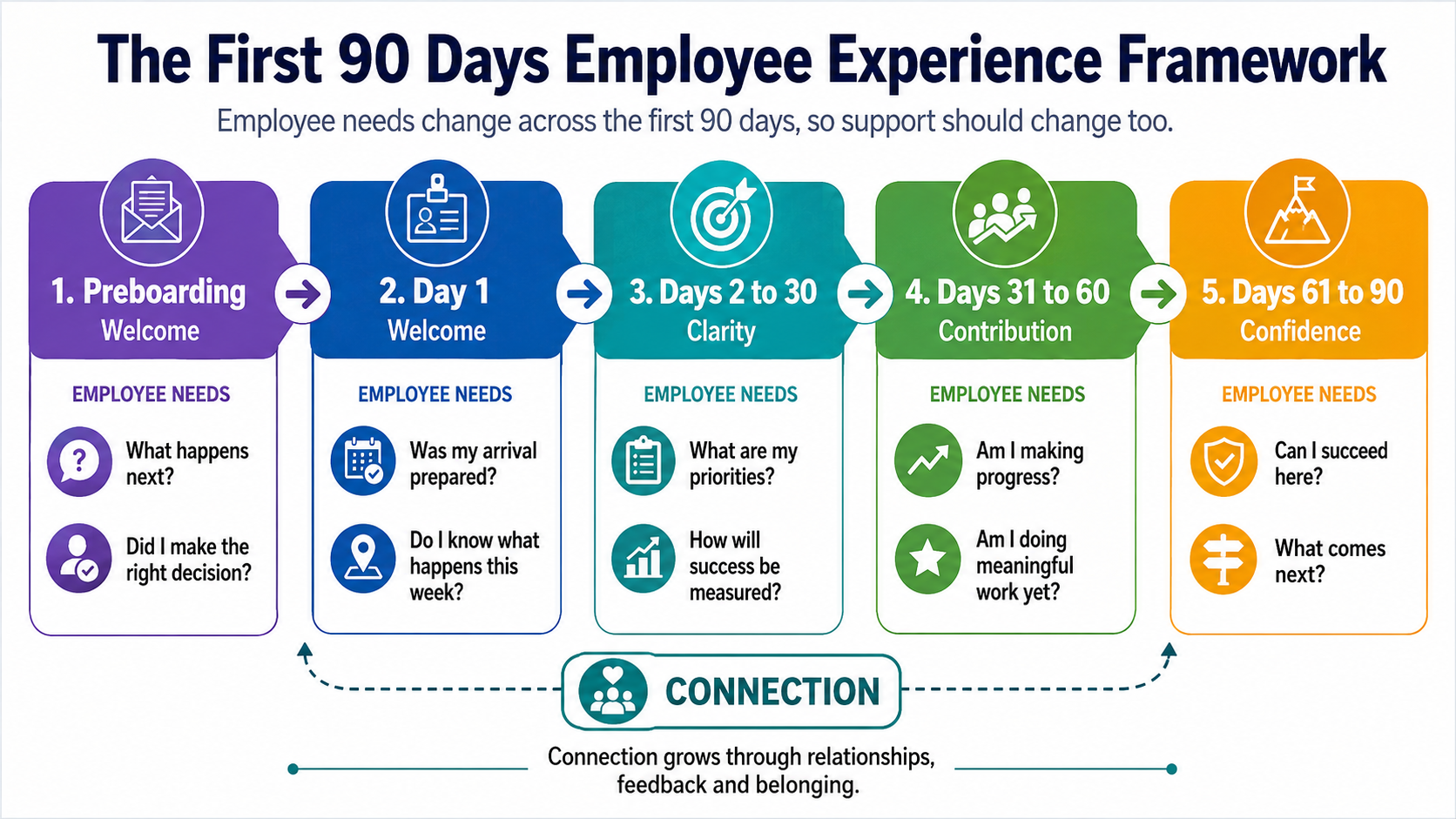
Administrative onboarding matters. Employees need equipment, policies, accounts, training and basic orientation. However, their needs change quickly after those fundamentals are handled. Before Day 1 they want reassurance. During the first month they need clarity. As they settle in, relationships and meaningful work become more important. By Day 90, the question is increasingly whether they can succeed independently.
Key Takeaways:
A useful first 90 days employee experience framework should change with them:
Welcome → Clarity → Connection → Contribution → Confidence
The goal is not 90 days of onboarding tasks. It is 90 days of giving employees the right support at the right time.
What is a first 90 days employee experience framework?
A first 90 days employee experience framework is a structured approach to designing what an employee experiences from preboarding until they can operate with growing confidence and independence.
It coordinates HR, managers, teammates, communications, learning, technology and employee feedback around changing employee needs.
This is broader than employee onboarding administration.
Onboarding may tell you whether the laptop arrived, policies were acknowledged and required training was completed. The experience asks different questions: Did anyone prepare for my arrival? Do I understand what good performance looks like? Can I find information without asking five people? Does my manager have time for me? Have I built relationships that help me get work done?
The difference matters. Gallup’s onboarding research has consistently emphasized people, learning and process, with manager involvement playing a particularly important role. ADP likewise distinguishes short orientation activities from the longer process of building relationships, understanding expectations and integrating into the organization.
The first 90 days at a glance
| Period | Experience stage | Employee need | Manager priority | HR priority | Strong experience signal |
| Before Day 1 | Welcome | Confidence | Personal contact | Readiness | “They were expecting me.” |
| Day 1 | Welcome | Human connection | Context and welcome | Smooth arrival | “I know what happens next.” |
| Days 2–30 | Clarity | Direction | Expectations | Access and resources | “I know what good looks like.” |
| Days 15–45 | Connection | Belonging | Relationships | Enable connection | “I know who I can rely on.” |
| Days 31–60 | Contribution | Progress | Coaching | Remove barriers | “I am doing meaningful work.” |
| Days 61–90 | Confidence | Independence | Autonomy and development | Listen and measure | “I can succeed here.” |
These periods overlap deliberately. Someone can be contributing meaningful work while still building relationships, just as an employee can feel socially comfortable while remaining unclear about priorities.
Before Day 1: Remove uncertainty before it starts
Once an employee accepts an offer, the recruiting process becomes a real workplace experience.
They may still be finishing another job, comparing the opportunity with alternatives or wondering whether joining was the right decision. Silence during this period creates unnecessary uncertainty.
The employee’s first question is simple:
“What happens next?”
HR should make paperwork and logistics easy to understand, confirm equipment and system readiness, and provide the information someone genuinely needs before starting. Meanwhile, the manager should make personal contact. A short message explaining that the team is looking forward to the employee joining can carry more weight than another automated welcome email.
At minimum, the employee should know when to arrive or log in, what the first day looks like, who to contact, what they need to bring and whether anything must be completed beforehand. ADP’s current guidance similarly recommends pre-start communication, manager contact information, equipment preparation and first-week details.
The warning sign at this stage is easy to spot: the employee has to chase the organization for basic information.
Preparedness communicates respect.
Day 1 should feel prepared, not improvised
Day 1 is not an opportunity to teach somebody everything about the company.
It is an opportunity to show that their arrival was planned.
A weak first day often contains six hours of presentations, policy explanations and system demonstrations, followed by very little time with the manager. The new employee receives a large amount of information but almost no help deciding what matters first.
A better first day is narrower.
Cover essential orientation. Make sure the employee can access the workplace and the tools they need. Introduce the people they will work with most. Give enough company and role context to make those introductions meaningful. Most importantly, the manager should explain what the first week will look like.
Poor experience: The employee finishes eight presentations, receives 27 links and has no idea what to work on tomorrow.
Better experience: The employee understands the organization at a high level, has met their immediate team, knows where essential resources live and leaves with three clear priorities for the first week.
More onboarding content is not automatically better onboarding. ADP specifically recommends spreading onboarding over time, which can reduce information overload and allow confidence to develop gradually.
Days 2–30: Build clarity before expecting speed
During the first month, the biggest need shifts from welcome to clarity.
New employees sometimes appear slower than expected because they are missing context, not capability.
They may know the formal responsibilities in the job description without knowing how those responsibilities translate into Tuesday morning. It may also be unclear whether speed, quality, customer satisfaction, accuracy or project ownership matters most. Even with a clear org chart, a new employee can still have no idea who actually makes certain decisions.
This is where the manager becomes critical.
The manager should translate the role into real priorities: what the employee should learn first, what they should deliver, which decisions they can make, where approval is required and how good performance will be evaluated.
HR’s role changes too. Instead of continuously adding content, HR should make foundational information accessible and check whether the employee can find what has already been provided.
Technology can help when it gives new hires one reliable place to find the information they need instead of making them search across emails, shared drives and disconnected systems. For example, an employee intranet can bring company communications, policies, people, onboarding resources and frequently used information into a more accessible environment. However, access alone is not enough. HR and managers still need to explain which resources matter, when employees should use them and where to go when the documented answer does not match the real situation.
Around Day 30, the conversation should focus less on completion and more on friction:
- What still feels unclear?
- What information has been hardest to find?
- Who has been especially helpful?
- Is anything meaningfully different from what you expected?
- Where do you need more support?
A warning sign is an employee who repeatedly says, “I think I understand,” but cannot explain their priorities in their own words.
Completion is not the same as understanding.
Connection cannot be completed during orientation
By the second or third week, another need becomes more visible: connection.
An employee can understand the job and still feel socially disconnected from the organization.
Belonging is created through interaction, not orientation slides. That means employees need useful relationships, not simply a long calendar of introductory meetings.
A buddy can help, for example, but assigning one does not automatically create belonging. The relationship needs some purpose. Perhaps the buddy explains unwritten team norms, helps the employee identify the right person for common questions or provides a safe place for questions that feel too minor for the manager.
Managers should also make cross-functional introductions selectively. The question is not “Who could this person meet?” It is “Who will help this person understand or perform their job?”
This becomes especially important for remote employees. Microsoft research into new-employee communication networks found that new hires’ networks continued developing across months, with meaningful differences from tenured employees remaining later in the onboarding period.
Therefore, three days of welcome calls are not enough. Remote employees need continued inclusion in working conversations, informal context, useful introductions and access to people outside scheduled status meetings.
Days 31–60: Give employees meaningful ownership
By the second month, learning should increasingly lead to contribution.
The employee should not still feel like a permanent observer.
At this stage, managers should identify work that matters but has an appropriate level of risk. Give the employee ownership of a real deliverable, customer interaction, operational responsibility, analysis, process or project component.
Then provide specific feedback.
“You’re doing well” is encouraging, but it teaches very little. Better feedback sounds more like: “Your analysis was strong. Next time, bring the recommendation forward earlier so the team can make a decision faster.”
The employee needs evidence that they are progressing.
Recognition matters here for the same reason. It does not have to be formal or public. A manager acknowledging that an employee handled their first difficult customer issue well can reinforce both confidence and the behavior the organization wants repeated.
Around Day 60, ask:
- Where do you feel confident now?
- Where are you still relying heavily on others?
- What has surprised you about the role?
- What would help you contribute more effectively?
- Are the original expectations still clear?
If the employee has completed weeks of training but still has no meaningful responsibility, that is an experience warning sign.
Days 61–90: Turn early progress into confidence
Around the 60-day mark, support should start changing again.
The goal is now confidence, not withdrawal.
Employees should take more independent ownership while still having access to coaching and feedback. Managers can broaden decision rights, set expectations for the next quarter and begin discussing development rather than treating development as something that starts after onboarding.
This period also tests whether the organization has delivered the experience promised during recruitment.
The employee is now in a better position to answer questions such as:
“Can I see myself succeeding here?”
They have experienced the manager, communication norms, workload, team relationships and actual culture rather than the recruiting version of them.
Therefore, HR should listen carefully at this stage. A 90-day survey or conversation can expose discrepancies that a completion dashboard never will.
What should happen at the 90-day employee experience review?
The 90-day conversation should not be a disguised performance review.
Performance belongs in the discussion, but so does the experience surrounding it.
Talk about role clarity, manager support, working relationships, barriers, expectations, access to information and what the employee needs next.
Useful questions include:
- What has helped you succeed so far?
- What made the first 90 days harder than necessary?
- What information do you wish you had received earlier?
- Which relationships have been most useful?
- Where would you like more responsibility?
- What should we change before the next person joins?
That final question is especially valuable. New employees can still remember problems that tenured employees have learned to work around.
Day 90 should therefore produce two outputs: a direction for the employee’s next stage and information for improving the next new hire’s experience.
Where the first 90 days usually break down
Most breakdowns are not dramatic. They are small gaps that repeat.
Everything happens during Week 1, then structured support disappears. HR assumes the manager has taken over. The manager assumes HR still owns onboarding. Information exists, but nobody explains which information matters. Feedback is postponed until the employee has already developed the wrong habits.
Remote employees may be left to build relationships themselves. Frontline employees may receive whatever experience an individual supervisor has time to provide. Meanwhile, the organization proudly reports 98 percent training completion.
That last failure is particularly important.
A completed process can coexist with a poor experience.
How to know whether the first 90 days are actually working
Process metrics still matter. If equipment repeatedly arrives late, HR needs to know.
However, process metrics answer a narrow question: Did the onboarding activity happen?
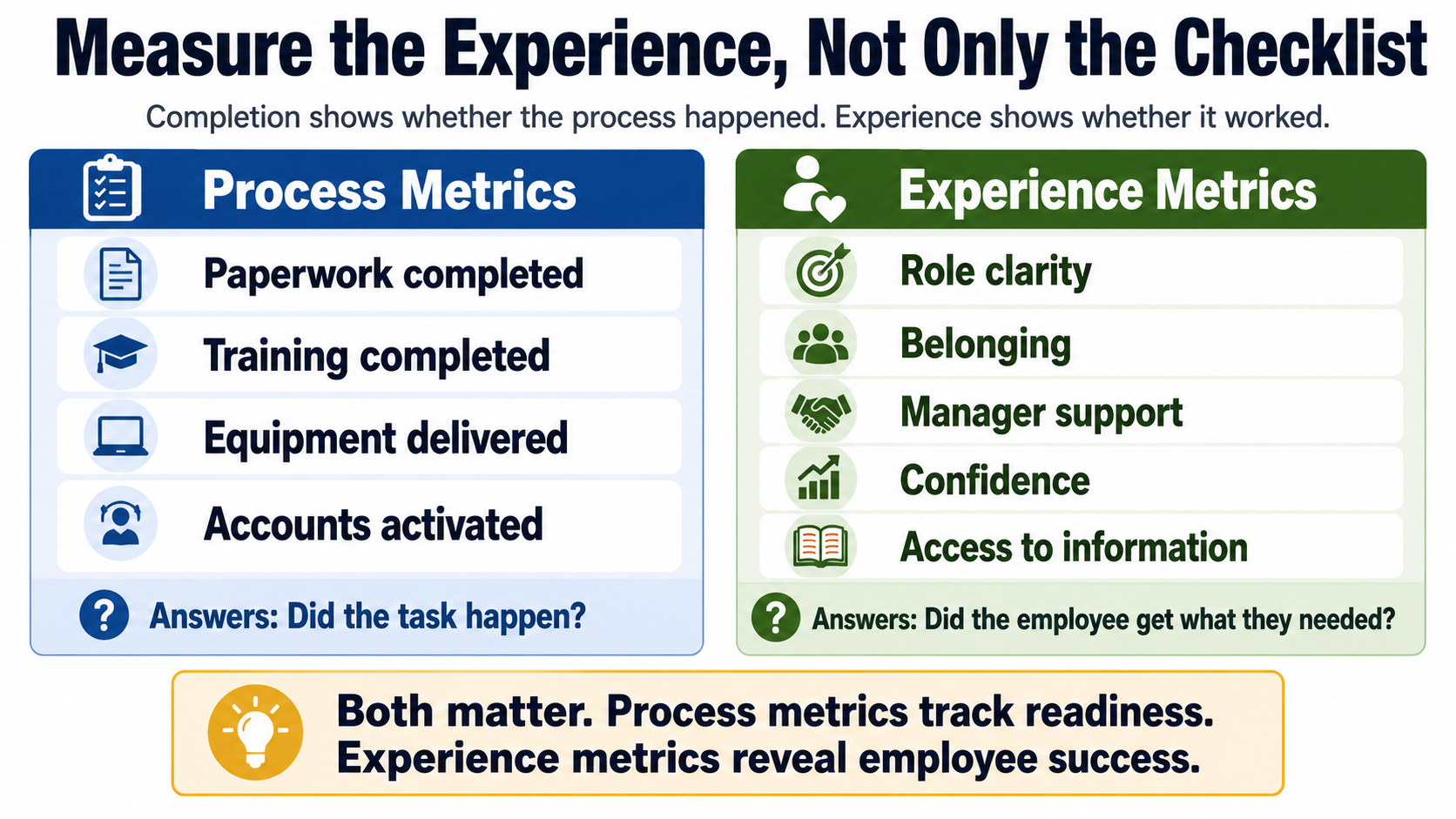
Examples include:
- paperwork completed
- training completed
- accounts activated
- equipment delivered
Experience metrics answer another question: Did the employee receive what they needed from the experience?
Measure areas such as role clarity, manager support, team connection, confidence, information access, communication quality and whether the employee has begun meaningful work.
New-hire pulse surveys, 30/60/90 conversations, early turnover, time to meaningful contribution, manager feedback and patterns in employee questions can all provide useful signals. ADP likewise recommends capturing employee feedback and using regular checkpoints rather than relying solely on administration.
No single metric proves the experience is working. Look for patterns.
Who owns the first 90 days?
Great onboarding fails when everyone assumes somebody else owns it.
| Experience area | HR | Manager | Team | Employee |
| Preboarding readiness | Lead | Support | Aware | Complete essentials |
| Equipment and access | Coordinate | Verify | Support | Flag issues |
| Role clarity | Enable | Lead | Reinforce | Ask and confirm |
| Team introductions | Support | Lead | Participate | Build relationships |
| Training | Coordinate | Contextualize | Share expertise | Participate |
| Feedback | Provide framework | Lead | Contribute | Seek and apply |
| Recognition | Enable | Lead | Reinforce | Receive and reflect |
| 30/60/90 conversations | Standardize | Lead | Input when useful | Participate |
| Experience feedback | Lead | Encourage | Support change | Share honestly |
| Development | Enable | Lead | Support | Shape goals |
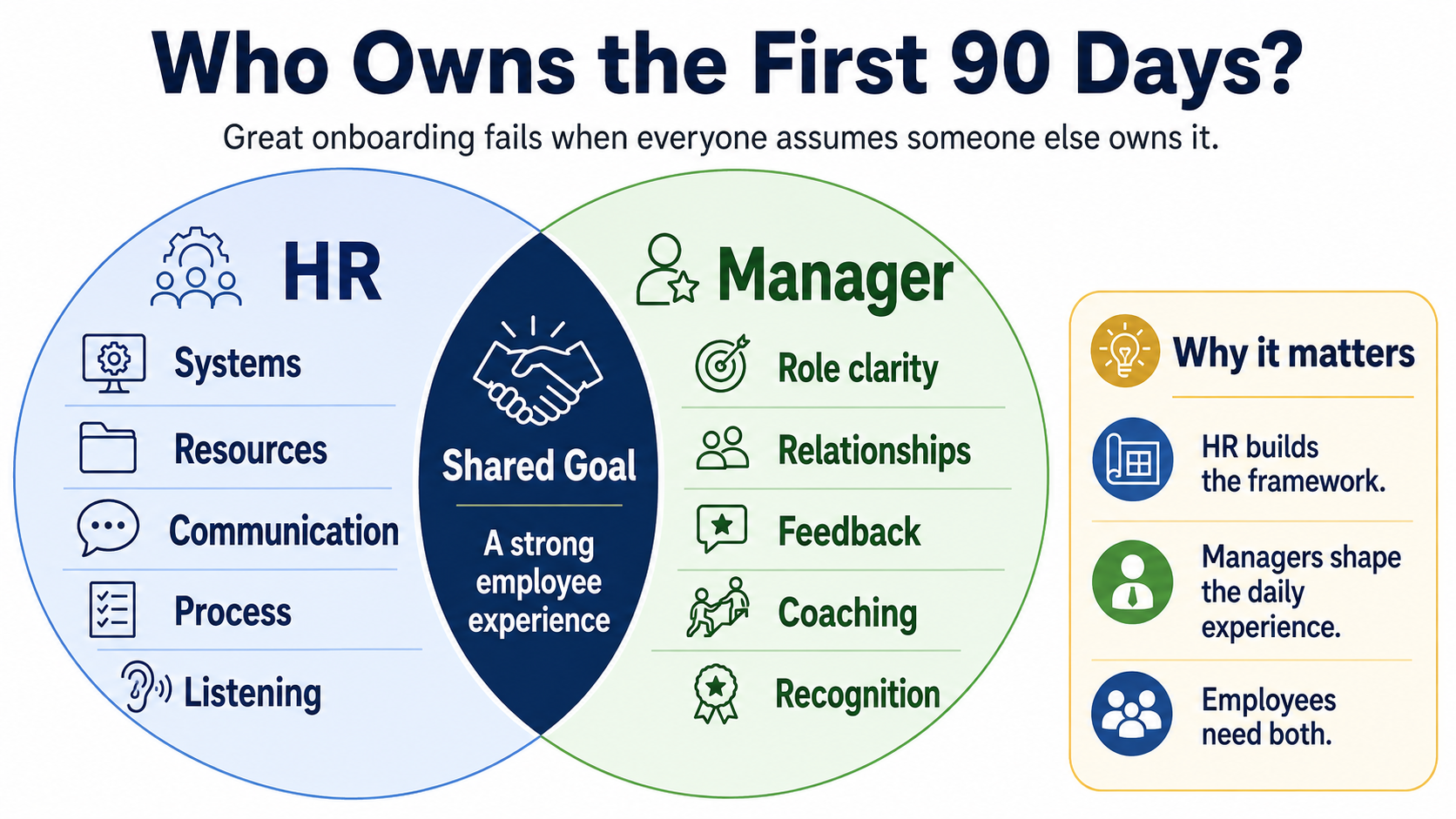
HR owns the architecture. Managers own much of the lived experience.
HR can design the framework, but much of the employee’s day-to-day experience depends on the manager. Gallup’s research on the manager’s active involvement in onboarding emphasizes the manager’s role in clarifying expectations, connecting new hires with teammates and helping employees understand how their work contributes to larger goals. That is why manager participation should be built into the first 90 days rather than treated as an optional addition to an HR-led process.
The same framework should look different for frontline employees
Consistency does not mean every employee receives an identical process.
A warehouse employee sharing devices across shifts, a nurse working nights and a remote software engineer have different access patterns even if each person needs welcome, clarity, connection, contribution and confidence.
For frontline employees, onboarding information may need to work on mobile devices, shared devices, printed resources or supervisor-led shift communication rather than assuming corporate email access.
Manager check-ins may need to be shorter and deliberately scheduled around shifts. Recognition may happen during operational meetings rather than through an office-based program. Policies and resources should also be easy to retrieve at the point of need.
The framework stays consistent.
The delivery changes.
Remote and hybrid onboarding needs more than meetings
Remote employees do not necessarily need more meetings. They need better designed access to context and relationships.
That might mean deliberately identifying five people the employee should know by Day 30, inviting them into working sessions where decisions are actually made, documenting team norms and making informal questions easy to ask.
Otherwise, video-call volume can increase while genuine connection remains weak.
Similarly, hybrid employees should not receive important context only on the days they happen to be in the office. Communication, resources and manager access need to work across locations.
Where technology removes friction
Technology is useful when it reduces the amount of effort required to participate in the experience.
An employee intranet or mobile employee app can provide one place for communications, company knowledge, policies, directories, onboarding resources and learning. Surveys can capture employee feedback. Recognition tools can make early contributions visible. Notifications can help managers remember important checkpoints.
However, technology should support the experience. It does not create the experience by itself.
A perfectly configured intranet cannot compensate for a manager who has not explained what success looks like.
Day 90 is a transition, not a finish line
A strong first 90 days experience does not come from giving every new employee more onboarding content. It comes from giving them the right support at the right time.
Before they start, they need evidence that the organization is prepared. Then they need clarity about the job and relationships that help them understand how work really gets done. As confidence grows, they need meaningful responsibility, useful feedback and enough autonomy to prove to themselves that they can succeed.
By Day 90, the employee should not simply have completed onboarding.
They should have enough context, connection, access and confidence to stop feeling like a new hire and start operating as an established member of the organization.
