Most employees do not leave without warning. However, organisations often notice those warnings only after the resignation letter arrives.
By that stage, the real conversation is over.
The employee has already weighed the options, spoken to people outside the organisation and mentally prepared to move on. An exit interview may explain what happened, but it rarely gives the organisation enough time to repair the situation.
That is why we bring you this practical stay interview template.
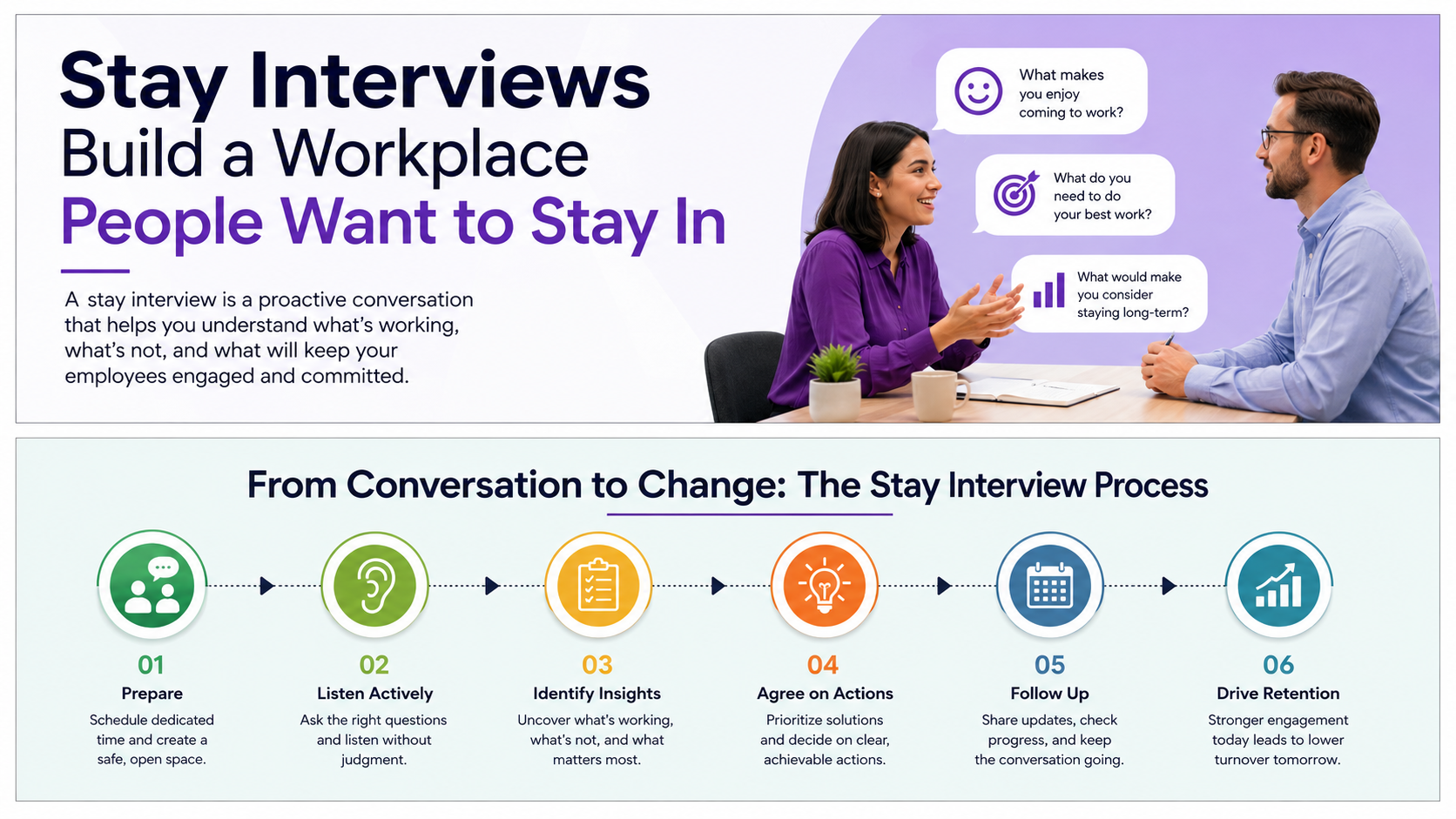
A stay interview is a structured one-to-one conversation that helps managers understand why an employee stays, what makes their work difficult and what could eventually push them to leave. According to SHRM’s guidance on stay interviews, these conversations should be led by the employee’s manager and focused on actions that can strengthen engagement and retention.
However, asking questions is only one part of the process.
A stay interview without follow-through can do more damage than no interview at all. Employees quickly notice when managers listen, take notes and then do nothing. As a result, they stop raising concerns and start looking elsewhere.
Therefore, this stay interview template includes four things managers need:
- Practical stay interview questions
- Clear manager guidance
- Employee retention risk signals
- A structured action tracker
The goal is not to create another HR form. Instead, the goal is to help managers act before avoidable turnover affects productivity, team morale and business continuity.
Why a Stay Interview Template Matters at the Organisational Level
Employee retention is not simply an HR metric. In practice, it affects almost every part of the business.
When experienced employees leave, organisations lose knowledge, customer relationships and team stability. At the same time, managers spend more time recruiting, onboarding and redistributing work. Consequently, remaining employees carry additional pressure, projects slow down and collaboration becomes harder.
The CIPD employee turnover and retention factsheet highlights that employee turnover can negatively affect organisational performance. It also recommends understanding why people leave so that employers can develop focused retention practices.
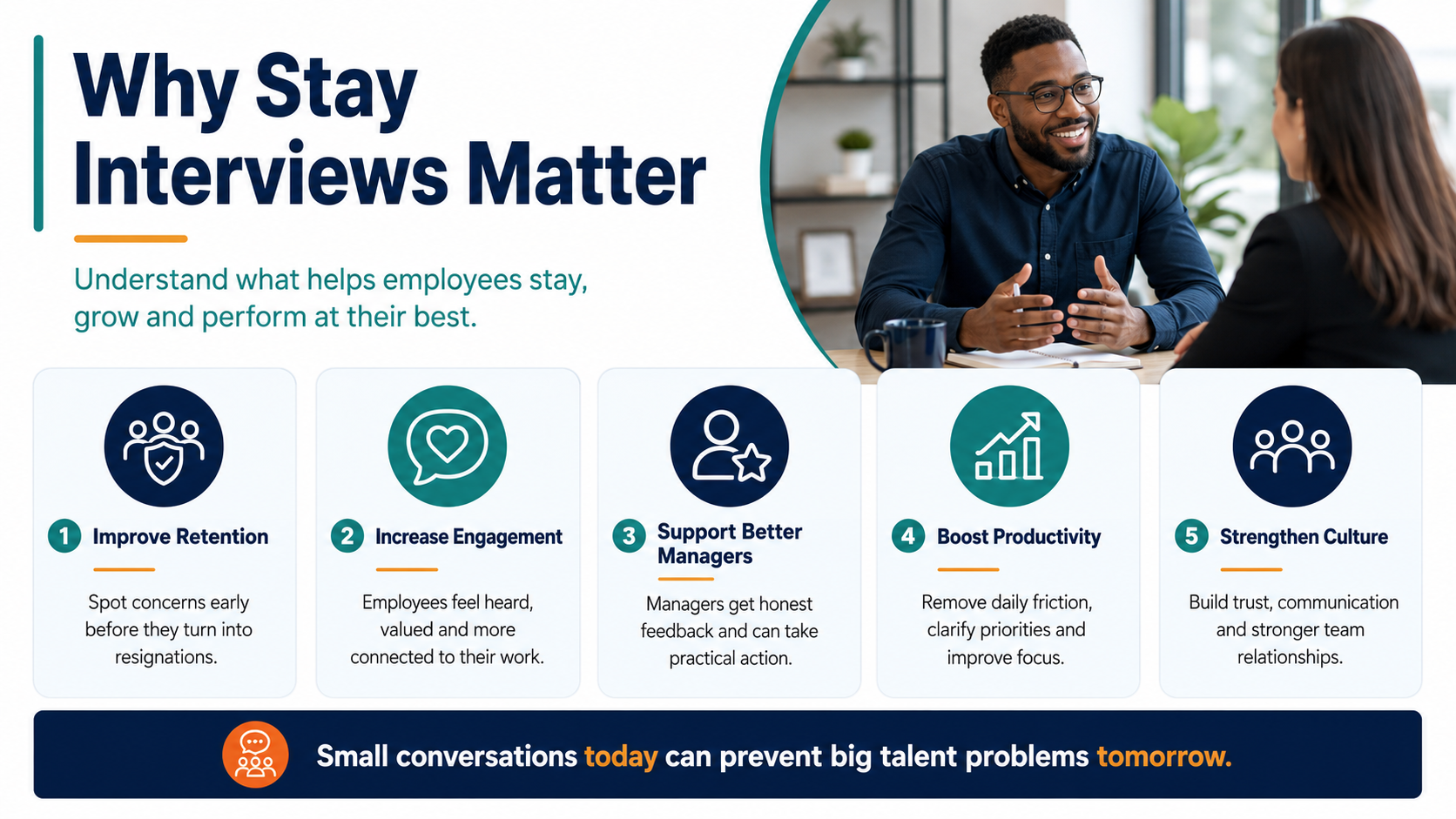
A practical stay interview process can help organisations improve:
Employee retention
Managers can identify concerns while those concerns are still manageable. For example, an employee may not need a promotion immediately. However, they may need a clear development path and evidence that their career is moving forward.
Productivity
Employees perform better when expectations are clear, processes work and managers remove unnecessary obstacles. Therefore, stay interviews should examine not only how an employee feels, but also what makes good work difficult.
Employee engagement
Stay interviews create space for regular, meaningful conversations about recognition, strengths, development and support. Gallup reports that engaged teams are associated with stronger productivity, profitability, retention and customer outcomes. It also states that managers account for a significant share of the differences in team engagement. Read Gallup’s employee engagement guidance.
Leadership effectiveness
A stay interview gives managers direct feedback about how their behaviour affects the team. Although this can be uncomfortable, it is often more useful than another management training presentation.
Team collaboration
When role confusion, uneven workloads or poor cross-team communication remain unresolved, frustration grows. Therefore, stay interviews can reveal operational problems that may not appear in engagement survey scores.
What we think is simple: retention problems are rarely created by one dramatic incident. More often, they grow through small frustrations that repeat every week.
The Research Model Behind This Stay Interview Template
For this stay interview template, we have used the Job Demands-Resources Model, commonly known as the JD-R Model.
The model was selected from the research frameworks listed in the reference document, which also includes Self-Determination Theory, Psychological Safety, the Job Characteristics Model and the Three-Component Model of Commitment.
Why we chose the Job Demands-Resources Model
The JD-R Model is particularly relevant because it organises the employee experience into two practical areas:
Job demands are the parts of work that require sustained physical, mental or emotional effort.
Examples include:
- Excessive workload
- Conflicting priorities
- Emotional pressure
- Difficult systems
- Staffing shortages
- Unclear responsibilities
- Poor work-life boundaries
- Repeated interruptions
- Unnecessary approval processes
Job resources are the conditions that help employees perform, grow and manage those demands.
Examples include:
- Manager support
- Clear priorities
- Autonomy
- Recognition
- Useful feedback
- Reliable technology
- Development opportunities
- Adequate staffing
- Access to information
- Supportive colleagues
The original research behind the model found that job demands were primarily connected with exhaustion, while a lack of job resources was connected with disengagement. Review the Job Demands-Resources research on PubMed.
Therefore, instead of asking the employee a vague question such as “Are you happy here?”, the JD-R Model encourages managers to ask:
- What is placing unnecessary pressure on this employee?
- What support is missing?
- What resources should be protected?
- What can the manager change?
- What requires organisational action?
This is why the model works well for stay interviews. It turns a general conversation into a practical workplace diagnosis.
How Managers Should Use This Stay Interview Template
A stay interview should not feel like an investigation. At the same time, it should not become an informal conversation with no outcome.
Therefore, managers should use this template as a conversation guide rather than reading every question like a script.
The recommended duration is 30 to 45 minutes. Moreover, the meeting should be kept separate from:
- Performance reviews
- Salary discussions
- Promotion decisions
- Disciplinary conversations
- Project status meetings
Employees are more likely to speak honestly when they believe they will not be punished, embarrassed or treated differently for raising a concern. The Center for Creative Leadership explains psychological safety as the belief that people can raise questions, concerns, ideas and mistakes without fear of humiliation or punishment.
However, managers should not promise complete confidentiality. Concerns involving harassment, discrimination, safety, misconduct or legal risk may need to be escalated.
Copy-Paste Stay Interview Template
1. Stay Interview Details
Employee name: ____________________________________
Job title: __________________________________________
Department or location: ______________________________
Manager: ___________________________________________
Interview date: ______________________________________
Employee tenure: ____________________________________
Previous stay interview date: __________________________
Scheduled follow-up date: _____________________________
Recommended duration: 30 to 45 minutes
2. Manager Opening Script
Thank you for taking the time to meet with me. This is not a performance review or a discussion about ratings.
I want to understand what is working well for you, what is making your job more difficult and what we can improve to make this a place where you can continue doing good work.
I may not be able to approve every request. However, I will be honest about what can be changed, what needs further discussion and what may not be possible. Before we finish, we will agree on specific follow-up actions.
Stay Interview Questions About Why Employees Stay
Question 1: What do you look forward to when you come to work?
Manager prompts
- Which tasks give you the most energy?
- Which people or relationships make work better?
- What makes a workday feel successful?
- When do you feel most involved in your work?
Listen for
- Meaningful work
- Positive team relationships
- Customer impact
- Autonomy
- Learning opportunities
- Recognition
- Flexibility
Retention risk signals
- “Nothing in particular.”
- “I am just completing my work.”
- “I used to enjoy the role more.”
- The employee cannot identify any positive part of the job.
- The employee speaks only about salary or job security.
Question 2: What is the main reason you have stayed with the organisation?
Manager prompts
- Has that reason changed over time?
- What should we make sure we do not lose?
- What would make that reason less important?
- Is the organisation currently protecting what matters to you?
This question identifies the employee’s retention anchors. However, managers should not assume that everyone stays for the same reason.
One employee may value stability. Meanwhile, another may stay because of flexibility, relationships, meaningful work, career growth or a supportive manager.
Primary reason for staying:
How well are we protecting it?
☐ Strongly
☐ Partly
☐ At risk
Question 3: When have you felt most valued here?
Manager prompts
- What happened?
- Who was involved?
- What type of recognition matters most to you?
- Do you receive enough useful feedback?
- How would you prefer your work to be recognised?
Retention risk signals
- The employee cannot remember being recognised.
- Recognition happens only during annual reviews.
- Strong performance results only in additional work.
- Recognition appears inconsistent or unfair.
- The same employees repeatedly receive visibility.
Recognition does not always require a formal reward. Nevertheless, employees need to know that their work is noticed, understood and valued.
Stay Interview Questions About Workload and Workplace Friction
Question 4: What part of your job regularly drains your time or energy?
Manager prompts
- Is the problem related to workload, process, technology or coordination?
- How often does it happen?
- What is the effect on your work?
- Who else is affected?
- What have you already tried?
Examples to examine
- Repetitive manual work
- Unnecessary approvals
- Conflicting priorities
- Understaffing
- Difficult customer interactions
- Poor scheduling
- Unclear ownership
- Too many communication channels
- Repeated follow-ups for basic information
Managers should not dismiss a frustration because it appears small. In fact, minor problems become serious retention risks when employees experience them every day.
Question 5: Where does your workload feel unrealistic or difficult to sustain?
Manager prompts
- Which deadlines are difficult to meet?
- What work is being added without anything being removed?
- Are priorities clear when everything feels urgent?
- How often are you working beyond normal expectations?
- Which responsibilities should be reconsidered?
High-risk responses
- “I cannot switch off.”
- “I am constantly covering for other people.”
- “The workload is not sustainable.”
- “I have stopped raising it because nothing changes.”
- “I am worried that saying no will affect my career.”
- “I am doing the work of two roles.”
The World Health Organization describes burnout as an occupational phenomenon resulting from chronic workplace stress that has not been successfully managed. Read the WHO guidance on workplace burnout.
Therefore, repeated comments about exhaustion should not be treated as a personal time-management problem without examining workload, staffing and management practices.
Question 6: What workplace obstacle makes it harder for you to do good work?
Manager prompts
- What would remove or reduce that obstacle?
- Is this within the team’s control?
- Who else is affected?
- What would improve if the problem were fixed?
- What is the smallest practical improvement we can make?
Obstacle category
☐ Process
☐ Technology
☐ Staffing
☐ Role clarity
☐ Communication
☐ Decision-making
☐ Cross-team coordination
☐ Other: __________________
This question is especially useful at the organisational level. For example, when several employees mention the same approval delay or system limitation, the issue is no longer an individual complaint. Instead, it is a business process problem.
Stay Interview Questions About Manager Support
Question 7: What support do you need from me that you are not receiving today?
Manager prompts
- Do you need clearer priorities?
- Do you need more frequent feedback?
- Are decisions taking too long?
- Do you need greater autonomy?
- Do you need help managing stakeholders?
- Do you need better access to information?
Managers should avoid explaining their intentions before understanding the employee’s experience.
“I thought I was supporting you” may be an honest reaction. However, it does not solve the problem.
A better response is:
Tell me more about where the support is missing and what better support would look like.
Question 8: Do you have enough authority, information and tools to perform your role well?
| Area | Yes | Partly | No |
|---|---|---|---|
| Clear responsibilities | ☐ | ☐ | ☐ |
| Authority to make decisions | ☐ | ☐ | ☐ |
| Access to information | ☐ | ☐ | ☐ |
| Reliable tools and technology | ☐ | ☐ | ☐ |
| Adequate staffing or support | ☐ | ☐ | ☐ |
| Clear priorities | ☐ | ☐ | ☐ |
| Manager availability | ☐ | ☐ | ☐ |
Most important resource gap:
This section connects directly with the Job Demands-Resources Model. Therefore, managers should look for resources that can reduce pressure and improve the employee’s ability to perform.
Question 9: Is there anything about my management style that makes your job harder?
Manager prompts
- Are my expectations clear?
- Do I involve you in decisions that affect your work?
- Do I give feedback at the right time?
- Do I create unnecessary delays?
- Is there anything you hesitate to discuss with me?
- What is one thing I could do differently?
Manager guidance
Do not defend yourself.
Do not debate the employee’s example.
Instead:
- Ask for clarification.
- Summarise what you heard.
- Thank the employee for being direct.
- Agree on one behaviour you can change.
- Review that change during the follow-up meeting.
A defensive manager can turn an honest answer into the employee’s last honest answer.
Stay Interview Questions About Career Growth
Question 10: Which of your strengths or skills are currently underused?
Manager prompts
- What work would you like greater exposure to?
- What responsibility are you ready to take on?
- Is there a project where this strength could be used?
- What would you like to become known for?
- Which skills would you like to practise more often?
Possible actions
- Project ownership
- Mentoring
- Cross-functional assignments
- Job shadowing
- Training
- Presentations
- Process improvement work
- Leadership exposure
Employees do not always need a new job title. Sometimes, they need an opportunity to contribute beyond the narrow limits of their current role.
Question 11: What would meaningful growth look like during the next 12 months?
Manager prompts
- Does growth mean promotion, a new skill or broader responsibility?
- What experience do you need?
- What support would help?
- What could block your progress?
- What can we begin within the next 30 days?
Retention risk signals
- No development discussion has taken place for a long time.
- The employee sees no realistic internal career path.
- Opportunities repeatedly go to the same people.
- The employee has stopped asking for development.
- Training is offered, but employees cannot apply what they learn.
- Career decisions appear unclear or inconsistent.
In our view, vague promises about future opportunities are not development plans. Therefore, every growth discussion should end with a practical next step.
Stay Interview Questions About Retention Risk
Question 12: What could make you seriously consider leaving this organisation?
Manager prompts
- Is that issue present today?
- How serious is it?
- Has it become better or worse recently?
- What would need to change?
- When would you expect to see progress?
Managers should not react emotionally to this question.
Instead, they should recognise that the employee is sharing information that many organisations receive only during an exit interview.
Question 13: What is one change that would make the biggest positive difference to your experience?
Manager prompts
- Why would that change matter?
- Is there a smaller first step?
- Who needs to be involved?
- What would progress look like within 30 days?
- How would the change affect your work?
Employee’s priority change:
Managers should not leave the meeting with ten vague suggestions. Instead, they should identify the one or two changes that matter most.
Question 14: Is there anything important that I have not asked?
Manager prompts
- Is there something you expected us to discuss?
- Is there a concern you have avoided raising?
- What should senior leadership understand about your experience?
- What should we discuss again during the follow-up?
This final question often produces the most useful response. Therefore, managers should allow a few seconds of silence rather than rushing to end the meeting.
Stay Interview Risk Signals Managers Should Track
One negative comment does not automatically mean that an employee is about to leave. However, managers should assess patterns across the full conversation.
Risk status should never be treated as a performance rating. It should also not be shared casually.
Green: Currently Stable
Typical signals include:
- The employee identifies clear reasons for staying.
- Work remains meaningful.
- The manager relationship is constructive.
- Workload is demanding but manageable.
- The employee can see development opportunities.
- Concerns are specific and solvable.
- The employee believes action will be taken.
Manager response: Protect the employee’s strongest retention factors and complete the agreed improvements.
Amber: Emerging Retention Risk
Typical signals include:
- Motivation has declined.
- Workload is becoming difficult to sustain.
- Career progression feels unclear.
- Recognition is inconsistent.
- Frustrations have been raised before without resolution.
- The employee feels underused.
- Trust in leadership is weakening.
- The employee uses phrases such as “for now” or “I will see how things go.”
Manager response: Create a documented 30-day action plan and schedule a follow-up within four to six weeks.
Red: Immediate Retention Risk
Typical signals include:
- The employee directly mentions looking for another role.
- The employee sees no future in the organisation.
- Burnout, exhaustion or persistent overload is evident.
- Trust in the manager or organisation has broken down.
- A critical concern has repeatedly been ignored.
- The employee has emotionally withdrawn.
- An external opportunity is specifically mentioned.
- The employee believes unfair treatment cannot be corrected.
Manager response: Involve HR promptly, determine what can realistically be addressed and avoid making promises that cannot be kept.
Overall retention status
☐ Green
☐ Amber
☐ Red
Evidence supporting this assessment:
Stay Interview Action Tracker
Every stay interview should end with no more than three clear commitments.
A long action list may look thorough. However, it usually means that very little will be completed.
| Priority issue | Agreed action | Owner | Due date | Success measure | Status |
|---|---|---|---|---|---|
| 1. | Not started | ||||
| 2. | Not started | ||||
| 3. | Not started |
Action categories
☐ Manager can resolve directly
☐ Requires HR support
☐ Requires senior leadership decision
☐ Requires policy review
☐ Requires budget approval
☐ Cannot currently be changed
☐ Further investigation required
When an action cannot be approved, the manager should still explain the reason and discuss a realistic alternative.
At HubEngage, we believe that employee listening becomes valuable only when organisations close the loop. Digital workplace tools can help HR teams distribute manager guidance, record themes and track agreed actions. However, the conversation itself must remain personal, honest and manager-led.
Manager Closing Script
Thank you for being honest. The main points I heard were:
We have agreed that I will:
I will update you by __________________, even if the final decision has not yet been made.
We will meet again on __________________ to review progress.
Manager Guidance Before, During and After a Stay Interview
Before the stay interview
- Schedule uninterrupted time.
- Review previous commitments.
- Choose a private setting.
- Keep the meeting separate from performance feedback.
- Prepare to hear criticism without becoming defensive.
- Understand which decisions you can make independently.
- Review any recent changes affecting the employee’s work.
During the stay interview
- Listen more than you speak.
- Ask for examples instead of making assumptions.
- Separate the employee’s experience from your intention.
- Do not pressure the employee to disclose personal information.
- Do not immediately try to solve every issue.
- Clarify what the employee needs before suggesting a solution.
- Document themes and commitments rather than every personal comment.
After the stay interview
- Send a short written summary of agreed actions.
- Complete at least one visible action quickly.
- Escalate serious issues through the correct process.
- Provide updates even when progress is slow.
- Revisit the conversation on the agreed date.
- Track recurring team themes without exposing individual employees.
Common Stay Interview Mistakes
Treating the stay interview like an engagement survey
A stay interview is a conversation. Therefore, reading questions without asking follow-up questions will produce safe and shallow answers.
Asking only high-performing employees
Selective interviews create suspicion and leave major risks hidden. Instead, use a consistent process across the workforce or clearly defined employee groups.
Waiting until resignations increase
Once resignations rise, the organisation is reacting to a pattern that should have been noticed earlier.
Making promises about promotions or pay
Managers should not commit to decisions they cannot approve. False hope damages trust faster than an honest limitation.
Ignoring operational frustrations
Employees experience work through systems, schedules, approvals, meetings and manager behaviour. Therefore, a strong company strategy cannot compensate for constant daily friction.
Failing to close the loop
Silence after a stay interview tells the employee that speaking honestly was pointless.
Recommended Stay Interview Schedule
The following schedule is a practical recommendation rather than a rigid policy.
| Employee situation | Recommended timing |
|---|---|
| New employee | Between 60 and 90 days |
| Established employee | Every six months |
| Critical or difficult-to-replace role | Quarterly |
| Following a manager or organisational change | Within 30 to 60 days |
| Following signs of disengagement | As soon as practical |
| After a major action plan | Follow up within 30 to 45 days |
Stay interviews should not replace regular one-to-one meetings. Instead, they provide a deeper retention conversation that status meetings rarely create.
How HR Leaders Can Implement This Stay Interview Template
Before launching the stay interview process, HR should confirm that:
☐ Managers have received basic conversation training.
☐ Employees understand the purpose of the interview.
☐ Interviews are separate from performance assessments.
☐ A consistent stay interview template is available.
☐ Managers know how to escalate serious concerns.
☐ Action owners and deadlines are recorded.
☐ Follow-up meetings are mandatory.
☐ Common themes are reviewed at the department level.
☐ Employee identities are protected in leadership reporting.
☐ Senior leaders are prepared to act on recurring issues.
In addition, HR should review organisation-wide patterns every quarter.
For example, if employees across several teams mention unclear priorities, the problem may sit above the manager level. Similarly, if development opportunities repeatedly appear as an amber or red risk, leadership may need to review internal mobility, manager capability or workforce planning.
Therefore, the real value of stay interviews comes from combining individual action with organisational learning.
Final Thoughts on Using a Stay Interview Template
The purpose of a stay interview is not to convince every employee to remain forever.
Instead, it helps the organisation understand the employee experience early enough to make an informed decision.
Some employees need clearer priorities. Others need relief from unsustainable demands. Meanwhile, some may need recognition, development, better tools or stronger manager support.
In some cases, an employee may have reached the natural end of their journey with the organisation. That is also useful information.
A strong stay interview template does not guarantee retention. However, it helps prevent good employees from leaving because of problems that the organisation never took the time to understand.
Most importantly, managers should remember one simple point:
Do not ask employees what needs to change unless the organisation is prepared to respond.