Most advice treats employee experience and workforce experience as interchangeable. That sounds tidy, but it leads companies to measure sentiment while missing the systems that shape whether people can do their jobs well.
That distinction matters because the stakes are huge. Low employee engagement costs the global economy US$8.8 trillion annually, equal to 9% of global GDP, according to Gallup data summarized by AIHR. If leaders keep treating experience as mainly an HR listening exercise, they leave a large operational blind spot untouched.
For office-based knowledge workers, that blind spot can look like tool sprawl, slow support, or poor manager communication. For distributed and frontline organizations, it’s larger. Scheduling, mobile access, task execution, and message reach often determine whether people feel supported at all. That’s why the discussion increasingly needs to move beyond employee journey design and toward the broader operating reality captured in frontline enablement.
Key Takeaways
- Employee experience tracks the human journey. It usually focuses on perception, culture, and lifecycle moments such as onboarding, development, and retention.
- Workforce experience adds the operating layer. It includes communication channels, digital tools, support flows, task execution, and the realities of frontline and distributed work.
- The measurement model changes. EX commonly uses eNPS and retention. WX adds workflow completion, tool satisfaction, and support ticket patterns to find friction in daily work.
- Frontline-heavy organizations need WX more than terminology debates. If most workers are mobile, deskless, or shift-based, sentiment alone won’t explain performance problems.
- The smartest shift isn’t abandoning EX. It’s treating EX as one part of a broader workforce system that connects engagement, technology, communications, AI, and operations.
The Trillion-Dollar Blind Spot in Employee Experience
Employee experience became popular because it gave leaders a human-centered way to talk about work. It also encouraged investment in culture, onboarding, development, and manager quality. That was progress. But the model has a limit. In practice, many EX programs still measure perception more consistently than they measure whether the work itself is well designed.
That gap matters because business performance is shaped by operating conditions, not sentiment alone.
Where the blind spot appears
A worker can value the company, trust their manager, and still lose productive time every shift because the schedule changes late, messages arrive across too many channels, or the task system is hard to use on a mobile device. In that environment, survey scores describe the outcome after friction has already affected execution. They do not identify the source of the friction with enough precision to fix it.
The cost is not theoretical. Low employee engagement costs the global economy US$8.8 trillion annually, equal to 9% of global GDP, according to Gallup data summarized by AIHR. Yet engagement is only one layer of the problem. If an organization improves sentiment while leaving broken workflows, weak communication paths, and poor digital access in place, it has treated a performance issue as a morale issue.
Frontline and distributed organizations feel this problem first. A desk-based employee can often work around bad systems. A shift worker, field technician, nurse, or store associate usually cannot. If the message does not reach them, if the app fails at clock-in, or if support is slow, the operational failure is immediate. That is why the broader discussion around frontline enablement for distributed teams matters here. It addresses whether people can do the job under real conditions, not just whether they feel positive about the employer brand.
Why the language matters
This is a model choice with budget implications.
When organizations frame the problem as EX alone, ownership often stays concentrated in HR. The response then tilts toward listening programs, recognition, manager coaching, and lifecycle design. Those interventions can improve retention and morale. They are less effective when the main barrier sits in fragmented communications, poor tool adoption, identity and access problems, inconsistent scheduling, or support processes that slow daily work.
Workforce Experience starts from a broader assumption. Experience is shaped by culture, but also by systems, channels, policies, and operating design. That makes WX a better fit for modern organizations where large parts of the workforce are mobile, deskless, outsourced, part-time, or spread across sites. In those settings, the blind spot in EX is not semantic. It can hide millions in lost productivity, preventable turnover, and uneven execution.
Understanding Employee Experience: EX
Employee experience, or EX, usually refers to how a person perceives their relationship with the organization across the employee lifecycle. It covers the moments people remember most clearly. Hiring, onboarding, manager interactions, learning, recognition, promotion, and exit all sit inside that frame.

That focus is valuable because perception shapes commitment. Employees who report a positive experience have 16 times the engagement of those with a negative experience, and they are eight times more likely to want to stay, according to McKinsey.
What EX is trying to improve
In practice, EX tries to answer questions like these:
- Do employees feel supported: by managers, peers, and leadership?
- Do career moments feel fair: including growth, recognition, and internal mobility?
- Does the culture match the promise: made during hiring and onboarding?
- Would employees recommend the organization: as a place to work?
These are the issues most often explored in employee experience coverage, and for good reason. They influence engagement, retention, and employer reputation.
How EX is usually measured
EX tends to rely on indicators that reflect sentiment and long-term commitment.
Practical rule: EX tells you whether people believe the organization is a good place to work.
Common EX measures include:
- eNPS: A quick signal of advocacy and loyalty.
- Retention rates: A lagging indicator of whether people choose to stay.
- Intent to stay: Useful when leaders want an earlier read than turnover alone.
- Lifecycle feedback: Onboarding, manager effectiveness, and engagement surveys.
EX is strongest when the goal is to improve culture and trust. It becomes weaker when leaders need to diagnose why work feels harder than it should.
Defining Workforce Experience: WX
Workforce experience, or WX, starts from a different premise. Work is not just a journey through moments that matter. It’s also a stream of tasks, communications, decisions, handoffs, tools, and support interactions that either help people perform or slow them down.
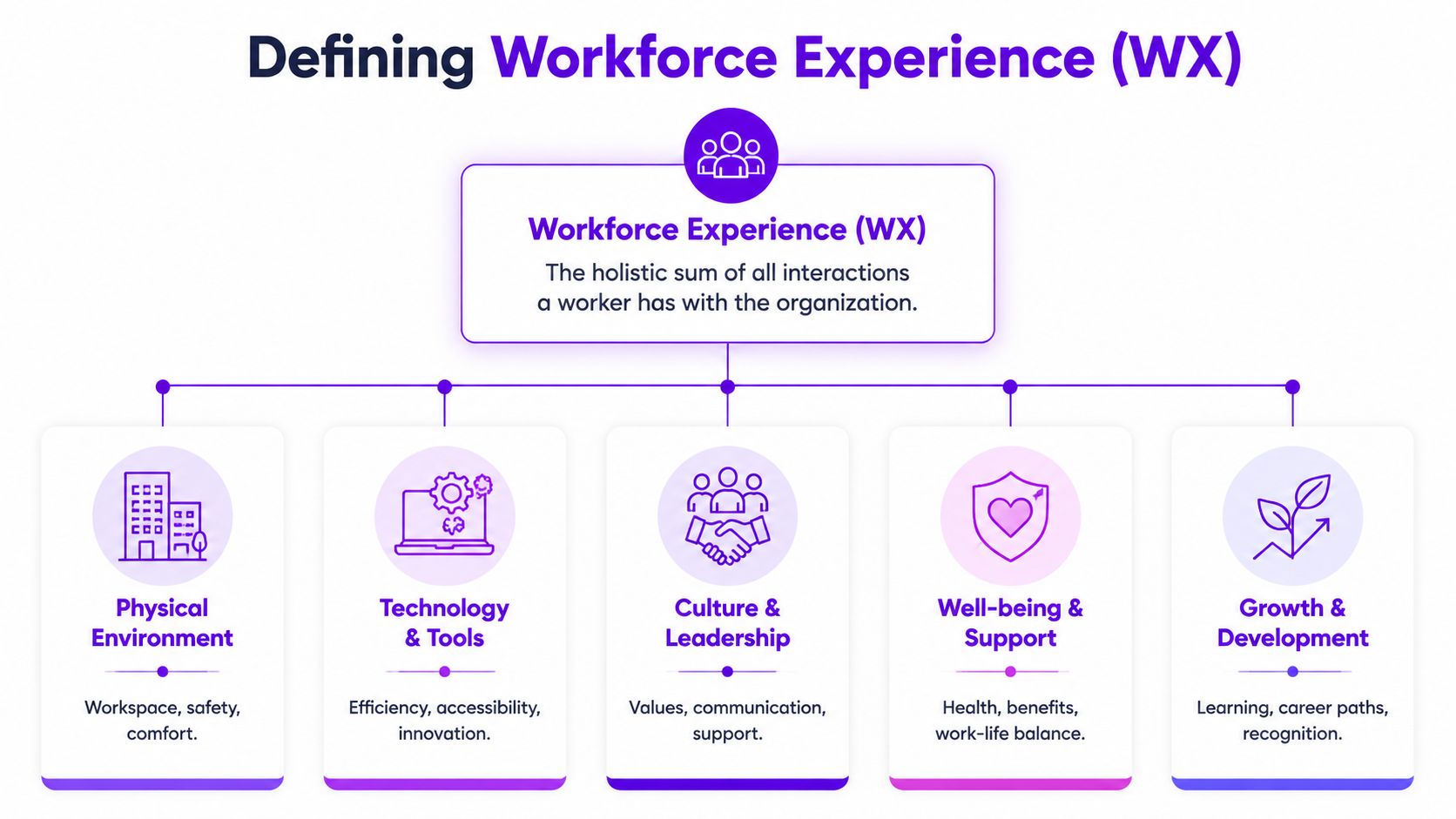
WX includes EX, but it doesn’t stop there. It covers the operational environment people depend on every day. That means messaging systems, scheduling, mobile access, learning delivery, digital tools, service support, workflow design, and the policies that determine how quickly someone can get something done.
A useful way to think about WX is through the lens of workforce experience as a discipline. It sits at the intersection of employee engagement, internal communications, HR technology, AI, frontline enablement, and workforce operations.
Why WX is broader than EX
EX usually assumes a traditional employee relationship. WX covers a broader labor reality. In many organizations, the people doing critical work include full-time employees, contractors, contingent staff, field teams, and shift-based workers who may never sit at a desk.
WX also changes the central question.
- EX asks, How do people feel about working here?
- WX asks, How do people feel, and how easily can they do the work?
That second question matters because operational friction becomes part of the experience itself. A missed alert, a clumsy mobile workflow, or a broken knowledge handoff doesn’t just reduce efficiency. It changes whether work feels manageable.
What WX pays attention to
WX treats several domains as inseparable:
- Communication reach and clarity. Can every worker receive, access, and act on information?
- Technology usability. Do tools reduce effort or create avoidable steps?
- Task execution. Can workers complete common workflows without support delays?
- Operational support. Are ticketing, service, and escalation paths responsive?
- Workforce inclusion. Does the system work for deskless, distributed, and nontraditional worker groups?
WX is the model you need when good intentions in HR collide with bad execution in operations.
That’s why WX is less a new buzzword than a more complete management lens.
EX vs. WX: A Direct Comparison
The cleanest way to understand employee experience vs workforce experience is to compare what each one is designed to see.
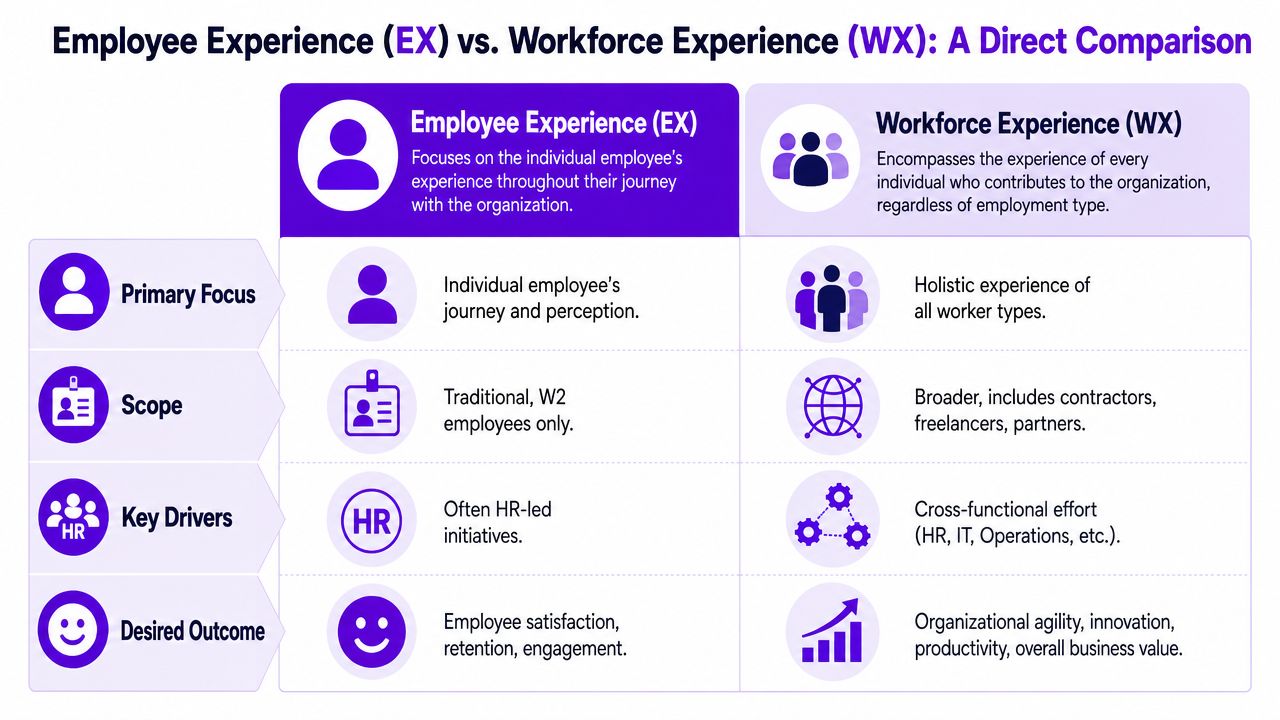
| Criterion | Employee Experience (EX) | Workforce Experience (WX) |
|---|---|---|
| Primary focus | Employee journey and perception | Journey plus execution environment |
| Core question | Do employees feel supported, valued, and engaged? | Can the workforce do great work with minimal friction? |
| Population | Usually employees | Employees plus broader worker groups where relevant |
| Main owner | Mostly HR | HR, IT, internal communications, and operations |
| Typical metrics | eNPS, retention, intent to stay | Workflow completion, tool satisfaction, support ticket patterns |
| Best use case | Culture, engagement, retention strategy | Frontline enablement, digital friction reduction, execution quality |
| Common failure mode | Measures sentiment but misses operational blockers | Can become too tool-centric if it ignores human factors |
The metric difference is the real difference
One of the strongest distinctions is measurement. EX is measured with eNPS and retention rates, while WFX focuses on workflow completion rates, tool satisfaction scores, and frequency of support tickets to identify daily friction, according to Moveworks’ explanation of employee and workforce metrics.
That difference changes what leaders can act on. If eNPS drops, leaders know there’s a perception problem. If workflow completion slows and support tickets spike, leaders can trace the issue to a broken process, fragmented toolset, or poor digital access.
A practical example
Consider onboarding.
An EX lens asks whether a new hire felt welcomed, understood the culture, and had a good manager check-in. A WX lens asks those questions too, but it also asks whether the worker got system access quickly, could find training on mobile, knew where to ask for help, and could complete core tasks without a workaround.
A strong EX program can tell you people are frustrated. A strong WX program can tell you where the friction lives.
When to use each term
Use employee experience when the discussion is primarily about:
- Lifecycle design
- Engagement and belonging
- Manager quality
- Retention and culture
Use workforce experience when the discussion includes:
- Frontline or deskless work
- Digital tool performance
- Internal communication effectiveness
- Workflow reliability
- Cross-functional execution between HR, IT, and operations
For organizations dealing with mobile workers, complex scheduling, or fragmented systems, workforce operations is not a side topic. It’s part of the experience itself.
Why an EX Focus Is No Longer Enough
EX became popular in an era when many experience programs were designed around office employees. That history still shows up in how organizations measure and improve it.
The biggest issue is coverage. A substantial share of the global workforce is frontline or deskless, yet EX strategies often fail to fit their reality.
Why frontline reality breaks the EX model
Deskless workers don’t experience the company mainly through career sites, office design, and desktop collaboration tools. They experience it through shift changes, device access, training availability, schedule clarity, supervisor communication, and whether information reaches them in time to act.
That means an EX-only approach often overweights survey sentiment and underweights execution.
- A retail associate may say communication is poor because updates arrive late or in the wrong channel.
- A healthcare worker may feel unsupported because mobile task access is cumbersome during a shift.
- A field technician may blame leadership when the underlying issue is fragmented tools and delayed support.
These are experience problems. But they are also operational problems.
The blind spot is organizational, not only analytical
Many companies assign EX to HR, digital workplace to IT, and task execution to operations. Each team sees one piece of the puzzle. Workers live inside all of them at once.
If a frontline worker can’t access training, misses a shift update, and waits on support for a broken app, that isn’t three separate issues. It’s one broken workforce experience.
This is why EX alone is no longer enough for frontline-heavy and operations-heavy organizations. It can identify dissatisfaction, but it often lacks the operating model to fix it.
The narrowness shows up in decision-making
An EX program might recommend more manager communication. A WX approach might identify that the communication platform itself doesn’t reach workers consistently, or that messages aren’t accessible when workers are offline, or that task instructions are disconnected from the message channel.
Those distinctions matter because they lead to different investments. One improves sentiment around the edges. The other removes friction from work itself.
How to Build a Unified Workforce Experience Strategy
A workable WX strategy doesn’t start with a rebrand. It starts with governance. Someone has to own the connections between HR, IT, communications, and operations.
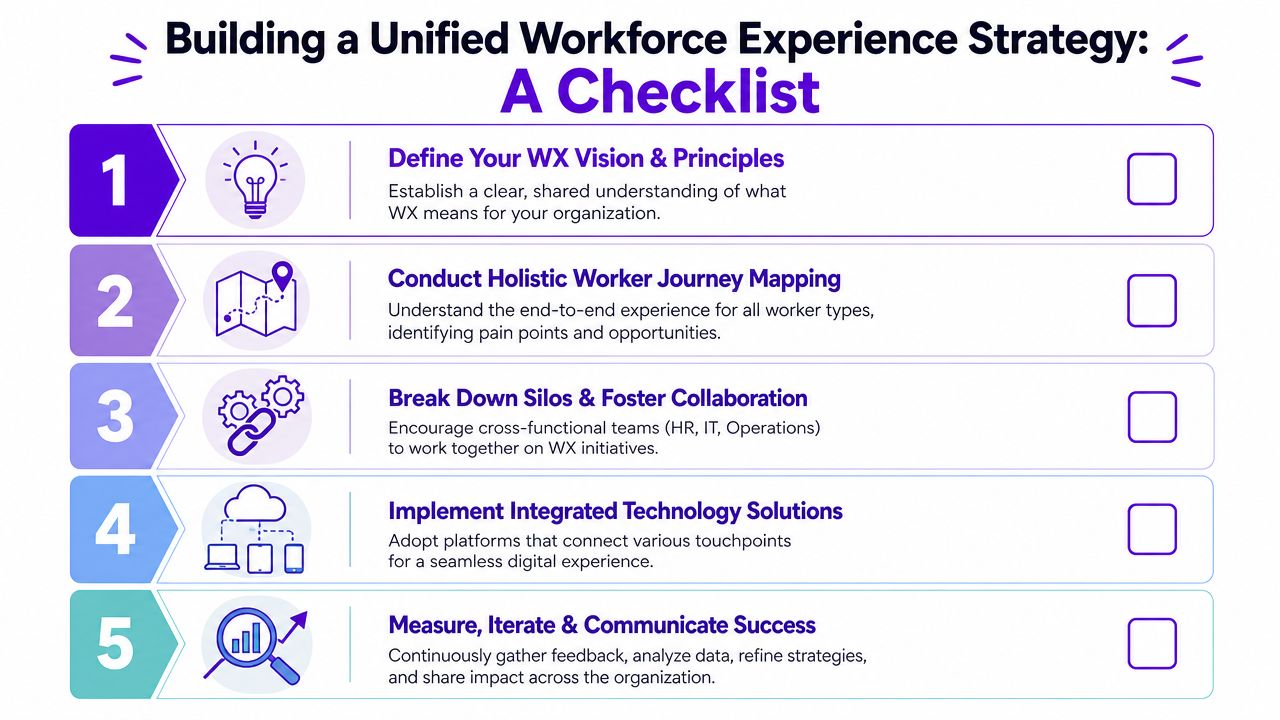
Five moves that make WX real
- Map the actual work journey
Don’t stop at lifecycle stages. Track what workers must do, what tools they use, where communication arrives, and where delays happen. Include deskless and distributed roles, not just headquarters functions. - Unify ownership across functions
HR can’t fix digital friction alone. IT can’t solve adoption without communications. Operations can’t improve execution if workers can’t access information. A useful WX program usually needs shared goals and a common review rhythm. - Measure both sentiment and friction
Keep EX indicators, but add operational ones. Look at workflow completion, tool satisfaction, support demand, and recurring breakdowns in task execution. - Design for the least-connected worker
If a platform works only for laptop users with stable connectivity, it won’t support a large portion of the workforce in many industries. - Use AI where it improves action, not just reporting
AI is most useful when it shortens response time, routes knowledge better, automates routine service, and flags risk before workers disengage.
Why AI matters in WX
AI is most useful in WX when it shortens response time, routes knowledge better, automates routine service, and flags retention risk earlier than an annual survey. Waiting for yearly feedback is too slow when daily friction is already driving attrition or poor execution.
A short self-check
Ask these questions:
- Can every worker receive and access key communications?
- Do our tools reduce effort or multiply logins, clicks, and support requests?
- Can frontline staff learn, ask questions, and complete tasks from the devices they use?
- Do HR, IT, and operations review the same experience signals together?
If the answer is no to several of those, a workforce experience platform is only part of the answer. The deeper need is a shared operating model.
Employee Experience vs Workforce Experience FAQs
Is workforce experience just a new name for employee experience
No. Workforce experience is broader. It includes employee experience, but also covers the systems, channels, and workflows people depend on to get work done. The distinction becomes especially useful in frontline, deskless, and distributed environments.
Which term should a company use internally
Use employee experience when the focus is culture, engagement, retention, and lifecycle design. Use workforce experience when leaders need a cross-functional frame that includes communications, tools, support, and operational execution.
Can a company have strong EX and weak WX
Yes. A company can invest in culture, surveys, and manager training while still forcing workers through fragmented tools and unreliable workflows. In that case, people may like the organization but still struggle to perform.
Is digital employee experience the same as workforce experience
Not quite. Digital employee experience usually focuses on technology interactions, especially for digital tools and devices. Workforce experience is broader because it connects technology with communication, support, operations, and the realities of different worker types.
What’s the first practical step toward a WX model
Start by mapping one high-friction workflow for one worker group. For example, onboarding a frontline hire, completing a shift handoff, or accessing training from a mobile device. If leaders can see where communication, tool access, and support break down in one workflow, the case for a workforce experience model becomes concrete fast.
If you want more analysis on workforce experience, internal communications, frontline enablement, and HR technology, explore more from Turn On Work.